OCR · A-Level · Psychology
Chaney et al. (2004) - Funhaler
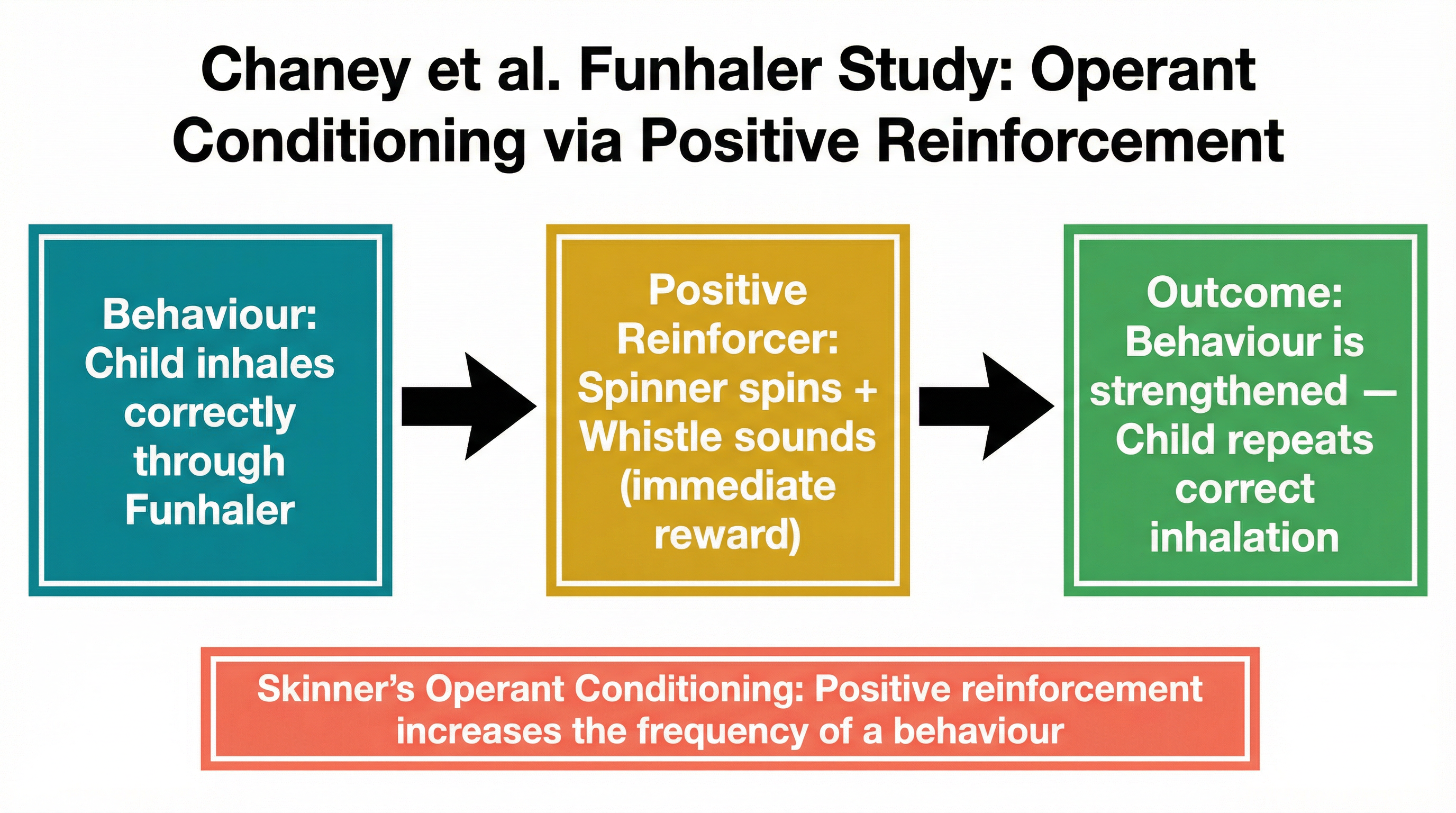
Chaney et al. (2004) provides crucial evidence for the power of Operant Conditioning in a real-world health setting. This study demonstrates how simple, fun-based incentives can significantly improve medical adherence in young children, offering a practical solution to a serious clinical problem and serving as a key contemporary study for OCR A-Level Psychology.
- 4 min read
- 3 worked examples
- 3 practice questions
- 6 key terms
Study Notes

Overview
Chaney, C. J., Mullins, L. L., & Uretsky, D. L. (2004) is a contemporary study within the developmental psychology component of the OCR A-Level specification. It investigates external influences on children's behaviour, specifically focusing on how principles of Operant Conditioning can be applied to improve compliance with asthma medication. The study introduces the 'Funhaler', a novel spacer device that incorporates incentive toys (a spinner and a whistle) to provide immediate positive reinforcement for correct inhalation technique. Examiners expect candidates to understand this study as a modern application of Skinnerian learning theory, contrasting it with the classic study by Bandura on observational learning. Marks are awarded for precise knowledge of the method (a field experiment with a repeated measures design), specific quantitative results, and a nuanced evaluation of its strengths and weaknesses, particularly its high ecological validity versus the potential for social desirability bias in the self-report data.

Key Individuals
Chaney, C. J., Mullins, L. L., & Uretsky, D. L.
Role: Researchers who designed and conducted the study.
Key Actions: They identified the clinical problem of low compliance with asthma medication in children. They then designed the Funhaler, a device that operationalised B.F. Skinner's theory of positive reinforcement by integrating a rewarding stimulus (toys) directly contingent on the desired behaviour (correct inhalation). They conducted a field experiment to compare its effectiveness against a standard spacer device.
Impact: Their research provided strong evidence that learning theories can be applied to solve real-world health problems. The study is a cornerstone of the developmental psychology module, demonstrating how external influences can shape positive behaviours in children and offering a clear, practical example of operant conditioning in action.
Second-Order Concepts
Causation
- Short-term cause: The immediate positive reinforcement from the spinner and whistle directly caused an increase in correct inhaler use.
- Long-term cause: The underlying theoretical principle of Operant Conditioning, developed by B.F. Skinner, provided the framework for the intervention. The need to address poor medical compliance in children was the motivating factor.
Consequence
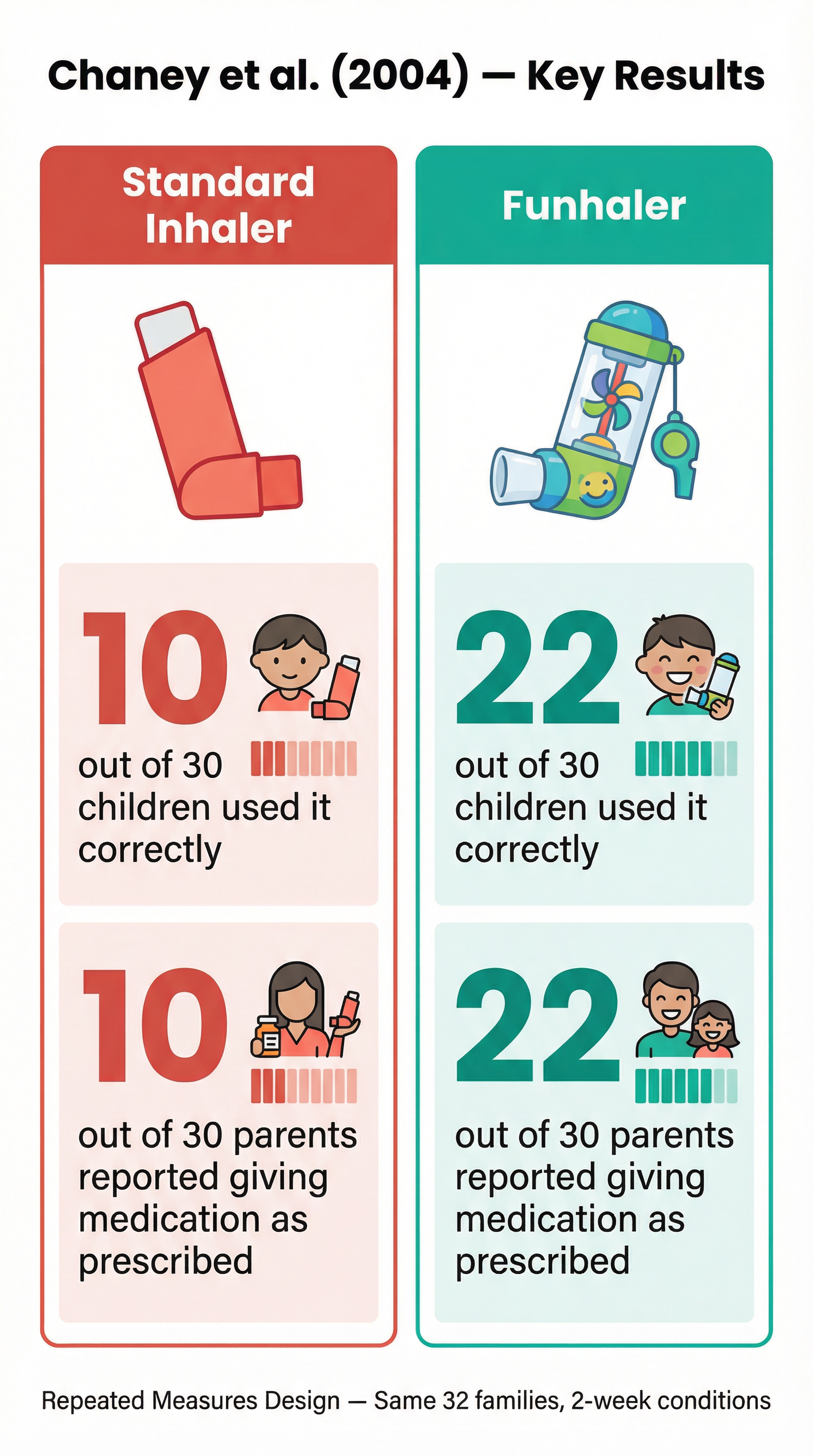
- Immediate consequence: Children found using their inhaler more enjoyable and were more willing to use it correctly (22/30 vs 10/30).
- Long-term consequence: The study demonstrated the potential for 'gamification' in healthcare to improve patient outcomes, influencing the design of pediatric medical devices.
Change & Continuity
- Change: The study marked a shift from purely functional medical devices to those incorporating psychological principles to modify behaviour.
- Continuity: The study builds upon the long-standing principles of behaviourism and operant conditioning, showing their continued relevance in a modern context.
Significance
- The study is significant because it provides a clear, effective, and ethically sound application of psychological theory to a real-world problem. It serves as a powerful example for students of how developmental psychology can have a direct and positive impact on people's lives.
Source Skills
While you won't be given traditional historical sources, you will be asked to interpret the study's findings. Treat the quantitative data as your primary source material.
- Content: What do the numbers show? A significant increase in compliance with the Funhaler.
- Provenance: Who collected the data? Parents. When? Over a two-week period. How? Via self-report questionnaires.
- Limitations: The reliance on parental self-report is a key limitation. Parents may have been influenced by social desirability bias, wanting to appear as responsible caregivers, which could inflate the reported compliance rates. This is a crucial point for AO3 evaluation marks.
Worked Examples
3 worked examples — open one to explore the question and available guidance.
Practice Questions
Test your understanding — click to reveal model answers
Describe two features of the Funhaler device. (4 marks)
Hint: Think about what made the device 'fun' and how it was linked to correct use.
Explain one strength and one weakness of the sample used in the Chaney et al. study. (6 marks)
Hint: For the strength, think about the target population. For the weakness, consider the size and origin of the sample.
Compare the study by Chaney et al. with the classic study by Bandura, Ross and Ross (1961). (8 marks)
Hint: Structure your answer around similarities and differences. Consider the theory, method, and type of behaviour studied.