OCR · A-Level · Psychology
Freud (1909) - Little Hans
Freud's (1909) case study of Little Hans is a landmark in psychology, offering a detailed psychodynamic explanation for phobias. This guide breaks down the complex theory, key events, and evaluation points you need to secure top marks in your OCR A-Level exam.
- 6 min read
- 2 worked examples
- 3 practice questions
- 6 key terms
Study Notes

Overview
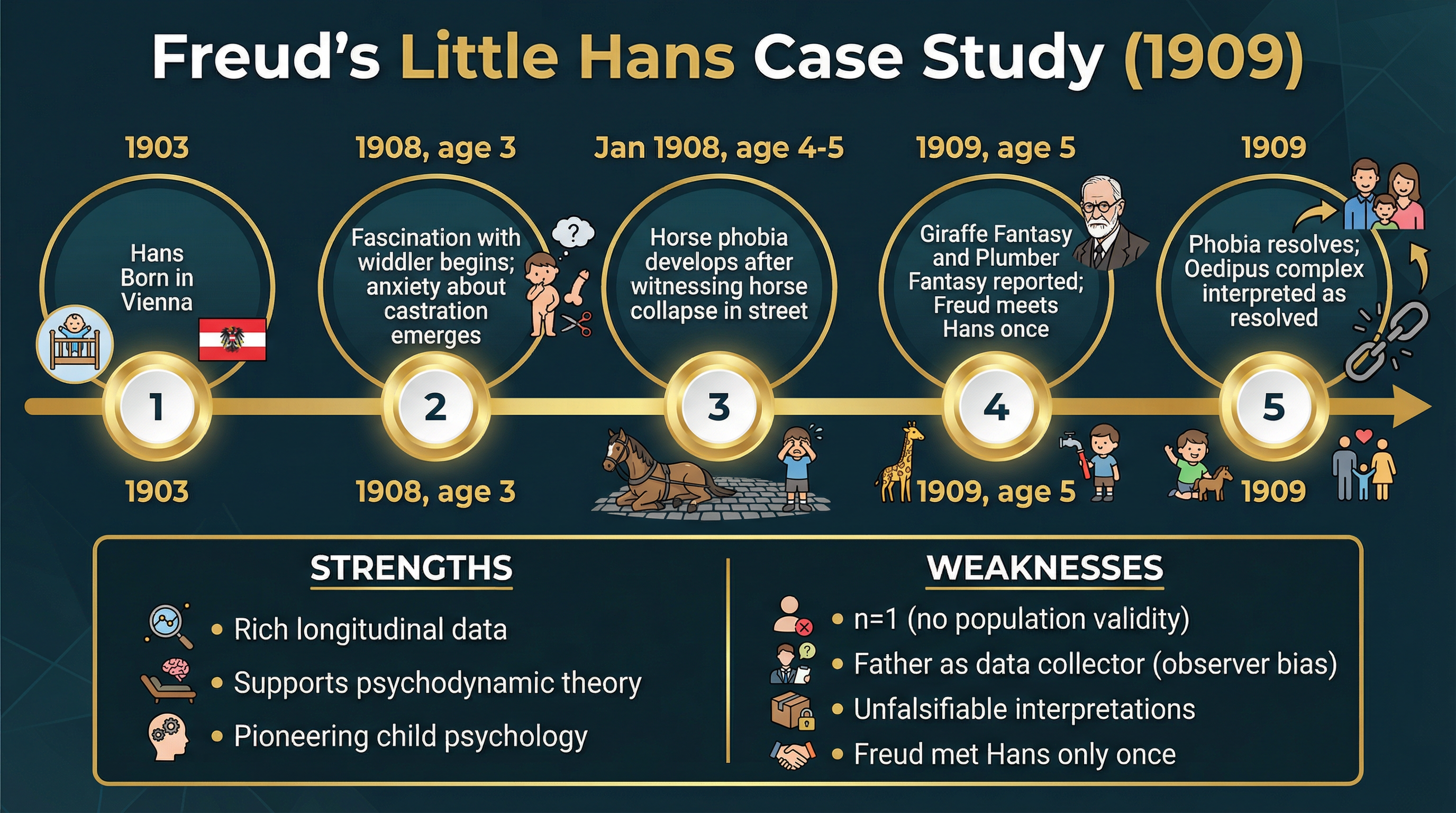
Freud's (1909) study, An Analysis of a Phobia in a Five-Year-Old Boy, is a seminal work in the psychodynamic approach and a required core study for the OCR A-Level Psychology Mental Health option. It presents a longitudinal case study of 'Little Hans' (real name Herbert Graf), a boy who developed a severe phobia of horses. Freud never met Hans, except for one brief occasion, and instead gathered data through detailed letters from the boy's father. The study is Freud's primary illustration of the Oedipus complex, the defence mechanism of displacement, and the use of dream and fantasy analysis to uncover unconscious conflicts. Examiners expect candidates to understand the theoretical underpinnings, the specific evidence (fantasies), and the significant methodological and ethical criticisms of the study. Mastery of this study is crucial for demonstrating AO1 (knowledge), AO2 (application), and AO3 (evaluation) skills.

Key Events & Developments
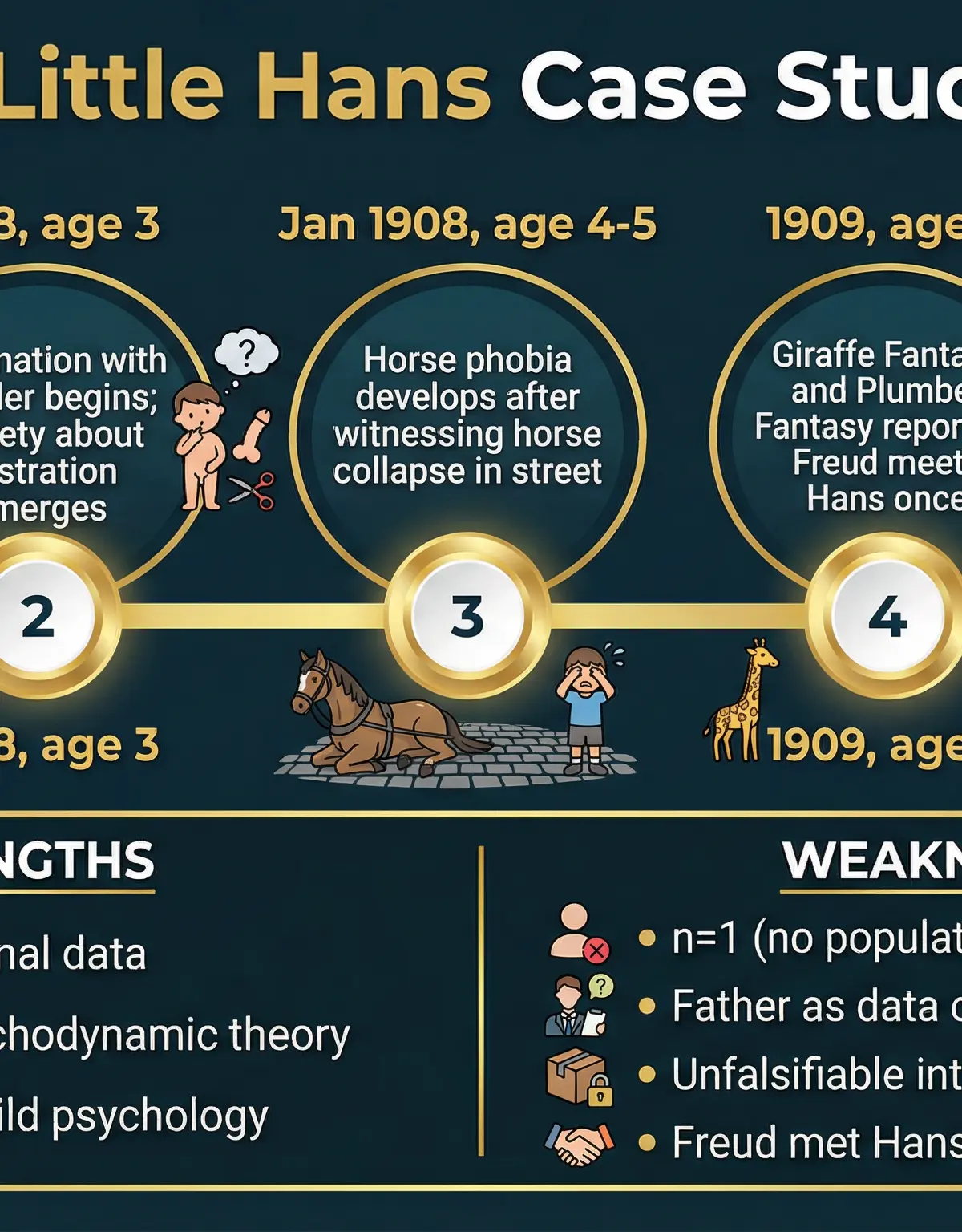
The Onset of Phobia
Date(s): January 1908
What happened: At nearly five years old, Hans developed an intense fear of horses, specifically that a horse would fall down in the street or bite him. This fear was so debilitating that he refused to go outside.
Why it matters: This is the central symptom that Freud seeks to explain. For the exam, candidates must understand that Freud saw this not as a simple phobia but as a symptom of a deeper, unconscious conflict.
Specific Knowledge: The phobia began after Hans witnessed a horse-drawn bus fall over. This event acted as a trigger, but Freud argued it was not the ultimate cause.
The Giraffe Fantasy
Date(s): 1909
What happened: Hans described a fantasy involving two giraffes: a large one and a 'crumpled' one. The large one shouted because Hans had taken the crumpled one away.
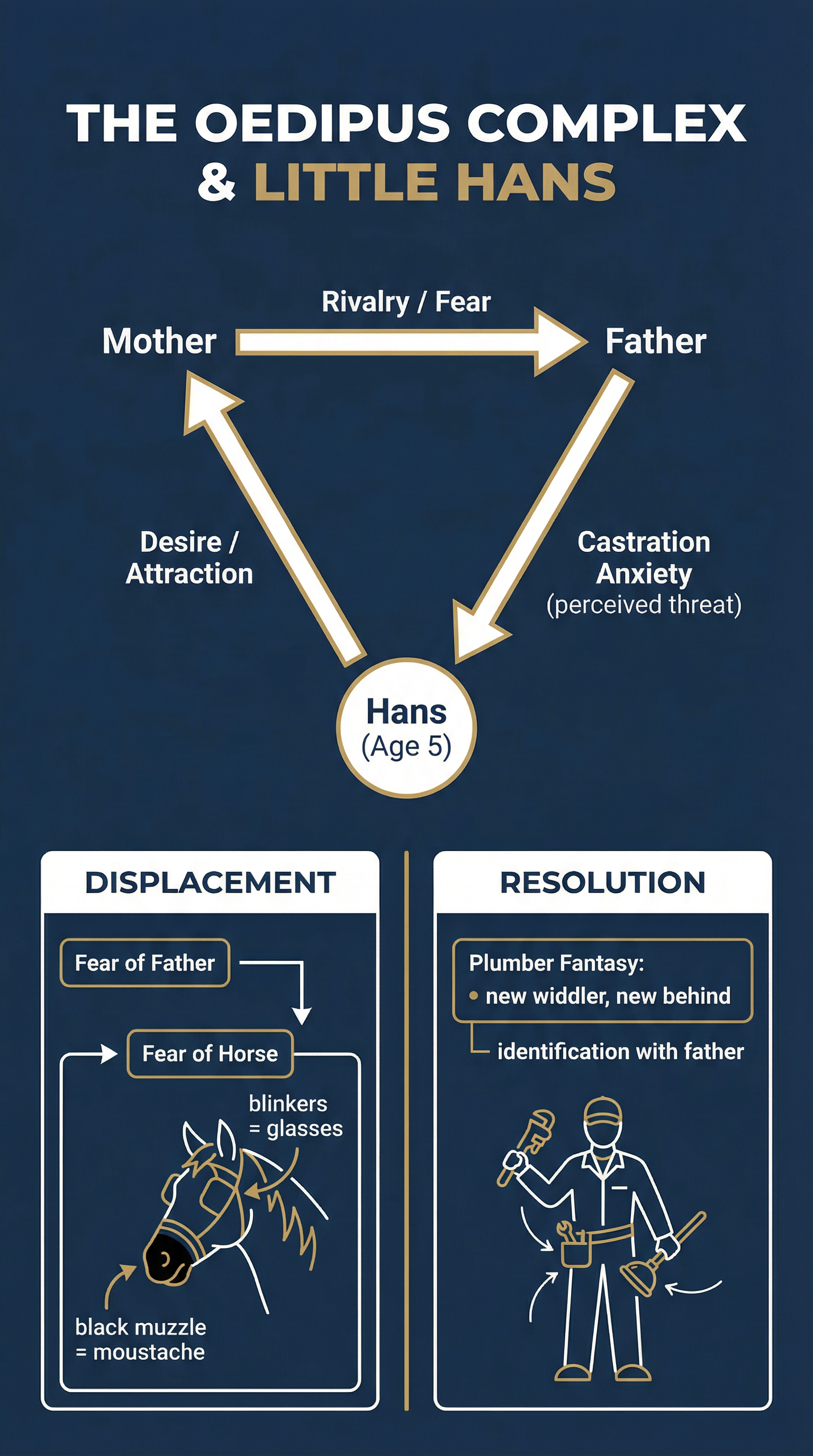
Why it matters: This is a key piece of evidence Freud used to support his theory of the Oedipus complex. Credit is given for explaining the symbolism: the large giraffe (long neck) represents the father, and the crumpled giraffe represents the mother. Hans taking the mother away signifies his Oedipal desire.
Specific Knowledge: Candidates must be able to link the manifest content (the giraffes) to the latent content (the unconscious family dynamics).
The Plumber Fantasy
Date(s): 1909
What happened: Hans fantasised that a plumber came and replaced his 'widdler' (penis) and bottom with larger ones.
Why it matters: Freud interpreted this as the resolution of the Oedipus complex. Hans was moving from fearing his father (castration anxiety) to identifying with him, wanting to be big and powerful like him. This demonstrates the final stage of the complex.
Specific Knowledge: Use this fantasy specifically when discussing the resolution phase to earn maximum credit.
Key Individuals
Little Hans (Herbert Graf)
Role: The subject of the case study.
Key Actions: Experienced and reported the phobia, fantasies, and anxieties that formed the basis of Freud's analysis.
Impact: His case became the primary evidence for Freud's theory of the Oedipus complex and the psychodynamic explanation of phobias.
Sigmund Freud
Role: The psychoanalyst and author of the study.
Key Actions: Interpreted the data provided by Hans's father, formulated the theoretical explanation, and met with Hans on a single occasion.
Impact: Used the case to popularise his theories of psychosexual development, defence mechanisms, and the unconscious mind.
Hans's Father (Max Graf)
Role: The primary data collector and correspondent.
Key Actions: Observed his son, recorded his conversations and behaviours in detail, and sent these reports to Freud. He also engaged in some interpretation himself, guided by Freud.
Impact: His role is a major point of evaluation. As a non-objective observer who was also a follower of Freud, his potential for bias is a significant methodological weakness.
Second-Order Concepts
Causation
Freud argues for a chain of causation: the underlying cause is the Oedipus complex (unconscious desire for the mother, rivalry with the father), which leads to castration anxiety. This anxiety is too great to be consciously acknowledged, so it is displaced onto a symbolic object (the horse). The trigger event (seeing a horse fall) provides the final link in the chain.
Consequence
The immediate consequence was Hans's debilitating phobia. The long-term consequence was the publication of a hugely influential, yet controversial, case study that has shaped psychological theory for over a century.
Change & Continuity
The study documents the change in Hans from a state of unresolved unconscious conflict to a resolution through identification with the father. It represents a continuity of Freud's core theoretical ideas, applying them to a real-world case.
Significance
The study is significant for being one of the first attempts to apply psychoanalytic theory to a child. It remains a cornerstone of the psychodynamic approach and a critical text for understanding Freudian concepts, despite its widely acknowledged flaws.
Source Skills
This is a case study, not a traditional historical source. When evaluating it, you are assessing its reliability and validity as a piece of scientific evidence. Key considerations for provenance are:
- Author: Freud, who had a vested interest in finding evidence for his theories.
- Purpose: To provide a detailed illustration and validation of the Oedipus complex.
- Method: Data collected by a biased observer (the father), not by Freud himself. This makes the data subjective and open to interpretation.
- Nature: A single, idiographic case study, meaning its findings cannot be generalised to the wider population.
Visual Resources
2 diagrams and illustrations
Interactive Diagrams
1 interactive diagram to visualise key concepts
Conceptual Flow Outline
Flowchart showing the psychodynamic causation of Little Hans's phobia.
Worked Examples
2 worked examples — open one to explore the question and available guidance.
Practice Questions
Test your understanding — click to reveal model answers
Describe the findings of Freud's (1909) study of Little Hans. (4 marks)
Hint: Briefly state two key findings, such as the role of the Oedipus complex and displacement.
Explain how Freud's study of Little Hans illustrates the psychodynamic explanation of phobias. (8 marks)
Hint: Focus on explaining the concepts of the unconscious, the Oedipus complex, and displacement, using evidence from the study.
To what extent is Freud's (1909) case study of Little Hans a valid piece of scientific research? (15 marks)
Hint: This is an evaluation question. You need to weigh up the strengths (e.g., rich data) against the weaknesses (e.g., bias, generalisability, falsifiability) and come to a justified conclusion.