OCR · A-Level · Psychology
History of Mental Health
This guide provides a comprehensive overview of the history of mental health for OCR A-Level Psychology. It traces the evolution of explanations for mental illness, from ancient humoral theory to the modern medical model, equipping students with the critical knowledge needed to evaluate diagnostic reliability and validity in their exams.
- 8 min read
- 3 worked examples
- 4 practice questions
- 6 key terms
Study Notes
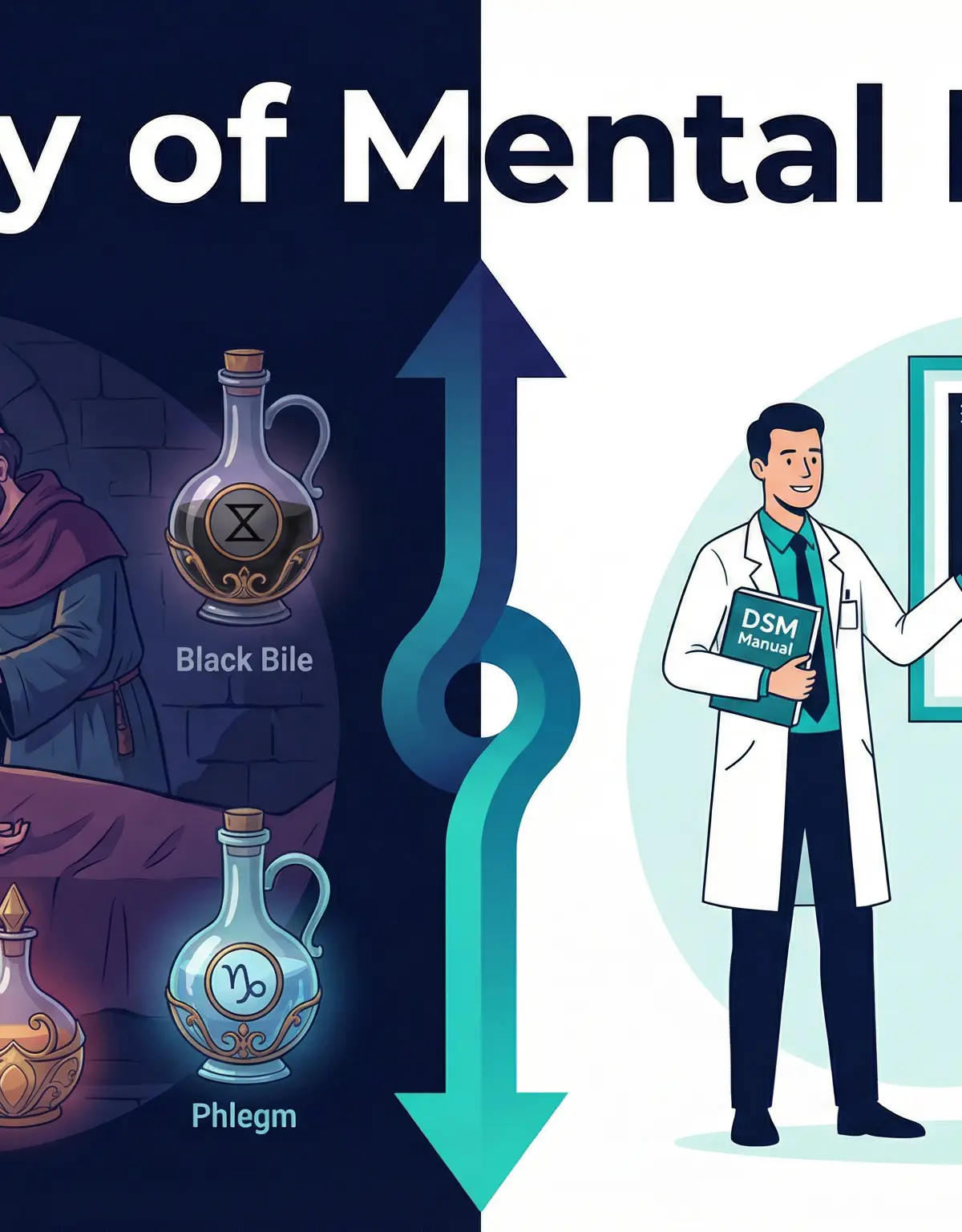
Overview
This study guide covers the essential historical context for understanding mental health as required by the OCR A-Level Psychology specification. It examines the progression of thought from supernatural and somatogenic explanations in ancient times to the development of the medical model and its subsequent critiques. For the exam, candidates are expected to not only describe these historical paradigms but also to critically evaluate them, with a particular focus on the reliability and validity of psychiatric diagnosis. A deep understanding of the shift from seeing mental illness as a spiritual failing to a medical condition is crucial. This includes appreciating the social and cultural contexts that shaped these views, from the asylum reforms of Pinel and Dix to the anti-psychiatry movement. The pivotal study by Rosenhan (1973) serves as the core evidence for evaluating the diagnostic process, and marks are awarded for using it effectively to challenge the assumptions of the medical model. This guide will provide the specific knowledge and analytical frameworks needed to achieve top marks.

Key Events & Developments
The Humoral Theory
Date(s): c. 400 BCE
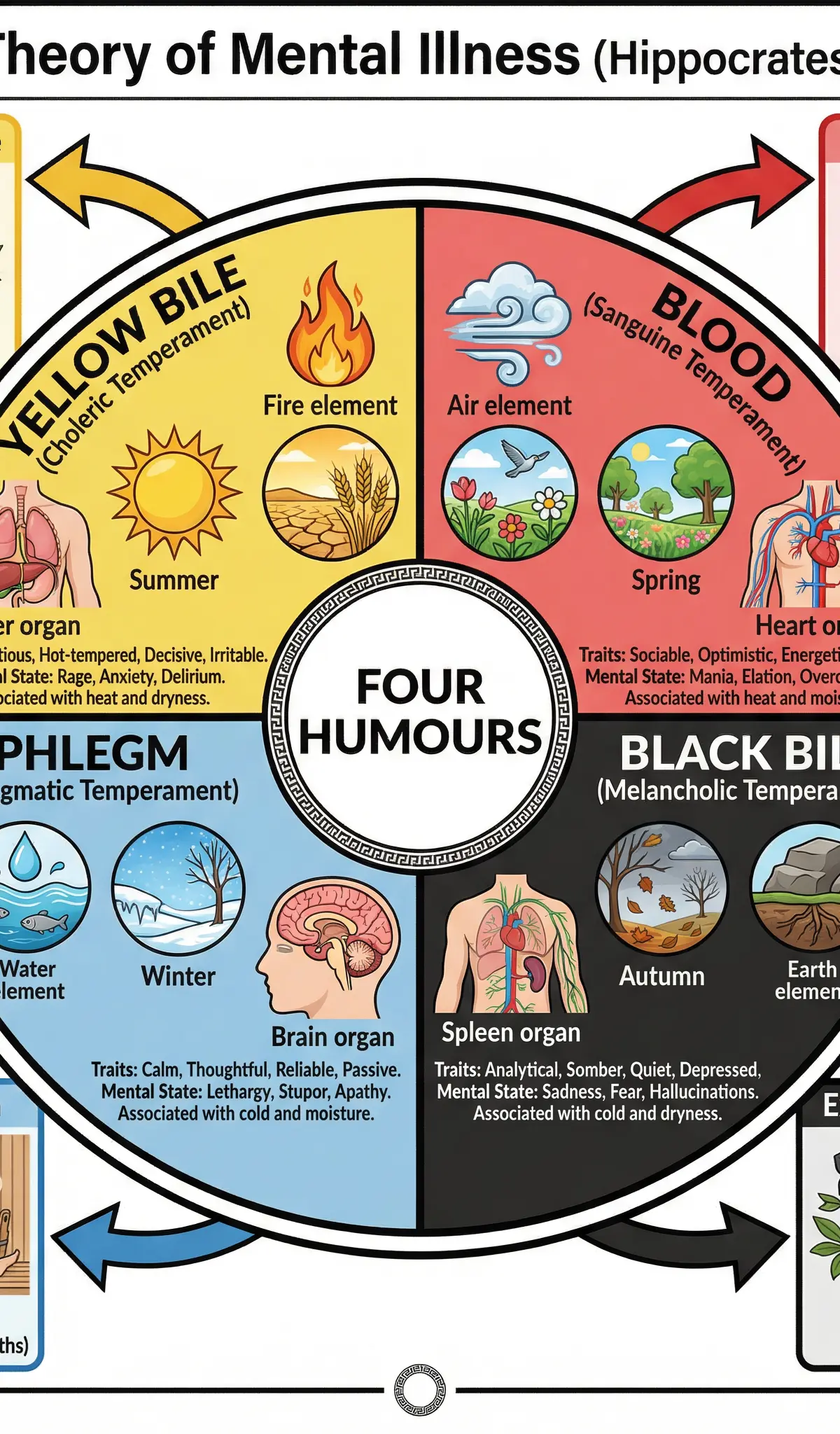
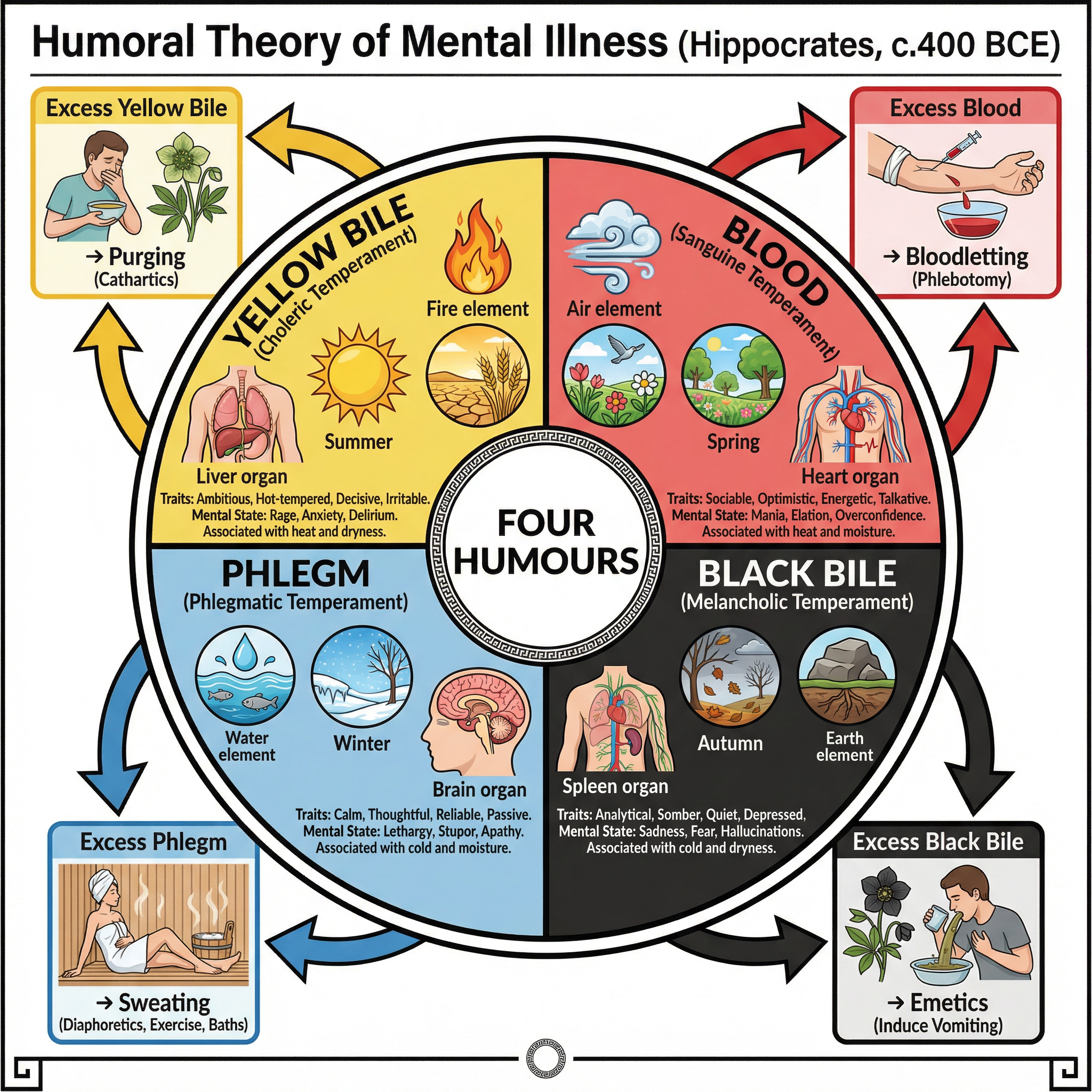
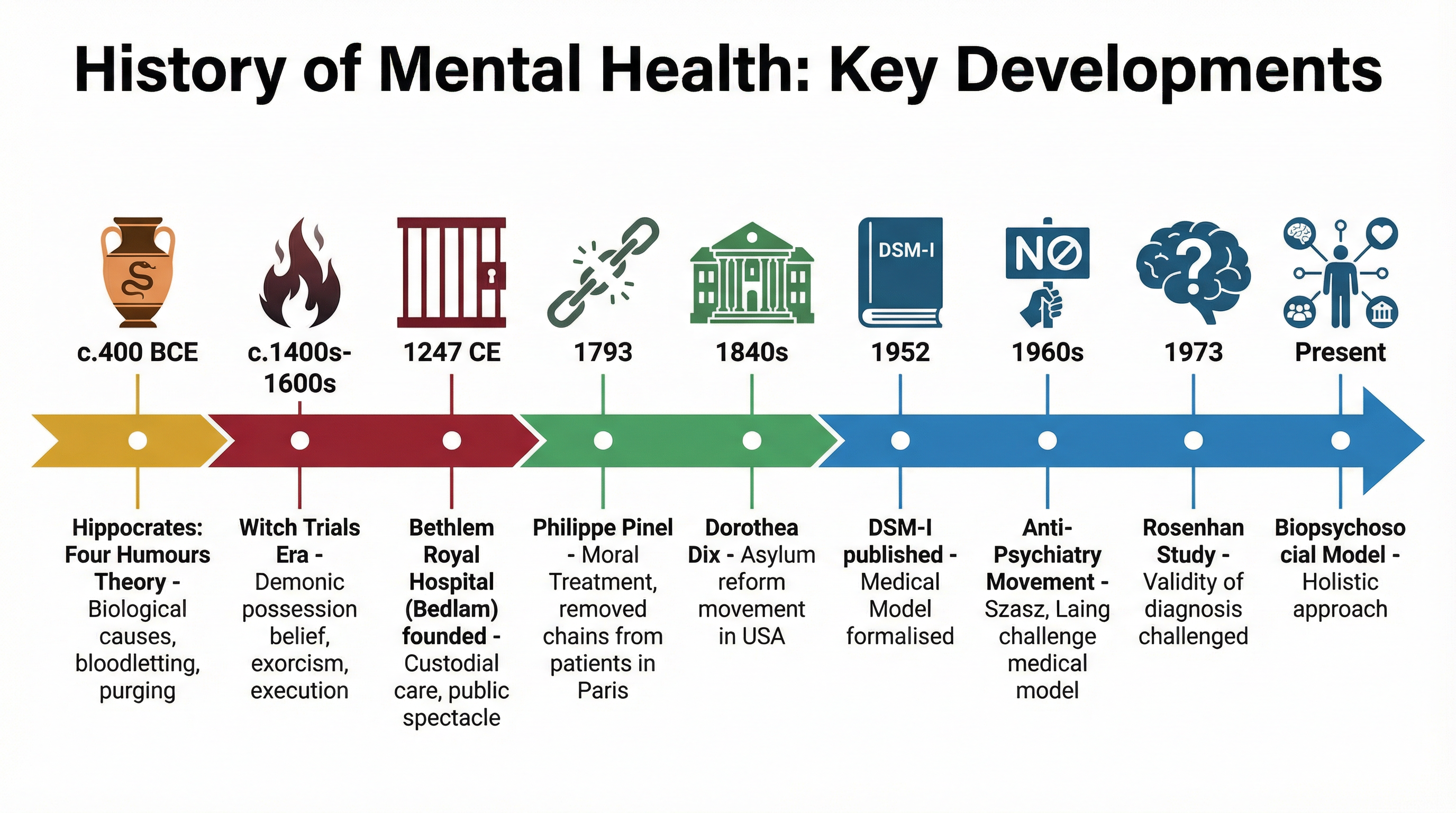
What happened: Hippocrates, an Ancient Greek physician, proposed that mental (and physical) illness was the result of an imbalance in four bodily fluids, or 'humours': blood, phlegm, yellow bile, and black bile. This was a significant departure from the prevailing supernatural explanations.
Why it matters: This was the first major somatogenic theory of mental illness, locating the cause within the body. It laid the groundwork for a biological approach to mental health that would later evolve into the medical model. For the exam, linking this etiology (cause) to its treatments (e.g., bloodletting, purging to rebalance humours) is key to gaining AO1 credit.
Specific Knowledge: Hippocrates, Four Humours (blood, phlegm, yellow bile, black bile), somatogenic, bloodletting, purging.
The Rise of Asylums & Moral Treatment
Date(s): 1247 (Bethlem founded), 1793 (Pinel's reforms)
What happened: Institutions for confining the mentally ill began to appear, such as Bethlem Royal Hospital in London. Initially, these were purely custodial, often with horrific conditions. A major turning point was the 'moral treatment' movement, pioneered by Philippe Pinel in Paris, who unchained patients and treated them with compassion.
Why it matters: This marks the beginning of a shift towards more humane treatment and the idea that recovery is possible. It challenged the view of the mentally ill as incurable or subhuman. Candidates should contrast the custodial model of Bedlam with the therapeutic principles of moral treatment.
Specific Knowledge: Bethlem Royal Hospital (Bedlam), Philippe Pinel, moral treatment, Dorothea Dix (asylum reform in the US).
The Medical Model and the DSM
Date(s): 1952 (DSM-I published)
What happened: The American Psychiatric Association published the first Diagnostic and Statistical Manual of Mental Disorders (DSM), classifying mental illnesses into a systematic framework. This solidified the medical model, which views mental disorders as illnesses with discrete symptoms, causes, and treatments, akin to physical diseases.
Why it matters: The DSM provided a standardized language for diagnosis, facilitating communication and research. However, it also became a powerful tool for labelling and has been heavily criticized for its questionable validity and reliability. Examiners expect candidates to understand the assumptions and limitations of this model.
Specific Knowledge: Medical Model, DSM, classification, diagnosis, reliability, validity.
The Anti-Psychiatry Movement & Rosenhan's Study
Date(s): 1960s-1970s; 1973 (Rosenhan study published)
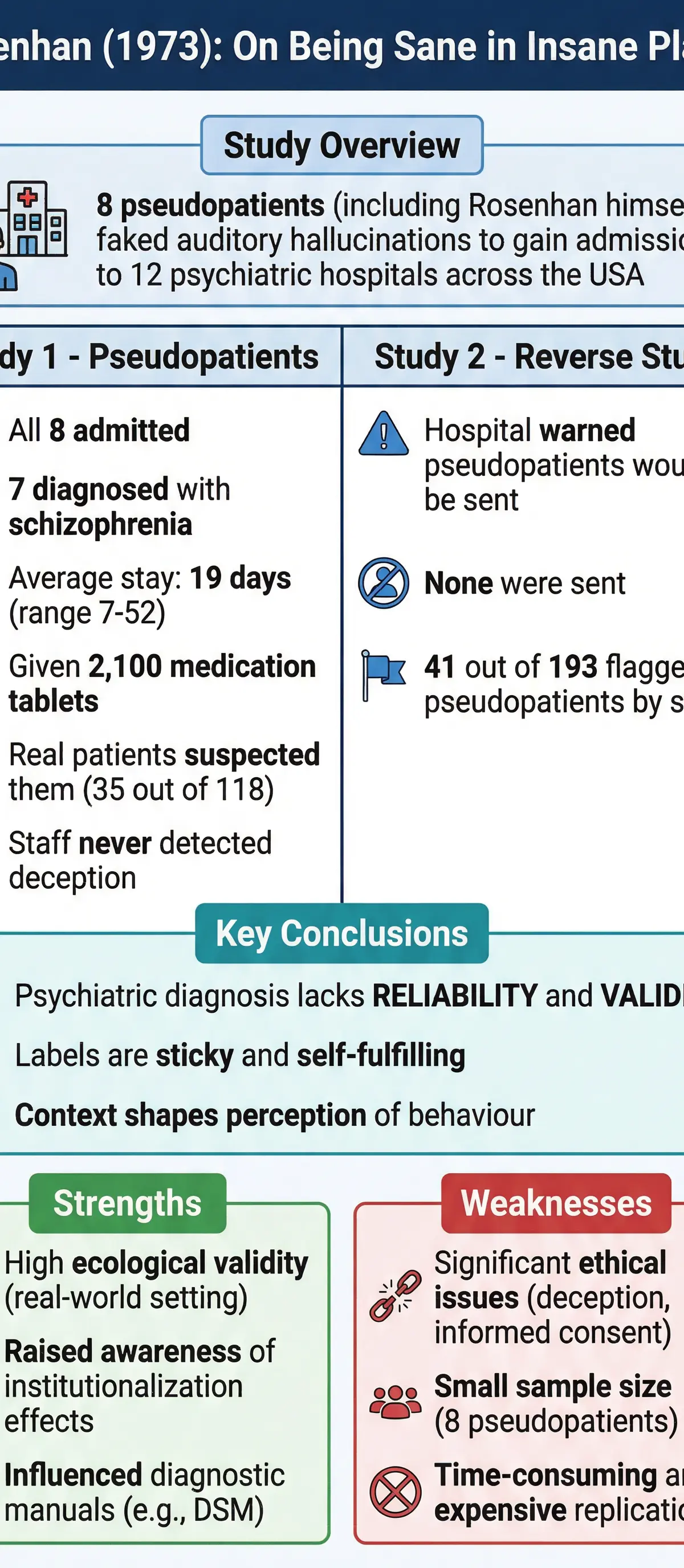
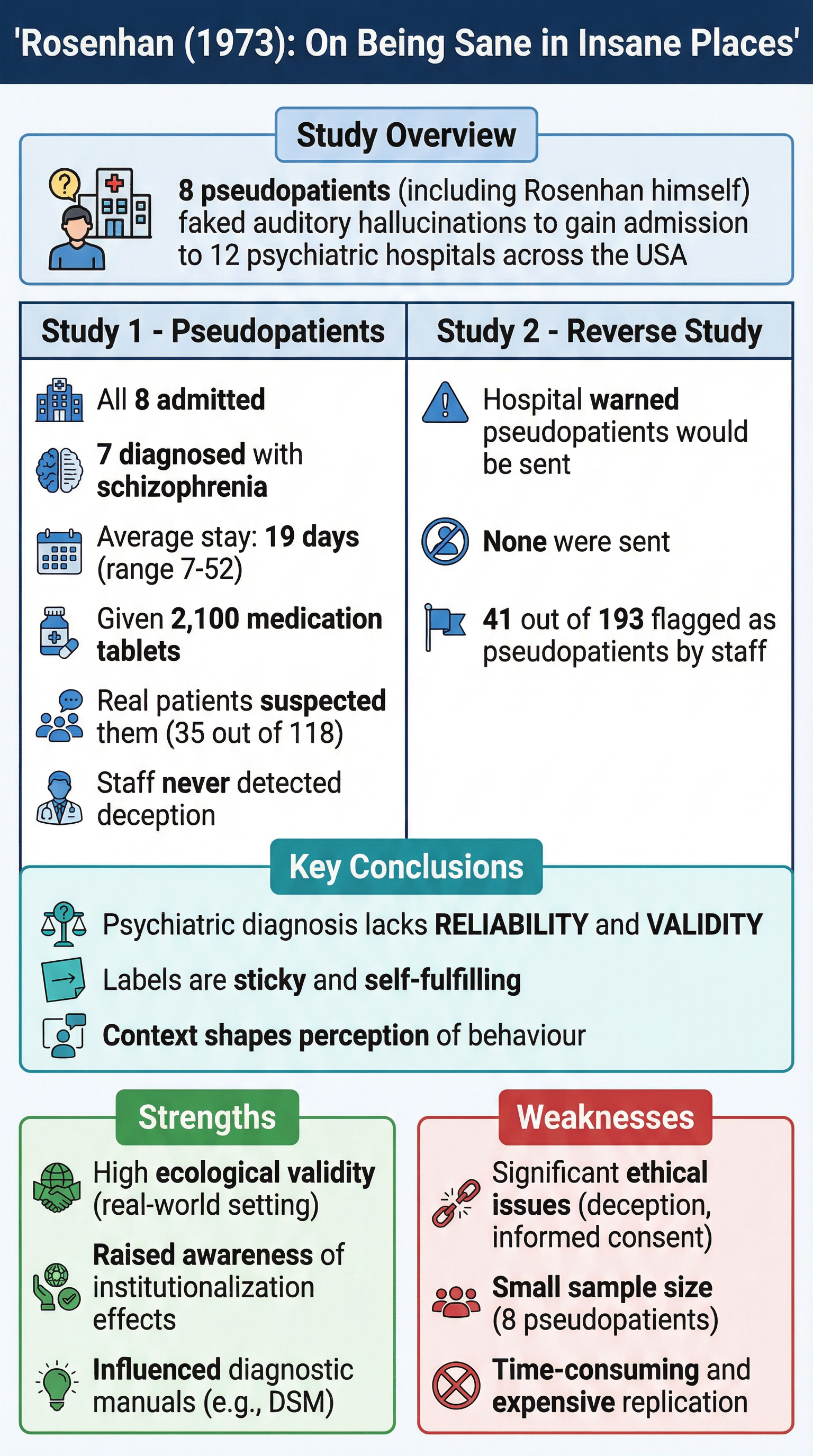
What happened: A movement emerged, led by thinkers like Thomas Szasz and R.D. Laing, that challenged the entire concept of mental illness as a medical category, arguing it was a tool for social control. This was powerfully supported by David Rosenhan's study, "On Being Sane in Insane Places", where healthy pseudopatients were admitted to psychiatric hospitals and their sanity was never detected.
Why it matters: This is the single most important event for AO3 evaluation. Rosenhan's study provides powerful empirical evidence to critique the reliability and validity of psychiatric diagnosis. It highlights the power of labels and the context in shaping perception. Candidates must use this study to construct arguments about the limitations of the medical model.
Specific Knowledge: Anti-psychiatry movement, Thomas Szasz, R.D. Laing, David Rosenhan (1973), pseudopatients, labelling theory, Type I error (false positive), Type II error (false negative).
Key Individuals
Hippocrates (c. 460 – c. 370 BCE)
Role: Ancient Greek Physician, often called the "Father of Medicine".
Key Actions: Developed the Humoral Theory, rejecting supernatural explanations for illness.
Impact: Shifted the understanding of mental illness from a spiritual to a biological (somatogenic) domain.
Philippe Pinel (1745-1826)
Role: French physician and pioneer of humane treatment for the mentally ill.
Key Actions: Famously removed chains from patients at the Salpêtrière Hospital in Paris in 1793. He advocated for psychological-oriented therapies, or 'moral treatment'.
Impact: His work was a catalyst for the moral treatment movement and the reform of asylums across Europe and America.
David Rosenhan (1929-2012)
Role: American psychologist and academic.
Key Actions: Conducted the 1973 study "On Being Sane in Insane Places", where he and seven other pseudopatients feigned hallucinations to get admitted into psychiatric hospitals.
Impact: His study is a cornerstone of the critique against psychiatric diagnosis, providing powerful evidence of its lack of reliability and validity. It is essential knowledge for any A-Level Psychology student.
Second-Order Concepts
Causation
The perceived causes of mental illness have shifted dramatically over time. Long-term causes include the influence of religious doctrine (leading to demonology) and the rise of scientific thought during the Enlightenment (leading to the medical model). Short-term triggers for change often came from key individuals like Pinel or landmark studies like Rosenhan's.
Consequence
The consequences of these changing views are profound. The belief in demonology led to persecution, while the custodial asylum model led to neglect and abuse. The medical model has led to the development of pharmaceutical treatments but also to the problems of labelling and stigma, which Rosenhan's study powerfully exposed.
Change & Continuity
While much has changed, some things have remained. The idea of confining the 'mad' has been a constant, evolving from prisons to asylums to modern psychiatric wards. The debate between somatogenic and psychogenic (psychological) causes also continues today within the modern biopsychosocial model.
Significance
The history of mental health is significant because it reveals that our understanding of abnormality is not fixed but is a product of its time. It demonstrates how scientific, social, and cultural values shape who gets defined as 'ill' and how they are treated. For the exam, this understanding is crucial for building effective evaluation.
Source Skills
When presented with a source, for example, an extract from a 19th-century asylum superintendent's diary, candidates must consider its provenance. Who wrote it? When and why? The superintendent might describe patients in a way that seems objective, but his purpose might be to secure more funding, thus exaggerating the severity of their conditions. Always question the source's utility and limitations based on its content and provenance.
Visual Resources
3 diagrams and illustrations
Interactive Diagrams
1 interactive diagram to visualise key concepts
Diagram could not be rendered
A simplified timeline of the major paradigms in the history of mental health.
Worked Examples
3 worked examples — open one to explore the question and available guidance.
Practice Questions
Test your understanding — click to reveal model answers
Describe two definitions of abnormality. (4 marks)
Hint: Think about how we decide what is 'normal'. One way is through statistics, another is through social rules.
Explain one strength and one weakness of the 'Deviation from Social Norms' definition of abnormality. (6 marks)
Hint: For the strength, think about real-world application. For the weakness, think about how norms change over time and across cultures.
Outline the findings of Rosenhan's (1973) study 'On Being Sane in Insane Places'. (6 marks)
Hint: Focus on the key results from both the first and second parts of the study.
To what extent has the medical model improved the lives of people with mental health problems? (20 marks)
Hint: This is a big essay. Argue for the improvements (e.g., effective treatments, scientific basis) and against (e.g., labelling, reductionism, invalid diagnosis). Use Rosenhan as key evidence.