Pearson Edexcel · GCSE · Psychology
Course version: 1PS0 · Version from Sept 2017
Understand the internal and external influences on sleep, including…
Full specification wording
Sleep and dreaming: 9.1.2 Understand the internal and external influences on sleep, including strengths and weaknesses of each explanation: a. bodily rhythms, to include (i) circadian rhythms (ii) ultradian rhythms b. hormones, to include (i) pineal gland (ii) melatonin c. zeitgebers, to include (i) light
Sleep is regulated by both internal (endogenous) and external (exogenous) factors.
Checked against the Pearson Edexcel 1PS0 specification (opens in a new tab) on .
- Point 2 of 5
- 4 key terms
Study notes
From the checked teaching notes for this specification point.
The idea
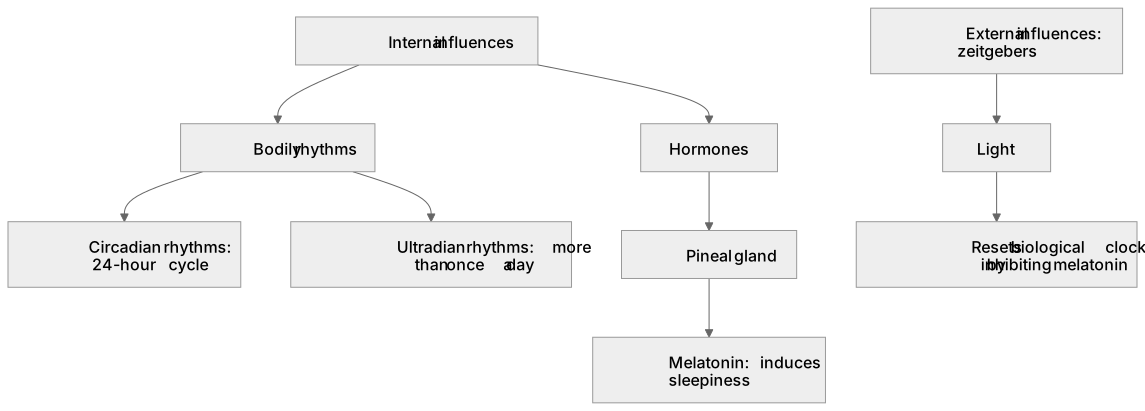
Sleep is regulated by both internal (endogenous) and external (exogenous) factors. Internal influences include bodily rhythms: circadian rhythms operate on a 24-hour cycle, regulating the sleep-wake cycle, while ultradian rhythms occur more than once a day, such as the 90-minute sleep stages. Hormones also play a key internal role; the pineal gland secretes melatonin, which induces sleepiness. External influences are called zeitgebers (time-givers), with light being the primary cue that resets our biological clock by inhibiting melatonin production. A strength of these explanations is strong supporting evidence from isolation studies. However, a weakness is that they often ignore individual differences and psychological factors like stress, which can override biological rhythms.
What earns the marks
- Identify circadian rhythms as 24-hour cycles and ultradian rhythms as cycles occurring multiple times within 24 hours.
- Explain the role of the pineal gland in releasing melatonin to promote sleep.
- Describe how light acts as a zeitgeber to regulate the sleep-wake cycle by suppressing melatonin.
- Evaluate the biological explanation by citing evidence from isolation studies or noting the limitation of ignoring psychological factors.
Common mistakes and how to put them right
Confusing circadian and ultradian rhythms.
Put it right: 'circa' means about a day (24 hours), while 'ultra' means more frequent (e.g., 90-minute sleep stages).
Believing light produces melatonin.
Put it right: Light actually inhibits or suppresses the release of melatonin from the pineal gland.
Thinking zeitgebers are internal biological clocks.
Put it right: Zeitgebers are external environmental cues, such as light, that entrain the internal clock.
Exam tips
- When evaluating, use specific examples like shift work or jet lag to illustrate how external zeitgebers and internal rhythms can become desynchronised.
- Clearly distinguish between the pineal gland (the structure) and melatonin (the hormone) when explaining internal influences.
- Be prepared to apply your knowledge of zeitgebers to novel scenarios, such as the effect of blue light from smartphones before bedtime.
Try the lesson
The start of the Sleep and dreaming: 9.1.2 Understand the internal and external influences on sleep, including strengths and weaknesses of each explanation: a. bodily rhythms, to include (i) circadian rhythms (ii) ultradian rhythms b. hormones, to include (i) pineal gland (ii) melatonin c. zeitgebers, to include (i) light lesson, made from checked teaching notes for this specification point.
Have a go first
Which hormone is primarily responsible for regulating the sleep-wake cycle?
Listen
Sleep is regulated by both internal (endogenous) and external (exogenous) factors. Internal influences include bodily rhythms: circadian rhythms operate on a 24-hour cycle, regulating the sleep-wake cycle, while ultradian rhythms occur more than once a day, such as the 90-minute sleep stages. Hormones also play a key internal role; the pineal gland secretes melatonin, which induces sleepiness. External influences are called zeitgebers (time-givers), with light being the primary cue that resets our biological clock by inhibiting melatonin production. A strength of these explanations is strong supporting evidence from isolation studies. However, a weakness is that they often ignore individual differences and psychological factors like stress, which can override biological rhythms. A strong answer earns marks for these points. Identify circadian rhythms as 24-hour cycles and ultradian rhythms as cycles occurring multiple times within 24 hours. Explain the role of the pineal gland in releasing melatonin to promote sleep. Describe how light acts as a zeitgeber to regulate the sleep-wake cycle by suppressing melatonin. Evaluate the biological explanation by citing evidence from isolation studies or noting the limitation of ignoring psychological factors. A common slip: Confusing circadian and ultradian rhythms. Instead, 'circa' means about a day (24 hours), while 'ultra' means more frequent (e.g., 90-minute sleep stages). Exam tip: When evaluating, use specific examples like shift work or jet lag to illustrate how external zeitgebers and internal rhythms can become desynchronised.
See it
Key words
Say what each word means before you turn the card.
Circadian rhythms
Try answering aloud or in your head before turning the card.
Ultradian rhythms
Try answering aloud or in your head before turning the card.
Melatonin
Try answering aloud or in your head before turning the card.
Zeitgebers
Try answering aloud or in your head before turning the card.
See every definition
- Circadian rhythms
- Bodily rhythms that operate on a 24-hour cycle, regulating the sleep-wake cycle.
- Ultradian rhythms
- Bodily rhythms that occur more than once a day, such as the 90-minute sleep stages.
- Melatonin
- A hormone secreted by the pineal gland which induces sleepiness.
- Zeitgebers
- External influences, or time-givers, with light being the primary cue that resets our biological clock by inhibiting melatonin production.
Label the diagram
Some boxes have lost their names. Pick the right name for each number.
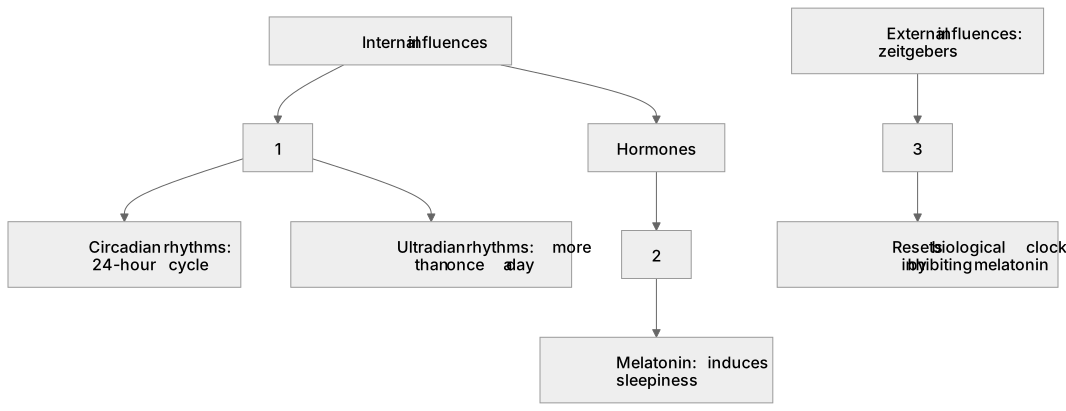
1Box 1
2Box 2
3Box 3
There is more to this lesson
The full lesson goes on to check your understanding and help you earn the marks. Create a free account to carry on, with your progress saved.
A week of Premium from your first lesson · Then the free plan continues · No card, no charge
Test your understanding of Sleep and dreaming: 9.1.2 Understand the internal and external influences on sleep, including strengths and weaknesses of each explanation: a. bodily rhythms, to include (i) circadian rhythms (ii) ultradian rhythms b. hormones, to include (i) pineal gland (ii) melatonin c. zeitgebers, to include (i) light
Active recall beats re-reading. Take an instant quiz now to test what you’ve learned and lock it into long-term memory.
A week of Premium from your first lesson · Then the free plan continues · No card, no charge