Addictive Behaviours
This study guide provides a comprehensive analysis of Addictive Behaviours for the WJEC A-Level Psychology specification. It delves into the biological, psychological, and social explanations for addiction, equipping students with the detailed knowledge and critical evaluation skills required to achieve top marks.
Study Notes
Overview
This topic explores the complex nature of addiction, a core component of the WJEC A-Level Psychology (Unit 3, Section A) specification. Examiners expect candidates to demonstrate a sophisticated understanding of the interplay between biological mechanisms, such as the mesolimbic dopamine pathway, and psychological factors, including learning theories and cognitive biases. Mastery involves not just describing these theories (AO1), but critically evaluating them and the therapies they inform (AO3). This guide will break down the key concepts, from Griffiths' six components of addiction to the mechanisms of agonist and antagonist treatments, providing the specific knowledge and analytical frameworks needed to excel in the exam. You will learn to move beyond generic evaluation points to provide contextualised analysis that directly addresses the demands of the question, a key discriminator for A/A* grades.
Biological Explanations of Addiction
The Role of Dopamine and the Mesolimbic Pathway
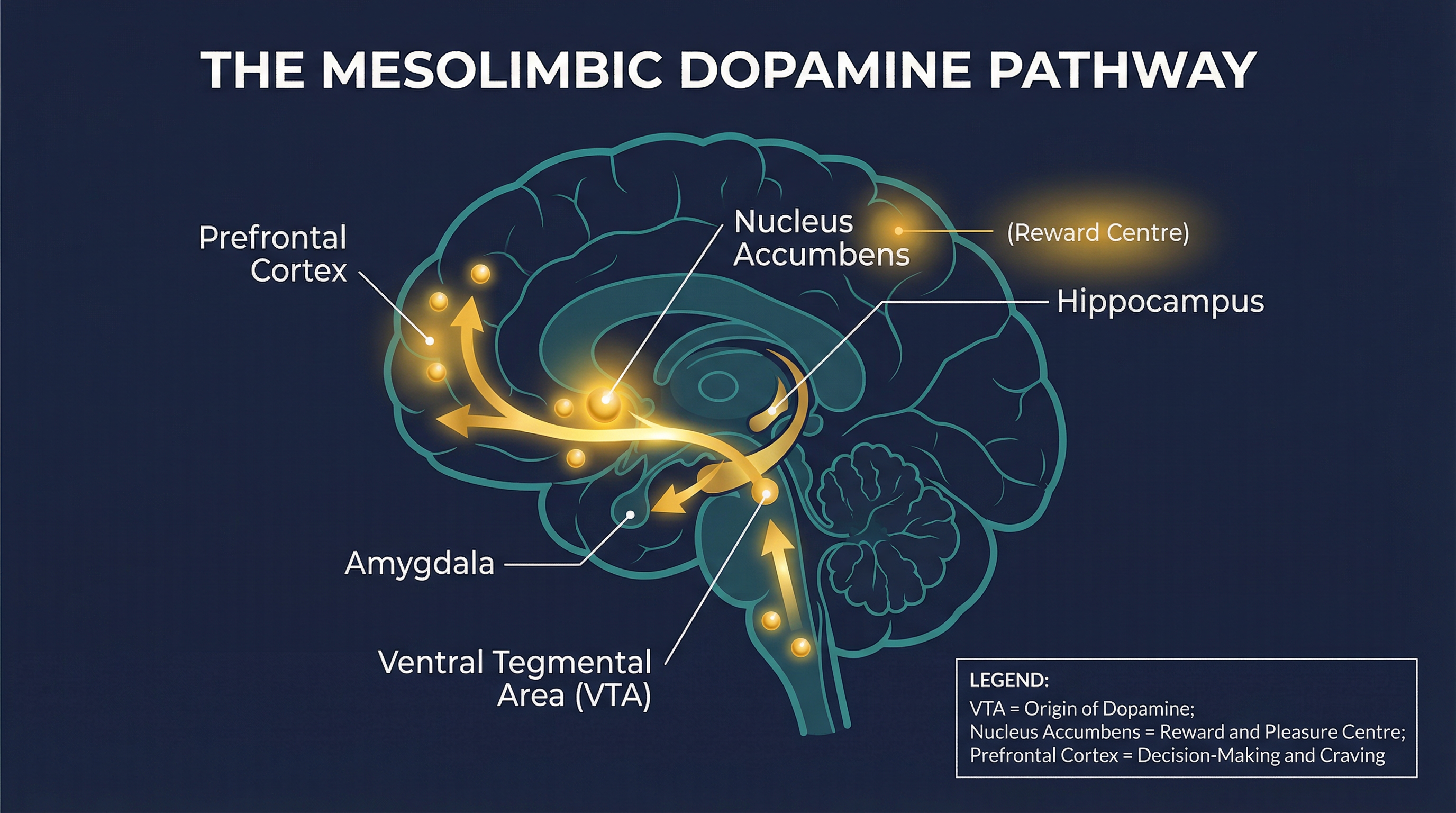
What happens: The biological approach posits that addiction is a brain disease. The central mechanism is the mesolimbic pathway, often called the brain's 'reward circuit'. When we engage in a rewarding activity, the Ventral Tegmental Area (VTA) releases the neurotransmitter dopamine into the Nucleus Accumbens (NAcc), producing feelings of pleasure and reinforcing the behaviour. Addictive substances like cocaine, heroin, and nicotine hijack this system, causing an artificially large surge of dopamine, creating an intense euphoria that is far more powerful than natural rewards.
Why it matters: For AO1 marks, candidates must accurately describe this pathway. For AO3, this forms the basis of evaluation. The desensitisation hypothesis explains tolerance: with chronic use, the brain downregulates (reduces) the number of D2 dopamine receptors to compensate for the overstimulation. This means more of the drug is needed to achieve the same effect. This biological model provides a powerful explanation for the maintenance of addiction and the experience of withdrawal.
Specific Knowledge: Key terms: Ventral Tegmental Area (VTA), Nucleus Accumbens (NAcc), Dopamine, Desensitisation, Downregulation. Key study: Volkow et al. (1997) used PET scans to show fewer dopamine receptors in the brains of cocaine addicts.
Psychological Explanations of Addiction
Learning Theory (Behaviourism)
What happened: Learning theory explains addiction through conditioning. Classical conditioning explains how neutral cues (e.g., a specific place, the sight of a needle) become associated with the drug's effects, eventually triggering cravings on their own (cue reactivity). Operant conditioning explains the maintenance of addiction. The initial pleasurable 'high' acts as a positive reinforcer, making the behaviour more likely to be repeated. Crucially, the avoidance of unpleasant withdrawal symptoms acts as a negative reinforcer. This is a key concept candidates often confuse: negative reinforcement is the removal of an unpleasant state, not a punishment.
Why it matters: This explanation highlights the role of the environment in triggering and maintaining addiction. It provides a clear rationale for treatments that involve avoiding triggers and learning new coping behaviours. For AO2 marks, you might be asked to apply these principles to a novel scenario.
Specific Knowledge: Key terms: Classical Conditioning, Operant Conditioning, Positive Reinforcement, Negative Reinforcement, Cue Reactivity. Key study: Skinner (1948) demonstrated the principles of reinforcement with rats.
Social Learning Theory
What happened: Bandura's Social Learning Theory (SLT) suggests addiction is initiated through observation and imitation of role models. If an adolescent observes peers or media figures gaining social status or pleasure from smoking or drinking, they may be motivated to imitate that behaviour (vicarious reinforcement).
Why it matters: SLT explains the initiation of addiction, particularly in young people, and highlights the influence of social context and peer groups. It bridges the gap between purely behavioural and cognitive explanations.
Specific Knowledge: Key terms: Social Learning Theory, Observation, Imitation, Vicarious Reinforcement. Key study: Bandura (1961) Bobo Doll study, demonstrating observational learning.
Cognitive Theory
What happened: The cognitive approach focuses on faulty thinking patterns. Beck proposed that individuals develop dysfunctional beliefs about substance use, such as 'I need it to cope' or 'I can't have fun without it'. These cognitive biases, like catastrophizing the effects of withdrawal, maintain the addictive cycle.
Why it matters: This model is crucial as it directly informs Cognitive Behavioural Therapy (CBT), one of the leading psychological treatments for addiction. It empowers the individual by suggesting that they can change their thinking and, therefore, their behaviour.
Specific Knowledge: Key terms: Cognitive Biases, Irrational Beliefs, Self-Efficacy. Key study: Griffiths (1994) found that regular gamblers had more irrational verbalisations during play than non-regular gamblers.
Modification of Addictive Behaviours
Biological Therapies
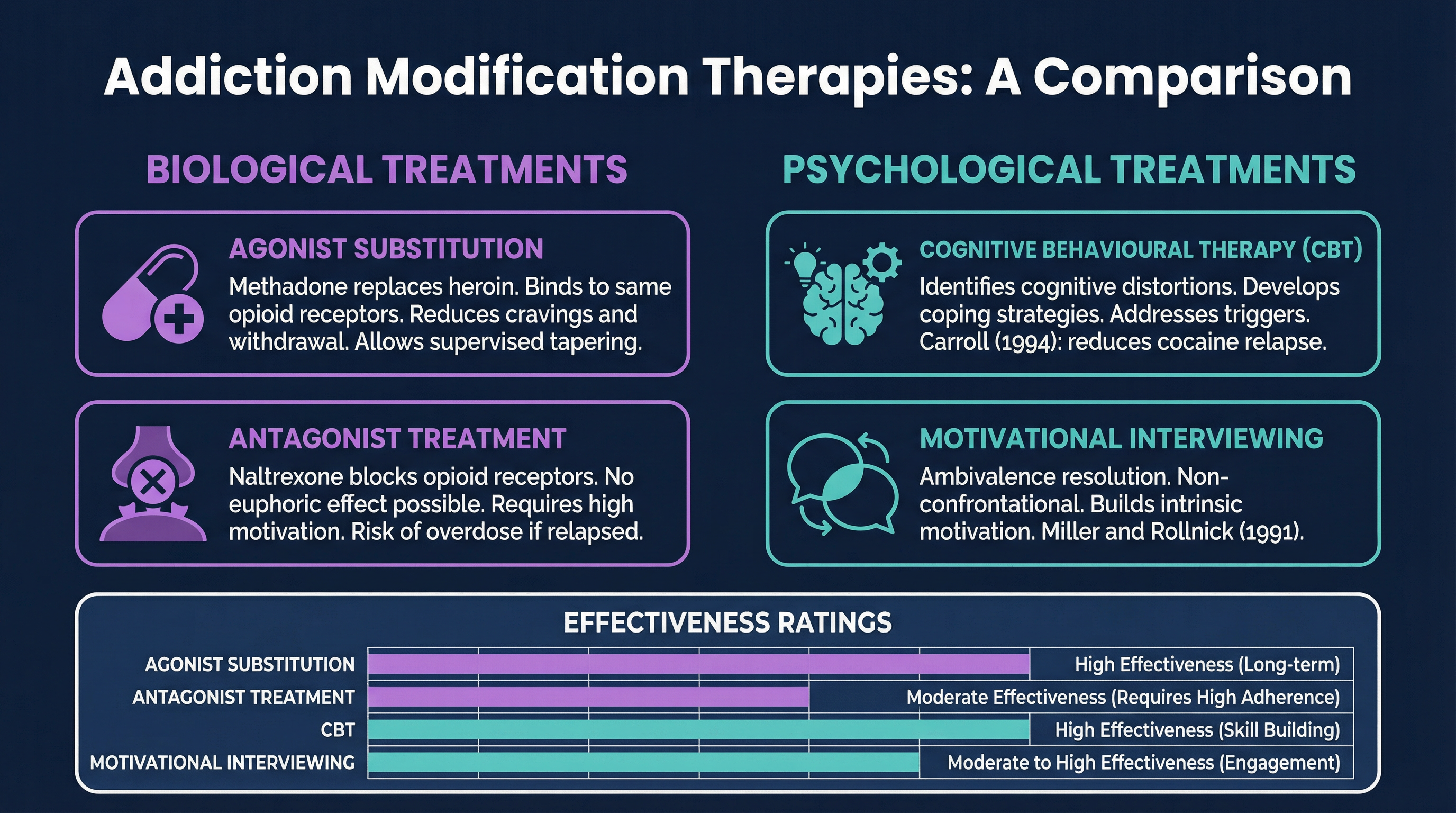
Agonist Substitution: Replaces the addictive drug with a safer substitute that has a similar effect but is less harmful. Example: Methadone for heroin addiction. It binds to opioid receptors, reducing cravings and withdrawal, allowing the user to stabilise their life.
Antagonist Treatment: Blocks the receptors that the drug acts on, preventing it from having its usual effect. Example: Naltrexone for opioid addiction. If the user takes heroin while on naltrexone, they feel no euphoria, removing the positive reinforcement.
Psychological Therapies
Cognitive Behavioural Therapy (CBT): Aims to identify and challenge the irrational thoughts and cognitive biases that maintain addiction. It also involves developing practical skills to cope with cravings and avoid high-risk situations (skills training).
Aversion Therapy: A behavioural therapy based on classical conditioning. It pairs the addictive substance with an unpleasant stimulus (e.g., an emetic drug that causes nausea). Over time, the substance itself becomes associated with the unpleasant response, leading to avoidance.
Second-Order Concepts
Causation
Addiction is caused by a complex interaction of factors. Biological vulnerability (e.g., genetic predisposition, dopamine system sensitivity) provides the foundation. Psychological factors (e.g., learning, cognitive biases) explain initiation and maintenance. Social factors (e.g., peer pressure, socioeconomic status) provide the environmental context.
Consequence
The consequences are wide-ranging, affecting the individual (physical and mental health decline, financial ruin), their family (relationship breakdown), and society (crime, healthcare costs, lost productivity).
Change & Continuity
While the substances of abuse change over time (e.g., the rise of synthetic opioids), the underlying neurobiological and psychological mechanisms of addiction remain largely the same. Treatment has changed from purely punitive to a medical and psychological model.
Significance
Understanding addiction is highly significant for public health policy, clinical practice, and the criminal justice system. It challenges debates around free will vs. determinism and has led to more compassionate and effective interventions.
Source Skills
For this topic, 'sources' are often research studies. When evaluating a study, consider its provenance: Who conducted it? When? What was the sample size? (e.g., a small sample limits generalisability). Consider its methodology: Was it a controlled lab experiment or a correlational study? (e.g., correlation does not equal causation). Consider its usefulness: What does it tell us about addiction? What are its limitations? (e.g., animal studies may not fully generalise to human addiction).
Visual Resources
3 diagrams and illustrations
Interactive Diagrams
1 interactive diagram to visualise key concepts
Conceptual Flow Outline
Flowchart showing the role of learning theories in the stages of addiction.
Worked Examples
3 detailed examples with solutions and examiner commentary
Practice Questions
Test your understanding — click to reveal model answers
Describe the role of dopamine in the process of addiction. (6 marks)
Hint: Focus on the specific pathway and the key brain structures involved. Explain what dopamine does.
Evaluate learning theory as an explanation for addiction. (10 marks)
Hint: Consider the strengths and weaknesses. Use evidence. Think about what the theory might ignore.
Distinguish between agonist and antagonist treatments for addiction. (4 marks)
Hint: For each, state what it does at the receptor level and give a named example.
Explain one ethical issue related to the use of aversion therapy to treat addiction. (4 marks)
Hint: Think about the patient's experience and the principles of ethical treatment.
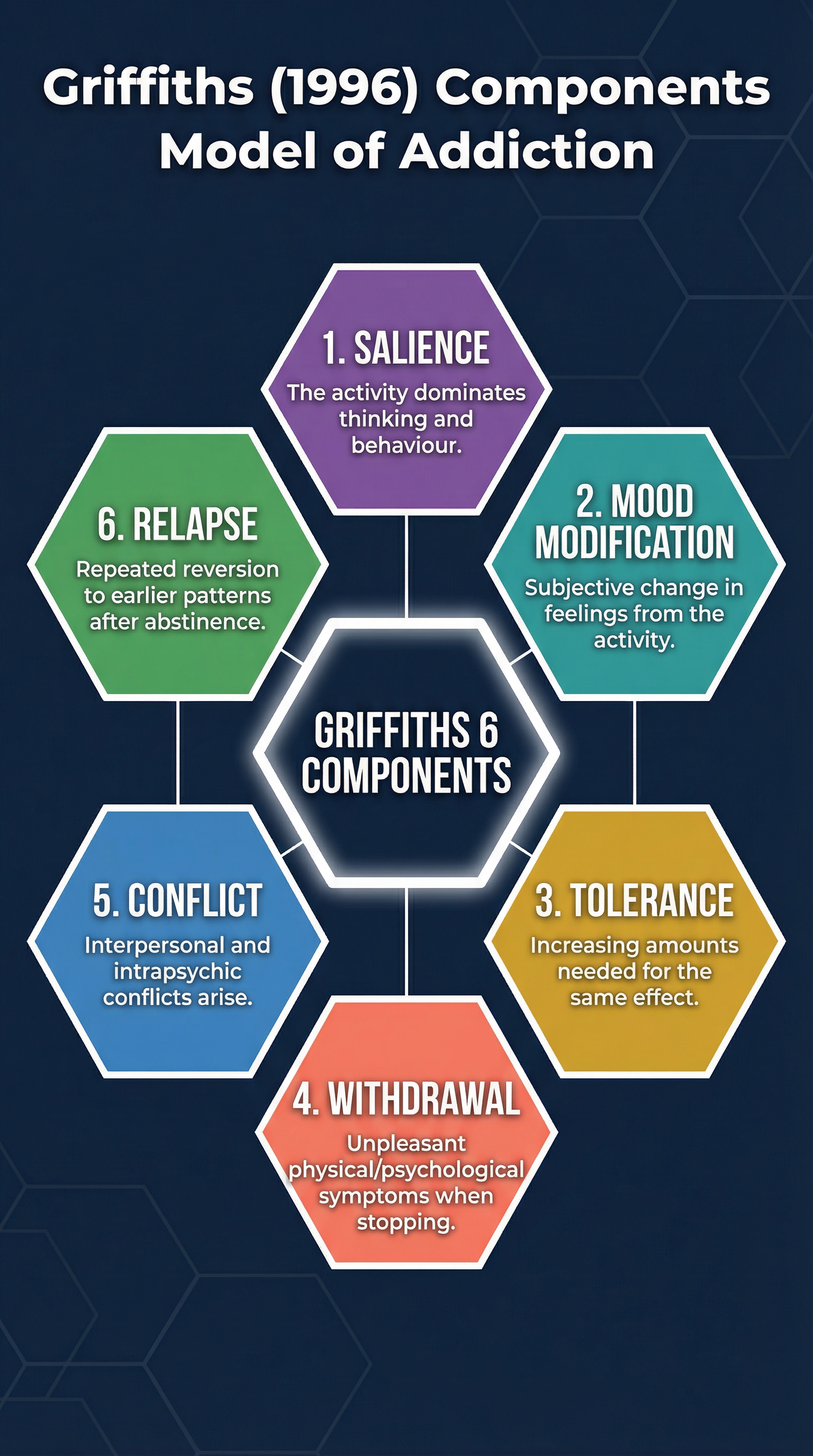
Outline Griffiths' (1996) six components of addiction. (6 marks)
Hint: List and briefly describe each of the six components.