WJEC · A-Level · Psychology
Biological Approach: Classic Research
Raine et al. (1997) is a cornerstone of the biological approach, using PET scans to explore the brains of murderers. This guide breaks down the complex procedure, findings, and crucial evaluation points you need to impress examiners and secure top marks.
- 7 min read
- 3 worked examples
- 5 practice questions
- 6 key terms
Study Notes
Overview
Raine et al. (1997) stands as a pivotal piece of classic research for the WJEC A-Level Psychology specification, providing key evidence for the Biological Approach. The study, titled "Brain Abnormalities in Murderers Indicated by Positron Emission Tomography," investigated whether there were functional differences in the brains of murderers who pleaded Not Guilty by Reason of Insanity (NGRI) compared to a matched control group. Its historical significance lies in its pioneering use of neuroimaging technology (PET scans) to explore the biological correlates of violent behaviour. Examiners expect candidates to have a precise understanding of the quasi-experimental methodology, the specific brain regions implicated (such as the prefrontal cortex), and the critical evaluative arguments surrounding the study, particularly the danger of inferring causality from correlational findings. Mastery of this study is essential for demonstrating an understanding of how biological factors can be linked to complex human behaviours like aggression.
The Classic Study: Raine et al. (1997)
The Procedure
Date(s): The study was published in 1997, reflecting research conducted in the preceding years.
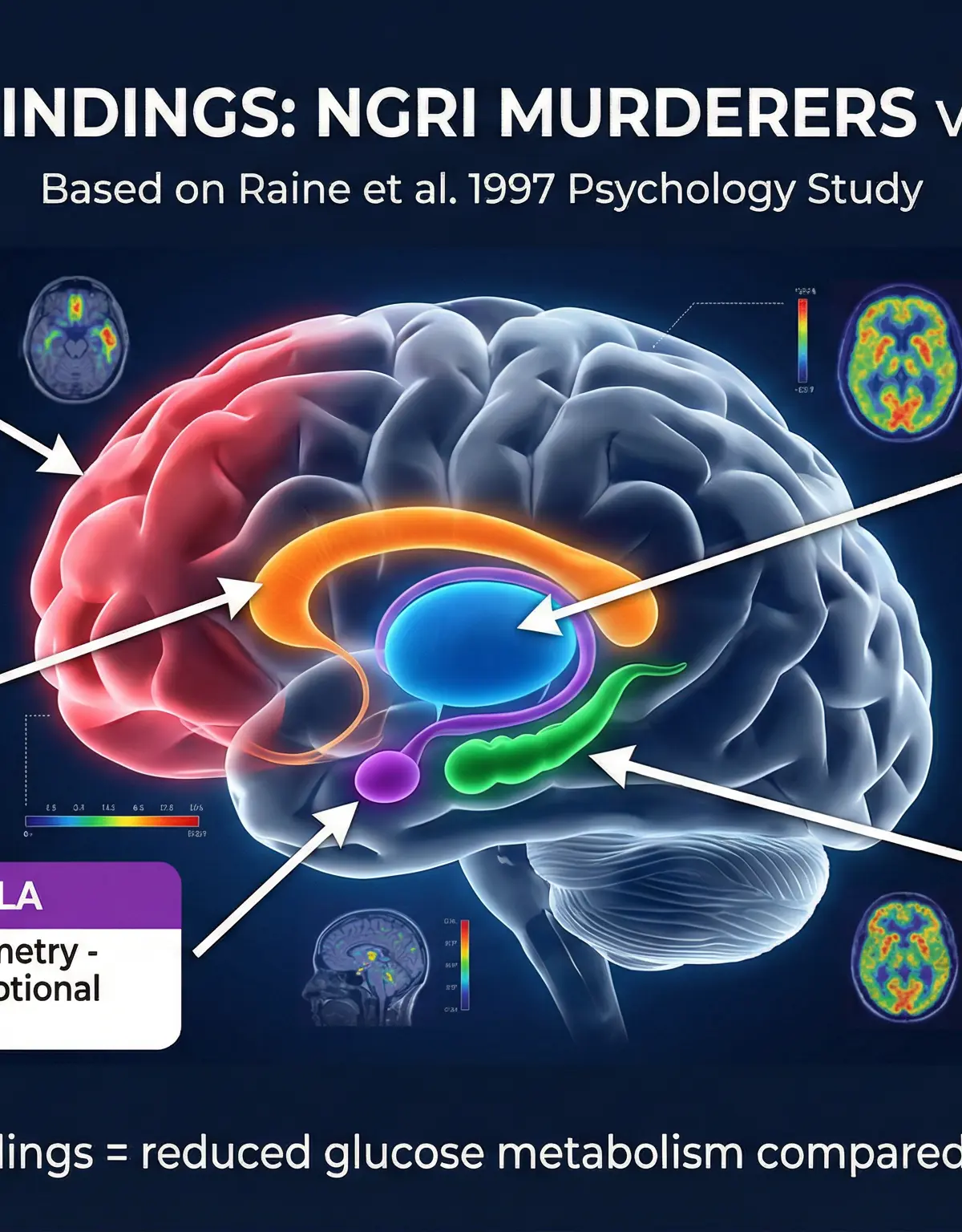
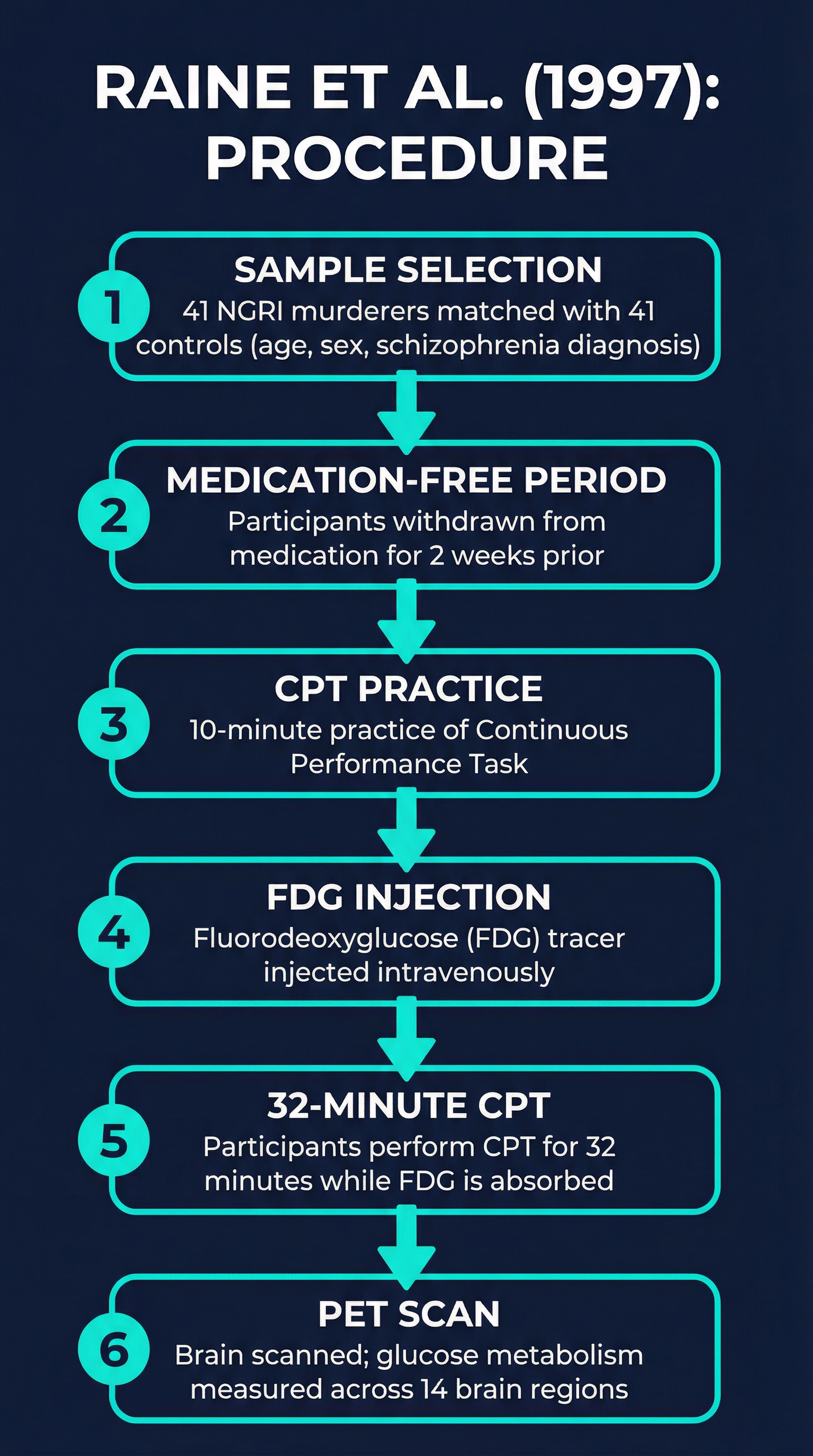
What happened: Researchers used Positron Emission Tomography (PET) scans to measure glucose metabolism in different brain regions of 41 murderers pleading NGRI and 41 matched controls. Participants were injected with a radioactive tracer (FDG) and performed a Continuous Performance Task (CPT) for 32 minutes to activate their brains, particularly the prefrontal cortex. The level of glucose metabolism in various brain areas was then measured and compared between the two groups.
Why it matters: This procedure allowed for a direct, quantitative comparison of brain function between the two groups. The use of a CPT was an attempt to simulate the cognitive demands of focusing attention and inhibiting impulses, functions thought to be impaired in violent individuals. The matching of participants was a key methodological strength designed to increase internal validity.
Specific Knowledge: Candidates must know the sample size (41 NGRI, 41 controls), the matching criteria (age, sex, and schizophrenia diagnosis), the name of the tracer (Fluorodeoxyglucose - FDG), and the name and duration of the task (32-minute Continuous Performance Task - CPT).
The Findings
What happened: The study revealed significant differences in brain metabolism between the NGRI murderers and the control group.
Why it matters: These findings provided the first direct evidence of functional brain differences in this specific population of violent offenders. They suggested a biological basis for behaviours associated with violence, such as impulsivity and lack of self-control. This had profound implications for the legal system and the concept of criminal responsibility.
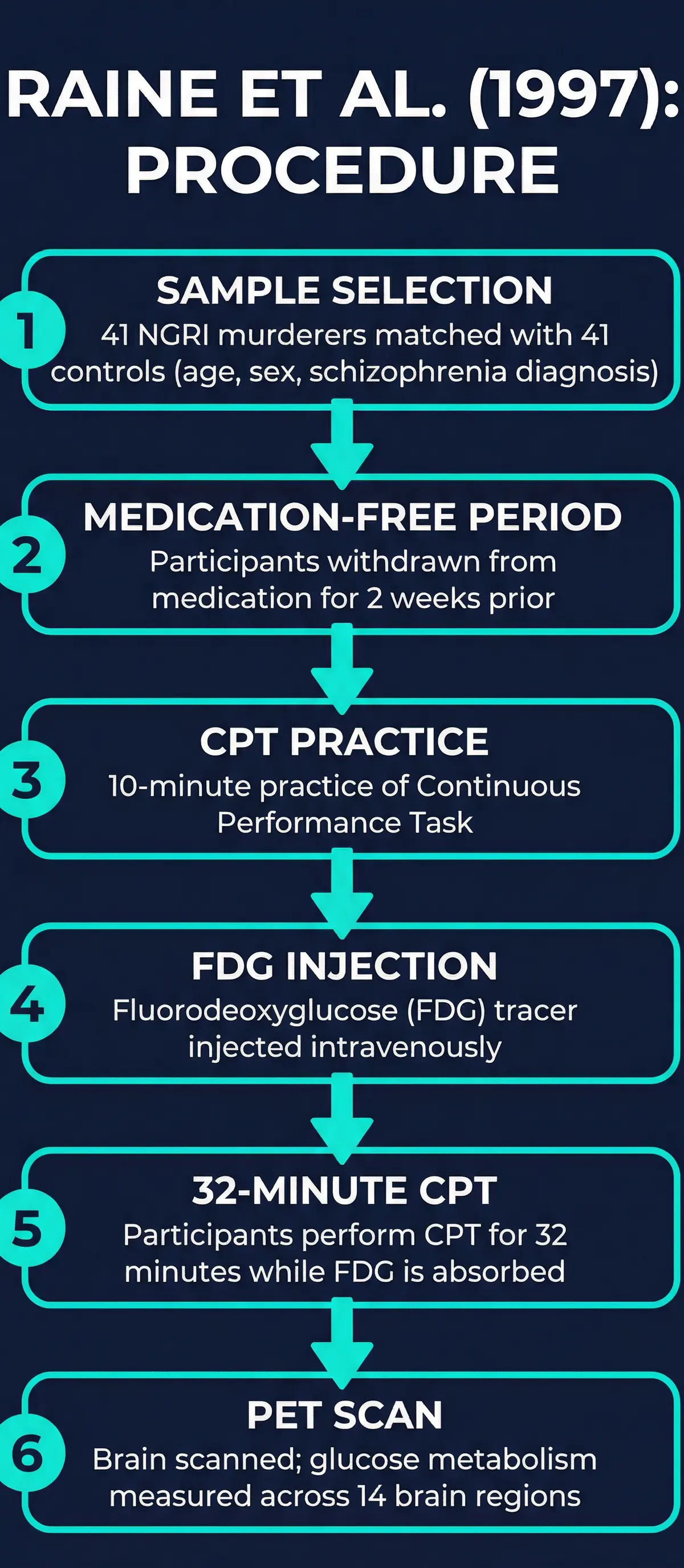
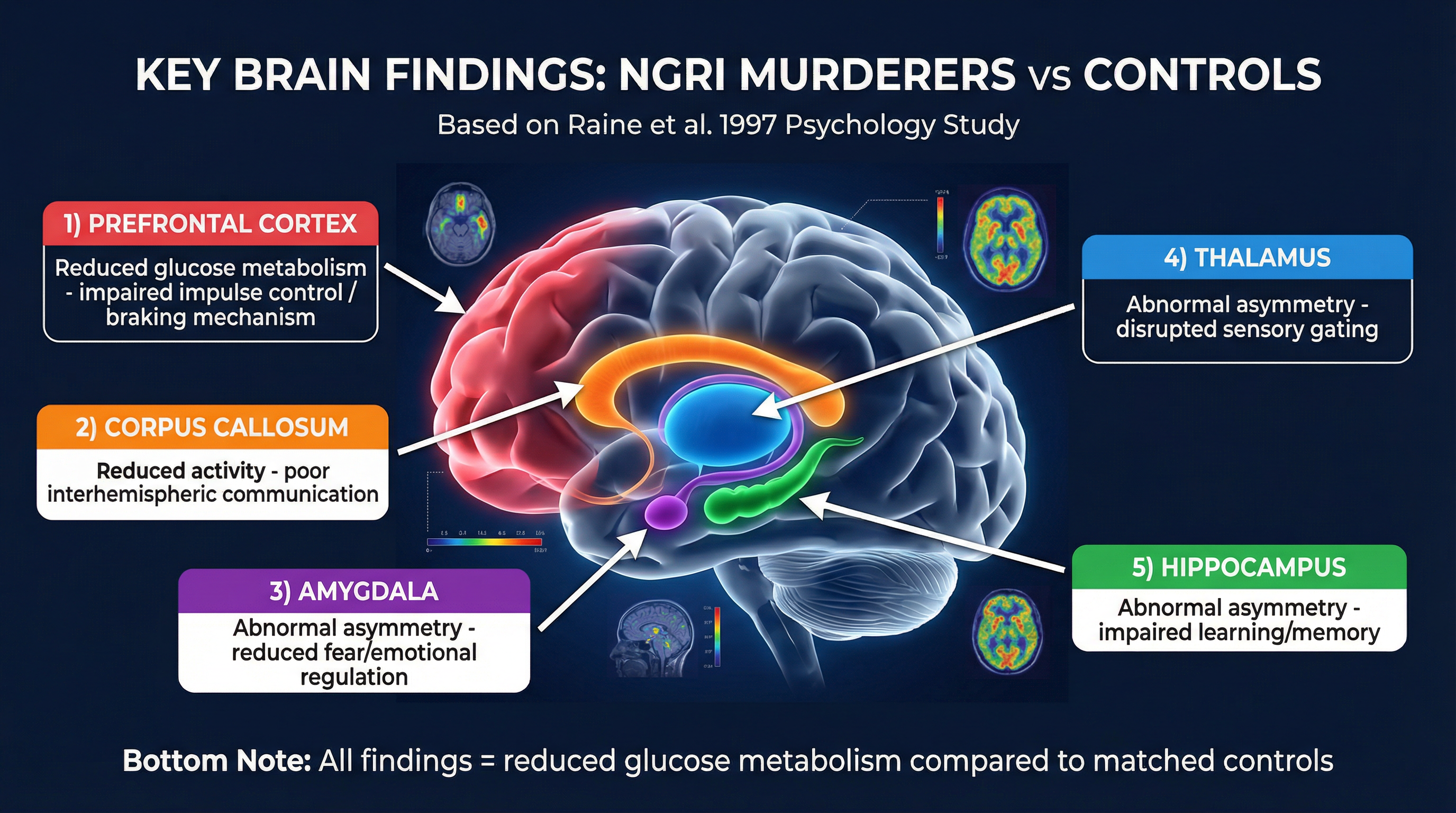
Specific Knowledge: Candidates must be able to identify specific brain regions and the nature of the differences. Key findings include:
- Reduced glucose metabolism in the prefrontal cortex, an area associated with rational thinking, self-control, and the regulation of aggression (the 'braking mechanism').
- Reduced glucose metabolism in the corpus callosum, the structure that connects the two cerebral hemispheres, suggesting impaired communication between them.
- Abnormal asymmetries in the limbic system, including the amygdala, hippocampus, and thalamus. The NGRI group had lower activity in the left amygdala and higher in the right, a pattern linked to reduced emotional regulation and fear responses.
Key Individuals
Adrian Raine
Role: Lead researcher and a prominent figure in the field of neurocriminology.
Key Actions: Designed and conducted the 1997 study, interpreting the PET scan data and linking it to theories of violent behaviour.
Impact: Raine's work has been highly influential in shifting the focus of criminology towards biological and genetic factors. However, he is also consistently careful to state that his findings are not deterministic and that social and environmental factors play a crucial role.
Second-Order Concepts for Evaluation (AO3)
Causation
This is the most critical concept for evaluation. Raine's study is correlational, not causal. The research shows a link between brain dysfunction and being an NGRI murderer, but it does not and cannot prove that the brain abnormalities caused the violent behaviour. There could be other explanations. For example, a history of head injury, which is common in violent offenders, could have caused both the brain damage and the violent tendencies. Examiners will award significant credit for candidates who clearly articulate this distinction.
Consequence
The consequences and implications of this research are far-reaching. If violent behaviour is linked to biological deficits, does this reduce personal responsibility? This has major ethical and legal implications. Defence lawyers could use such evidence to argue for diminished responsibility, potentially leading to lighter sentences. It also raises the spectre of screening individuals for these biological markers, which poses a significant ethical dilemma.
Change & Continuity
This study represented a significant change in criminological research, moving away from purely social or psychological explanations towards a more integrated biopsychosocial model. It cemented the role of neuroscience in the study of crime. However, the continuity lies in the ongoing debate about nature vs. nurture. Raine's work adds to the 'nature' side of the argument but does not resolve the debate.
Significance
The study is significant because it was one of the first to use modern neuroimaging to study the minds of violent offenders in a systematic way. It provided objective, empirical evidence that there are measurable differences in the brains of some criminals, lending scientific credibility to the biological approach to explaining crime.
Source Skills (Methodological Evaluation)
When evaluating this study, treat it like a source. Consider its strengths and weaknesses:
- Provenance (Methodology): It is a quasi-experiment. This is a strength as it allows the study of real-world phenomena that cannot be ethically manipulated. However, the lack of random allocation to conditions means that causal conclusions cannot be drawn. The use of PET scans is a major strength, providing objective, quantitative data. The matched pairs design is another strength, controlling for key confounding variables.
- Limitations: The sample was highly specific (NGRI murderers) and cannot be generalised to all violent offenders. The CPT is an artificial task, which may limit the ecological validity of the findings. The findings are correlational, as discussed above. Ethical issues include the fact that the participants may not have been mentally capable of providing fully informed consent due to their psychiatric conditions.
Worked Examples
3 worked examples — open one to explore the question and available guidance.
Practice Questions
Test your understanding — click to reveal model answers
Outline the findings of the classic study by Raine et al. (1997). (8 marks)
Hint: Focus on at least three different brain regions and be specific about the differences found.
To what extent can the findings of Raine et al. (1997) be used to explain all violent crime? (12 marks)
Hint: This is an evaluation question about generalisability. Argue both for and against the statement.
Outline one strength and one weakness of the methodology used in Raine et al. (1997). (4 marks)
Hint: For each point, state the strength/weakness and explain WHY it is a strength/weakness.
Describe the sample used in Raine et al. (1997). (4 marks)
Hint: Be precise with numbers and groups.
Explain the conclusion of Raine et al.'s (1997) study. (4 marks)
Hint: Be very careful with your wording around causality.
Test your understanding of Biological Approach: Classic Research
Active recall beats re-reading. Take an instant quiz now to test what you’ve learned and lock it into long-term memory.
7 days Premium · Then free forever · No card, no charge