AQA · A-Level · Religious Studies
Islam and Society
Islam and Society sits at the heart of AQA Component 2A, demanding that candidates move beyond description to genuine critical evaluation of how Islamic theology engages with contemporary social structures, secularisation, and pluralism. This topic rewards students who can cite Quranic verses with precision, deploy contrasting scholarly voices, and sustain a reasoned argument across the full range of AO2 assessment. Mastering it unlocks not only high marks in this component but also synoptic connections across ethics, philosophy of religion, and comparative study.
- 13 min read
- 3 worked examples
- 5 practice questions
- 9 key terms
Study Notes
Overview
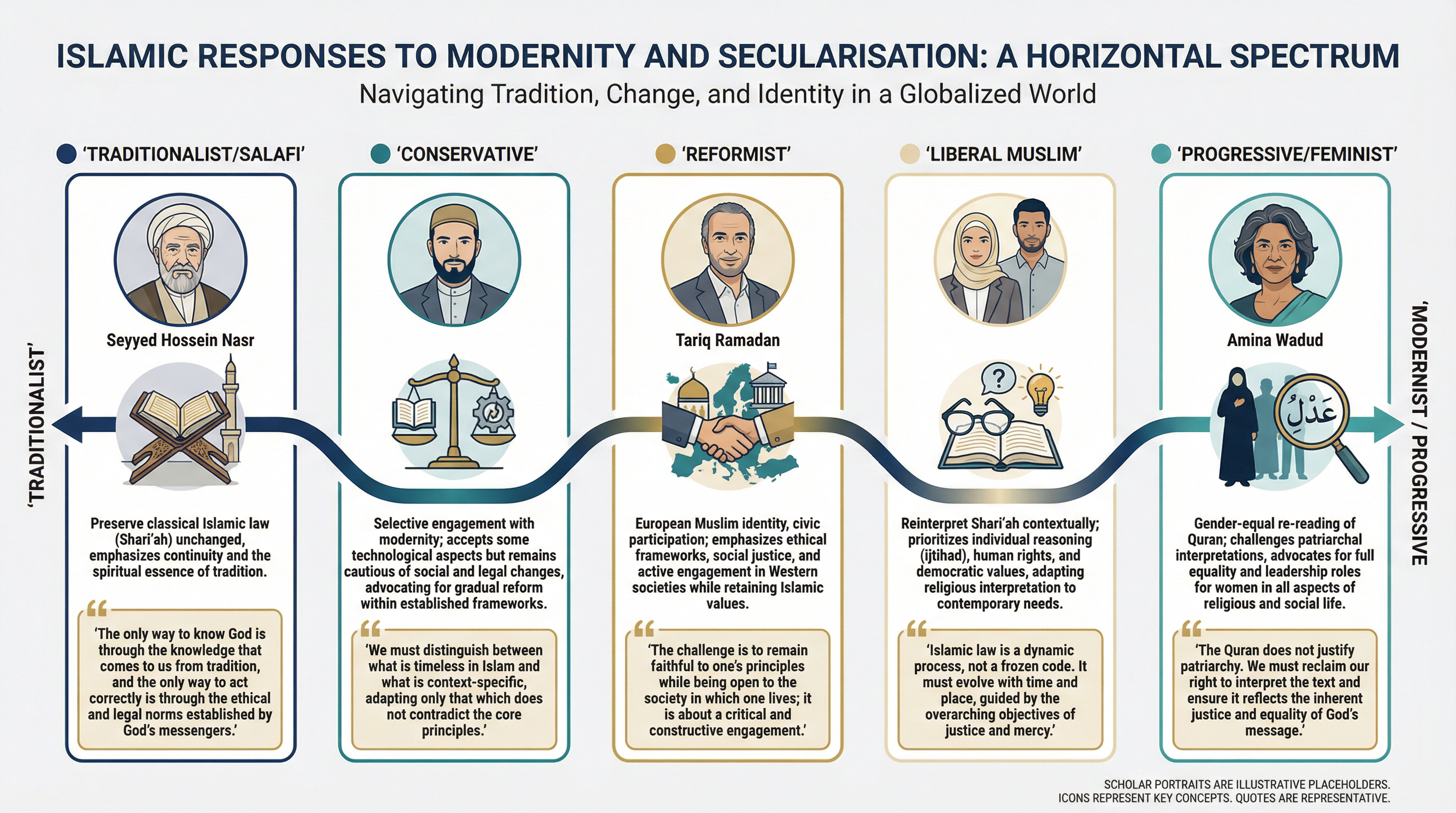
AQA A-Level Religious Studies Component 2A requires candidates to critically examine the relationship between Islamic theology and contemporary social structures. This topic spans four major themes: the nature and scope of Jihad, gender roles and feminist theology, the applicability of Shari'ah in secular Western democracies, and Muslim responses to religious pluralism and secularisation. Examiners expect candidates to demonstrate both accurate knowledge of Islamic sources — Quranic verses, Hadith, and scholarly opinion — and the ability to evaluate competing interpretations with philosophical rigour. The assessment objective weighting is decisive: AO1 (knowledge and understanding) carries 40% of marks, while AO2 (analysis and evaluation) carries 60%. Candidates who merely describe Islamic beliefs without sustained critical argument will be capped at the lower mark bands. The most successful responses engage directly with named scholars such as Tariq Ramadan, Seyyed Hossein Nasr, and Amina Wadud, cite specific Quranic verses by surah and verse number, and reach conclusions that follow logically from the evaluation rather than simply restating the introduction.

Key Themes and Developments
Theme 1: Jihad — Beyond the Military Definition
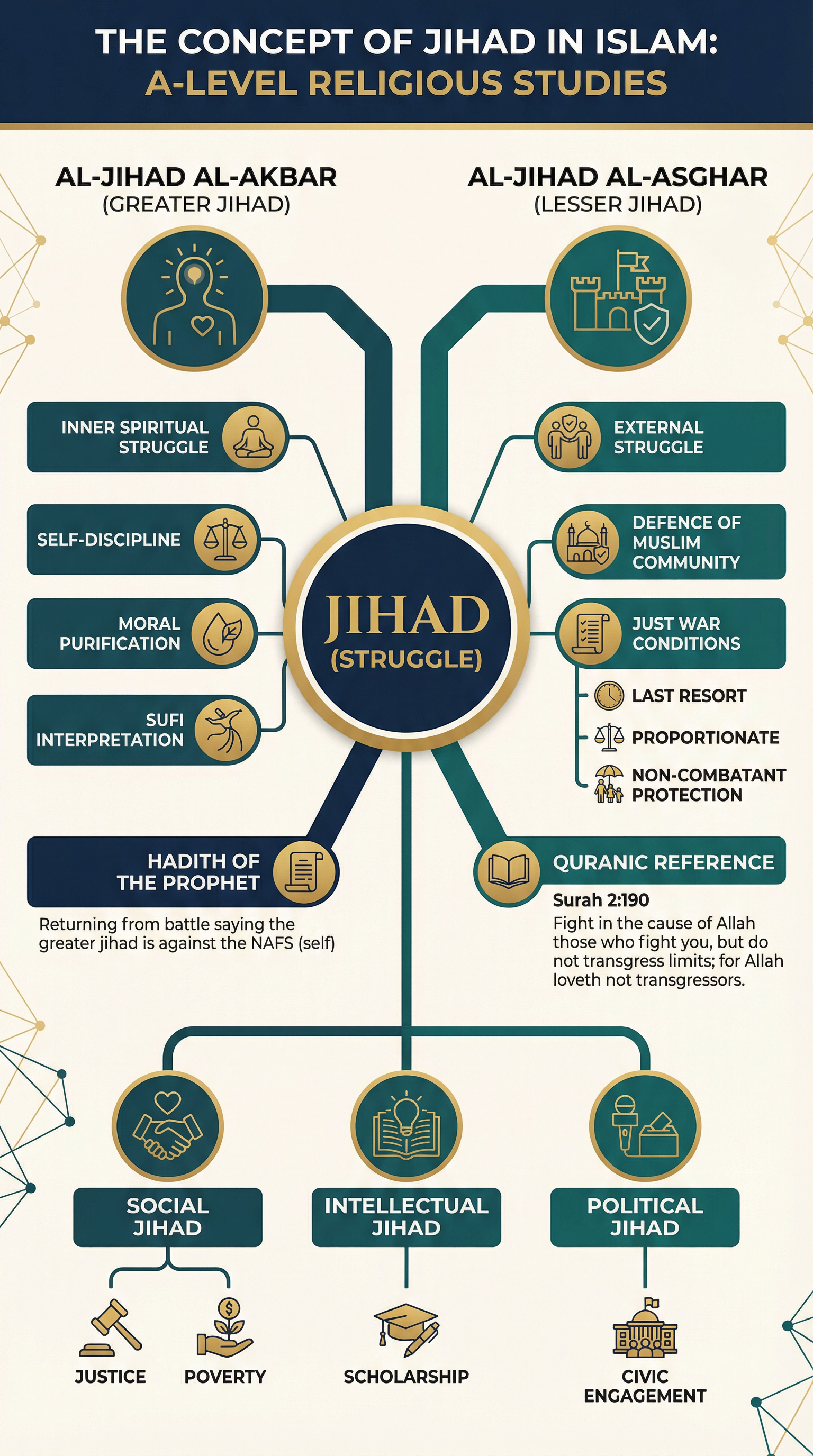
Core Concept: The Arabic term Jihad derives from the root jahada, meaning to strive or struggle. It is not synonymous with holy war, and examiners will credit candidates who establish this distinction clearly.
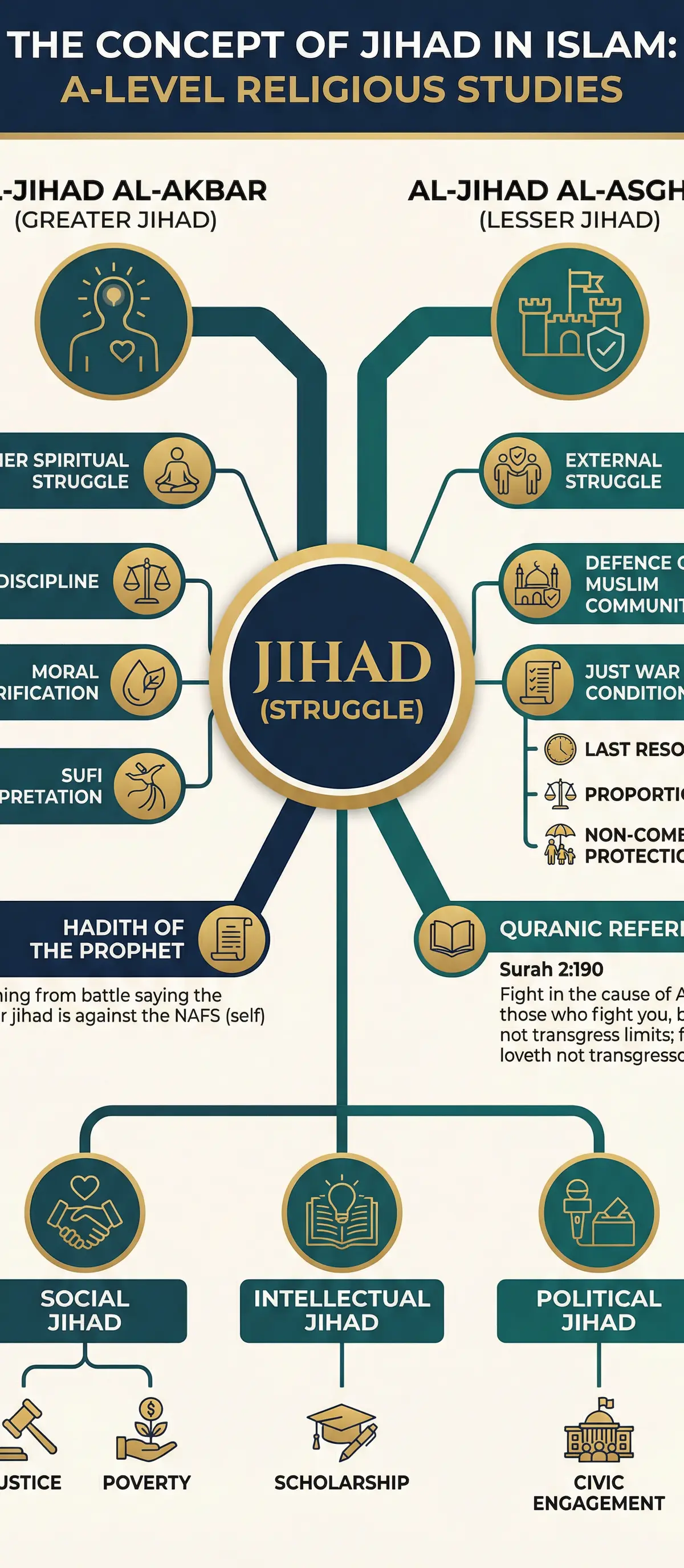
The Greater and Lesser Jihad: Classical Islamic scholarship distinguishes between Al-Jihad al-Akbar (the Greater Jihad) — the inner spiritual struggle against the ego, desires, and moral failings — and Al-Jihad al-Asghar (the Lesser Jihad) — external struggle, which may include armed defence under strict conditions. The distinction is grounded in a Hadith attributed to the Prophet Muhammad upon returning from battle: "We have returned from the lesser jihad to the greater jihad — the struggle against the self." Sufi traditions, particularly those associated with scholars such as Al-Ghazali (1058–1111), place overwhelming emphasis on the Greater Jihad as the authentic spiritual core of Islamic practice.
Specific Knowledge: Surah 2:190 sets conditions for armed struggle: "Fight in the cause of Allah those who fight you, but do not transgress limits; for Allah loveth not transgressors." Classical jurists derived five conditions for legitimate armed Jihad: just cause, last resort, proportionality, legitimate authority, and protection of non-combatants. These conditions closely parallel Western just war theory, a comparison examiners reward.
Contemporary Reinterpretation: Tariq Ramadan (b. 1962), in Western Muslims and the Future of Islam (2004), argues that Jihad in the contemporary context is primarily social and civic — combating poverty, injustice, and discrimination through democratic engagement. This represents a significant departure from classical military jurisprudence and is contested by traditionalist scholars.
Why It Matters: Questions on Jihad frequently appear as 10-mark 'Examine' questions. Candidates must move beyond the military definition and demonstrate awareness of spiritual, social, and political dimensions. Credit is awarded for linking Jihad to contemporary debates about Muslim identity in Western societies.
Theme 2: Shari'ah and Secular Democracy
Core Concept: Shari'ah (literally, 'the path to the watering hole') is the comprehensive ethical, legal, and spiritual framework derived from the Quran and Sunnah. It is not reducible to a penal code; it encompasses personal piety, family law, commercial ethics, and social justice.
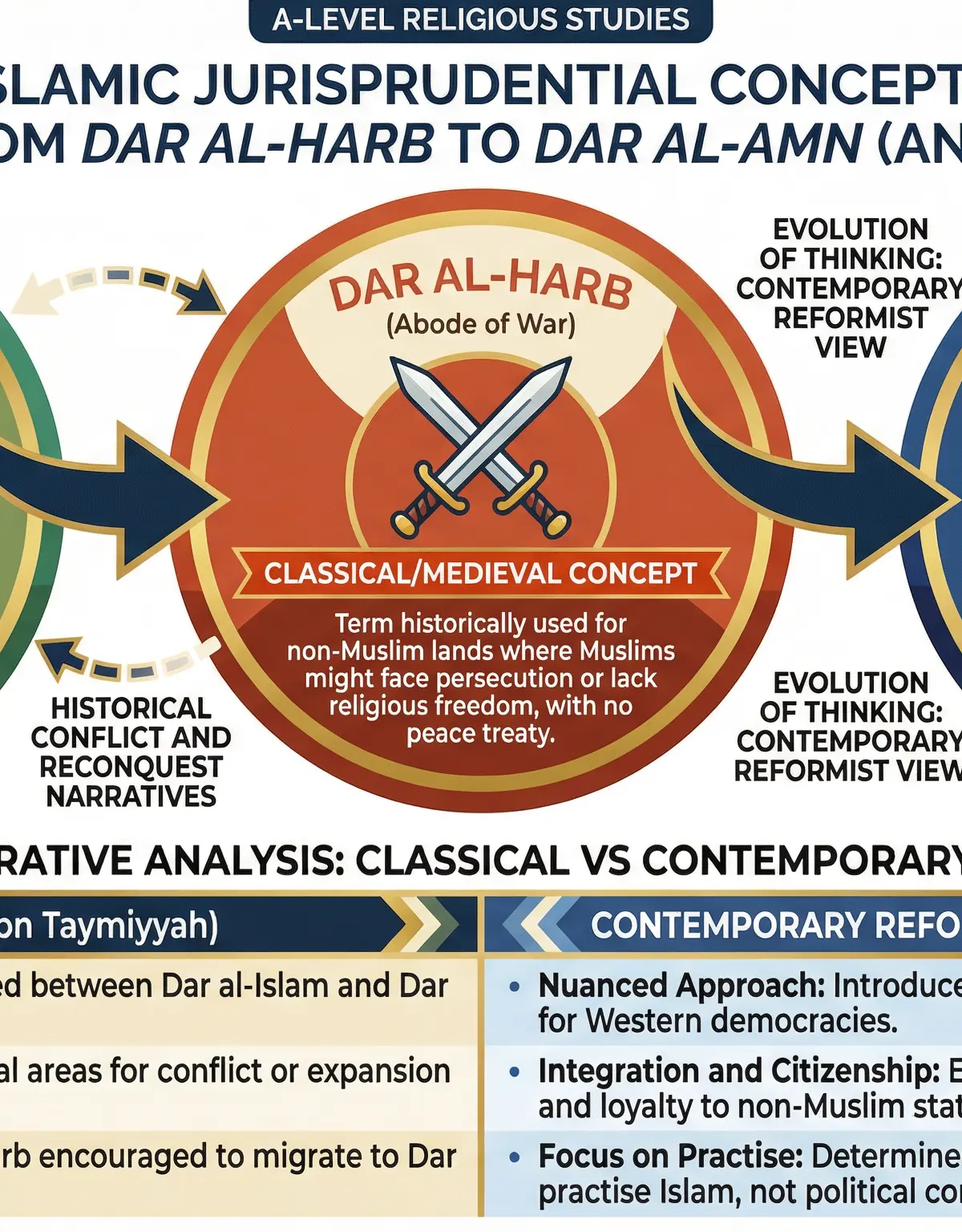
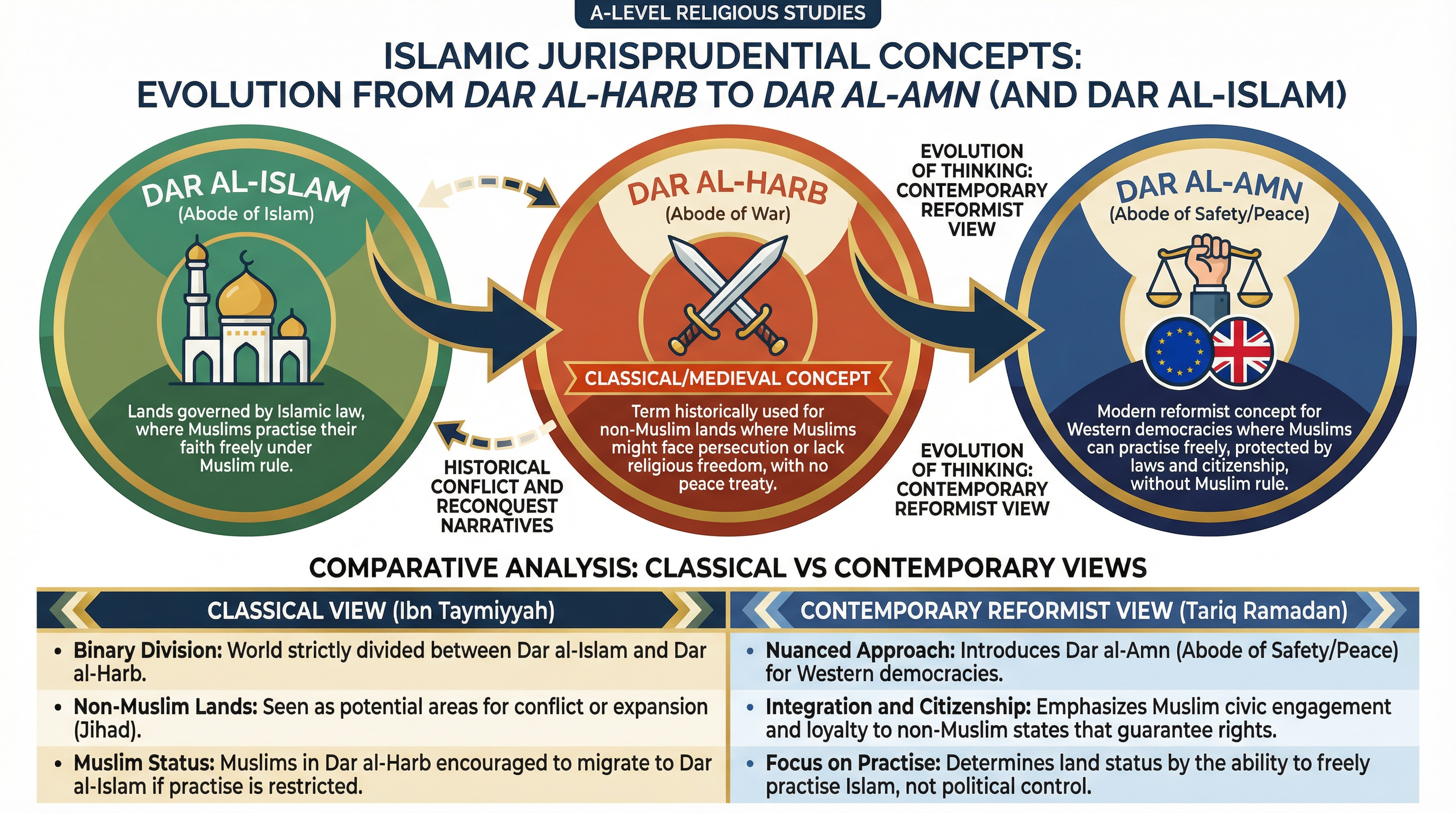
The Dar al-Harb / Dar al-Amn Debate: Classical Islamic jurisprudence divided the world into Dar al-Islam (the Abode of Islam, lands governed by Islamic law) and Dar al-Harb (the Abode of War, non-Muslim territories). Medieval scholars such as Ibn Taymiyyah (1263–1328) used this binary to argue that Muslims in non-Muslim lands faced an inherently hostile environment. Contemporary reformist scholars have challenged this framework fundamentally. Tariq Ramadan proposes Dar al-Amn (the Abode of Safety/Peace) as a more appropriate designation for Western liberal democracies, where Muslims can practise their faith freely, enjoy legal protections, and participate fully in civic life. This reframing has profound implications for questions of Muslim loyalty, citizenship, and political engagement.
Traditionalist Counter-Position: Seyyed Hossein Nasr (b. 1933), in The Heart of Islam (2002), argues that Shari'ah cannot be disaggregated from its divine source without losing its essential character. Nasr contends that modernity represents a 'spiritual crisis' rooted in the abandonment of the sacred, and that Islam must offer an alternative civilisational vision rather than accommodating itself to secular norms. For Nasr, the concept of ijtihad (independent legal reasoning) has limits — it cannot override the immutable principles of divine law.
Specific Knowledge: The Maqasid al-Shari'ah (objectives of Islamic law), systematised by Al-Ghazali and later by Ibn Ashur (1879–1973), identifies five protected values: life, intellect, lineage, property, and religion. Contemporary scholars use this framework to argue that Shari'ah's ultimate purpose — human flourishing — is compatible with, and even supportive of, democratic governance and human rights frameworks.
Theme 3: Gender Roles and Feminist Theology
Core Concept: The relationship between Islam and gender is one of the most contested areas of the specification. Candidates must distinguish carefully between theological precepts derived from Quranic sources and cultural practices that have been incorrectly attributed to Islamic teaching.
The Key Verse — Surah 4:34: This verse describes men as qawwamun over women, a term variously translated as 'protectors,' 'maintainers,' or 'guardians.' Traditional exegesis, represented by scholars such as Ibn Kathir (1301–1373), used this verse to establish male authority in the family structure. However, the interpretation of qawwamun is itself contested.
Amina Wadud's Feminist Hermeneutics: Amina Wadud (b. 1952), in Quran and Woman: Rereading the Sacred Text from a Woman's Perspective (1992), argues that qawwamun referred to a specific economic arrangement in seventh-century Arabia — men provided financial support (nafaqa) in exchange for a degree of household authority — and cannot be universalised as a permanent theological principle. Wadud advocates for a tawhidic paradigm of gender equality rooted in the Quranic principle that all human beings are equal before God (Surah 49:13). In 2004, Wadud controversially led mixed-gender Friday prayers in New York, an act that crystallised the debate between progressive and traditionalist positions.
Cultural Practice vs. Theological Precept: Examiners specifically credit candidates who distinguish between the Islamic institution of Mahr (the obligatory gift from husband to wife at marriage, a financial protection for women) and the South Asian cultural practice of dowry (a payment from the bride's family to the groom's). Conflating these is identified as a common error that will cost marks. Similarly, the practice of purdah (physical seclusion) is a cultural practice found in specific South Asian and Middle Eastern contexts, not a universal Quranic requirement.
Specific Knowledge: The Prophet Muhammad's first wife, Khadijah bint Khuwaylid (555–619 CE), was a successful merchant who employed him before their marriage — a historical fact frequently cited by Muslim feminists as evidence of women's economic agency in early Islam. The Prophet's wife Aisha bint Abi Bakr (613–678 CE) transmitted approximately 2,210 Hadith and led military campaigns, demonstrating female religious and political authority.
Theme 4: Religious Pluralism and Secularisation
Core Concept: How should Muslims relate to non-Muslim religious traditions and to secular political frameworks? This theme requires candidates to engage with both internal Islamic debates and broader philosophical questions about religious truth and tolerance.
Surah 2:256 and Religious Freedom: "There is no compulsion in religion; the right way has become distinct from the wrong way." This verse is foundational to Islamic discussions of religious pluralism. Classical scholars interpreted it narrowly, as prohibiting forced conversion of non-Muslims under Islamic governance. Contemporary scholars such as Ramadan interpret it as a universal principle of religious liberty that supports Muslim engagement with pluralist democratic societies.
Nasr's Perennial Philosophy: Seyyed Hossein Nasr draws on the philosophia perennis tradition, arguing that all major religious traditions share a common esoteric core and that Islam, properly understood, affirms the validity of other revealed religions. This position, known as inclusivism, contrasts with exclusivist positions that hold Islam to be the sole path to salvation. Nasr's approach has been criticised by traditionalist Sunni scholars as philosophically compromised by Western academic frameworks.
Secularisation as Challenge: The secularisation thesis — the sociological claim that modernisation leads to the declining social significance of religion — poses a specific challenge to Islamic communities in Western Europe. Nasr views secularisation as catastrophic, a symptom of modernity's rejection of the sacred. Ramadan, by contrast, argues that secularism as a political framework (the separation of religious and state authority) is not inherently hostile to Muslim practice and can in fact protect religious freedom.
Key Individuals
Tariq Ramadan (b. 1962)
Role: Swiss-born Muslim scholar, grandson of Hassan al-Banna (founder of the Muslim Brotherhood), Professor of Contemporary Islamic Studies at the University of Oxford (2009–2018).
Key Works: Western Muslims and the Future of Islam (2004); Radical Reform: Islamic Ethics and Liberation (2009).
Key Arguments: Muslims in Western democracies inhabit Dar al-Amn and should engage fully as citizens; Shari'ah's principles are compatible with democratic values; Jihad in the contemporary context is primarily social and civic; ijtihad must be applied to contemporary challenges.
Impact: Ramadan's work is central to AQA Component 2A. His reformist position provides the primary counter-argument to traditionalist positions. Examiners reward precise citation of his arguments.
Seyyed Hossein Nasr (b. 1933)
Role: Iranian-American philosopher, University Professor of Islamic Studies at George Washington University. Leading voice of Islamic traditionalism and perennial philosophy.
Key Works: The Heart of Islam (2002); Islam and the Plight of Modern Man (1975); Knowledge and the Sacred (1981).
Key Arguments: Modernity represents a spiritual crisis; Shari'ah cannot be reinterpreted through secular frameworks without distortion; Islamic civilisation offers a holistic sacred alternative to Western materialism; the perennial philosophy affirms a common esoteric core across religious traditions.
Impact: Nasr provides the traditionalist pole in AO2 evaluations. His critique of modernity is philosophically sophisticated and examiners reward engagement with his specific arguments rather than generic 'traditionalist' labels.
Amina Wadud (b. 1952)
Role: American Muslim scholar, Professor Emerita of Islamic Studies at Virginia Commonwealth University. Leading figure in Islamic feminist theology.
Key Works: Quran and Woman: Rereading the Sacred Text from a Woman's Perspective (1992); Inside the Gender Jihad (2006).
Key Arguments: Quranic interpretation has been dominated by male scholars; a gender-equal hermeneutics reveals the Quran's commitment to justice for all; qawwamun in Surah 4:34 is contextually specific, not a universal principle; women can and should lead mixed-gender prayer.
Impact: Wadud is the primary scholarly voice for Islamic feminist theology in this specification. Her 1992 work and 2004 prayer leadership are specific events examiners expect candidates to know.
Second-Order Concepts
Causation
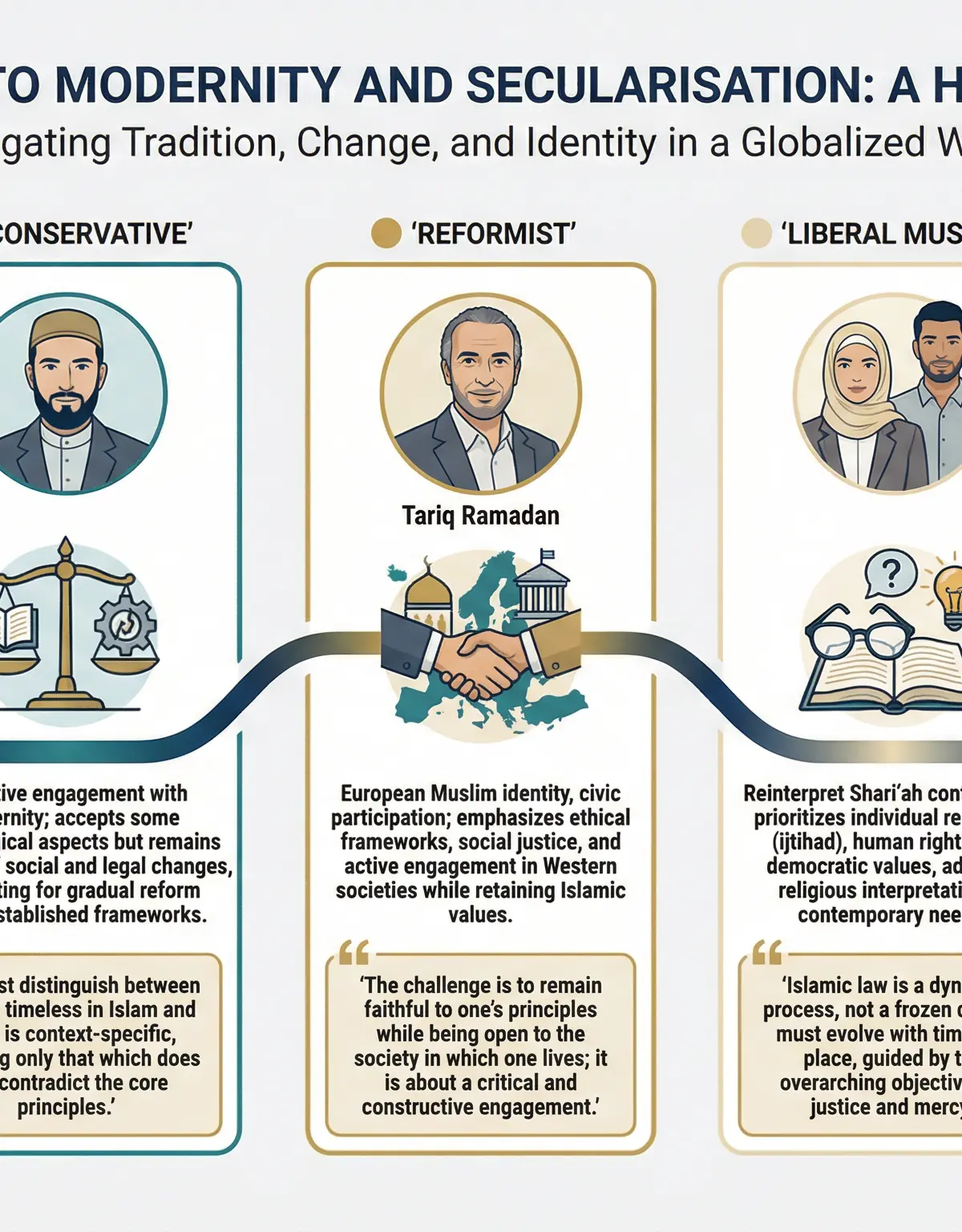
The diversity of Muslim responses to modernity is caused by multiple intersecting factors: the colonial disruption of classical Islamic scholarship in the 19th and 20th centuries; the emergence of Muslim minority communities in Western Europe following post-war migration; the global communication of Islamic ideas via digital media; and the political crises in Muslim-majority states that have prompted both revivalist and reformist responses. No single cause explains the spectrum from Nasr's traditionalism to Wadud's progressivism.
Consequence
The debates examined in this topic have concrete social consequences: the legal status of Shari'ah-compliant finance in British courts; the accommodation of religious dress codes in secular workplaces; the role of Muslim scholars in public policy debates on extremism; and the emergence of female-led mosques and prayer spaces in Western Europe. Examiners reward candidates who connect theological arguments to real-world social outcomes.
Change and Continuity
What has changed is the context: Muslims now constitute significant minorities in Western liberal democracies, a situation without direct classical precedent. What has remained continuous is the methodological framework of Islamic jurisprudence — the Quran, Sunnah, ijma (consensus), and qiyas (analogy) — even as scholars disagree profoundly about how to apply these sources to contemporary questions.
Significance
This topic is historically significant because it represents one of the most important intellectual and social negotiations of the 21st century: how a major world religious tradition adapts to, challenges, and is transformed by the conditions of late modernity. For AQA candidates, its significance lies in its capacity to generate genuinely contested AO2 questions where multiple defensible positions exist.
Visual Resources
3 diagrams and illustrations
Interactive Diagrams
3 interactive diagrams to visualise key concepts
Conceptual Flow Outline
Three main positions in Islamic responses to modernity, with key scholars and arguments
Conceptual Flow Outline
The two dimensions of Jihad and their sub-categories
Diagram could not be rendered
Timeline of key scholars and publications in Islam and Society
Worked Examples
3 worked examples — open one to explore the question and available guidance.
Practice Questions
Test your understanding — click to reveal model answers
Examine the view that Shari'ah is incompatible with life in a Western secular democracy. (10 marks)
Hint: Consider both the traditionalist position (Nasr) and the reformist position (Ramadan). Use the Dar al-Harb / Dar al-Amn distinction and the concept of ijtihad. Cite Quranic verses where relevant.
Evaluate the claim that Islam is a religion that oppresses women. (15 marks)
Hint: This question requires careful distinction between theological precepts and cultural practices. Use Amina Wadud's feminist hermeneutics, the traditionalist position, and specific Quranic verses. Link to ethical theories (Kantian dignity, utilitarian outcomes). Your conclusion must reach a specific judgement.
Examine the concept of the Greater Jihad in Islamic thought. (10 marks)
Hint: Focus on the spiritual dimension of Jihad. Use the Hadith on returning from battle, Al-Ghazali's Sufi perspective, and contrast with the Lesser Jihad. Demonstrate awareness of how this concept challenges popular misconceptions.
Evaluate the view that Tariq Ramadan's concept of Dar al-Amn is the most appropriate framework for Muslim life in Western Europe. (15 marks)
Hint: Evaluate Ramadan's framework against the classical Dar al-Harb position and Nasr's traditionalist critique. Consider the practical implications for Muslim civic engagement. Link to philosophical frameworks where relevant.
Examine the significance of Amina Wadud's contribution to Islamic feminist theology. (10 marks)
Hint: Focus on Wadud's hermeneutical method, her reinterpretation of Surah 4:34, the tawhidic paradigm, and the significance of her 2004 prayer leadership. Contrast with traditionalist responses.