AQA · GCSE · Religious Studies
Applying Religious Teachings to Contemporary Issues
This study guide provides a comprehensive breakdown of how to apply Christian teachings to contemporary ethical issues for AQA GCSE Religious Studies. It is designed to help students master the AO2 skills required to analyse, evaluate, and construct well-supported arguments, moving beyond simplistic statements to achieve top-level marks.
- 10 min read
- 3 worked examples
- 5 practice questions
- 6 key terms
Study Notes

Overview
This section of the AQA GCSE Religious Studies specification (Specification A) is designed to test your ability to apply religious beliefs, teachings, and sources of wisdom to a range of complex contemporary ethical themes. It accounts for 50% of your final grade, making it crucial for success. Examiners are not just looking for you to state what a religion teaches; they want to see you engage critically with these teachings, exploring the diversity of views within a religion (specifically Christianity and one other) and constructing sophisticated, well-reasoned arguments. You will be expected to analyse issues such as medical ethics, war and peace, crime and punishment, and human rights, demonstrating a nuanced understanding of how ancient wisdom is interpreted and applied in the modern world. This guide will equip you with the specific knowledge, analytical frameworks, and exam techniques needed to excel in this challenging but fascinating area of study.

Key Concepts: The Foundations of Ethical Application
To master this topic, you must understand the core principles that underpin religious ethical reasoning. These are the building blocks of any strong argument in the exam.
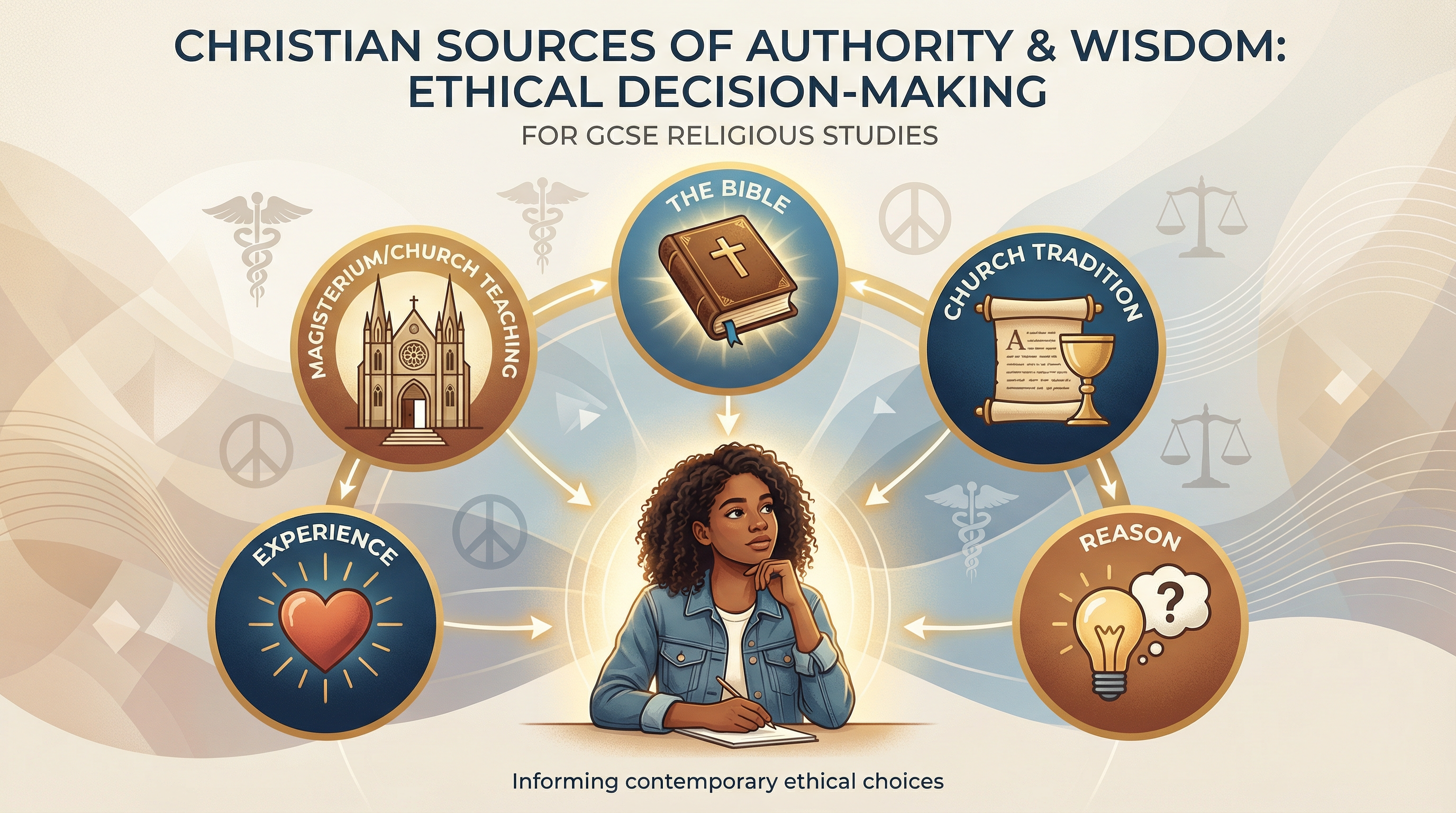
Sources of Wisdom and Authority
When constructing an argument, you must ground your points in recognised sources of religious authority. For Christianity, these are not all equal, and different denominations place emphasis on different sources. A top-level answer will show awareness of this hierarchy.
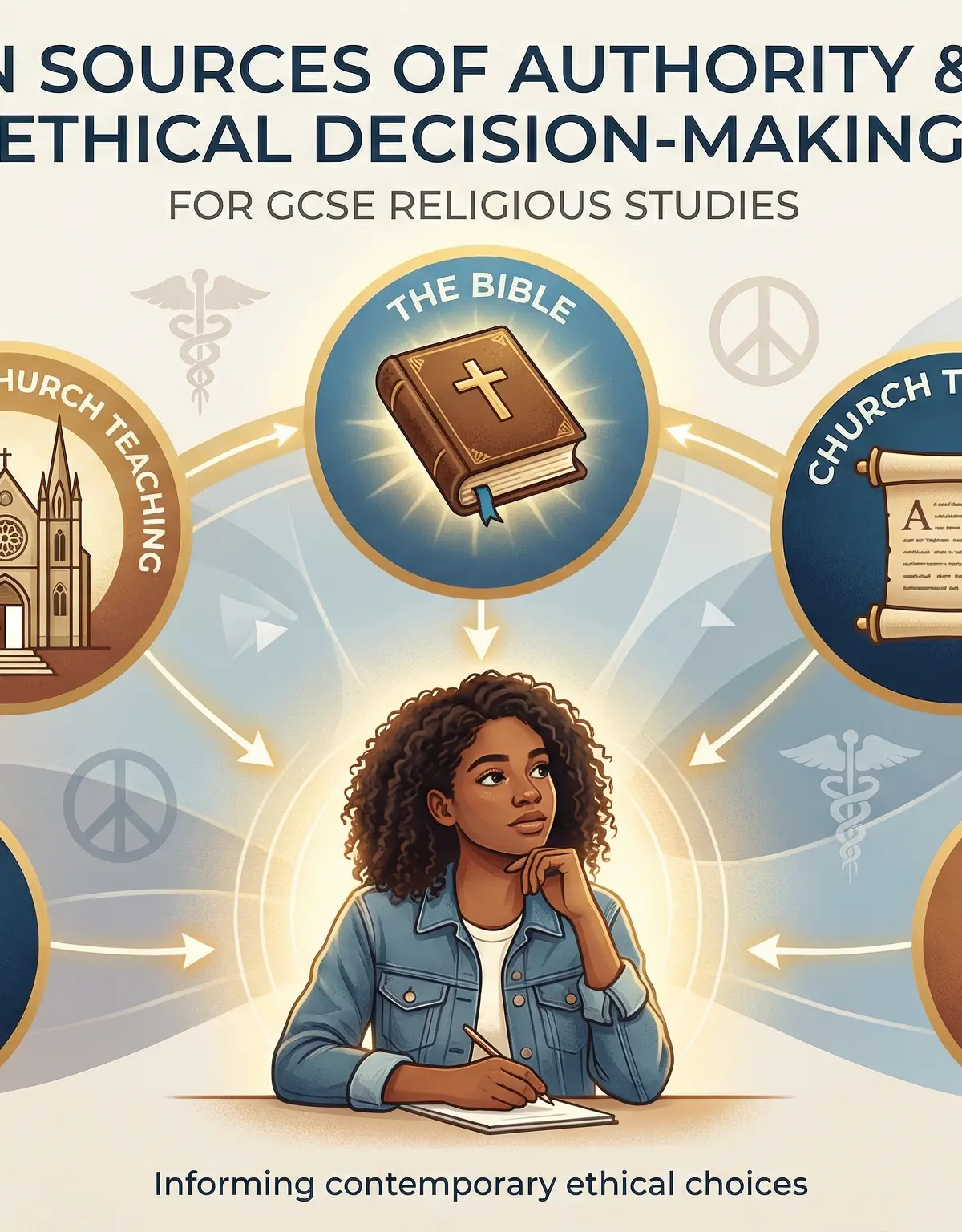
- The Bible: The primary source for all Christians, containing the Old and New Testaments. It includes law, history, prophecy, and the teachings of Jesus. Examiners expect you to cite specific books and, ideally, chapters (e.g., Genesis 1, Matthew 5). A key skill is interpreting scripture, as some passages are taken literally while others are seen as symbolic.
- Church Tradition: The accumulated wisdom and practices of the Church throughout history. For Roman Catholics and Anglicans, this is a vital source of authority, encompassing the writings of early Church Fathers, the decisions of Ecumenical Councils, and established liturgical practices.
- Reason: The use of logic and intellect to understand God and make moral decisions. Thinkers like Thomas Aquinas argued that reason is a gift from God and should be used to interpret scripture and tradition. It allows believers to apply ancient teachings to new problems like genetic engineering.
- Experience: The personal, lived experience of faith. For many modern Christians, personal conscience and the feeling of the Holy Spirit's guidance are important factors in decision-making. This is particularly significant in Pentecostal and charismatic traditions.
- The Magisterium: For Roman Catholics, this is the official teaching authority of the Church, vested in the Pope and the bishops. Documents like Papal Encyclicals (e.g., Laudato Si') and the Catechism of the Catholic Church are considered authoritative guidance.
Denominational Diversity
One of the biggest mistakes candidates make is writing 'Christians believe...'. This is a gross oversimplification. You MUST show awareness of the rich diversity of views within Christianity. Examiners award significant credit for distinguishing between denominational perspectives.
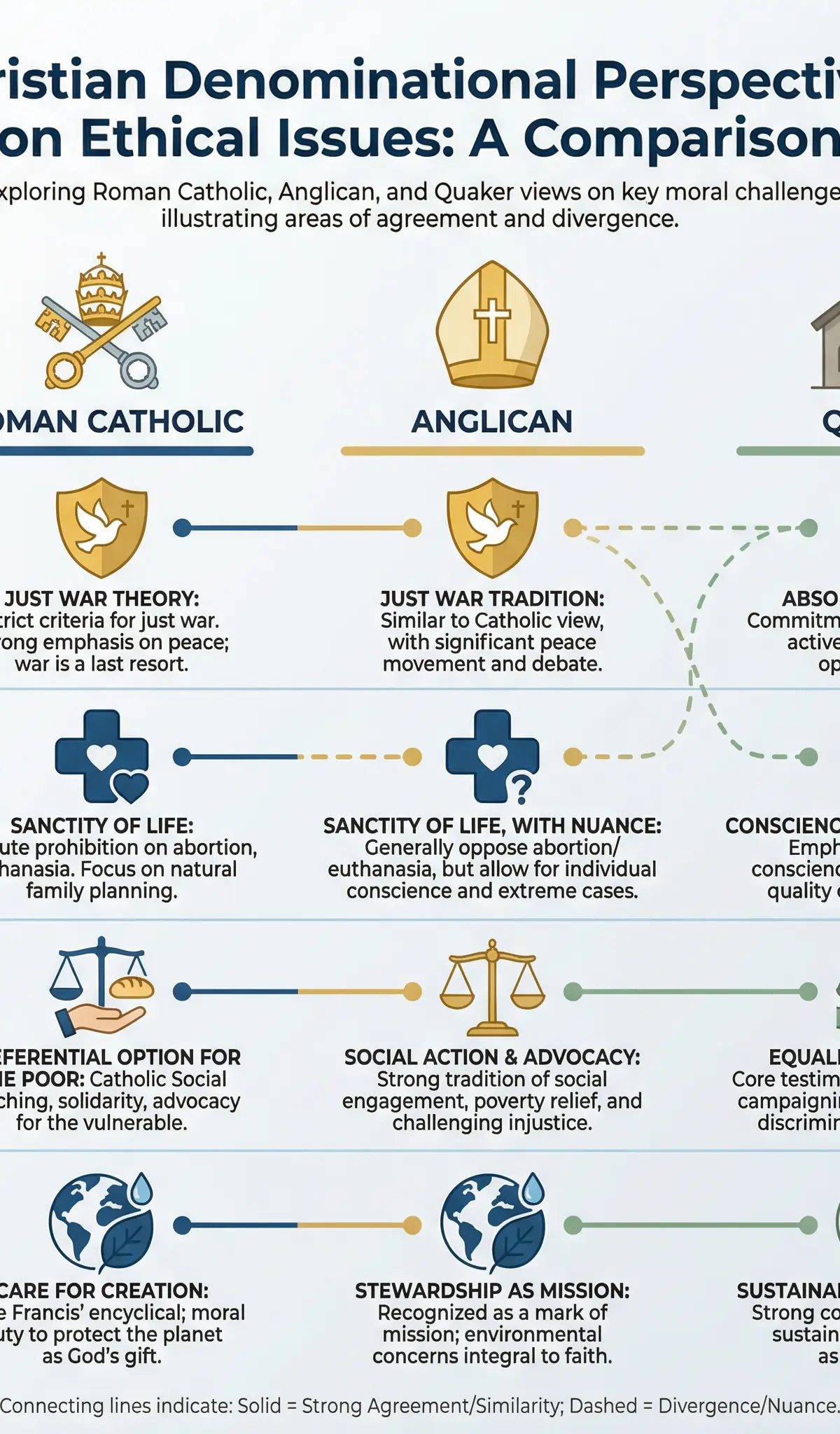
- Roman Catholic: The largest Christian denomination, with a clear hierarchical structure headed by the Pope. Ethical teaching is strongly based on the Magisterium, Tradition, and Natural Law theory. Stances on issues like abortion and euthanasia are generally absolute and based on the sanctity of life from conception to natural death.
- Anglican (Church of England): As the established church in England, it often seeks a 'middle way' (via media) between Catholic and Protestant traditions. It values scripture, tradition, and reason (the 'three-legged stool'). There is more room for individual conscience and debate on ethical issues compared to Catholicism, leading to a wider range of views on topics like divorce and homosexuality.
- Quaker (Religious Society of Friends): A non-conformist denomination with no formal creed or clergy. They believe in the 'inner light' of God in everyone. This leads to a strong emphasis on conscience, simplicity, and equality. Quakers are absolute pacifists and are deeply involved in social justice and environmental activism.
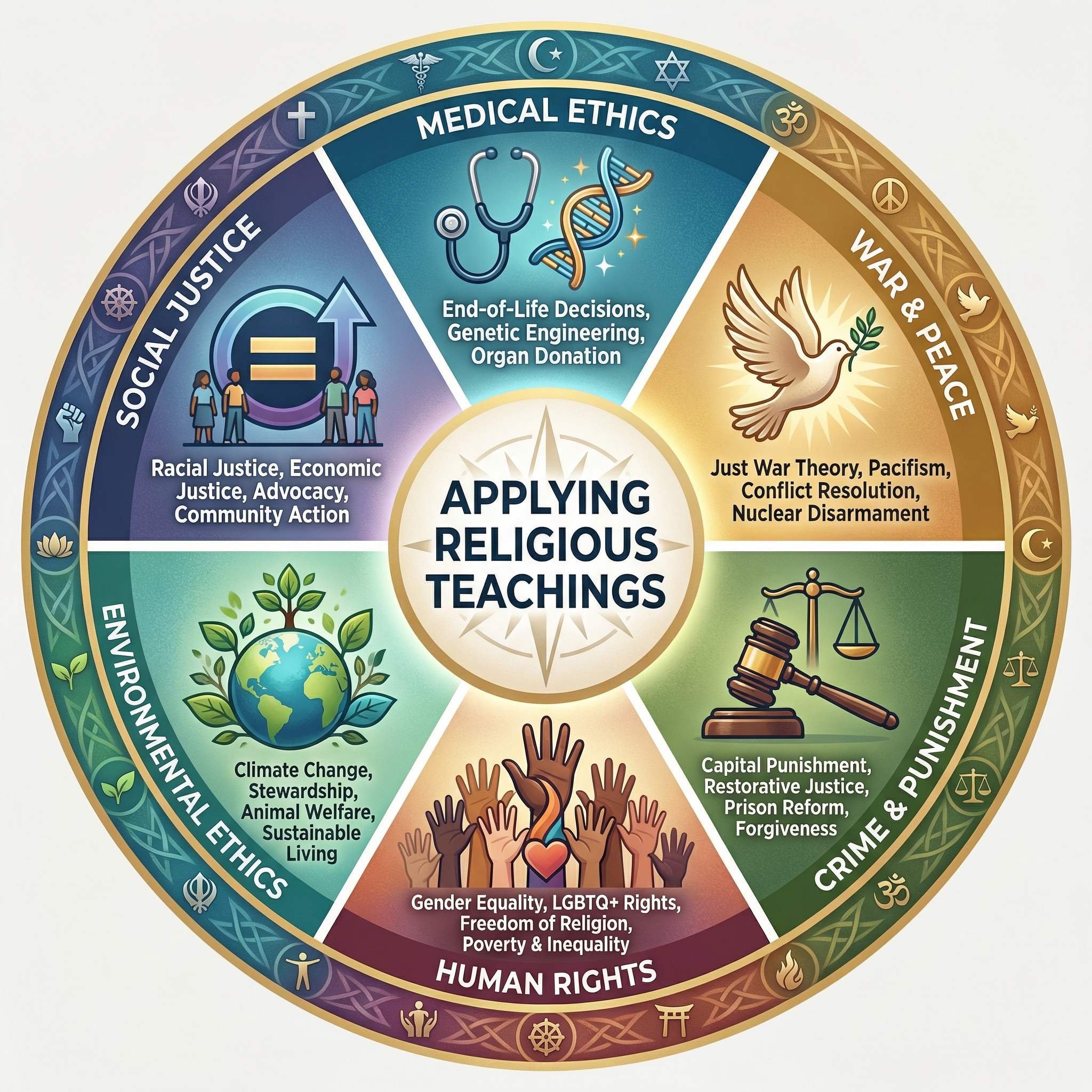
Contemporary Ethical Themes Explored
This section breaks down the key themes you will be tested on, providing the specific knowledge and religious perspectives you need.
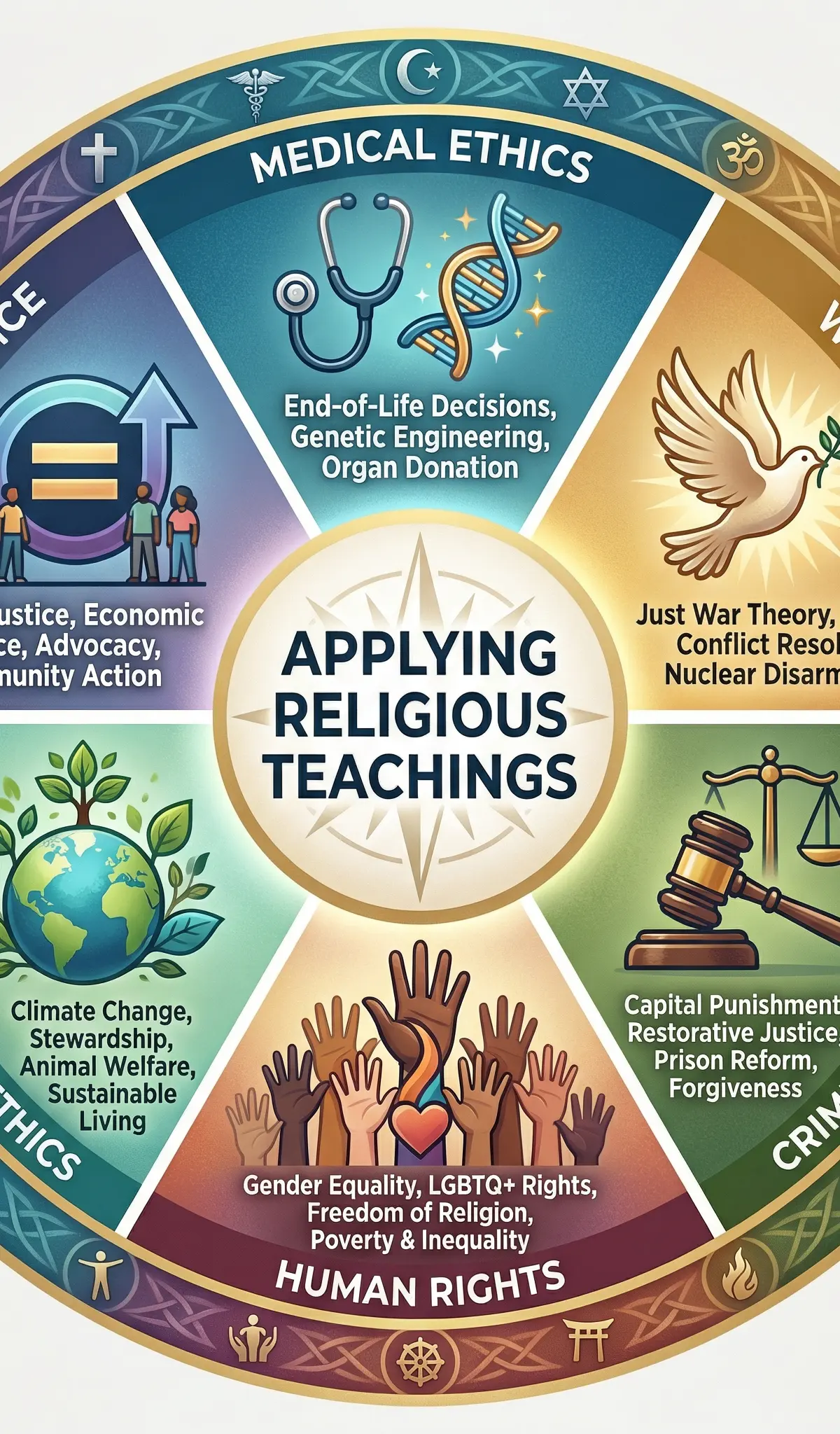
1. Medical Ethics
- Core Issues: Abortion, euthanasia, genetic engineering, organ donation.
- Key Concepts: Sanctity of Life vs. Quality of Life, Stewardship, Imago Dei (Image of God), Agape (selfless love).
- Christian Perspectives:
- Sanctity of Life: The belief that all life is sacred and belongs to God. This is a foundational principle, often linked to Genesis 1:27 ('So God created mankind in his own image'). It underpins the strong Roman Catholic opposition to abortion and euthanasia, which are seen as usurping God's authority over life and death. The Catechism states, 'Human life must be respected and protected absolutely from the moment of conception.' [1]
- Quality of Life: Some liberal Christians, particularly within the Anglican tradition, may argue that the quality of a person's life is also a valid consideration. They might argue that keeping a person alive in a permanent vegetative state with no hope of recovery does not reflect a loving or compassionate God. This is often linked to the principle of Agape.
- Stewardship: In the context of genetic engineering, this concept is crucial. Are humans using their God-given intellect to cure disease (good stewardship), or are they 'playing God' by altering the fundamental building blocks of life (bad stewardship)? There is no single Christian view on this.
2. War and Peace
- Core Issues: Just War Theory, Pacifism, Nuclear Weapons, Conflict Resolution.
- Key Concepts: Justice, Peace (Shalom), Forgiveness, Reconciliation.
- Christian Perspectives:
- Just War Theory: First articulated by St. Augustine and developed by Thomas Aquinas, this is not a theory for justifying war, but a set of strict criteria to determine if a war could be morally permissible. It is the dominant view in the Roman Catholic and Anglican churches. Key criteria include: Just Cause, Legitimate Authority, Right Intention, Last Resort, Proportionality, and Reasonable Chance of Success. You must be able to explain and apply these.
- Pacifism: The belief that all violence and war are wrong. The primary example is the Quaker tradition, which bases its absolute pacifism on Jesus's teachings in the Sermon on the Mount, such as 'Blessed are the peacemakers' (Matthew 5:9) and 'Turn the other cheek' (Matthew 5:39). Many early Christians were pacifists.
- Nuclear Disarmament: Most Christian denominations condemn the use of nuclear weapons as they are indiscriminate and violate the principle of proportionality. The Church of England has called for multilateral disarmament.
3. Crime and Punishment
- Core Issues: Capital Punishment, Prison Reform, Forgiveness, Restorative Justice.
- Key Concepts: Retribution, Deterrence, Reformation, Justice.
- Christian Perspectives:
- Retribution vs. Reformation: Does the punishment fit the crime ('an eye for an eye' - Exodus 21:24), or should the focus be on reforming the offender? While the Old Testament contains retributive principles, the New Testament, particularly the teachings of Jesus, emphasizes forgiveness and restoration. Jesus's statement, 'Let any one of you who is without sin be the first to throw a stone at her' (John 8:7), is a powerful challenge to harsh punishment.
- Capital Punishment: Most Christians today oppose the death penalty. The Roman Catholic Church, under Pope Francis, has declared it 'inadmissible' in all cases. The Church of England also opposes it, arguing that it is a denial of the potential for reformation and forgiveness. However, some fundamentalist Christians may support it, citing Old Testament laws.
- Forgiveness: A central Christian virtue. The Parable of the Unforgiving Servant (Matthew 18) teaches that humans should forgive others as God has forgiven them. This inspires many Christians to work as prison chaplains or support restorative justice programmes that bring offenders and victims together.
4. Human Rights & Social Justice
- Core Issues: Racial Justice, Gender Equality, LGBTQ+ Rights, Poverty, Wealth Distribution.
- Key Concepts: Imago Dei, Agape, Justice, Equality, Liberation Theology.
- Christian Perspectives:
- Imago Dei: The belief that all humans are made in the image of God (Genesis 1:27) is the bedrock of Christian support for human rights. It means every individual has intrinsic dignity and worth, regardless of race, gender, or any other characteristic. This is your 'utility quote' for any human rights question.
- Social Justice: The Parable of the Sheep and the Goats (Matthew 25:31-46) is a powerful call to action: 'whatever you did for one of the least of these brothers and sisters of mine, you did for me.' This inspires Christians to challenge unjust structures and advocate for the poor and marginalized. Organisations like Christian Aid and CAFOD put this teaching into practice.
- Divergent Views: While the principle of Imago Dei is universal, its application is not. There are significant disagreements within Christianity on issues like gender roles and LGBTQ+ inclusion. For example, the Roman Catholic Church does not ordain women, whereas the Anglican and many Protestant churches do. You must be able to explain these different interpretations of scripture and tradition.
References
[1] Catechism of the Catholic Church, 2270. Vatican City: Libreria Editrice Vaticana.
Visual Resources
3 diagrams and illustrations
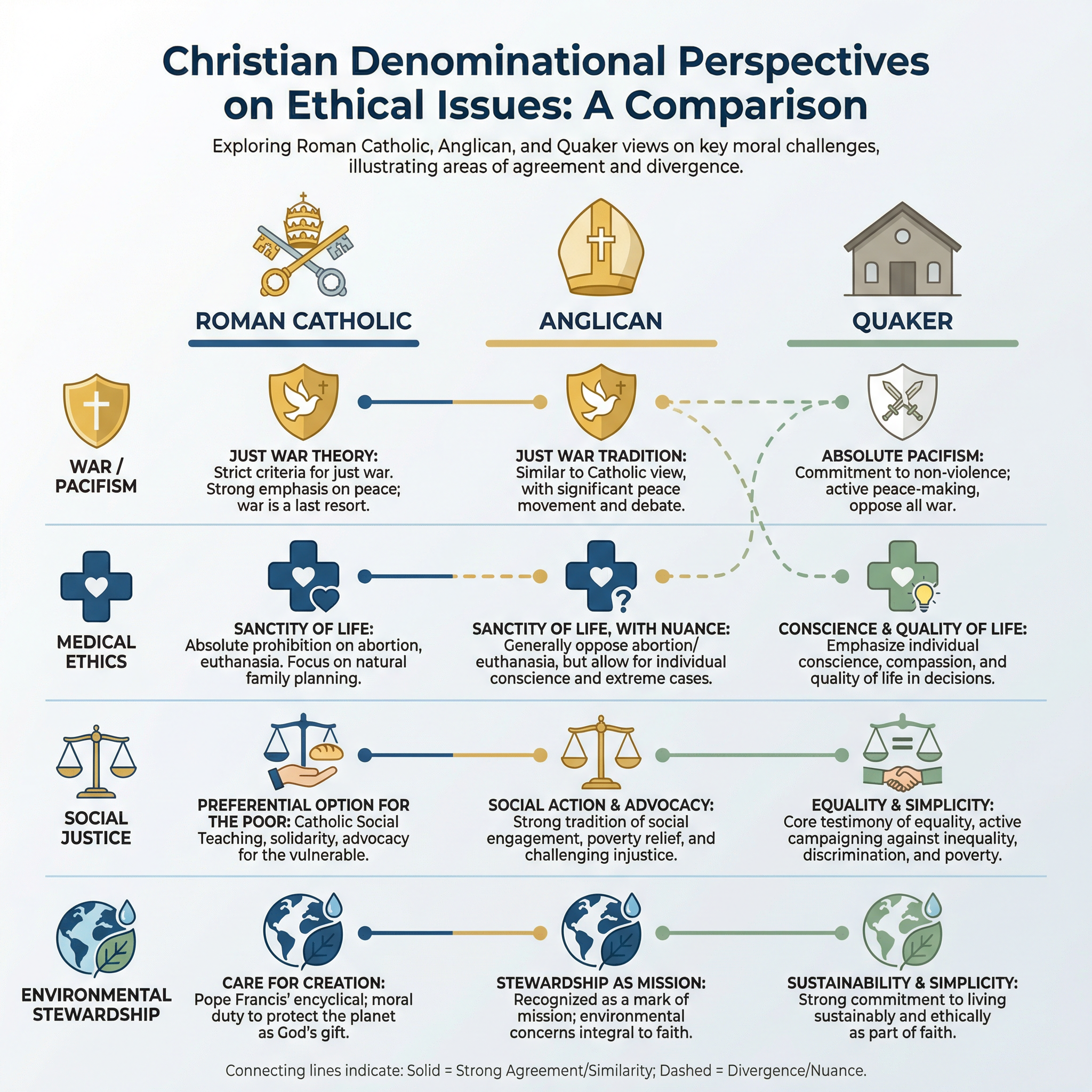
Interactive Diagrams
1 interactive diagram to visualise key concepts
Conceptual Flow Outline
A flowchart showing how different sources of authority can lead to divergent conclusions on an ethical issue like euthanasia.
Worked Examples
3 worked examples — open one to explore the question and available guidance.
Practice Questions
Test your understanding — click to reveal model answers
‘The principle of the sanctity of life is the most important factor for a Christian when making decisions about abortion.’ Evaluate this statement. (12 marks)
Hint: Consider the absolute view of the sanctity of life (Catholic) versus a more nuanced view that might consider quality of life or the mother's wellbeing (Liberal Protestant). Use the concept of Agape as a counterpoint.
Explain two religious beliefs about social justice. Refer to sacred writings in your answer. (5 marks)
Hint: Think about the duty to help the poor and challenging unjust systems. Use a parable and a quote from the Old Testament.
‘Forgiveness is the most important part of Christian teaching on crime and punishment.’ Evaluate this statement. (12 marks)
Hint: Contrast the New Testament emphasis on forgiveness (e.g., the Lord's Prayer, Parable of the Unforgiving Servant) with the need for justice and protection of society (e.g., Romans 13).
Explain two contrasting Christian beliefs about human sexuality. Refer to sacred writings or another source of religious belief and teaching in your answer. (5 marks)
Hint: Contrast the traditional view based on Genesis and St. Paul with a modern, liberal view based on love and inclusion.
Explain two religious beliefs about stewardship of the environment. Refer to sacred writings or another source of religious belief and teaching in your answer. (5 marks)
Hint: Use the key concept of Stewardship from Genesis and a modern source like a Papal Encyclical.