OCR · GCSE · Religious Studies
Key beliefs of Sikhism
This study guide delves into the core theological beliefs of Sikhism for OCR GCSE Religious Studies. It is designed to build a precise understanding of concepts like the Mool Mantar, the nature of God, and the human journey towards liberation, equipping students to secure top marks.
- 5 min read
- 3 worked examples
- 3 practice questions
- 6 key terms
Study Notes
Overview
This unit explores the foundational beliefs of Sikhism, a monotheistic religion founded in the Punjab region of India in the 15th century by Guru Nanak. For the OCR J625 specification, candidates must demonstrate a precise understanding of Sikh theology, moving beyond surface-level descriptions. The central axiom of Sikh belief is the Mool Mantar, which defines the nature of the one God, Waheguru. Examiners expect you to explore the dual nature of God as both Nirgun (transcendent, without attributes) and Sargun (immanent, with attributes), and to understand the human condition as a struggle between being Manmukh (self-facing) and becoming Gurmukh (God-facing). The ultimate aim is to achieve Mukti (liberation) from the cycle of Samsara. This guide will provide the specific knowledge, terminology, and analytical skills needed to explain these concepts with the depth required for high-level responses. You will also find a podcast to support your revision.
Key Beliefs & Concepts
The Nature of God: Ik Onkar, Nirgun & Sargun
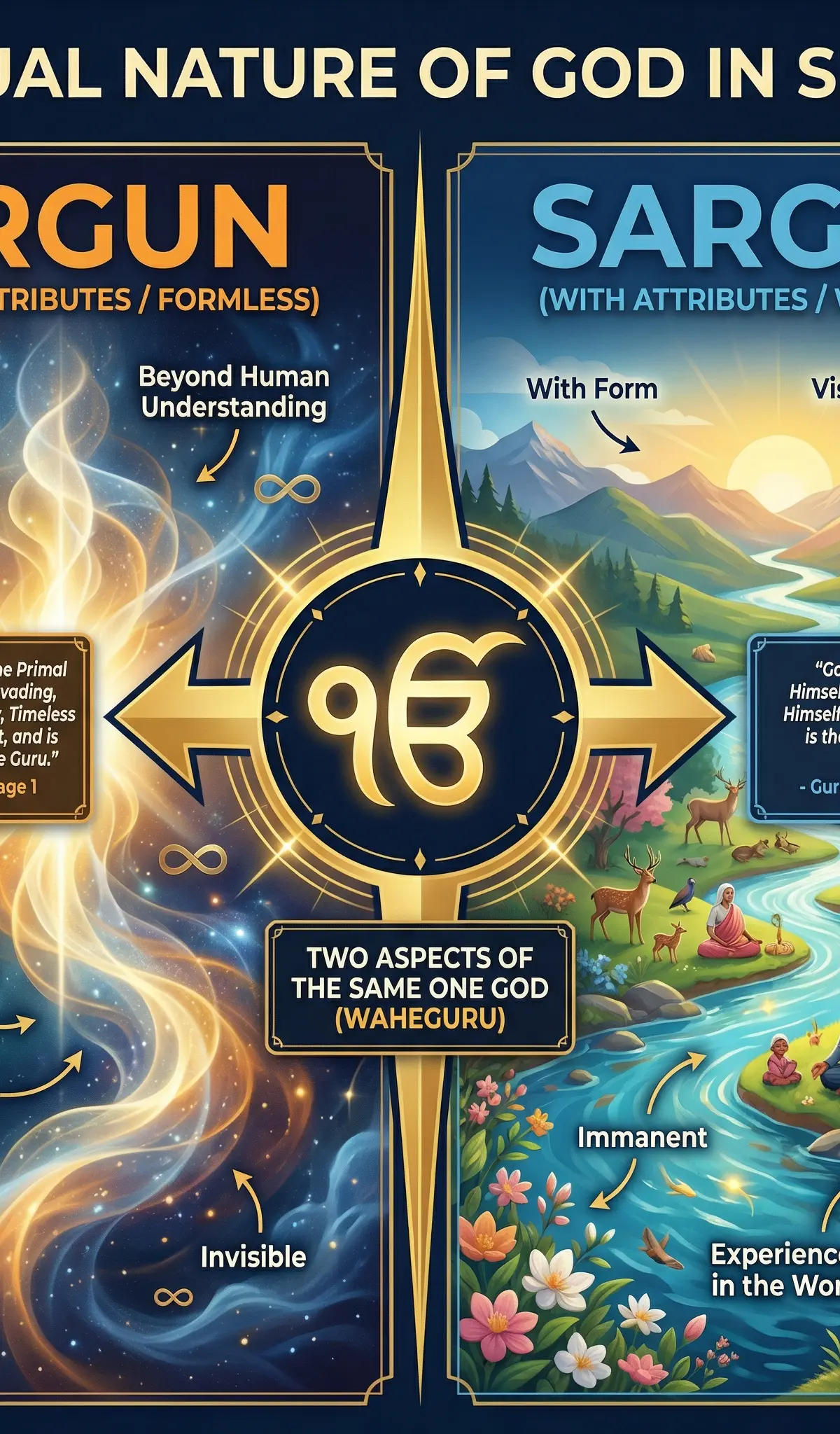
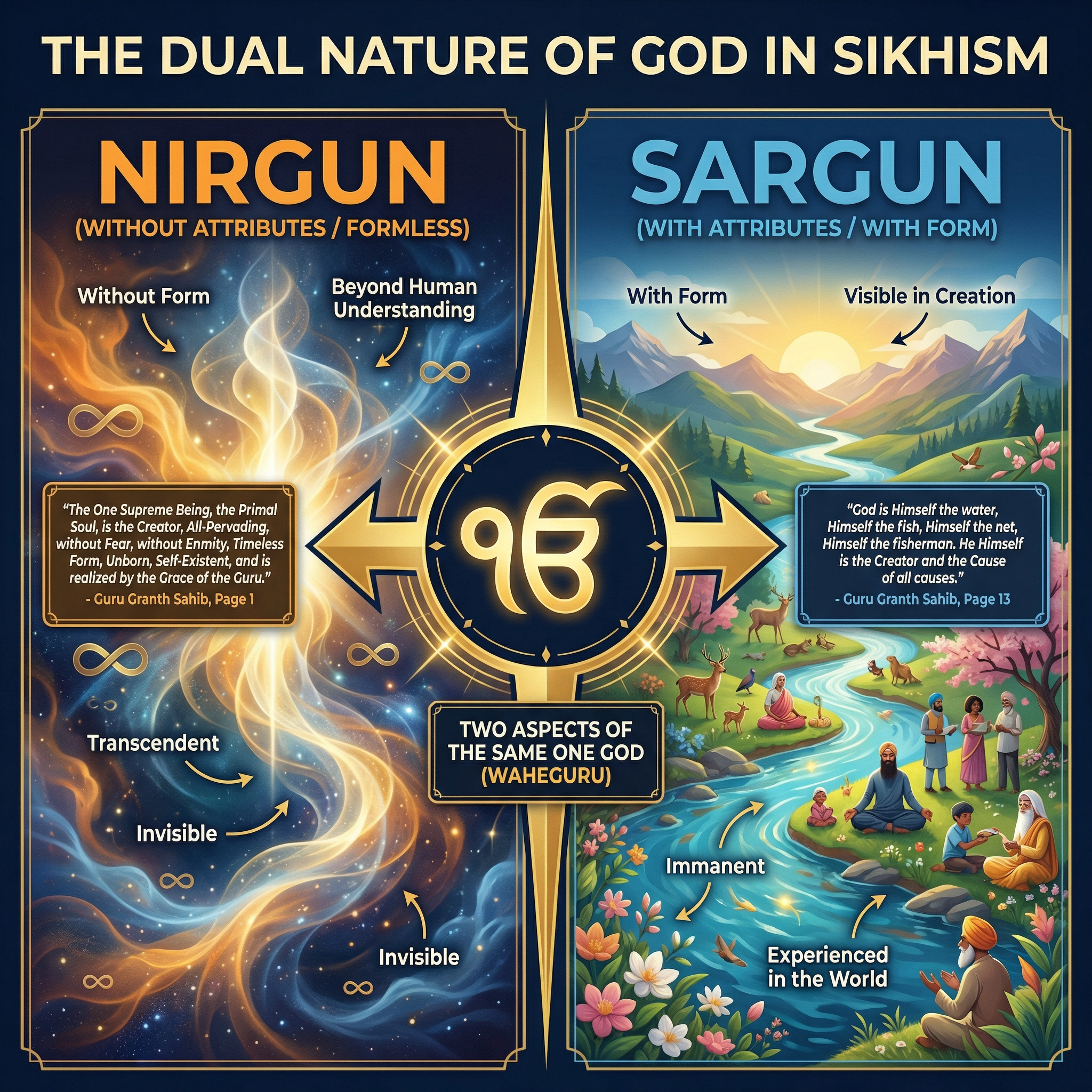
What it is: The cornerstone of Sikhism is the belief in one God, expressed as Ik Onkar (ੴ). This is not just a statement of monotheism but of a panentheistic reality: God is both within and outside of creation. This single reality, Waheguru, is understood in two aspects:
- Nirgun: God in a transcendent state, beyond all form, attributes, and human comprehension. Formless, eternal, and unknowable.
- Sargun: God in an immanent state, revealed within creation. God is the light in every soul, the beauty in nature, and the truth in the universe.
Why it matters: Candidates must be able to distinguish the Sikh concept of God from Abrahamic definitions. Marks are awarded for explaining the Nirgun/Sargun dynamic. It shows you understand that for Sikhs, God is not a distant creator but a reality to be experienced within the world. This is a high-level concept that differentiates a top-band answer.
Specific Knowledge: The Mool Mantar is the primary Source of Wisdom and Authority (SOWA) for the nature of God. You must be able to reference its attributes.
The Mool Mantar: The Foundational Creed
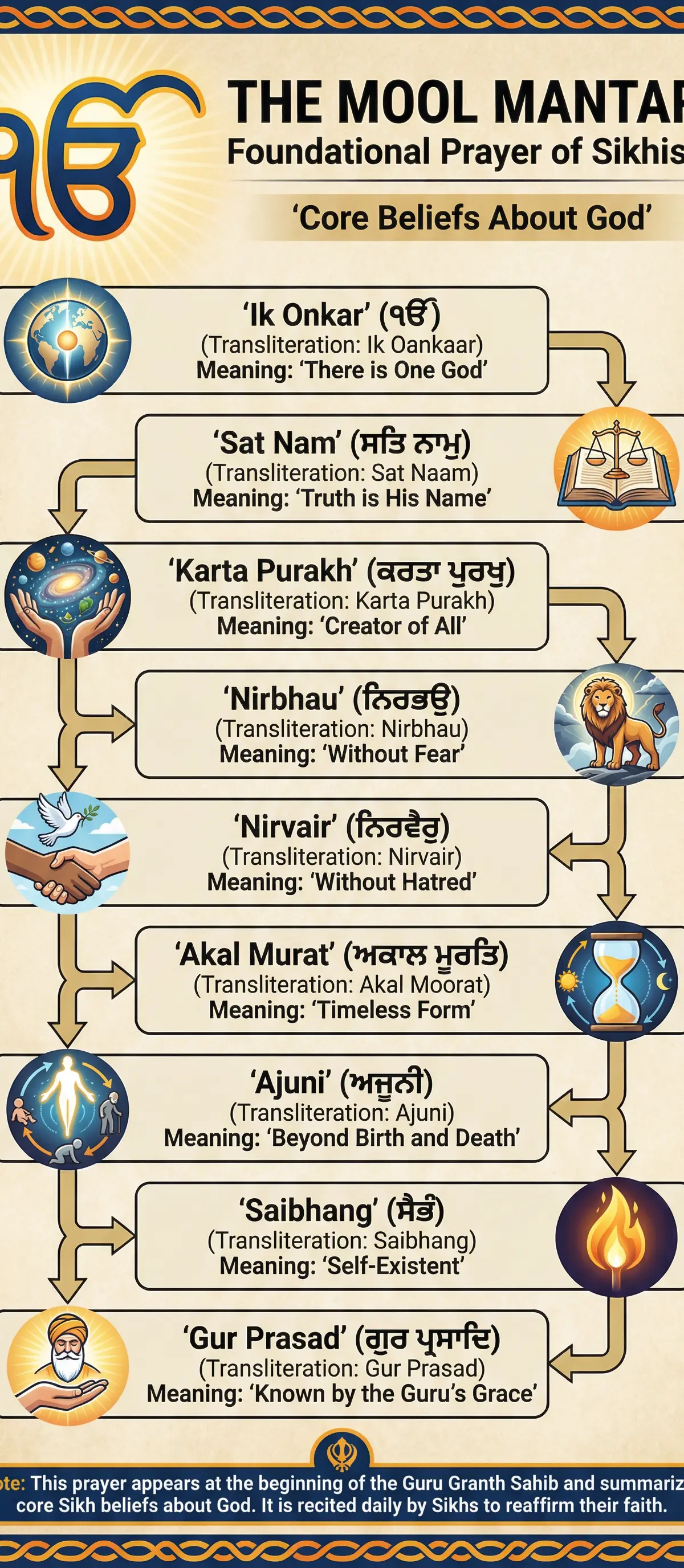
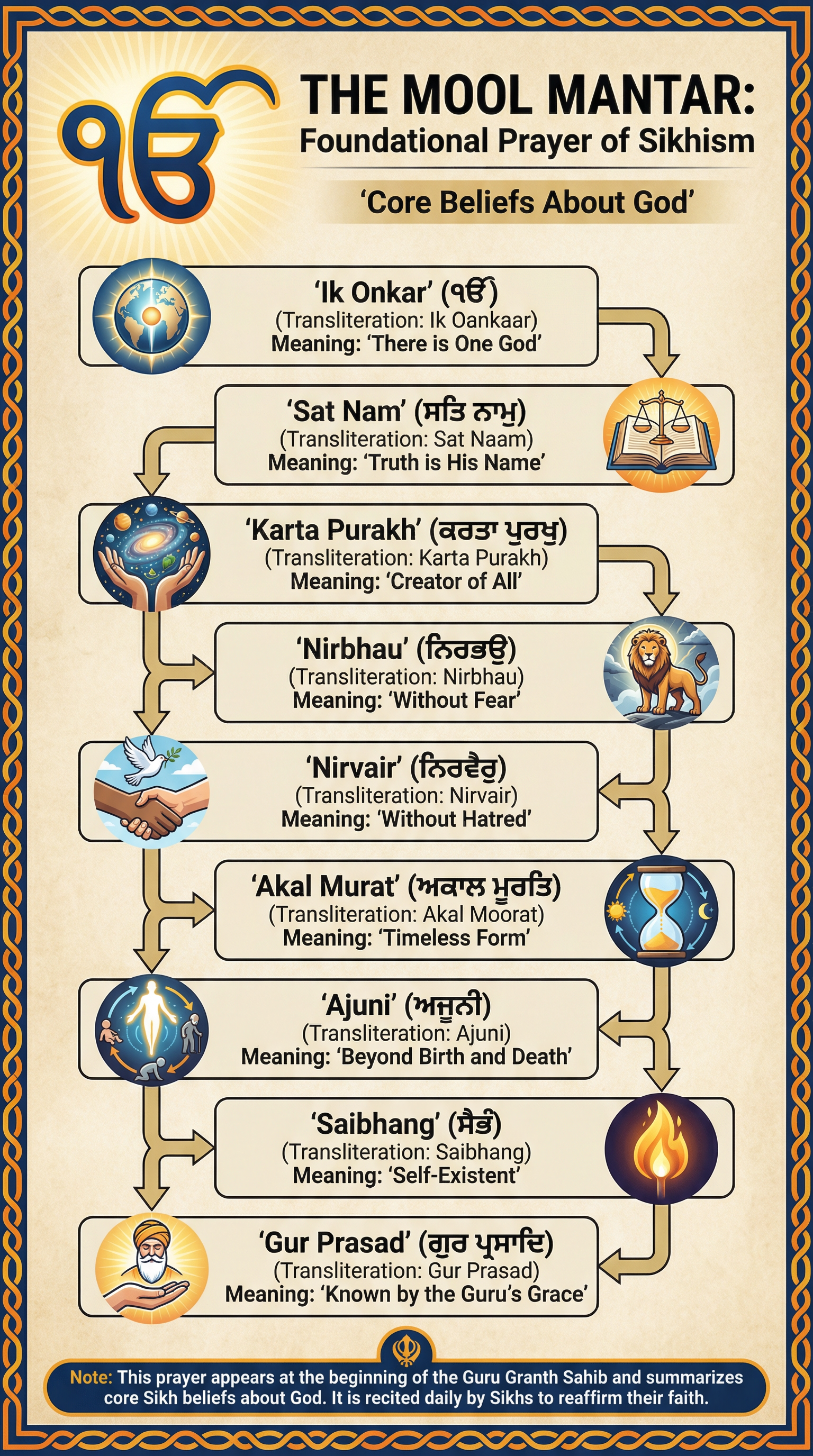
What it is: The Mool Mantar is the opening verse of the Guru Granth Sahib. It is a concise summary of Sikh theology regarding God. Memorising its attributes in English is essential for exam success.
Why it matters: Any question on the nature of God requires you to cite the Mool Mantar. It is the ultimate SOWA. Explaining the meaning of terms like 'Ajuni' (beyond birth/death) or 'Saibhang' (self-existent) demonstrates precise knowledge.
Specific Knowledge: Ik Onkar (One God), Sat Nam (Truth is His Name), Karta Purakh (Creator), Nirbhau (Without Fear), Nirvair (Without Hatred), Akal Murat (Timeless Form), Ajuni (Beyond Birth/Death), Saibhang (Self-Existent), Gur Prasad (Known by Guru's Grace).
The Human Condition: Manmukh to Gurmukh
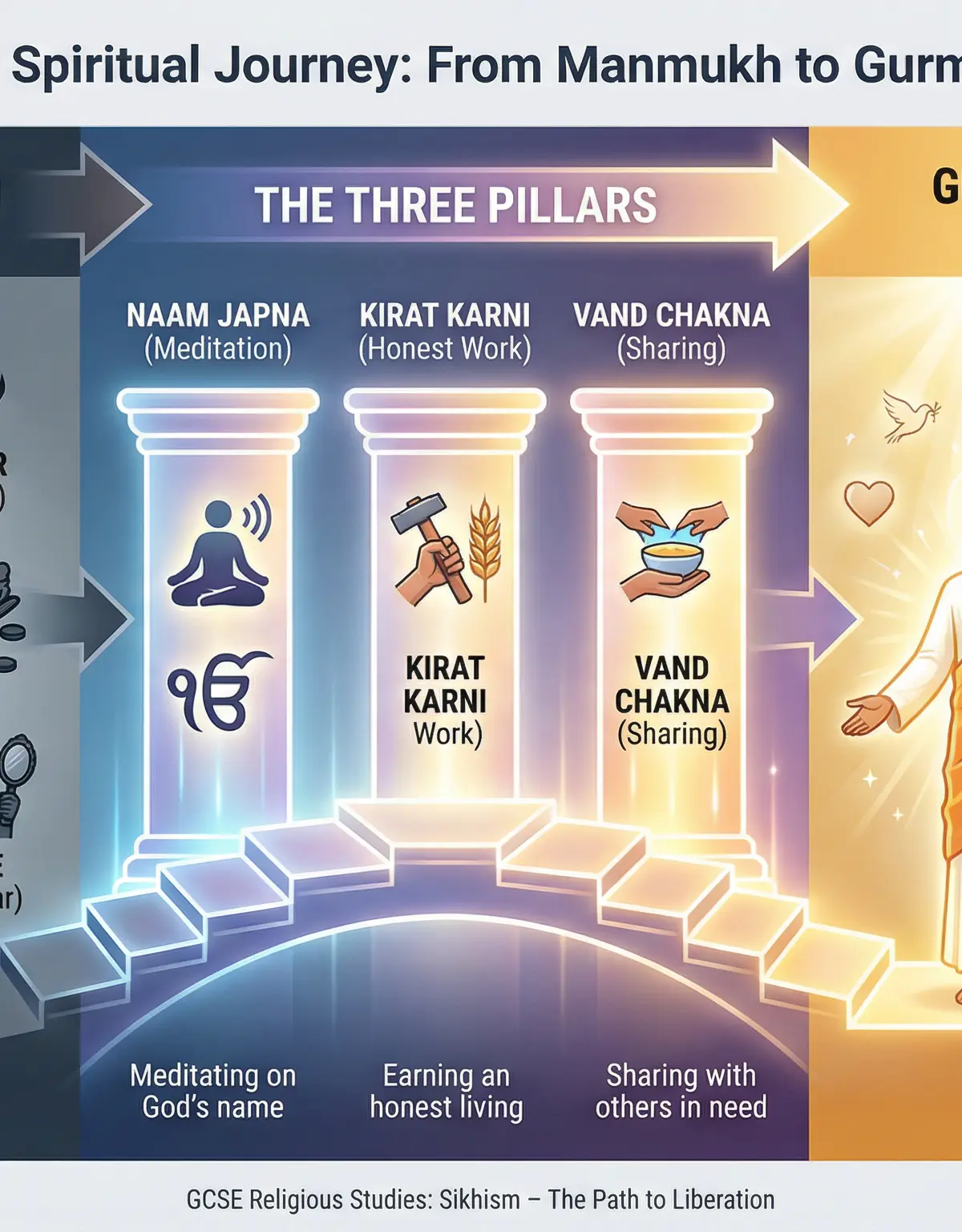
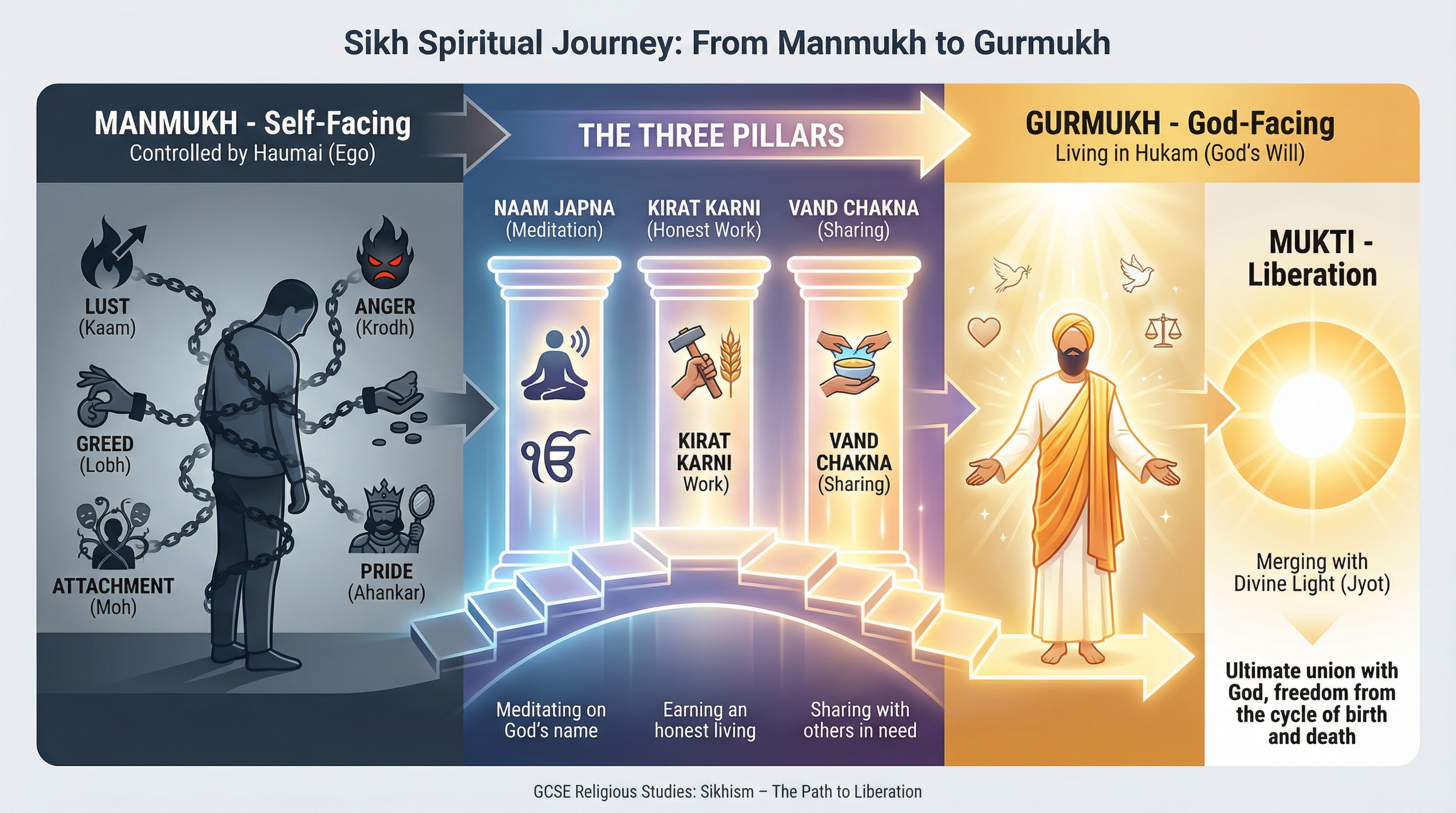
What it is: Sikhs believe humans are born with a divine spark (Jyot) but are separated from God by Haumai (ego). This ego-led state is called Manmukh (self-facing), where an individual is controlled by the Five Evils (Panj Doot): Kaam (lust), Krodh (anger), Lobh (greed), Moh (attachment), and Ahankar (pride). The spiritual journey is to become Gurmukh (God-facing) by overcoming Haumai and living in accordance with Hukam (God's will).
Why it matters: This framework explains the purpose of Sikh practice. It provides the 'why' behind ethical teachings. Using the terms Manmukh, Gurmukh, and Haumai will elevate your answers, showing a deeper understanding of Sikh anthropology.
Specific Knowledge: The Five Evils, the concepts of Haumai and Hukam, and the goal of becoming Gurmukh.
The Path to Liberation: The Three Pillars & Mukti
What it is: The path from Manmukh to Gurmukh is built on The Three Pillars:
- Naam Japna: Meditating on God's name. This focuses the mind on the divine and away from the ego.
- Kirat Karni: Earning an honest living. This rejects a monastic life and grounds spirituality in the everyday world.
- Vand Chakna: Sharing with others. This includes the practice of Sewa (selfless service), which is a practical tool for destroying the ego.
The ultimate goal is Mukti (liberation) from the cycle of Samsara (birth, death, and rebirth). Mukti is the state of merging with the divine light (Jyot), achieving a state of oneness with Waheguru. This can be experienced in life (Jivan Mukt).
Why it matters: This explains the practical application of Sikh beliefs. Candidates must be able to explain how the Three Pillars, especially Sewa, directly address the problem of Haumai. It is also crucial to accurately define Mukti as merging with God, not as entering a paradise or heaven.
Specific Knowledge: The Three Pillars, Sewa, Mukti, Samsara, Jivan Mukt.
Worked Examples
3 worked examples — open one to explore the question and available guidance.
Practice Questions
Test your understanding — click to reveal model answers
Explain two Sikh beliefs about creation. (6 marks)
Hint: Think about the Mool Mantar and the concept of God's role in the universe.
Explain two ways a Sikh can perform Sewa. (6 marks)
Hint: Think about the different types of service: physical, mental, and material.
'The most important duty for a Sikh is Naam Japna (meditating on God's name).' Discuss. (15 marks)
Hint: You need to evaluate the importance of Naam Japna against the other two pillars (Kirat Karni and Vand Chakna). Is one more important than the others, or do they work together?