WJEC · GCSE · Religious Studies
Relationships.
This study guide provides a comprehensive analysis of Christian and non-religious perspectives on Relationships for WJEC GCSE Religious Studies. It focuses on the core themes of Marriage, Adultery, Divorce, and Gender Equality, equipping students with the specific knowledge and evaluative skills required to excel in their exams.
- 6 min read
- 3 worked examples
- 5 practice questions
- 6 key terms
Study Notes
Overview
This guide covers Theme 1 of the WJEC GCSE Religious Studies specification, focusing on Relationships. Examiners expect candidates to demonstrate a detailed understanding of Christian and non-religious viewpoints on key ethical issues. This includes a nuanced analysis of marriage as a concept, the moral implications of adultery and divorce, and the ongoing debate surrounding gender equality within religious and secular contexts. Success in this topic hinges on the ability to contrast the specific teachings of the Catholic Church and the Church of England (Anglicanism) with secular perspectives like Humanism. Crucially, marks are awarded for the precise use of Sources of Wisdom and Authority, such as biblical texts and official church documents, to support arguments. This guide will break down these complex ideas, provide exam-focused advice, and offer tools to help you retain the key information needed to achieve top marks.

Key Concepts & Beliefs
Marriage
What it is: A formal, legally and/or religiously recognized union between two people. In Christianity, it is often seen as a divine institution.
Why it matters: The nature and purpose of marriage are central to understanding Christian ethics. Different denominations hold distinct views that affect their teachings on divorce, cohabitation, and same-sex relationships.
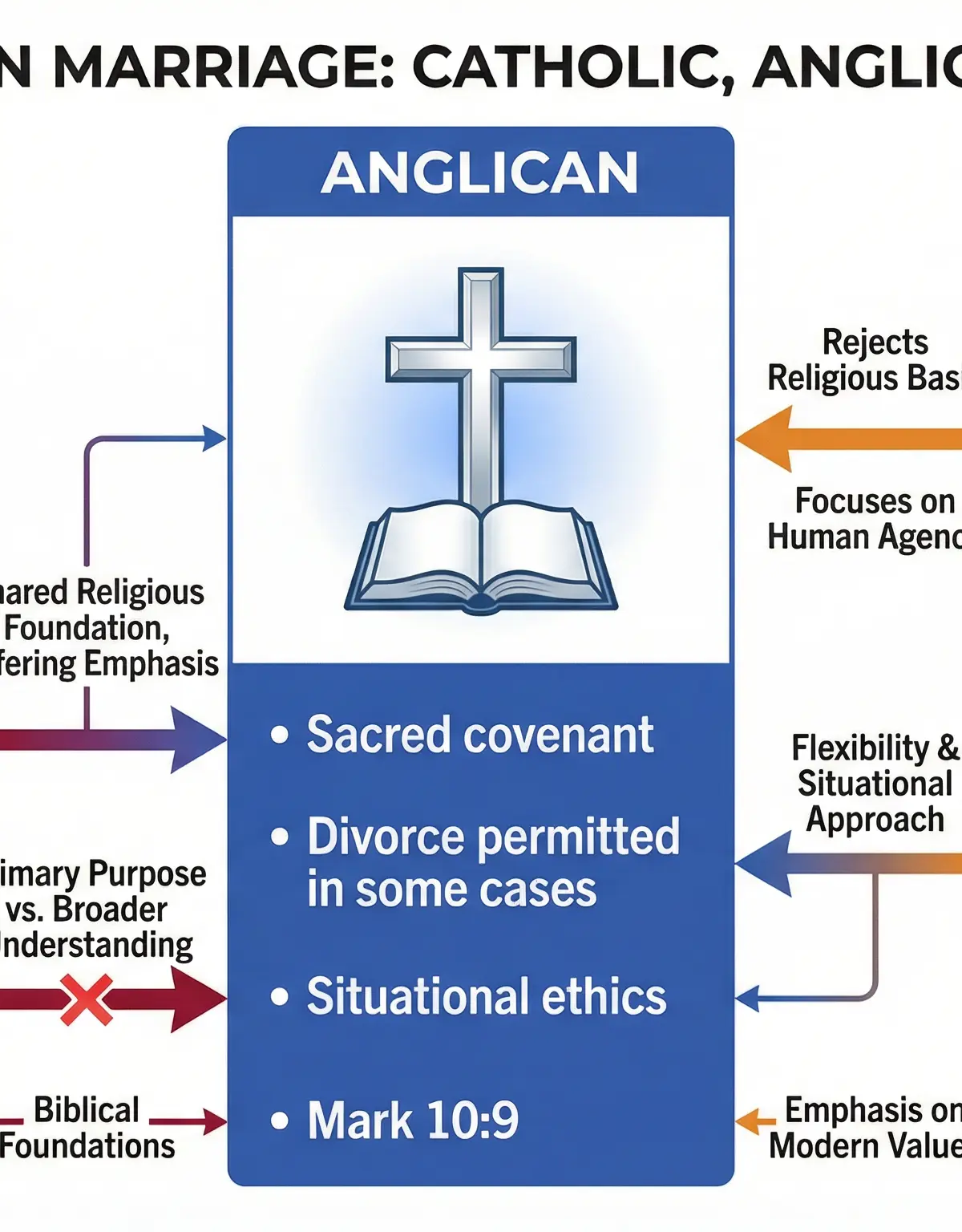
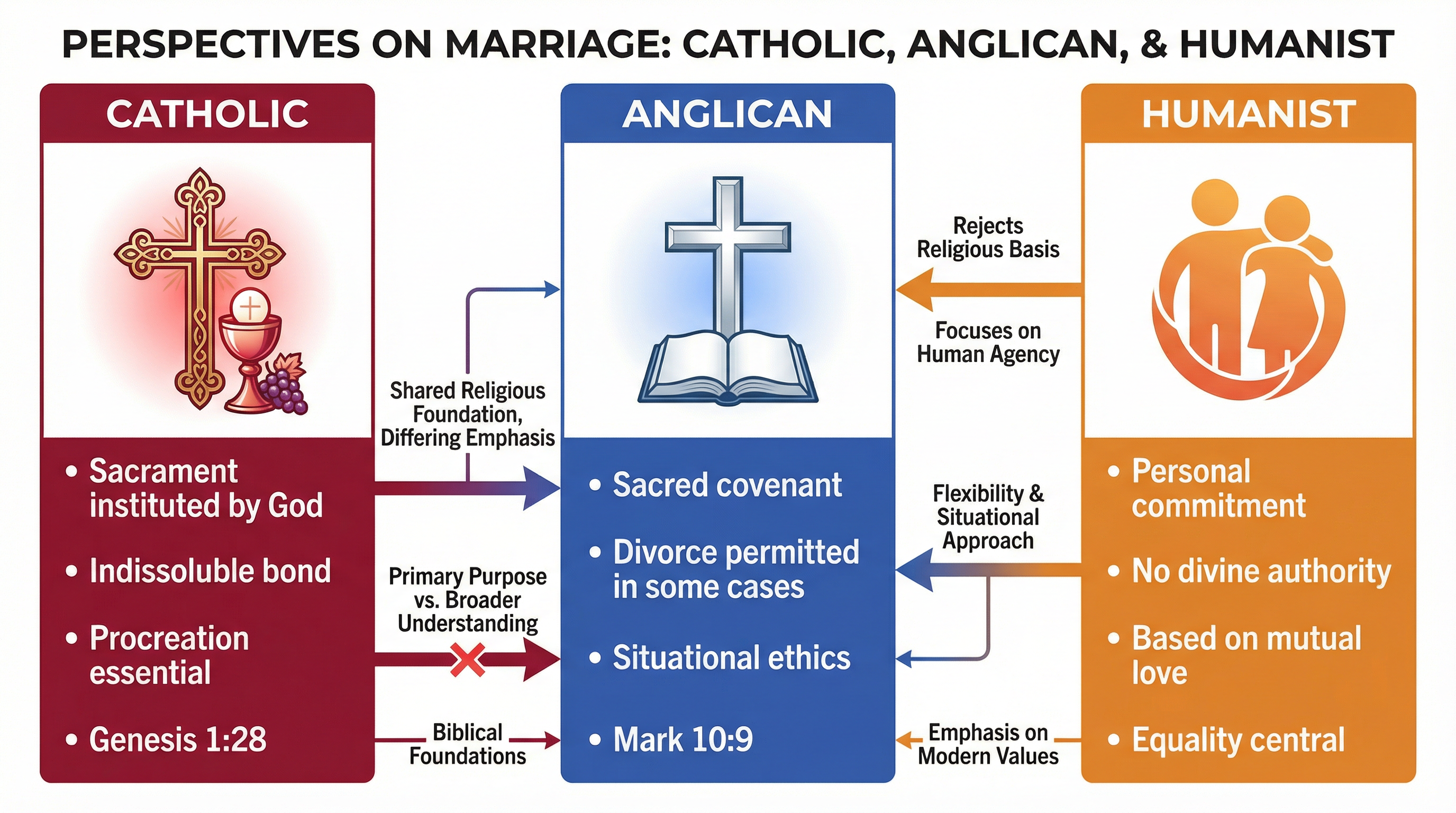
Specific Knowledge: Candidates must be able to differentiate between the Catholic view of marriage as a sacrament (a sacred, indissoluble bond instituted by God) and the Anglican view of it as a covenant (a solemn promise, but one that can be broken). Humanists view marriage as a personal commitment based on love and mutual respect, devoid of any divine element.
Adultery
What it is: Voluntary sexual intercourse between a married person and a person who is not their spouse.
Why it matters: Adultery is explicitly forbidden by the Ten Commandments ("You shall not commit adultery", Exodus 20:14) and is seen as a betrayal of the marriage vows made before God. It undermines the family unit, which Christians consider the bedrock of society.
Specific Knowledge: Jesus intensifies the prohibition in Matthew 5:27-28, stating that even lustful thoughts constitute adultery of the heart. This highlights the importance of inner purity and faithfulness, not just outward actions.
Divorce
What it is: The legal dissolution of a marriage.
Why it matters: Christian views on divorce are a key area of denominational difference. The permissibility of divorce and remarriage has significant implications for individuals and the community.
Specific Knowledge: The Catholic Church does not permit divorce, citing Matthew 19:6: "What God has joined together, let no one separate." It does, however, permit annulment, a declaration that a true marriage never existed. The Church of England allows for divorce and remarriage in church, often applying situational ethics to make compassionate decisions based on individual circumstances.
Gender Equality
What it is: The belief that all genders should have equal rights, responsibilities, and opportunities.
Why it matters: The role of women in the church and society has been a source of debate for centuries. This topic requires candidates to engage with both traditional and contemporary interpretations of scripture.
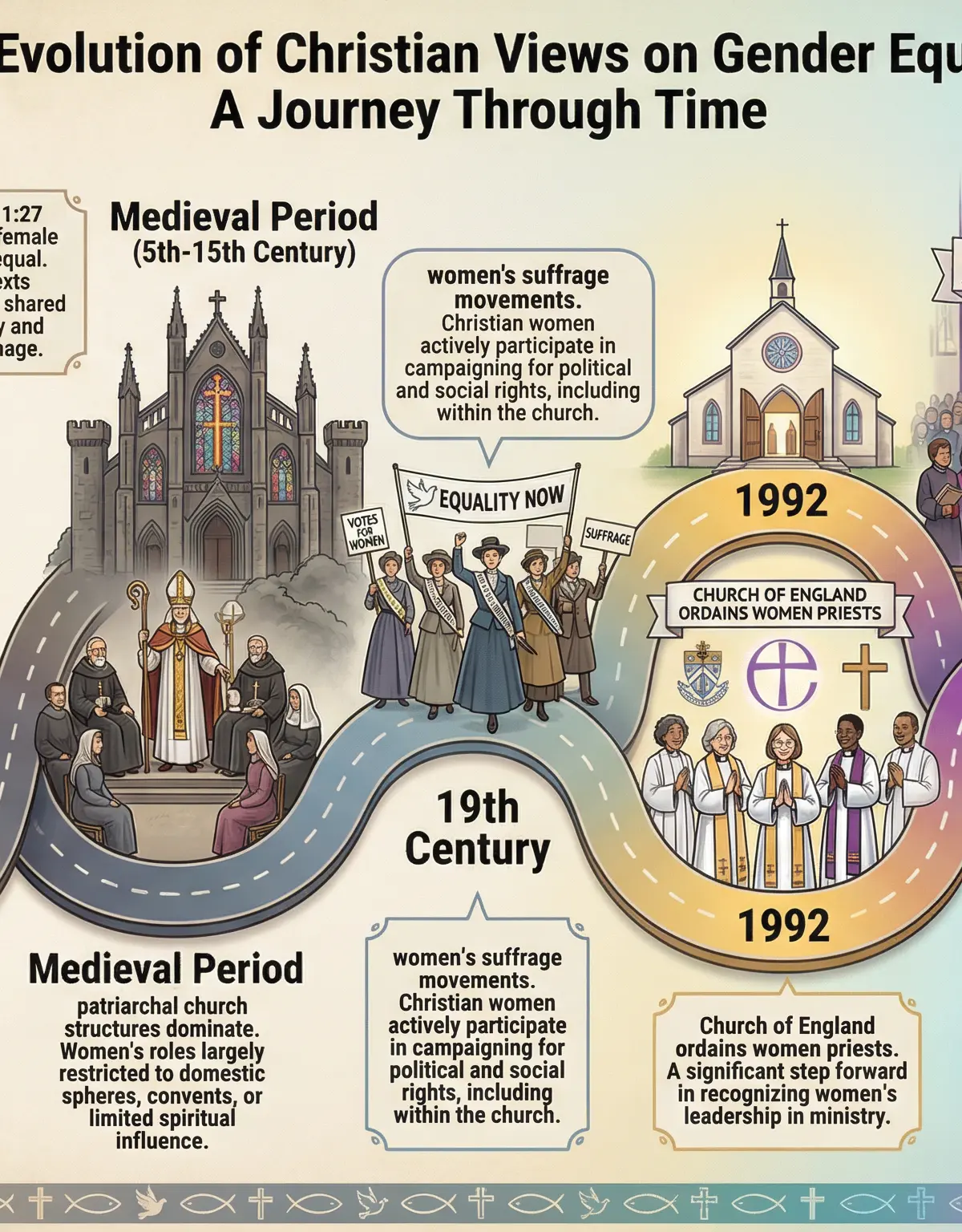
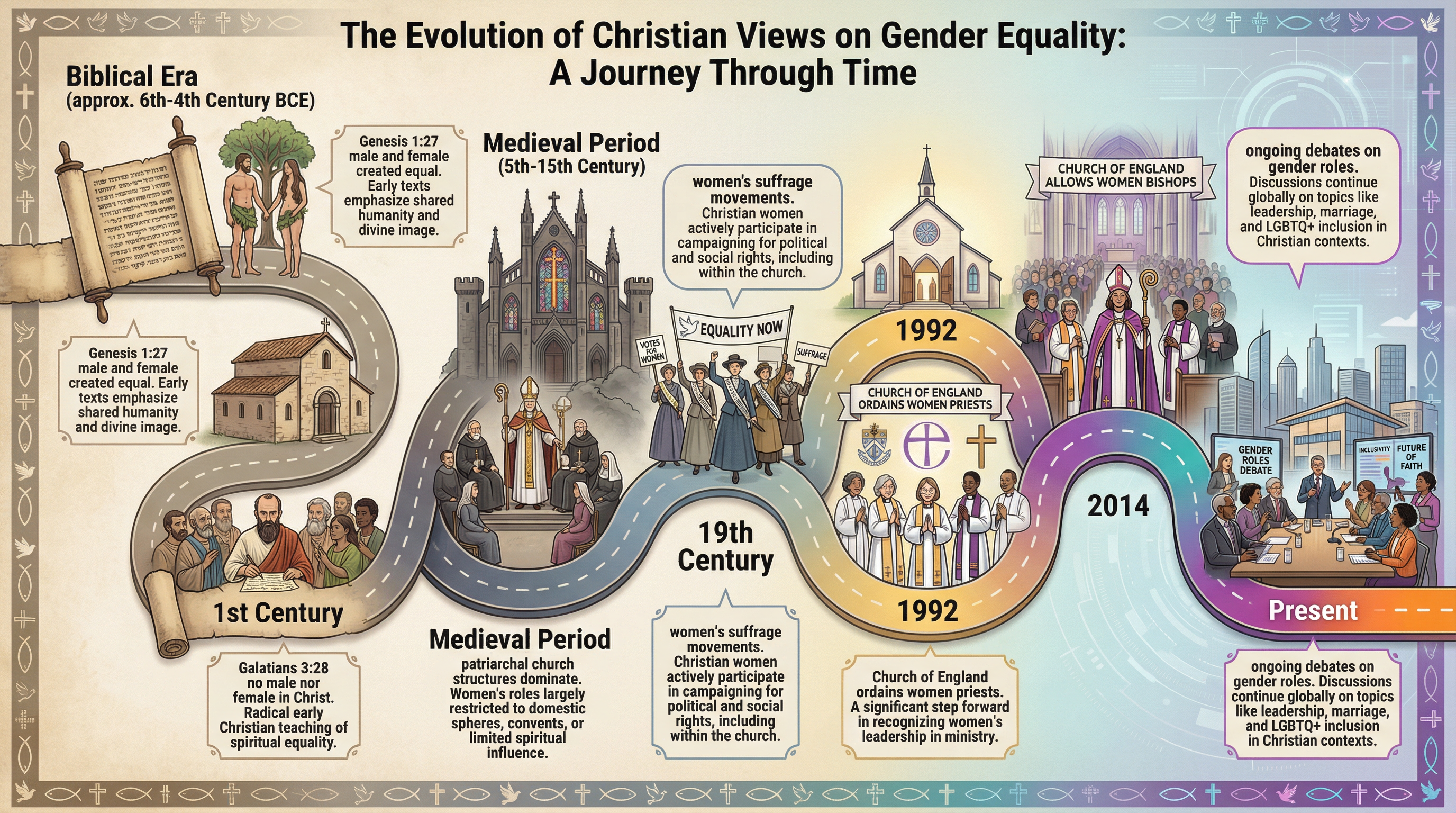
Specific Knowledge: Key texts include Genesis 1:27 ("male and female he created them") and Galatians 3:28 ("neither male nor female... you are all one in Christ Jesus"), which support equality. However, other texts like 1 Timothy 2:12 have been used to justify male leadership. The ordination of women as priests (1992) and bishops (2014) in the Church of England is a crucial modern development to contrast with the Catholic Church's male-only priesthood.
Second-Order Concepts
Diversity of Views
There is no single "Christian view" on relationships. It is essential to analyze the diversity within Christianity, primarily between Catholic and Anglican perspectives, and contrast these with non-religious views like Humanism.
Interpretation of Scripture
How Christians interpret the Bible is key. Some take a literalist approach, while others view it as a book of guidance that must be interpreted in the context of modern life, reason, and tradition. This explains why Anglicans might permit divorce while Catholics do not, despite both reading the same texts.
Significance
These debates are not just theological; they have profound real-world significance, affecting laws, social norms, and the lives of millions of people. Understanding these issues helps us understand the society we live in.
Source Skills
When presented with a source (e.g., a biblical quote, a statement from the Pope, a Humanist viewpoint), your task is to analyze its meaning and apply it to the question. Ask yourself:
- Who said it? (Provenance: Is it from the Bible, a church leader, a modern thinker?)
- What does it mean? (Content: What is the core message?)
- How does it apply? (Application: How does this source inform beliefs about marriage, divorce, etc.?)
- How does it compare? (Evaluation: How does it agree or disagree with other sources or viewpoints?)
Visual Resources
2 diagrams and illustrations
Interactive Diagrams
1 interactive diagram to visualise key concepts
Conceptual Flow Outline
Flowchart showing the key differences in belief about marriage between Catholic, Anglican, and Humanist perspectives.
Worked Examples
3 worked examples — open one to explore the question and available guidance.
Practice Questions
Test your understanding — click to reveal model answers
Explain two Christian beliefs about adultery. Refer to sacred writings in your answer. (5 marks)
Hint: Think about the Ten Commandments and Jesus' teachings in the Sermon on the Mount.
Explain two contrasting Christian beliefs about divorce. (5 marks)
Hint: Contrast the Catholic and Anglican positions, using the correct terminology.
"Religious believers should accept that men and women are equal." Discuss this statement. (15 marks)
Hint: You must include religious and non-religious views, and views for and against the statement. Think about Genesis, Galatians, and 1 Timothy.
Explain two ways a Christian might show commitment in a marriage. (4 marks)
Hint: Think about the vows and the expectations of a Christian marriage.
Explain why many Christians are opposed to cohabitation (living together without being married). (8 marks)
Hint: Consider the purpose of sex, the sanctity of marriage, and the stability of the family.