AQA · GCSE · Religious Studies
Course version: 8062 · Version from Sept 2018
Buddhism - 3.1.1.2 Practices: compassion (karuna)
Karuna (compassion) is a fundamental Buddhist virtue, particularly emphasised in Mahayana Buddhism as a prerequisite for becoming a Bodhisattva.
Checked against the AQA 8062 specification (opens in a new tab) on .
- Point 15 of 29
- 4 key terms
Study notes
From the checked teaching notes for this specification point.
The idea
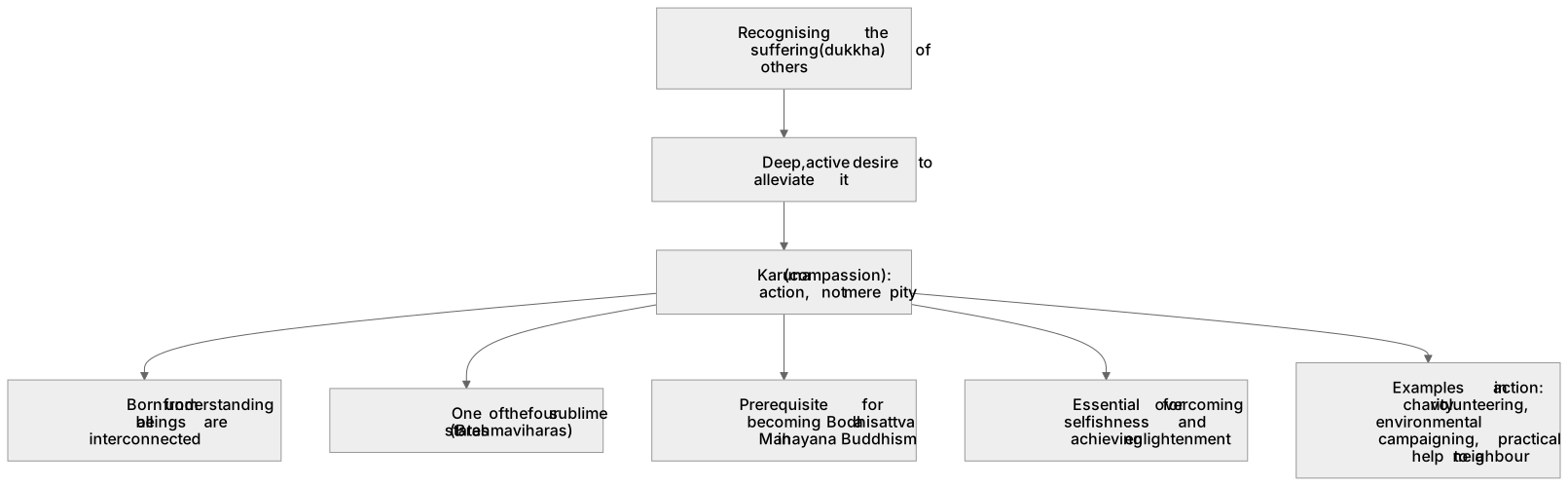
Karuna (compassion) is a fundamental Buddhist virtue, particularly emphasised in Mahayana Buddhism as a prerequisite for becoming a Bodhisattva. It involves recognising the suffering (dukkha) of others and feeling a deep, active desire to alleviate it. Unlike mere pity, karuna requires action and is born from the understanding that all beings are interconnected. For example, a Buddhist might demonstrate karuna by volunteering at a charity, campaigning for environmental protection, or simply offering practical help to a neighbour in distress. It is one of the four sublime states (Brahmaviharas) and is essential for overcoming selfishness and achieving enlightenment.
What earns the marks
- Define karuna as active compassion and the sincere desire to relieve the suffering of others.
- Explain its connection to the concept of dukkha (suffering) and the motivation to end it.
- Identify karuna as a crucial quality of a Bodhisattva in Mahayana Buddhism.
- Provide examples of karuna in action, such as charitable work or ethical living (Right Action).
Common mistakes and how to put them right
Confusing karuna with metta.
Put it right by specifying that karuna specifically focuses on alleviating suffering, whereas metta is a general wish for happiness.
Viewing karuna as passive pity.
Put it right by emphasising that karuna requires active effort and practical action to help others.
Thinking karuna only applies to humans.
Put it right by noting that Buddhists extend compassion to all sentient beings, often influencing dietary choices like vegetarianism.
Exam tips
- Use the term 'dukkha' when explaining why karuna is necessary in the world.
- Link karuna to Mahayana Buddhism and the Bodhisattva ideal for higher-level evaluation marks.
- Provide a concrete example of how a Buddhist might practice karuna in modern society, such as supporting the Rokpa charity.
Try the lesson
The start of the Buddhism - 3.1.1.2 Practices: compassion (karuna) lesson, made from checked teaching notes for this specification point.
Have a go first
In Buddhist practice, what does the term 'karuna' refer to?
Listen
Karuna (compassion) is a fundamental Buddhist virtue, particularly emphasised in Mahayana Buddhism as a prerequisite for becoming a Bodhisattva. It involves recognising the suffering (dukkha) of others and feeling a deep, active desire to alleviate it. Unlike mere pity, karuna requires action and is born from the understanding that all beings are interconnected. For example, a Buddhist might demonstrate karuna by volunteering at a charity, campaigning for environmental protection, or simply offering practical help to a neighbour in distress. It is one of the four sublime states (Brahmaviharas) and is essential for overcoming selfishness and achieving enlightenment. A strong answer earns marks for these points. Define karuna as active compassion and the sincere desire to relieve the suffering of others. Explain its connection to the concept of dukkha (suffering) and the motivation to end it. Identify karuna as a crucial quality of a Bodhisattva in Mahayana Buddhism. Provide examples of karuna in action, such as charitable work or ethical living (Right Action). A common slip: Confusing karuna with metta. Instead, specifying that karuna specifically focuses on alleviating suffering, whereas metta is a general wish for happiness. Exam tip: Use the term 'dukkha' when explaining why karuna is necessary in the world.
See it
Key words
Say what each word means before you turn the card.
Dukkha
Try answering aloud or in your head before turning the card.
Bodhisattva ideal
Try answering aloud or in your head before turning the card.
Mahayana Buddhism
Try answering aloud or in your head before turning the card.
Brahmaviharas (Four Sublime States)
Try answering aloud or in your head before turning the card.
See every definition
- Dukkha
- The suffering of others that compassion involves recognising and feeling a deep, active desire to alleviate.
- Bodhisattva ideal
- Becoming a Bodhisattva, for which compassion is a prerequisite, particularly emphasised in Mahayana Buddhism.
- Mahayana Buddhism
- The tradition in which compassion is particularly emphasised as a prerequisite for becoming a Bodhisattva.
- Brahmaviharas (Four Sublime States)
- The four sublime states, of which compassion is one and which is essential for overcoming selfishness and achieving enlightenment.
Label the diagram
Some boxes have lost their names. Pick the right name for each number.
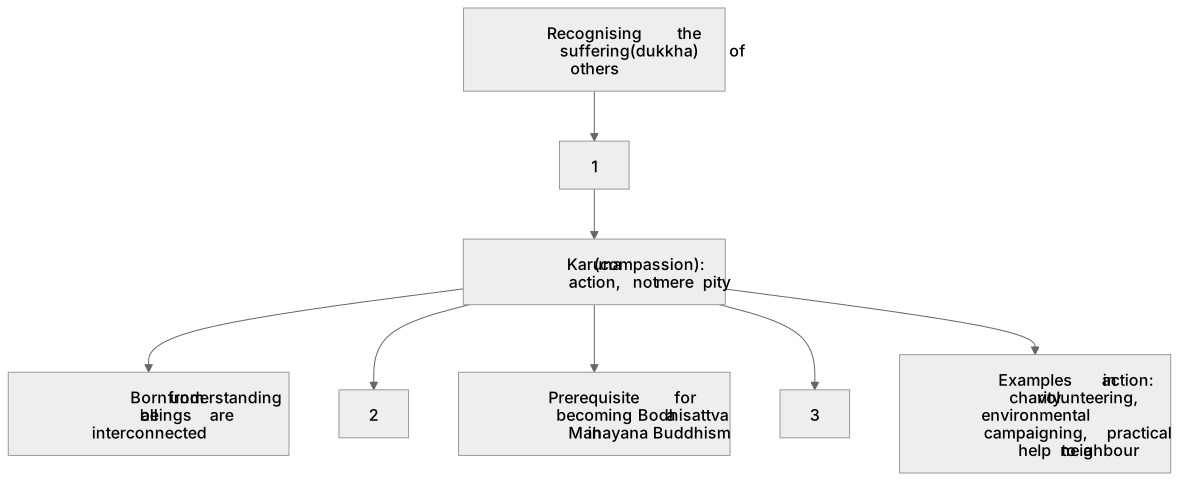
1Box 1
2Box 2
3Box 3
There is more to this lesson
The full lesson goes on to check your understanding and help you earn the marks. Create a free account to carry on, with your progress saved.
A week of Premium from your first lesson · Then the free plan continues · No card, no charge
Test your understanding of Buddhism - 3.1.1.2 Practices: compassion (karuna)
Active recall beats re-reading. Take an instant quiz now to test what you’ve learned and lock it into long-term memory.
A week of Premium from your first lesson · Then the free plan continues · No card, no charge