AQA · GCSE · Religious Studies
Course version: 8062 · Version from Sept 2018
Buddhism - 3.1.1.2 Practices: loving kindness (metta).
Metta (loving kindness) is the Buddhist practice of cultivating a deep, unconditional love and goodwill towards all sentient beings.
Checked against the AQA 8062 specification (opens in a new tab) on .
- Point 16 of 29
- 2 key terms
Study notes
From the checked teaching notes for this specification point.
The idea
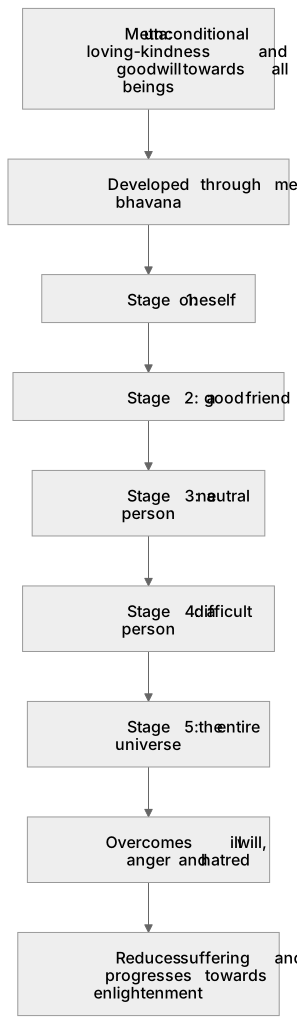
Metta (loving kindness) is the Buddhist practice of cultivating a deep, unconditional love and goodwill towards all sentient beings. Unlike romantic or attached love, metta is entirely selfless and expects nothing in return. It is developed through practices such as metta bhavana (loving-kindness meditation), where a practitioner sequentially directs well-wishes towards themselves, a good friend, a neutral person, a difficult person, and finally the entire universe. By developing metta, Buddhists aim to overcome ill will, anger, and hatred, thereby reducing suffering and progressing towards enlightenment. While wisdom overcomes ignorance, metta acts as the specific antidote to hatred. It forms the foundation for harmonious relationships, ethical behaviour, and compassionate action in the world.
What earns the marks
- Define metta as unconditional loving-kindness and goodwill towards all beings without attachment.
- Describe the practice of metta bhavana (loving-kindness meditation) and its five distinct stages.
- Explain how metta serves as the direct antidote to overcome negative states such as anger, ill will, and hatred.
- Contrast metta with ordinary love, highlighting its selfless nature and lack of expectation for reward.
Common mistakes and how to put them right
Equating metta with romantic love.
Put it right by explaining that metta is universal, selfless goodwill without attachment.
Confusing metta with karuna.
Put it right by stating metta is the wish for others to be happy, while karuna is the specific desire to remove their suffering.
Claiming that metta overcomes ignorance.
Put it right by noting that metta specifically counters hatred and ill will, whereas ignorance is overcome by wisdom (panna).
Exam tips
- Outline the five stages of metta bhavana meditation to demonstrate specific knowledge of Buddhist practices.
- Contrast metta with hatred (one of the Three Poisons) to show how it aids spiritual progress and ethical living.
Try the lesson
The start of the Buddhism - 3.1.1.2 Practices: loving kindness (metta). lesson, made from checked teaching notes for this specification point.
Have a go first
What is the primary focus of the Buddhist practice of metta?
Listen
Metta (loving kindness) is the Buddhist practice of cultivating a deep, unconditional love and goodwill towards all sentient beings. Unlike romantic or attached love, metta is entirely selfless and expects nothing in return. It is developed through practices such as metta bhavana (loving-kindness meditation), where a practitioner sequentially directs well-wishes towards themselves, a good friend, a neutral person, a difficult person, and finally the entire universe. By developing metta, Buddhists aim to overcome ill will, anger, and hatred, thereby reducing suffering and progressing towards enlightenment. While wisdom overcomes ignorance, metta acts as the specific antidote to hatred. It forms the foundation for harmonious relationships, ethical behaviour, and compassionate action in the world. A strong answer earns marks for these points. Define metta as unconditional loving-kindness and goodwill towards all beings without attachment. Describe the practice of metta bhavana (loving-kindness meditation) and its five distinct stages. Explain how metta serves as the direct antidote to overcome negative states such as anger, ill will, and hatred. Contrast metta with ordinary love, highlighting its selfless nature and lack of expectation for reward. A common slip: Equating metta with romantic love. Instead, explaining that metta is universal, selfless goodwill without attachment. Exam tip: Outline the five stages of metta bhavana meditation to demonstrate specific knowledge of Buddhist practices.
See it
Key words
Say what each word means before you turn the card.
Metta Bhavana
Try answering aloud or in your head before turning the card.
Overcoming Hatred
Try answering aloud or in your head before turning the card.
See every definition
- Metta Bhavana
- Loving-kindness meditation in which a practitioner sequentially directs well-wishes towards themselves, a good friend, a neutral person, a difficult person, and finally the entire universe.
- Overcoming Hatred
- Developing metta so that ill will, anger, and hatred are overcome, thereby reducing suffering and progressing towards enlightenment.
Label the diagram
Some boxes have lost their names. Pick the right name for each number.
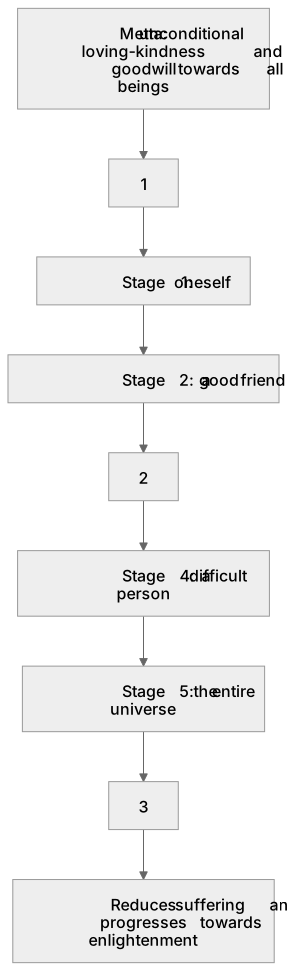
1Box 1
2Box 2
3Box 3
There is more to this lesson
The full lesson goes on to check your understanding and help you earn the marks. Create a free account to carry on, with your progress saved.
A week of Premium from your first lesson · Then the free plan continues · No card, no charge
Test your understanding of Buddhism - 3.1.1.2 Practices: loving kindness (metta).
Active recall beats re-reading. Take an instant quiz now to test what you’ve learned and lock it into long-term memory.
A week of Premium from your first lesson · Then the free plan continues · No card, no charge