AQA · GCSE · Religious Studies
Course version: 8062 · Version from Sept 2018
Buddhism - 3.1.1.2 Practices: do not take what is not given
The precept 'do not take what is not given' is the second of the Five Moral Precepts in Buddhism.
Checked against the AQA 8062 specification (opens in a new tab) on .
- Point 19 of 29
- 4 key terms
Study notes
From the checked teaching notes for this specification point.
The idea
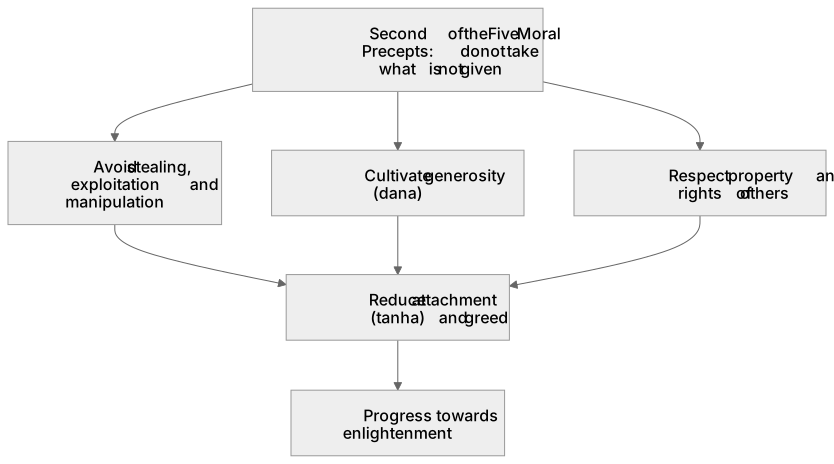
The precept 'do not take what is not given' is the second of the Five Moral Precepts in Buddhism. It goes beyond a simple prohibition against stealing, encouraging Buddhists to avoid exploitation, manipulation, and taking advantage of others. It requires cultivating the positive virtue of generosity (dana) and respecting the property and rights of others. For example, a Buddhist might apply this precept by ensuring they pay fair prices for goods, avoiding tax evasion, or not taking credit for a colleague's work. By practising this precept, Buddhists aim to reduce attachment (tanha) and greed, which are root causes of suffering (dukkha), thereby progressing towards enlightenment.
What earns the marks
- Identifies 'do not take what is not given' as the second of the Five Moral Precepts.
- Explains that it prohibits stealing, fraud, and exploiting others for personal gain.
- Links the precept to the cultivation of generosity (dana) and right livelihood.
- Connects the practice to reducing greed and attachment (tanha), helping to overcome suffering (dukkha).
Common mistakes and how to put them right
Thinking this precept only applies to physical theft.
Put it right: Understand that it also covers intellectual property, time, and exploiting others' generosity.
Viewing the precept as a strict commandment from a deity.
Put it right: Recognise it as a voluntary training rule undertaken to aid personal spiritual development.
Failing to mention the positive counterpart of the precept.
Put it right: Link the avoidance of taking to the active cultivation of generosity (dana).
Exam tips
- Use the Pali term 'dana' (generosity) to show a deeper understanding of the positive action associated with this precept.
- Link this precept to the Noble Eightfold Path, specifically Right Action and Right Livelihood.
- Provide modern examples, such as avoiding piracy or paying fair trade prices, to illustrate how the precept is applied today.
Try the lesson
The start of the Buddhism - 3.1.1.2 Practices: do not take what is not given lesson, made from checked teaching notes for this specification point.
Have a go first
What is the primary meaning of the second Buddhist moral precept?
Listen
The precept 'do not take what is not given' is the second of the Five Moral Precepts in Buddhism. It goes beyond a simple prohibition against stealing, encouraging Buddhists to avoid exploitation, manipulation, and taking advantage of others. It requires cultivating the positive virtue of generosity (dana) and respecting the property and rights of others. For example, a Buddhist might apply this precept by ensuring they pay fair prices for goods, avoiding tax evasion, or not taking credit for a colleague's work. By practising this precept, Buddhists aim to reduce attachment (tanha) and greed, which are root causes of suffering (dukkha), thereby progressing towards enlightenment. A strong answer earns marks for these points. Identifies 'do not take what is not given' as the second of the Five Moral Precepts. Explains that it prohibits stealing, fraud, and exploiting others for personal gain. Links the precept to the cultivation of generosity (dana) and right livelihood. Connects the practice to reducing greed and attachment (tanha), helping to overcome suffering (dukkha). A common slip: Thinking this precept only applies to physical theft. Instead, Understand that it also covers intellectual property, time, and exploiting others' generosity. Exam tip: Use the Pali term 'dana' (generosity) to show a deeper understanding of the positive action associated with this precept.
See it
Key words
Say what each word means before you turn the card.
The Five Moral Precepts
Try answering aloud or in your head before turning the card.
Generosity (Dana)
Try answering aloud or in your head before turning the card.
Attachment (Tanha)
Try answering aloud or in your head before turning the card.
Suffering (Dukkha)
Try answering aloud or in your head before turning the card.
See every definition
- The Five Moral Precepts
- The precept 'do not take what is not given' is the second of these in Buddhism.
- Generosity (Dana)
- The positive virtue the precept requires Buddhists to cultivate, alongside respecting the property and rights of others.
- Attachment (Tanha)
- A root cause of suffering that Buddhists aim to reduce by practising this precept, along with greed.
- Suffering (Dukkha)
- That which greed and attachment are root causes of, and which reducing them helps to overcome.
Label the diagram
Some boxes have lost their names. Pick the right name for each number.
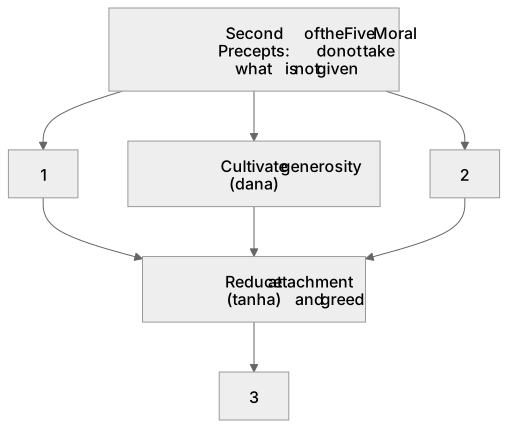
1Box 1
2Box 2
3Box 3
There is more to this lesson
The full lesson goes on to check your understanding and help you earn the marks. Create a free account to carry on, with your progress saved.
A week of Premium from your first lesson · Then the free plan continues · No card, no charge
Test your understanding of Buddhism - 3.1.1.2 Practices: do not take what is not given
Active recall beats re-reading. Take an instant quiz now to test what you’ve learned and lock it into long-term memory.
A week of Premium from your first lesson · Then the free plan continues · No card, no charge