AQA · GCSE · Religious Studies
Course version: 8062 · Version from Sept 2018
Buddhism - 3.1.1.2 Practices: do not take life
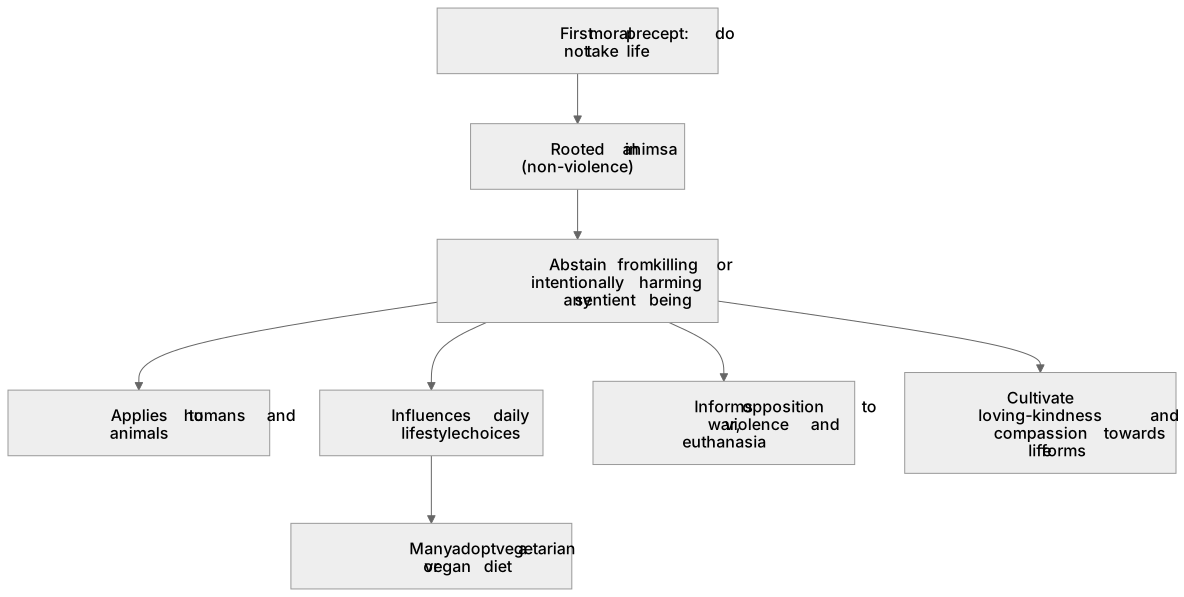
The first moral precept, 'do not take life', is the foundational ethical principle of Buddhism, rooted in the concept of ahimsa (non-violence).
Checked against the AQA 8062 specification (opens in a new tab) on .
- Point 18 of 29
- 4 key terms
Study notes
From the checked teaching notes for this specification point.
The idea
The first moral precept, 'do not take life', is the foundational ethical principle of Buddhism, rooted in the concept of ahimsa (non-violence). It requires Buddhists to abstain from killing or intentionally harming any sentient being, including humans and animals. This precept stems from the understanding that all living beings fear death and desire happiness. In practice, this commitment deeply influences daily lifestyle choices. For example, many Buddhists adopt a vegetarian or vegan diet to avoid contributing to animal slaughter. Furthermore, this precept informs Buddhist opposition to war, violence, and euthanasia, encouraging practitioners to actively cultivate loving-kindness and compassion towards all life forms instead.
What earns the marks
- Define the first precept as the commitment to abstain from taking life and practicing ahimsa (non-violence).
- Explain how this precept applies to all sentient beings, not just humans, influencing attitudes towards animals.
- Provide examples of how this precept is practiced, such as adopting vegetarianism or engaging in pacifism.
- Link the avoidance of taking life to the active cultivation of metta (loving-kindness) and karuna (compassion).
Common mistakes and how to put them right
Claiming that all Buddhists must be strictly vegan or vegetarian.
Put it right: State that while many Buddhists are vegetarian to follow this precept, it is a personal choice and not universally mandated.
Limiting the precept to only mean 'do not murder humans'.
Put it right: Broaden the definition to include abstaining from harming any sentient being, including animals.
Viewing the precept merely as a negative restriction.
Put it right: Explain that it also involves the positive action of protecting life and showing compassion.
Exam tips
- Use the Sanskrit or Pali term 'ahimsa' (non-violence) to show a deeper understanding of the first precept.
- Apply this precept to contemporary ethical issues like abortion, euthanasia, or animal rights in evaluation questions.
- Contrast the negative phrasing 'do not take life' with the positive Buddhist virtues of metta and karuna.
Try the lesson
The start of the Buddhism - 3.1.1.2 Practices: do not take life lesson, made from checked teaching notes for this specification point.
Have a go first
What does the first of the five moral precepts instruct Buddhists to avoid?
Listen
The first moral precept, 'do not take life', is the foundational ethical principle of Buddhism, rooted in the concept of ahimsa (non-violence). It requires Buddhists to abstain from killing or intentionally harming any sentient being, including humans and animals. This precept stems from the understanding that all living beings fear death and desire happiness. In practice, this commitment deeply influences daily lifestyle choices. For example, many Buddhists adopt a vegetarian or vegan diet to avoid contributing to animal slaughter. Furthermore, this precept informs Buddhist opposition to war, violence, and euthanasia, encouraging practitioners to actively cultivate loving-kindness and compassion towards all life forms instead. A strong answer earns marks for these points. Define the first precept as the commitment to abstain from taking life and practicing ahimsa (non-violence). Explain how this precept applies to all sentient beings, not just humans, influencing attitudes towards animals. Provide examples of how this precept is practiced, such as adopting vegetarianism or engaging in pacifism. Link the avoidance of taking life to the active cultivation of metta (loving-kindness) and karuna (compassion). A common slip: Claiming that all Buddhists must be strictly vegan or vegetarian. Instead, State that while many Buddhists are vegetarian to follow this precept, it is a personal choice and not universally mandated. Exam tip: Use the Sanskrit or Pali term 'ahimsa' (non-violence) to show a deeper understanding of the first precept.
See it
Key words
Say what each word means before you turn the card.
Ahimsa (Non-violence)
Try answering aloud or in your head before turning the card.
Metta (Loving-kindness)
Try answering aloud or in your head before turning the card.
Animal rights
Try answering aloud or in your head before turning the card.
Pacifism
Try answering aloud or in your head before turning the card.
See every definition
- Ahimsa (Non-violence)
- The concept of non-violence that the first moral precept, 'do not take life', is rooted in.
- Metta (Loving-kindness)
- A virtue that practitioners actively cultivate towards all life forms instead of taking life.
- Animal rights
- An issue the precept applies to, since it covers abstaining from harming any sentient being, including animals.
- Pacifism
- Opposition to war and violence, which the precept informs as Buddhist practitioners cultivate compassion towards all life forms.
Label the diagram
Some boxes have lost their names. Pick the right name for each number.
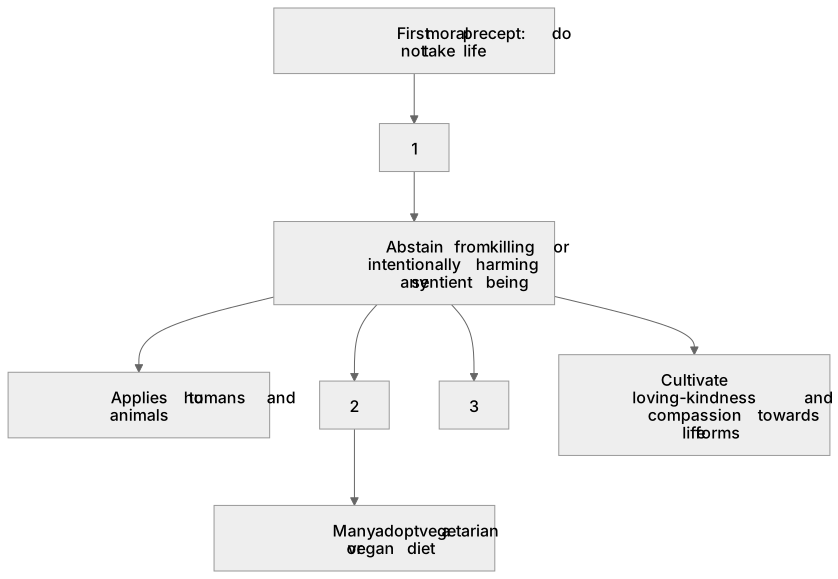
1Box 1
2Box 2
3Box 3
There is more to this lesson
The full lesson goes on to check your understanding and help you earn the marks. Create a free account to carry on, with your progress saved.
A week of Premium from your first lesson · Then the free plan continues · No card, no charge
Test your understanding of Buddhism - 3.1.1.2 Practices: do not take life
Active recall beats re-reading. Take an instant quiz now to test what you’ve learned and lock it into long-term memory.
A week of Premium from your first lesson · Then the free plan continues · No card, no charge