AQA · GCSE · Religious Studies
Course version: 8062 · Version from Sept 2018
Buddhism - 3.1.1.2 Practices: The five moral precepts:
The five moral precepts are fundamental ethical guidelines that Buddhists voluntarily undertake to cultivate moral discipline and reduce suffering.
Checked against the AQA 8062 specification (opens in a new tab) on .
- Point 17 of 29
- 4 key terms
Study notes
From the checked teaching notes for this specification point.
The idea
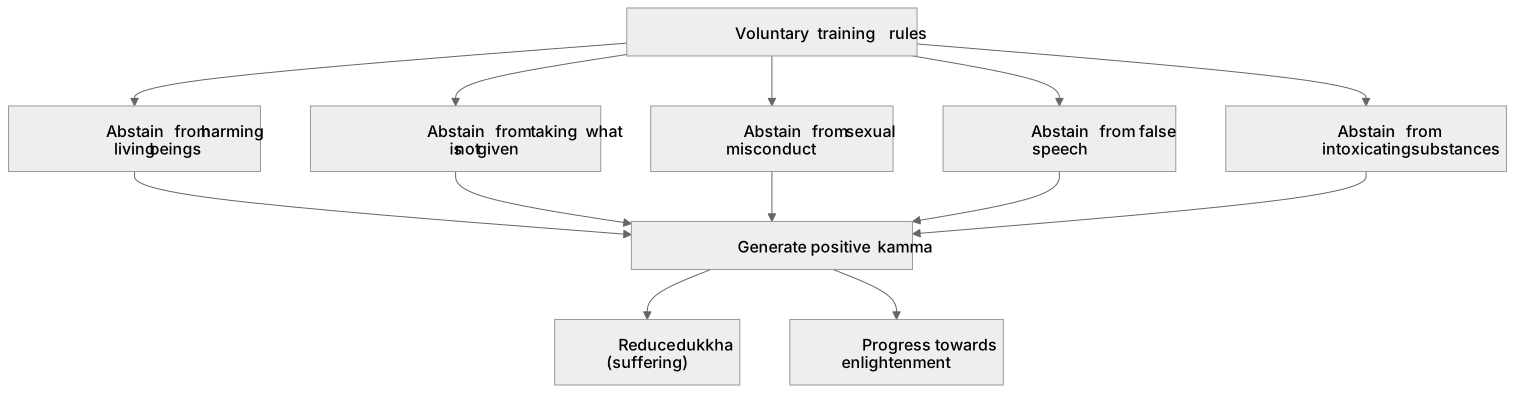
The five moral precepts are fundamental ethical guidelines that Buddhists voluntarily undertake to cultivate moral discipline and reduce suffering. Unlike divine commandments, these precepts are personal training rules aimed at purifying the mind and developing compassion. They apply to both lay Buddhists and monks, forming the foundation of right action on the Eightfold Path. By committing to abstain from harming living beings, taking what is not given, sexual misconduct, false speech, and intoxicating substances, Buddhists actively work to generate positive kamma.
For example: A Buddhist might recite the precepts daily as a reminder to act mindfully, ensuring their behaviour supports their ultimate goal of achieving enlightenment.
What earns the marks
- Identify the five moral precepts as voluntary training rules rather than strict commandments.
- Explain their role in generating positive kamma and reducing dukkha (suffering).
- Connect the precepts to the Eightfold Path, specifically the ethical conduct (sila) section such as Right Action.
- Describe how practicing the precepts helps Buddhists progress towards enlightenment by cultivating mindfulness and compassion.
Common mistakes and how to put them right
Calling the precepts 'commandments' or laws given by God.
Put it right: Describe them as voluntary training rules or guidelines undertaken by the individual.
Stating that breaking a precept results in punishment from the Buddha.
Put it right: Explain that breaking a precept results in negative kamma as a natural consequence, not a divine punishment.
Believing the precepts only apply to monks and nuns.
Put it right: Clarify that the five moral precepts apply to all Buddhists, including the lay community.
Exam tips
- Always link the practice of the five moral precepts to the generation of positive kamma and the reduction of suffering.
- Use the term 'training rules' to demonstrate an accurate understanding of Buddhist ethics compared to theistic laws.
- When evaluating the difficulty of following the precepts, use modern examples such as the challenge of avoiding false speech on social media.
Try the lesson
The start of the Buddhism - 3.1.1.2 Practices: The five moral precepts: lesson, made from checked teaching notes for this specification point.
Have a go first
Which of the following is one of the five moral precepts that Buddhists undertake to follow?
Listen
The five moral precepts are fundamental ethical guidelines that Buddhists voluntarily undertake to cultivate moral discipline and reduce suffering. Unlike divine commandments, these precepts are personal training rules aimed at purifying the mind and developing compassion. They apply to both lay Buddhists and monks, forming the foundation of right action on the Eightfold Path. By committing to abstain from harming living beings, taking what is not given, sexual misconduct, false speech, and intoxicating substances, Buddhists actively work to generate positive kamma. For example, a Buddhist might recite the precepts daily as a reminder to act mindfully, ensuring their behaviour supports their ultimate goal of achieving enlightenment. A strong answer earns marks for these points. Identify the five moral precepts as voluntary training rules rather than strict commandments. Explain their role in generating positive kamma and reducing dukkha (suffering). Connect the precepts to the Eightfold Path, specifically the ethical conduct (sila) section such as Right Action. Describe how practicing the precepts helps Buddhists progress towards enlightenment by cultivating mindfulness and compassion. A common slip: Calling the precepts 'commandments' or laws given by God. Instead, Describe them as voluntary training rules or guidelines undertaken by the individual. Exam tip: Always link the practice of the five moral precepts to the generation of positive kamma and the reduction of suffering.
See it
Key words
Say what each word means before you turn the card.
Ethical conduct (Sila)
Try answering aloud or in your head before turning the card.
Kamma
Try answering aloud or in your head before turning the card.
Dukkha (Suffering)
Try answering aloud or in your head before turning the card.
The Eightfold Path
Try answering aloud or in your head before turning the card.
See every definition
- Ethical conduct (Sila)
- The section of the Eightfold Path that the five moral precepts form the foundation of right action within.
- Kamma
- Positive kamma is generated by actively abstaining from harming living beings, taking what is not given, sexual misconduct, false speech and intoxicating substances.
- Dukkha (Suffering)
- The five moral precepts are undertaken to cultivate moral discipline and reduce this.
- The Eightfold Path
- The five moral precepts form the foundation of right action on this path.
Label the diagram
Some boxes have lost their names. Pick the right name for each number.
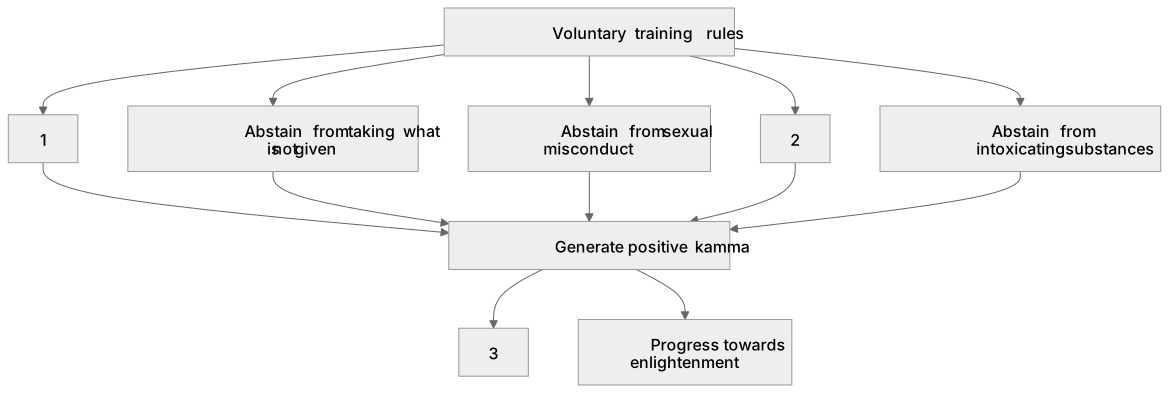
1Box 1
2Box 2
3Box 3
There is more to this lesson
The full lesson goes on to check your understanding and help you earn the marks. Create a free account to carry on, with your progress saved.
A week of Premium from your first lesson · Then the free plan continues · No card, no charge
Test your understanding of Buddhism - 3.1.1.2 Practices: The five moral precepts:
Active recall beats re-reading. Take an instant quiz now to test what you’ve learned and lock it into long-term memory.
A week of Premium from your first lesson · Then the free plan continues · No card, no charge