AQA · GCSE · Religious Studies
Course version: 8062 · Version from Sept 2018
Meditation, the different aims, significance and methods of meditation:
Full specification wording
Buddhism - 3.1.1.2 Practices: Meditation, the different aims, significance and methods of meditation:
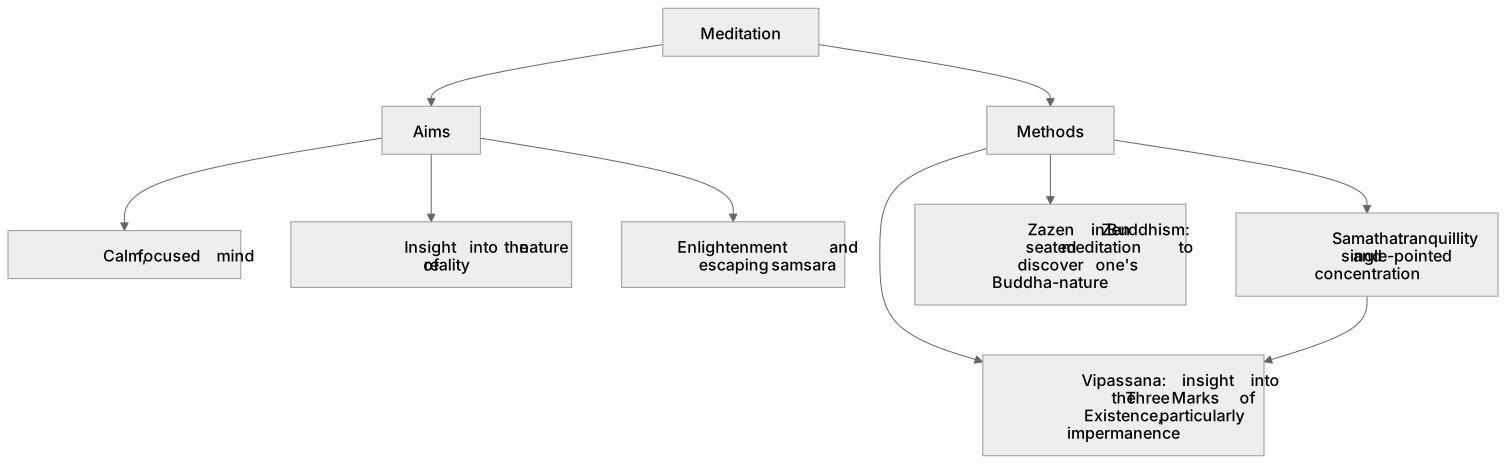
Meditation is a central Buddhist practice aimed at developing a calm, focused mind and achieving profound insight into the nature of reality.
Checked against the AQA 8062 specification (opens in a new tab) on .
- Point 4 of 29
- 2 key terms
Study notes
From the checked teaching notes for this specification point.
The idea
Meditation is a central Buddhist practice aimed at developing a calm, focused mind and achieving profound insight into the nature of reality. Its ultimate significance lies in its necessity for reaching enlightenment and escaping the cycle of samsara. Methods vary across traditions: Samatha meditation focuses on developing tranquillity and single-pointed concentration, often using mindfulness of breathing as a focal point. Vipassana meditation aims to develop deep insight into the Three Marks of Existence, particularly impermanence. Additionally, Zazen in Zen Buddhism involves seated meditation to discover one's Buddha-nature. These diverse methods all share the goal of transforming the mind and overcoming suffering.
What earns the marks
- Identify the primary aims of meditation, such as achieving mental clarity, insight, and ultimately enlightenment.
- Explain the significance of meditation as a practical tool for overcoming suffering and breaking the cycle of samsara.
- Describe Samatha meditation as a method for developing calm and concentration, often using the breath.
- Describe Vipassana meditation as a method for gaining insight into the true nature of reality, such as impermanence.
- Explain how different Buddhist traditions emphasise different methods, such as Zazen in Zen Buddhism.
Common mistakes and how to put them right
Treating Samatha and Vipassana as completely unrelated practices.
Put it right: Explain that Samatha (calm) is often used as a foundation to prepare the mind for Vipassana (insight).
Stating that the only aim of meditation is relaxation.
Put it right: Clarify that while relaxation is a byproduct, the ultimate aims are spiritual insight, understanding reality, and enlightenment.
Assuming all Buddhists meditate in exactly the same way.
Put it right: Highlight the different methods used across traditions, such as mindfulness of breathing versus Zen seated meditation.
Exam tips
- Clearly distinguish between the aims of Samatha (calmness) and Vipassana (insight) when discussing meditation methods.
- Link the practice of meditation directly to the Eightfold Path, specifically the steps relating to mental discipline.
- Use specific terminology like 'Zazen' or 'mindfulness of breathing' to demonstrate detailed knowledge of methods.
Try the lesson
The start of the Buddhism - 3.1.1.2 Practices: Meditation, the different aims, significance and methods of meditation: lesson, made from checked teaching notes for this specification point.
Have a go first
What is a primary aim of meditation in Buddhist practice?
Listen
Meditation is a central Buddhist practice aimed at developing a calm, focused mind and achieving profound insight into the nature of reality. Its ultimate significance lies in its necessity for reaching enlightenment and escaping the cycle of samsara. Methods vary across traditions: Samatha meditation focuses on developing tranquillity and single-pointed concentration, often using mindfulness of breathing as a focal point. Vipassana meditation aims to develop deep insight into the Three Marks of Existence, particularly impermanence. Additionally, Zazen in Zen Buddhism involves seated meditation to discover one's Buddha-nature. These diverse methods all share the goal of transforming the mind and overcoming suffering. A strong answer earns marks for these points. Identify the primary aims of meditation, such as achieving mental clarity, insight, and ultimately enlightenment. Explain the significance of meditation as a practical tool for overcoming suffering and breaking the cycle of samsara. Describe Samatha meditation as a method for developing calm and concentration, often using the breath. Describe Vipassana meditation as a method for gaining insight into the true nature of reality, such as impermanence. A common slip: Treating Samatha and Vipassana as completely unrelated practices. Instead, Explain that Samatha (calm) is often used as a foundation to prepare the mind for Vipassana (insight). Exam tip: Clearly distinguish between the aims of Samatha (calmness) and Vipassana (insight) when discussing meditation methods.
See it
Key words
Say what each word means before you turn the card.
Enlightenment
Try answering aloud or in your head before turning the card.
Insight
Try answering aloud or in your head before turning the card.
See every definition
- Enlightenment
- The ultimate aim of meditation, which is necessary for reaching it and escaping the cycle of samsara.
- Insight
- A profound understanding of the nature of reality, which meditation aims to achieve.
Label the diagram
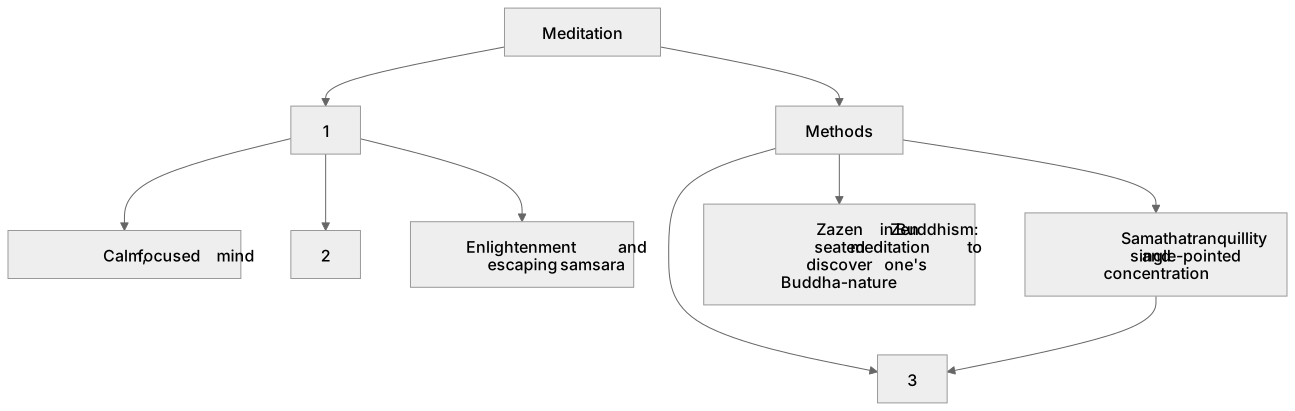
Some boxes have lost their names. Pick the right name for each number.
1Box 1
2Box 2
3Box 3
There is more to this lesson
The full lesson goes on to check your understanding and help you earn the marks. Create a free account to carry on, with your progress saved.
A week of Premium from your first lesson · Then the free plan continues · No card, no charge
Test your understanding of Buddhism - 3.1.1.2 Practices: Meditation, the different aims, significance and methods of meditation:
Active recall beats re-reading. Take an instant quiz now to test what you’ve learned and lock it into long-term memory.
A week of Premium from your first lesson · Then the free plan continues · No card, no charge