AQA · GCSE · Religious Studies
Course version: 8062 · Version from Sept 2018
Puja, the significance and role of puja/devotional ritual in the home and…
Full specification wording
Buddhism - 3.1.1.2 Practices: Puja, the significance and role of puja/devotional ritual in the home and in the temple, including chanting, both as a devotional practice and as an aid to mental concentration, mantra recitation, use of malas.
Puja is a devotional ritual expressing gratitude and respect for the Buddha and his teachings.
Checked against the AQA 8062 specification (opens in a new tab) on .
- Point 3 of 29
Study notes
From the checked teaching notes for this specification point.
The idea
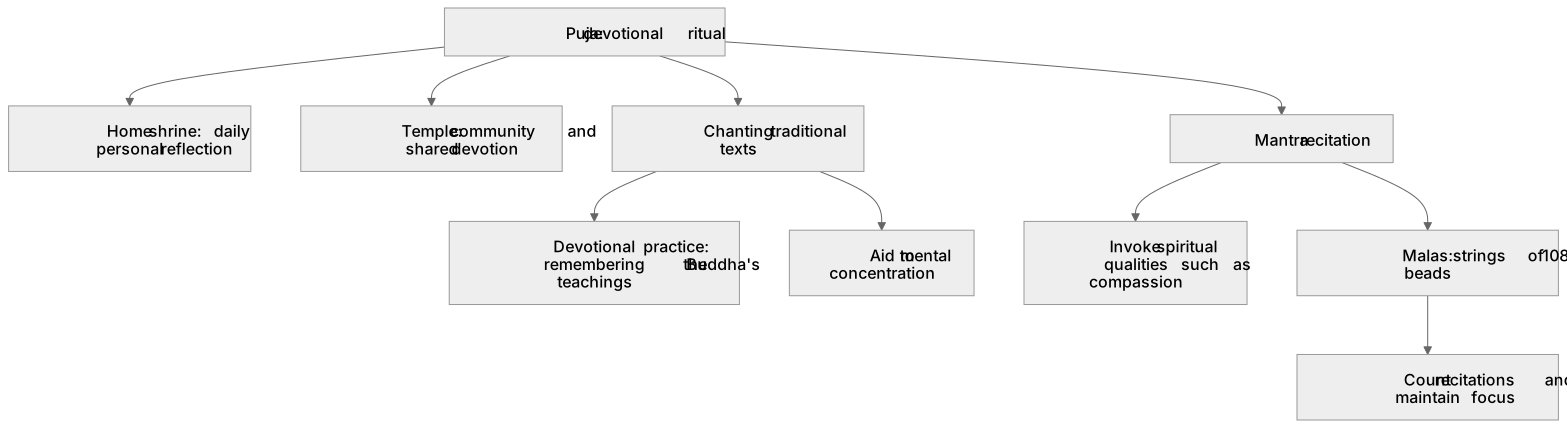
Puja is a devotional ritual expressing gratitude and respect for the Buddha and his teachings. It can be performed at a home shrine, offering daily personal reflection, or in a temple, fostering community and shared devotion. Key elements include chanting traditional texts, which serves both as a devotional practice to remember the Buddha's teachings and as a powerful aid to mental concentration. Buddhists also recite mantras, such as 'Om Mani Padme Hum', to invoke spiritual qualities like compassion. To count these recitations and maintain focus, practitioners use malas, which are strings of 108 beads. Together, these practices deepen faith, calm the mind, and prepare Buddhists for deeper meditation.
What earns the marks
- Explain the role of puja in expressing gratitude to the Buddha and acknowledging his teachings.
- Contrast the personal, daily nature of home puja with the communal, structured nature of temple puja.
- Describe chanting as a dual-purpose practice: showing devotion and aiding mental concentration.
- Explain the use of mantras to invoke specific enlightened qualities, such as compassion.
- Identify malas as strings of beads used to count mantra recitations and maintain focus.
Common mistakes and how to put them right
Confusing puja with worshipping the Buddha as a creator god.
Put it right: Explain that puja is an expression of respect and gratitude for the Buddha's teachings, not worship of a deity.
Stating that chanting is only for memorising texts.
Put it right: Note that while it helps remember teachings, chanting is also a devotional act and a vital aid to mental concentration.
Thinking malas are merely decorative jewellery.
Put it right: Specify that malas are practical tools used to count mantra recitations and help focus the mind.
Exam tips
- Use specific examples of mantras, such as 'Om Mani Padme Hum', to illustrate how recitation invokes compassion.
- When evaluating the importance of puja, compare the benefits of private home practice with the community support found in temple rituals.
- Explicitly link the physical use of a mala to the mental benefit of improved concentration during mantra recitation.
Try the lesson
The start of the Buddhism - 3.1.1.2 Practices: Puja, the significance and role of puja/devotional ritual in the home and in the temple, including chanting, both as a devotional practice and as an aid to mental concentration, mantra recitation, use of malas. lesson, made from checked teaching notes for this specification point.
Have a go first
What is the primary purpose of using a mala during Buddhist puja?
Listen
Puja is a devotional ritual expressing gratitude and respect for the Buddha and his teachings. It can be performed at a home shrine, offering daily personal reflection, or in a temple, fostering community and shared devotion. Key elements include chanting traditional texts, which serves both as a devotional practice to remember the Buddha's teachings and as a powerful aid to mental concentration. Buddhists also recite mantras, such as 'Om Mani Padme Hum', to invoke spiritual qualities like compassion. To count these recitations and maintain focus, practitioners use malas, which are strings of 108 beads. Together, these practices deepen faith, calm the mind, and prepare Buddhists for deeper meditation. A strong answer earns marks for these points. Explain the role of puja in expressing gratitude to the Buddha and acknowledging his teachings. Contrast the personal, daily nature of home puja with the communal, structured nature of temple puja. Describe chanting as a dual-purpose practice: showing devotion and aiding mental concentration. Explain the use of mantras to invoke specific enlightened qualities, such as compassion. A common slip: Confusing puja with worshipping the Buddha as a creator god. Instead, Explain that puja is an expression of respect and gratitude for the Buddha's teachings, not worship of a deity. Exam tip: Use specific examples of mantras, such as 'Om Mani Padme Hum', to illustrate how recitation invokes compassion.
See it
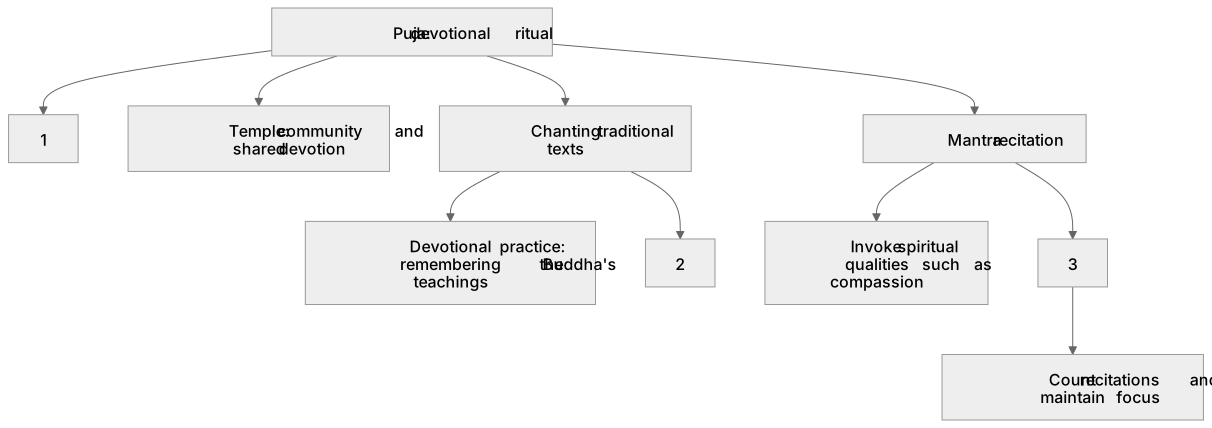
Label the diagram
Some boxes have lost their names. Pick the right name for each number.
1Box 1
2Box 2
3Box 3
There is more to this lesson
The full lesson goes on to check your understanding and help you earn the marks. Create a free account to carry on, with your progress saved.
A week of Premium from your first lesson · Then the free plan continues · No card, no charge
Test your understanding of Buddhism - 3.1.1.2 Practices: Puja, the significance and role of puja/devotional ritual in the home and in the temple, including chanting, both as a devotional practice and as an aid to mental concentration, mantra recitation, use of malas.
Active recall beats re-reading. Take an instant quiz now to test what you’ve learned and lock it into long-term memory.
A week of Premium from your first lesson · Then the free plan continues · No card, no charge