AQA · GCSE · Religious Studies
Course version: 8062 · Version from Sept 2018
Component 1: The study of religions: beliefs, teachings: Christianity
The study of Christianity focuses on the core beliefs and teachings underpinning the faith.
Checked against the AQA 8062 specification (opens in a new tab) on .
- Point 2 of 7
- 3 key terms
Study notes
From the checked teaching notes for this specification point.
The idea
The study of Christianity focuses on the core beliefs and teachings underpinning the faith. Students explore the nature of God, including the Trinity and God's omnipotent, loving nature. The curriculum covers biblical accounts of creation, the problem of evil, and the life of Jesus Christ, encompassing his incarnation, crucifixion, resurrection, and ascension. Furthermore, students examine Christian eschatology, including beliefs about the afterlife, judgement, heaven, and hell. Understanding these foundational concepts is crucial, as they inform Christian practices and ethical decision-making.
For example: Belief in the incarnation demonstrates God's love, directly influencing how Christians treat others in their daily lives.
What earns the marks
- Accurate explanation of the Trinity and its significance in understanding the nature of God.
- Clear articulation of the events of Jesus' life (incarnation, crucifixion, resurrection) and their salvific meaning.
- Evaluation of how beliefs about the afterlife and judgement influence Christian behaviour.
- Application of relevant sources of authority, distinguishing scripture (e.g., John 1:1-3) from non-scriptural creeds (e.g., the Apostles' Creed), to support explanations.
Common mistakes and how to put them right
Confusing the roles of the Trinity.
Put it right: Clearly distinguish the Father as creator, Son as saviour, and Holy Spirit as the unseen power in the world.
Treating all Christian denominations as having identical beliefs.
Put it right: Acknowledge diverse views, such as literalist versus non-literalist interpretations of creation.
Misidentifying creeds as scripture.
Put it right: Correctly identify the Bible as scripture and the Apostles' Creed as a statement of belief or source of authority, not a biblical text.
Exam tips
- Memorise at least three versatile biblical quotes that can be applied to multiple topics, such as John 3:16.
- When referencing the Apostles' Creed, introduce it as a 'historical statement of Christian belief' rather than a 'quote from the Bible'.
Try the lesson
The start of the Component 1: The study of religions: beliefs, teachings: Christianity lesson, made from checked teaching notes for this specification point.
Have a go first
What is the Christian belief about the nature of the Trinity?
Listen
The study of Christianity focuses on the core beliefs and teachings underpinning the faith. Students explore the nature of God, including the Trinity and God's omnipotent, loving nature. The curriculum covers biblical accounts of creation, the problem of evil, and the life of Jesus Christ, encompassing his incarnation, crucifixion, resurrection, and ascension. Furthermore, students examine Christian eschatology, including beliefs about the afterlife, judgement, heaven, and hell. Understanding these foundational concepts is crucial, as they inform Christian practices and ethical decision-making. For example, belief in the incarnation demonstrates God's love, directly influencing how Christians treat others in their daily lives. A strong answer earns marks for these points. Accurate explanation of the Trinity and its significance in understanding the nature of God. Clear articulation of the events of Jesus' life (incarnation, crucifixion, resurrection) and their salvific meaning. Evaluation of how beliefs about the afterlife and judgement influence Christian behaviour. Application of relevant sources of authority, distinguishing scripture (e.g., John 1:1-3) from non-scriptural creeds (e.g., the Apostles' Creed), to support explanations. A common slip: Confusing the roles of the Trinity. Instead, clearly distinguish the Father as creator, Son as saviour, and Holy Spirit as the unseen power in the world. Exam tip: Memorise at least three versatile biblical quotes that can be applied to multiple topics, such as John 3:16.
See it

Key words
Say what each word means before you turn the card.
The Nature of God
Try answering aloud or in your head before turning the card.
The Life and Work of Jesus Christ
Try answering aloud or in your head before turning the card.
Sources of Wisdom and Authority
Try answering aloud or in your head before turning the card.
See every definition
- The Nature of God
- The core beliefs about God, including the Trinity and God's omnipotent, loving nature.
- The Life and Work of Jesus Christ
- The biblical accounts of Jesus, encompassing his incarnation, crucifixion, resurrection, and ascension.
- Sources of Wisdom and Authority
- Scripture such as the Bible, distinguished from non-scriptural creeds such as the Apostles' Creed.
Label the diagram
Some boxes have lost their names. Pick the right name for each number.
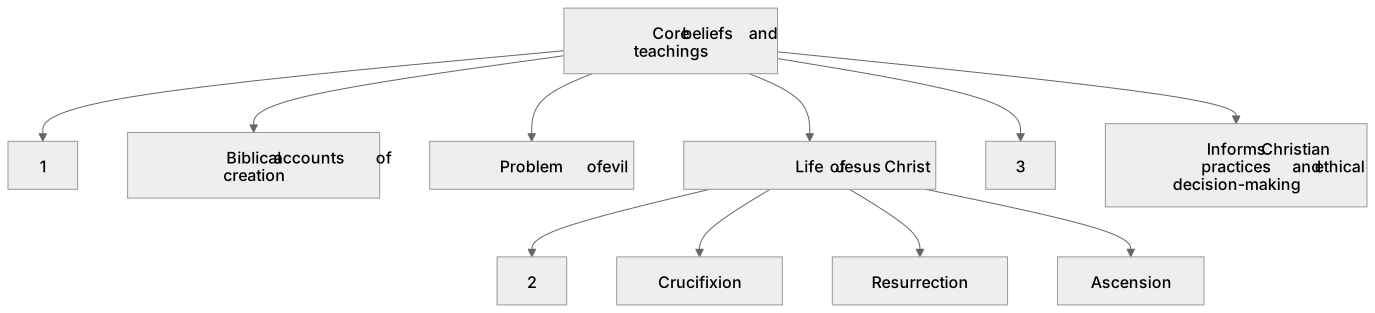
1Box 1
2Box 2
3Box 3
There is more to this lesson
The full lesson goes on to check your understanding and help you earn the marks. Create a free account to carry on, with your progress saved.
A week of Premium from your first lesson · Then the free plan continues · No card, no charge
Test your understanding of Component 1: The study of religions: beliefs, teachings: Christianity
Active recall beats re-reading. Take an instant quiz now to test what you’ve learned and lock it into long-term memory.
A week of Premium from your first lesson · Then the free plan continues · No card, no charge