AQA · GCSE · Religious Studies
Buddhism
Master the core beliefs, practices, and ethics of Buddhism for your GCSE exam. This guide covers the life of the Buddha, the fundamental differences between Theravada and Mahayana traditions, and how key concepts like the Four Noble Truths shape daily Buddhist life.
- 6 min read
- 3 worked examples
- 5 practice questions
- 6 key terms
Study Notes
Overview
Buddhism is a major world religion originating in ancient India, founded upon the teachings of Siddhartha Gautama (the Buddha). For your GCSE Religious Studies exam, you are required to demonstrate a deep understanding of Buddhist beliefs, teachings, and practices. Examiners expect you to accurately define key terms, explain complex concepts such as the Three Marks of Existence and the Four Noble Truths, and crucially, differentiate between the Theravada and Mahayana traditions. You must also be able to link these foundational beliefs to daily practices, including meditation, worship (puja), and ethical conduct (sila). Understanding how the Dhamma influences the lives of individuals and communities is essential for achieving the highest marks.

Key Beliefs & Teachings
The Life of the Buddha
Date(s): c. 563 BCE – c. 483 BCE
What happened: Siddhartha Gautama was born a prince in Lumbini (modern-day Nepal). Shielded from suffering, he eventually encountered the Four Sights (old age, sickness, death, and a holy man). This prompted his renunciation of royal life. After six years of extreme asceticism, he achieved Enlightenment under the Bodhi tree in Bodh Gaya, becoming the Buddha. He then taught the Dhamma for 45 years, beginning with his first sermon at the Deer Park in Sarnath.
Why it matters: The Buddha's life serves as the ultimate template for all Buddhists. His realisation that neither extreme luxury nor extreme asceticism leads to liberation resulted in the 'Middle Way'. His Enlightenment proves that humans can escape the cycle of samsara.
Specific Knowledge: Lumbini (birthplace), Four Sights, asceticism, Bodh Gaya (Enlightenment), Sarnath (first sermon), Nibbana/Nirvana.
The Three Marks of Existence
What happened: The Buddha taught that all conditioned existence shares three fundamental characteristics: Anicca (impermanence), Anatta (not-self), and Dukkha (suffering/unsatisfactoriness).
Why it matters: Understanding these marks is essential for Enlightenment. Because things are impermanent (Anicca) and lack a fixed self (Anatta), clinging to them inevitably causes suffering (Dukkha). Recognising this is the first step on the Buddhist path.
Specific Knowledge: Anicca, Anatta, Dukkha. Theravada's Five Aggregates (skandhas) explain Anatta.
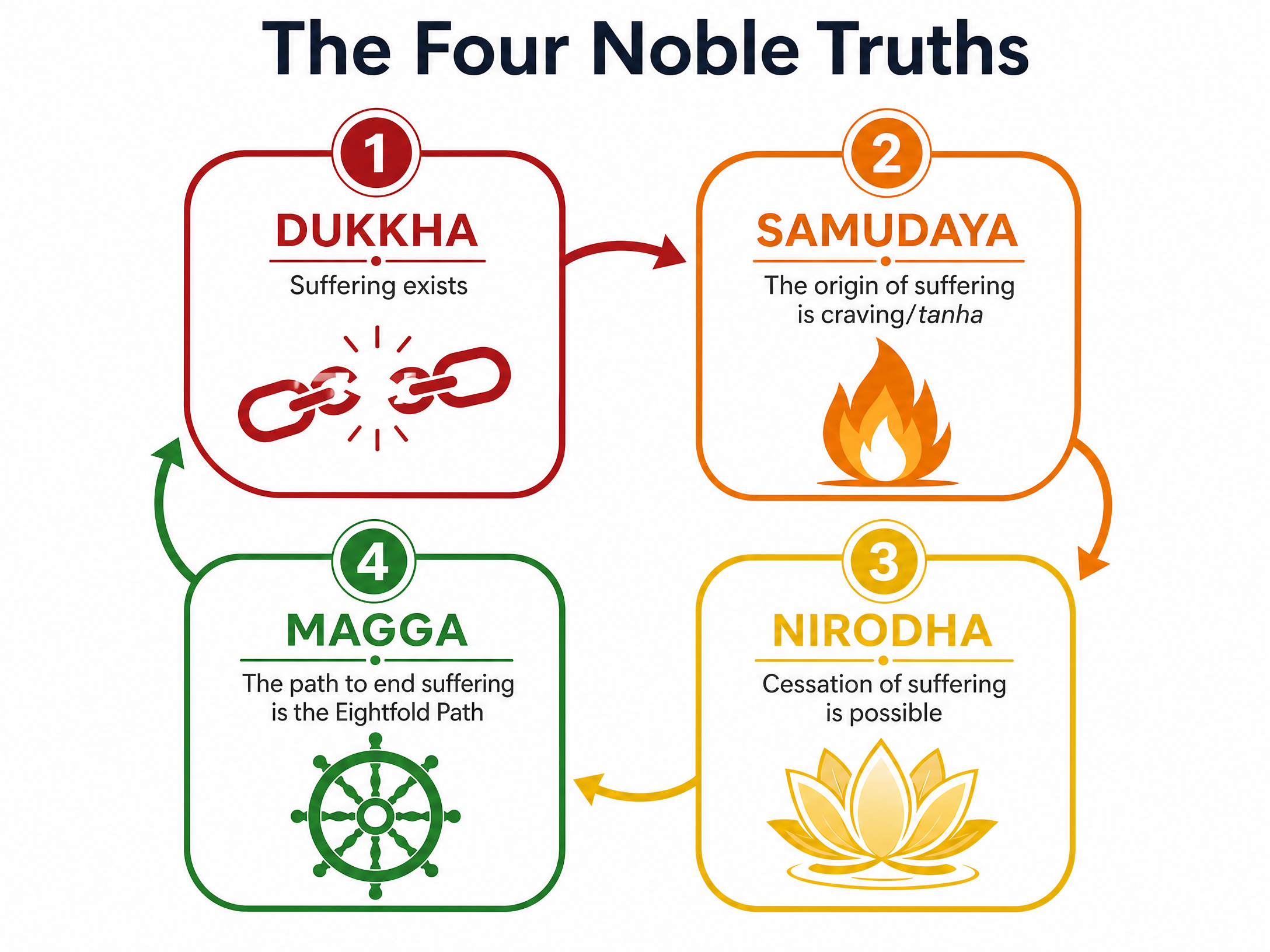
The Four Noble Truths
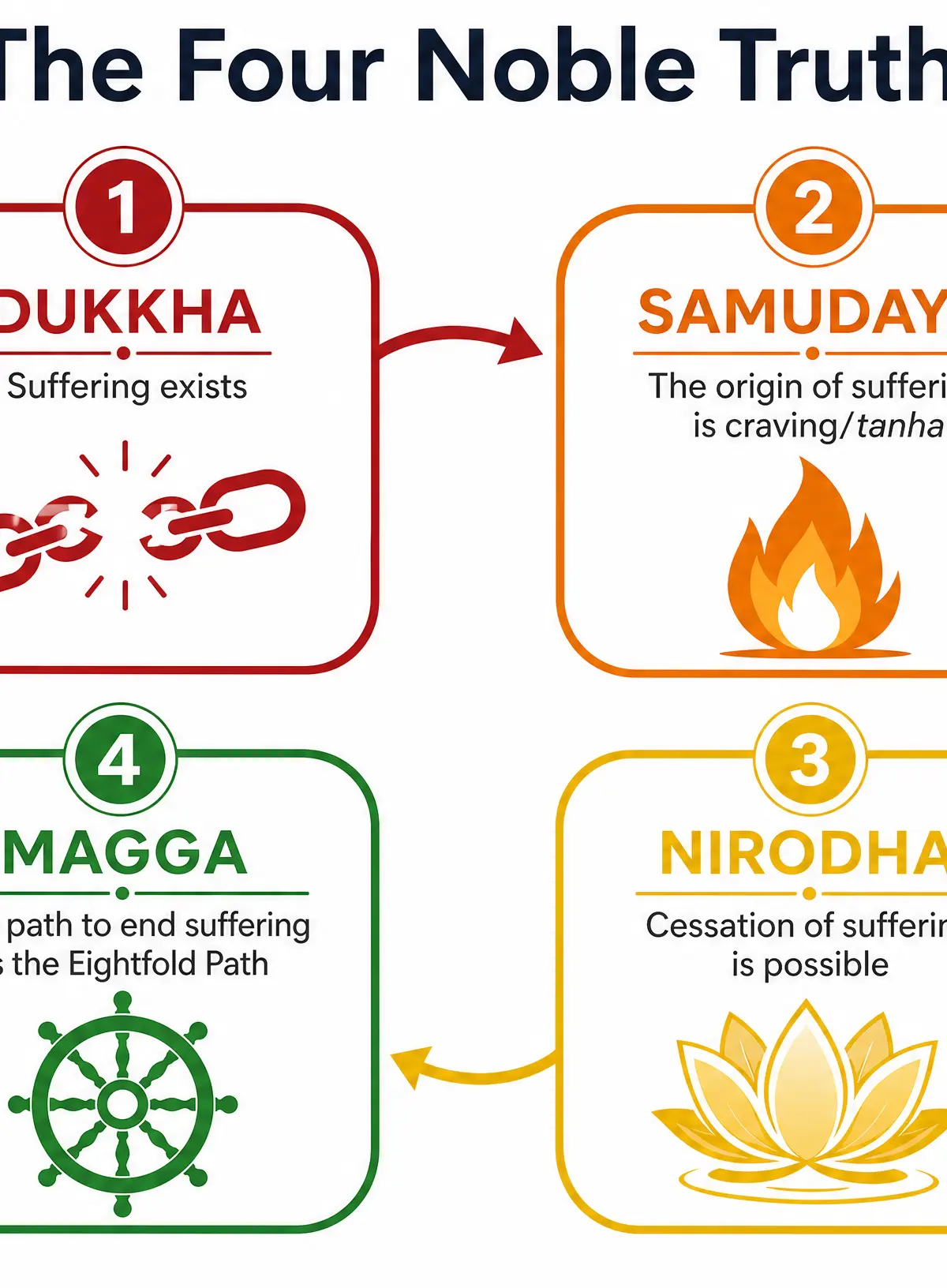
What happened: The core of the Buddha's first sermon. 1) Dukkha (Suffering exists). 2) Samudaya (The origin of suffering is craving/tanha). 3) Nirodha (The cessation of suffering is possible - Nibbana). 4) Magga (The path to cessation is the Noble Eightfold Path).
Why it matters: This is the medical model of Buddhism: diagnosis, cause, prognosis, and cure. It forms the foundation of all Buddhist practice.
Specific Knowledge: Dukkha, Samudaya, Nirodha, Magga, Tanha (craving).
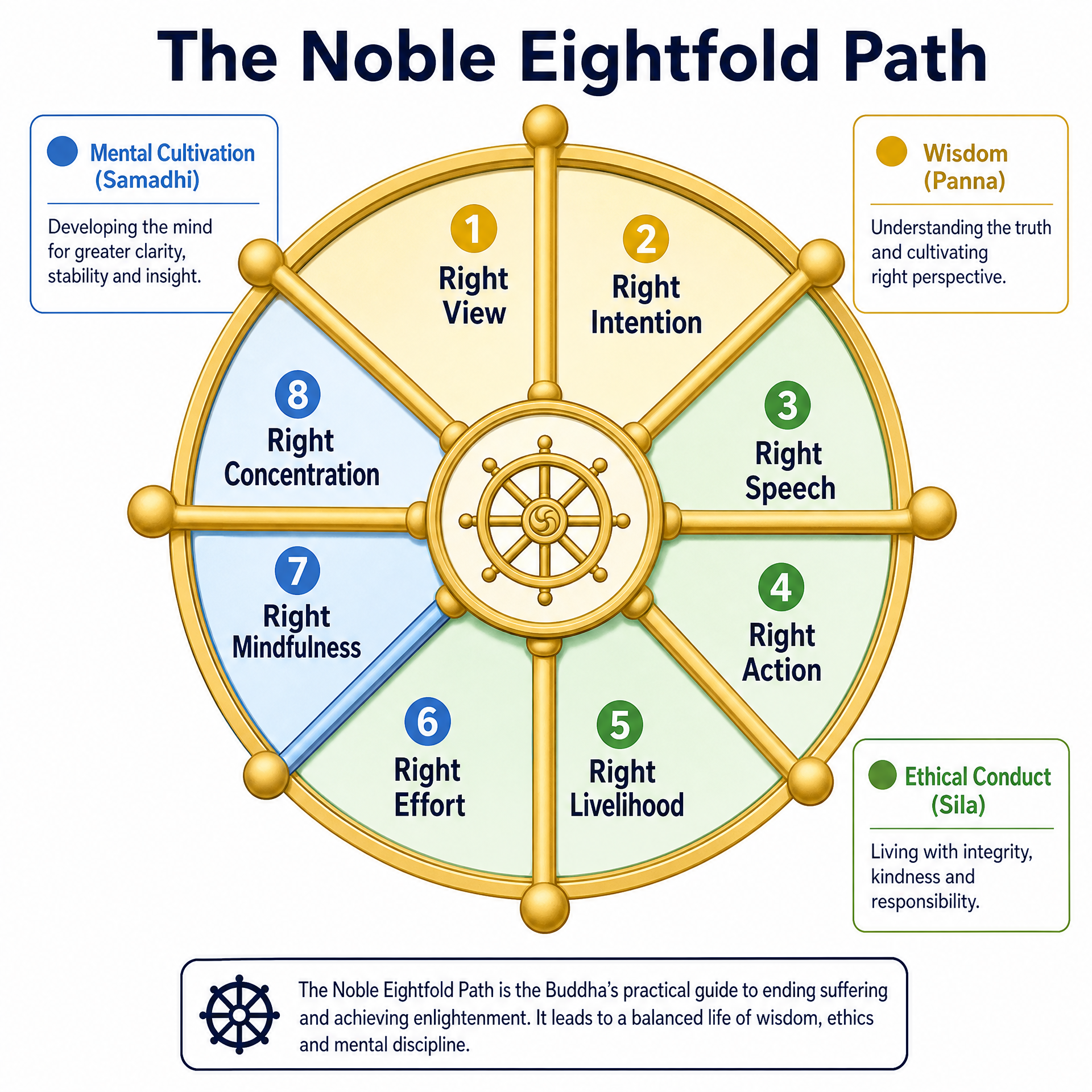
The Noble Eightfold Path (Threefold Way)
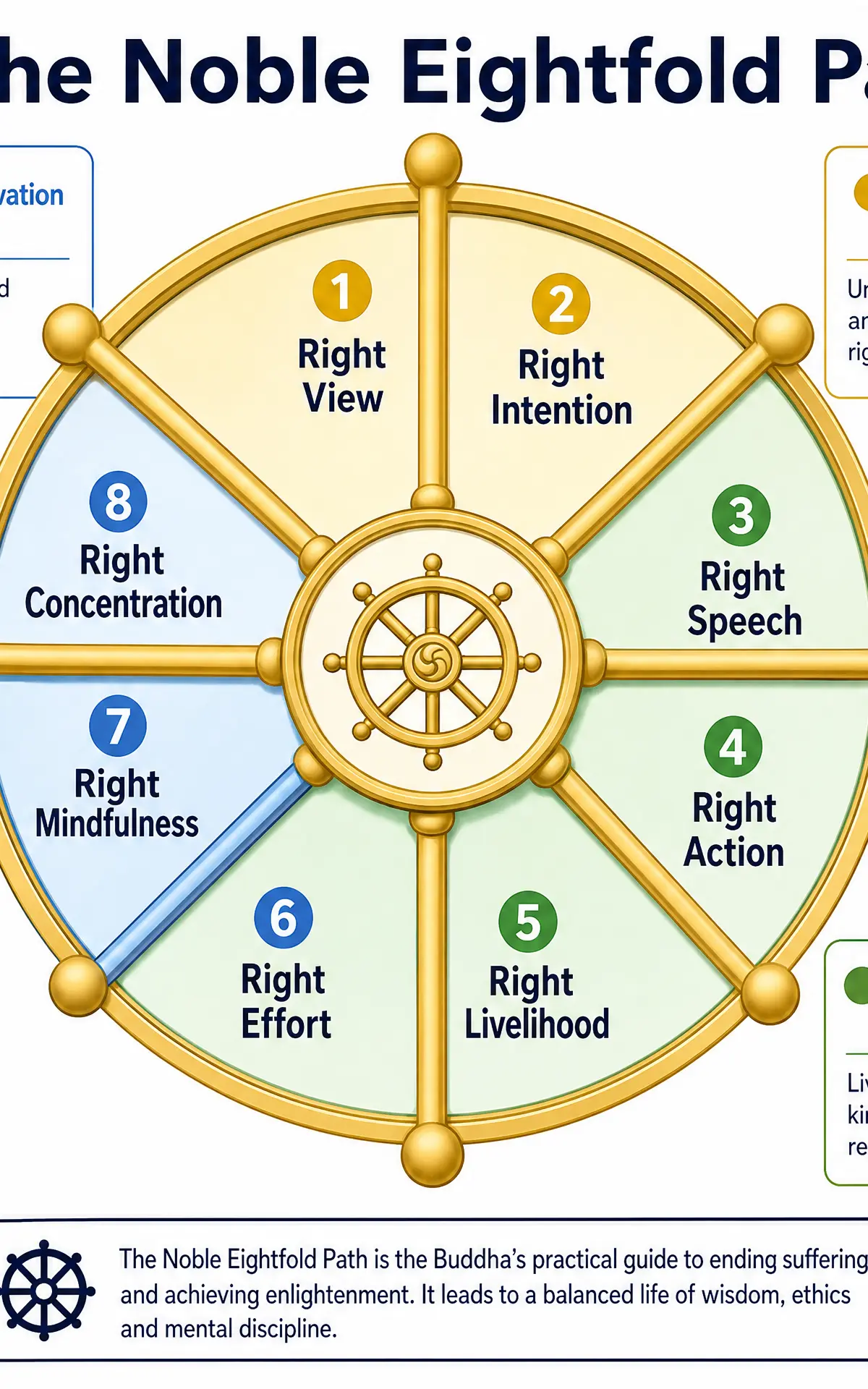
What happened: The practical guide to achieving Enlightenment, grouped into the Threefold Way: Panna (Wisdom - Right View, Right Intention), Sila (Ethics - Right Speech, Right Action, Right Livelihood), and Samadhi (Meditation - Right Effort, Right Mindfulness, Right Concentration).
Why it matters: This is the practical application of the Dhamma. It shows examiners how Buddhists live out their beliefs.
Specific Knowledge: Panna, Sila, Samadhi.
Traditions & Practices
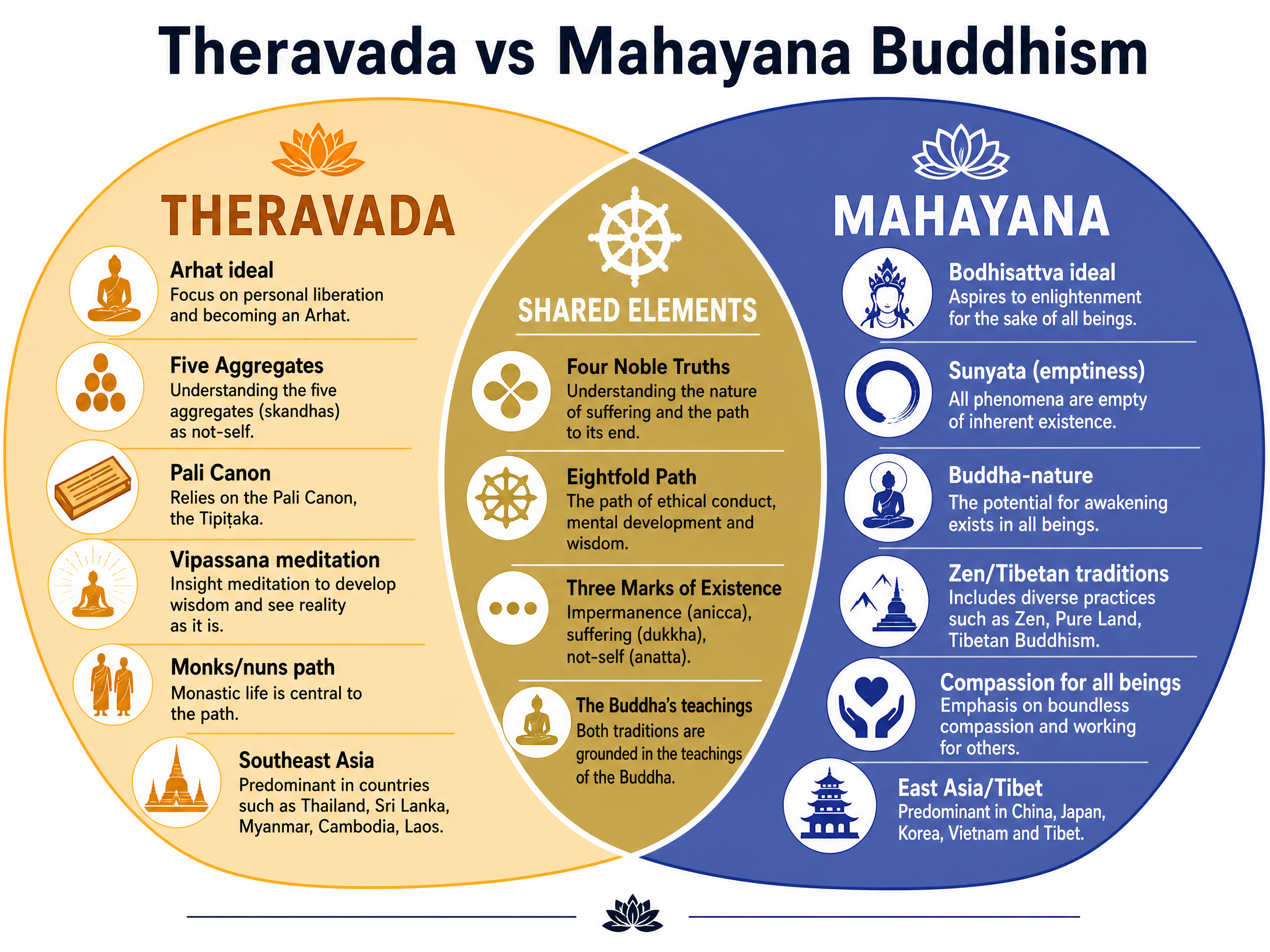
Theravada vs Mahayana Buddhism
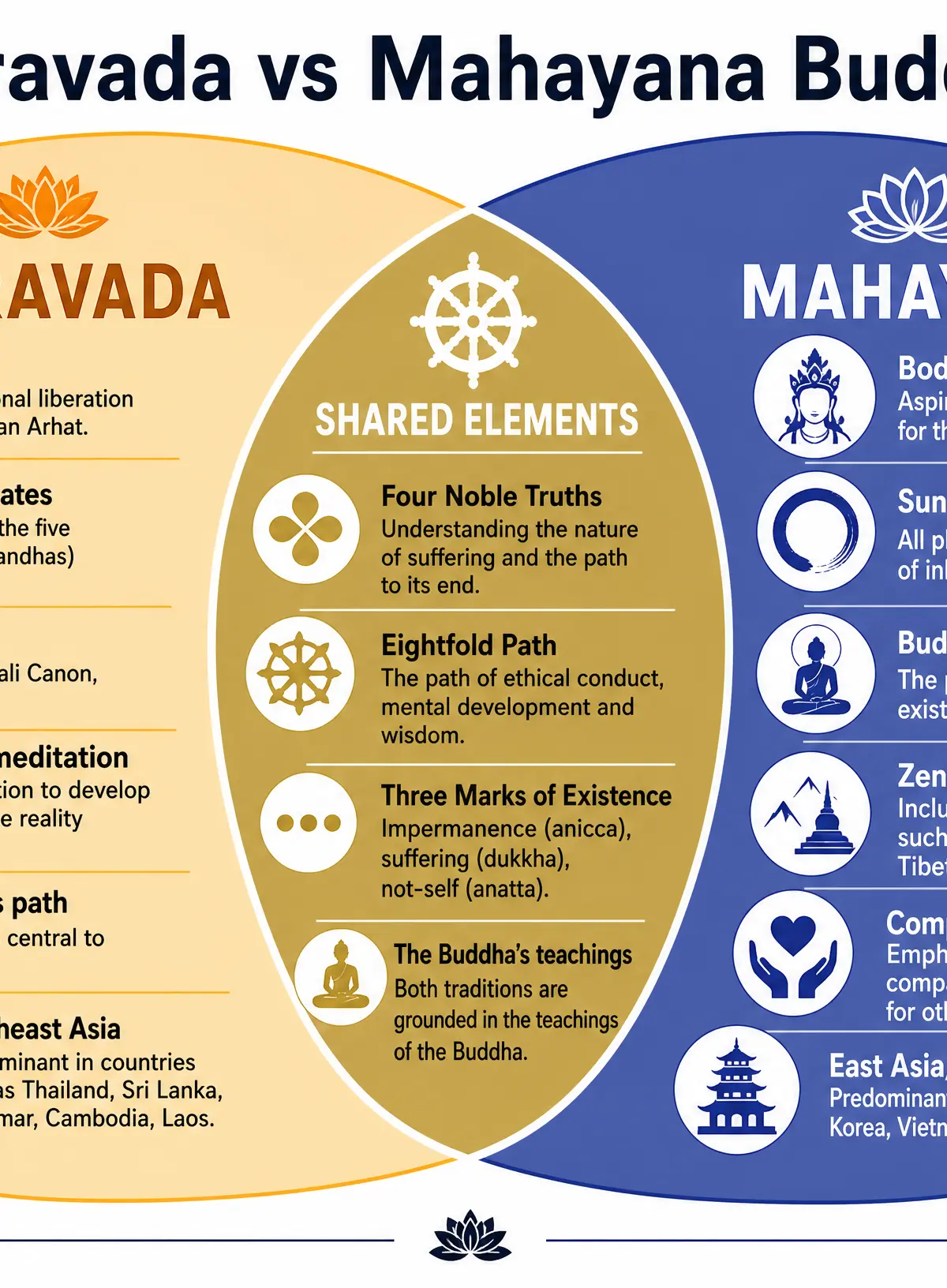
Role: The two major branches of Buddhism.
Key Actions: Theravada ('Way of the Elders') focuses on the Arhat ideal (personal liberation) and relies on the Pali Canon. Mahayana ('Great Vehicle') focuses on the Bodhisattva ideal (delaying Nirvana to help all beings) out of karuna (compassion). Mahayana also emphasises sunyata (emptiness) and Buddha-nature.
Impact: Examiners frequently ask for comparisons. Confusing the two is a major pitfall.
Places of Worship and Puja
Role: Temples, viharas, gompas, and shrines.
Key Actions: Devotional practices (puja) include chanting, mantra recitation (often using malas), and making offerings (flowers, candles, incense) at a shrine featuring a Buddha rupa.
Impact: Offerings are symbolic (e.g., fading flowers represent Anicca). This demonstrates the link between practice and belief.
Meditation
Role: Central practice for mental cultivation (Samadhi).
Key Actions: Samatha (calmness/mindfulness of breathing) and Vipassana (insight into the true nature of reality). Mahayana includes zazen (seated meditation in Zen) and visualisation (in Tibetan Buddhism).
Impact: Meditation is the primary tool for achieving Enlightenment and understanding the Dhamma.
Ethical Teachings
Kamma and Rebirth
What happened: Kamma (karma) is the law of moral cause and effect. Intentional actions shape future rebirths within samsara.
Why it matters: It provides the moral framework for Buddhist behaviour, encouraging karuna (compassion) and metta (loving-kindness).
The Precepts and Perfections
What happened: The Five Moral Precepts (no killing, stealing, sexual misconduct, lying, intoxicants) guide all Buddhists. The Six Perfections (paramitas) guide Mahayana Bodhisattvas.
Why it matters: These are the practical rules for living a Buddhist life, directly linked to Right Action in the Eightfold Path.
Source Skills
When evaluating Buddhist sources of wisdom (e.g., the Dhammapada, the Tipitaka, Jataka tales), consider their tradition. A Theravada source will emphasise the Arhat path and individual effort, while a Mahayana text (like the Lotus Sutra) will emphasise compassion, the Bodhisattva path, and sunyata. Always use sources to support your explanations in longer exam questions.
Visual Resources
3 diagrams and illustrations
Interactive Diagrams
1 interactive diagram to visualise key concepts
Conceptual Flow Outline
The Cycle of Samsara and the Path to Nibbana
Worked Examples
3 worked examples — open one to explore the question and available guidance.
Practice Questions
Test your understanding — click to reveal model answers
Explain two reasons why the Buddha's Enlightenment is important for Buddhists today. (4 marks)
Hint: Think about what his Enlightenment proved was possible, and what he did afterwards.
Explain two ways in which a belief in kamma influences Buddhists. In your answer you must refer to a source of wisdom and authority. (5 marks)
Hint: How does it affect their daily actions and their attitude towards others?
'Meditation is the most important Buddhist practice.' Evaluate this statement. (12 marks)
Hint: Compare meditation (Samadhi) with ethical conduct (Sila) or devotional practices (Puja).
Explain two differences between Theravada and Mahayana Buddhism. (4 marks)
Hint: Think about their ultimate goals and their views on the nature of reality.
Give two of the Five Moral Precepts. (2 marks)
Hint: What are Buddhists expected to abstain from?