AQA · GCSE · Religious Studies
Good, Evil, and Suffering
This study guide for AQA GCSE Religious Studies unpacks the profound theological problem of evil and suffering. It explores the core tension between God's nature and the reality of pain, equipping candidates with the critical arguments, scriptural evidence, and exam techniques needed to achieve top marks in this challenging but rewarding topic.
- 7 min read
- 3 worked examples
- 5 practice questions
- 6 key terms
Study Notes
Overview
This topic explores one of the most significant challenges to belief in God: the existence of evil and suffering. For AQA GCSE Religious Studies (Specification A), candidates must grapple with the theological tension between the nature of God as omnipotent and omnibenevolent, and the undeniable reality of pain in the world. Examiners expect a clear understanding of the Inconsistent Triad, the distinction between moral and natural evil, and a critical evaluation of key religious responses, known as theodicies. This guide will break down the core concepts, analyse the key arguments from Christianity and Islam, and provide the specific knowledge and skills required to excel in the exam. A strong answer will not just describe these ideas, but will weigh their strengths and weaknesses, using precise terminology and scriptural evidence to support every point.

Key Concepts & Developments
The Inconsistent Triad
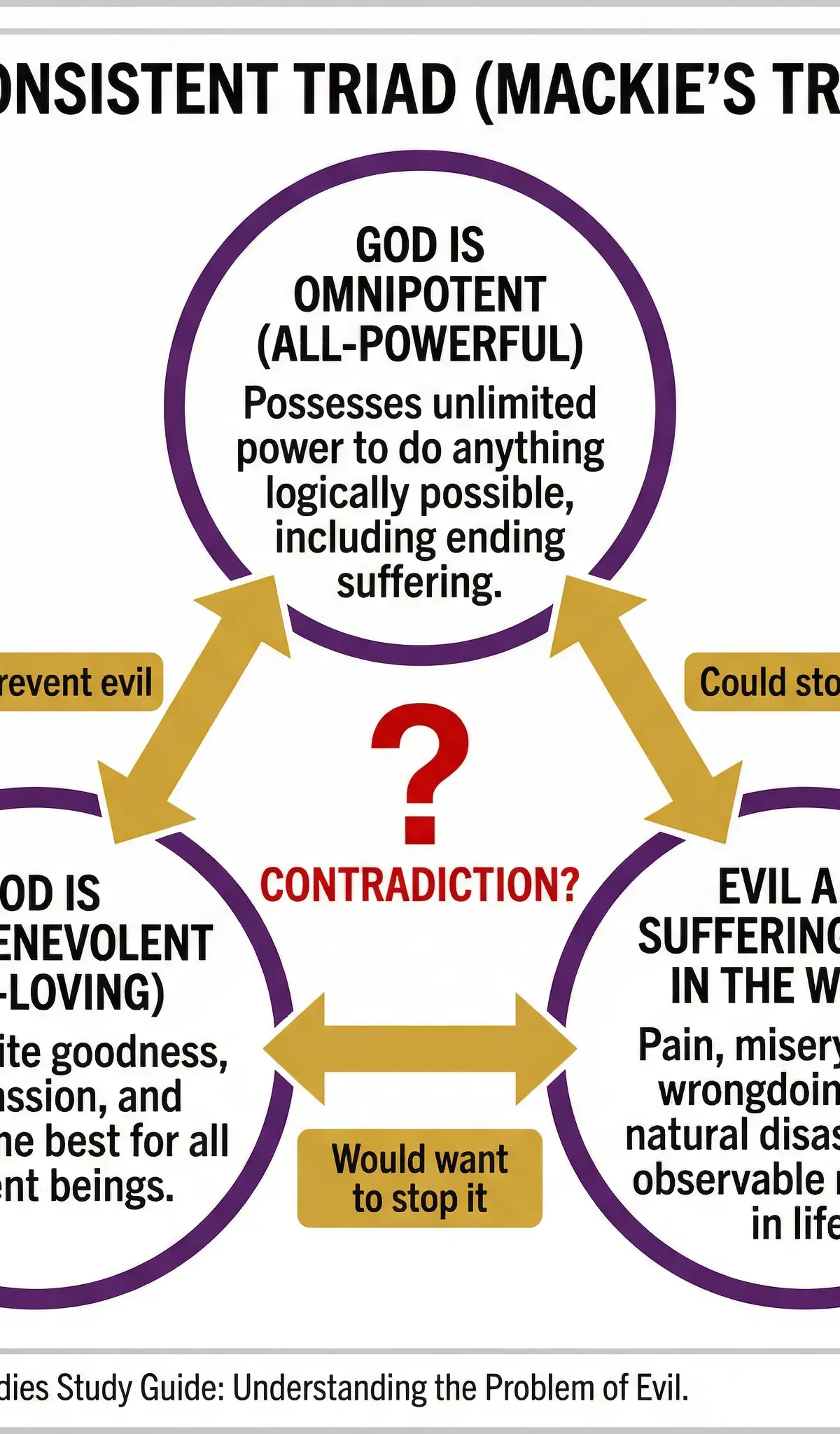
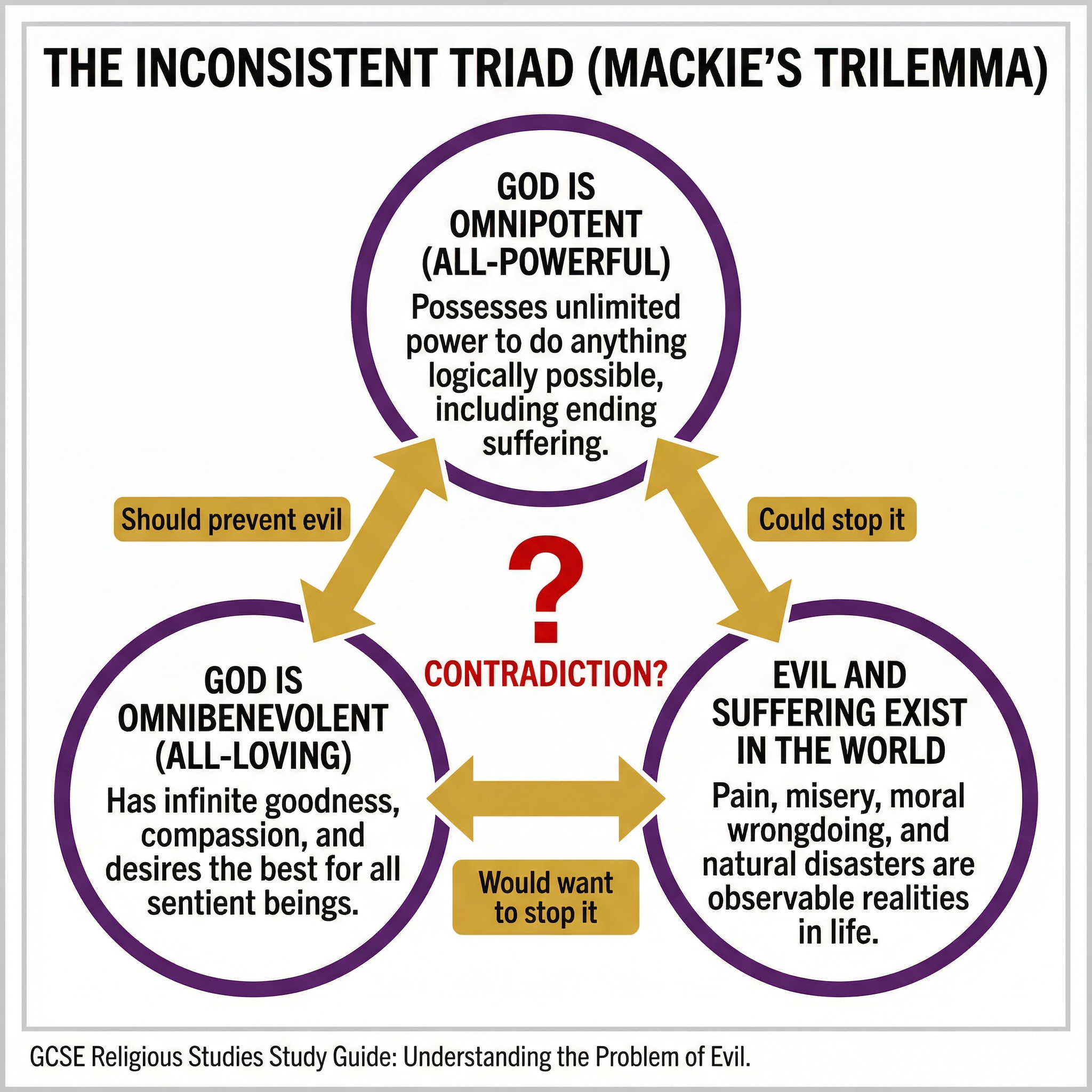
What it is: First articulated in its modern form by the philosopher J.L. Mackie (1955), the Inconsistent Triad is a logical problem that highlights an apparent contradiction within theism. It consists of three propositions that, Mackie argued, cannot all be true simultaneously.
The Three Points:
- God is Omnipotent (all-powerful)
- God is Omnibenevolent (all-loving and perfectly good)
- Evil and Suffering Exist
Why it matters: This is the foundational problem of this topic. An omnipotent God could prevent evil. An omnibenevolent God would want to prevent evil. Yet, evil exists. This leads to the logical conclusion that either God lacks the power, lacks the goodness, or does not exist. In the exam, this is your starting point for any evaluative question. You must show the examiner you understand this fundamental tension.
Moral and Natural Evil
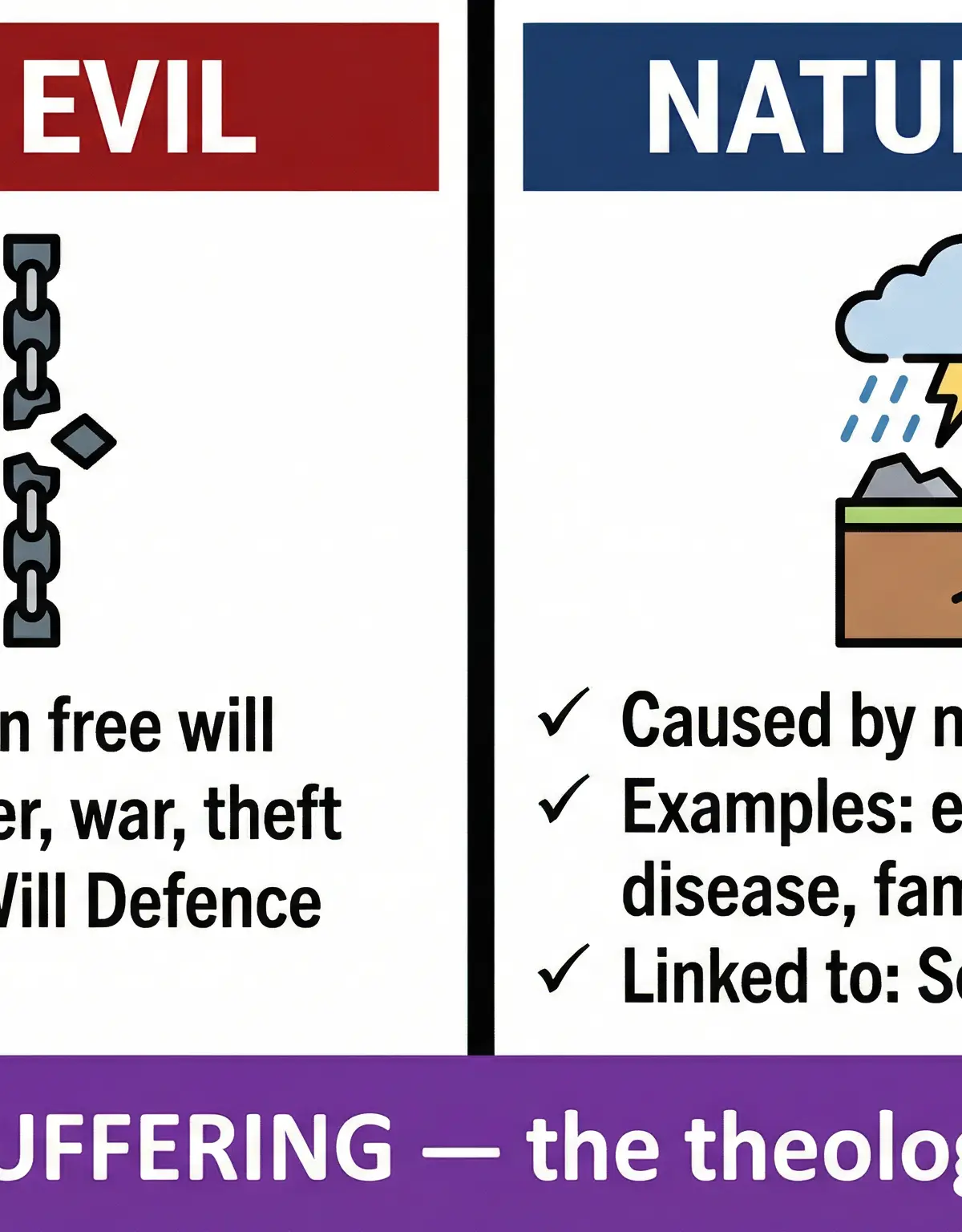
What it is: A crucial distinction that examiners award marks for. It is essential to separate evil into two distinct categories.
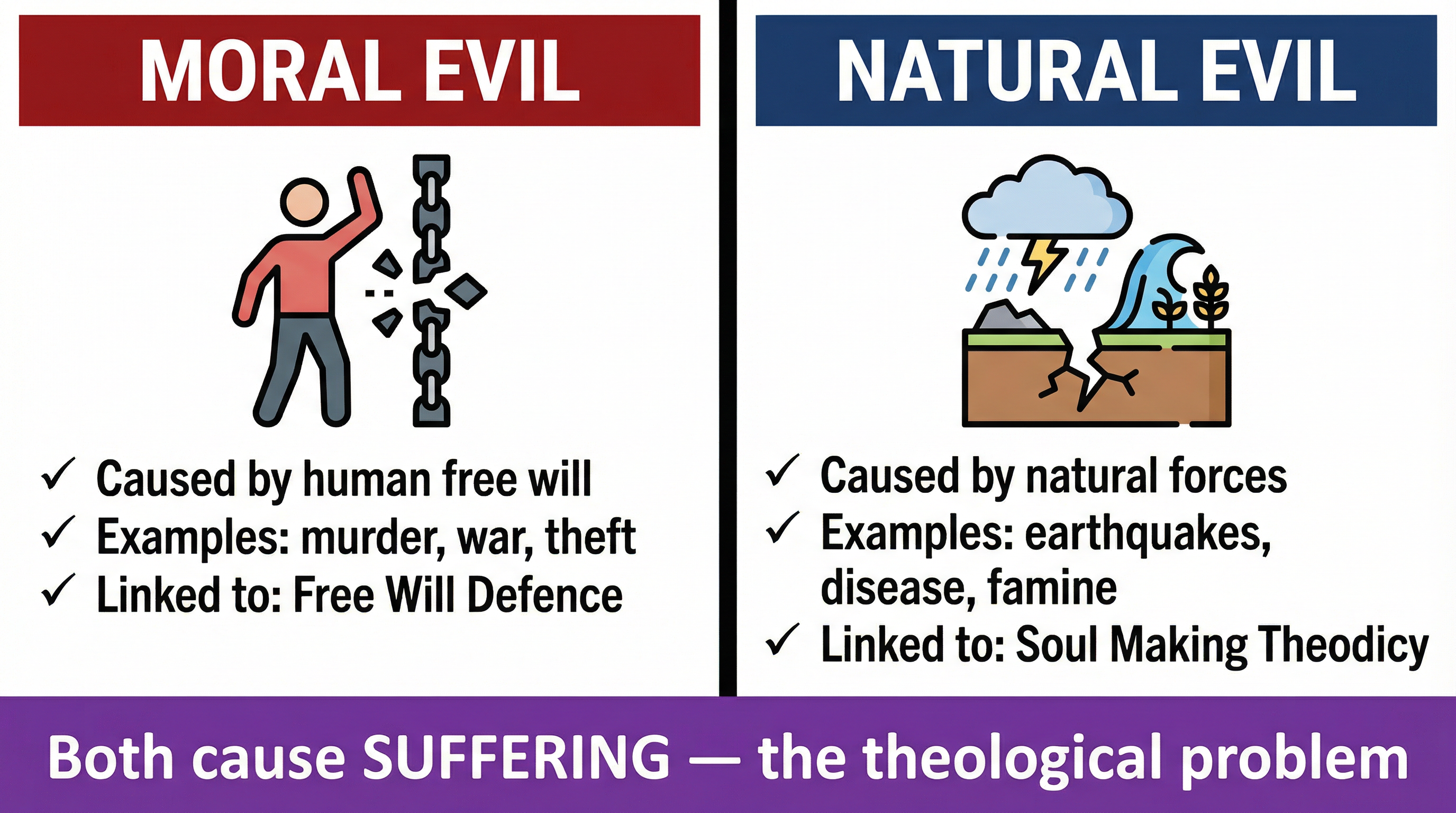
- Moral Evil: Suffering that results directly from the choices and actions of free-willed beings. It is evil for which humans are morally responsible.
- Natural Evil: Suffering that results from the workings of the natural world, with no direct human intervention.
Why it matters: Different theodicies are designed to respond to different types of evil. The Free Will Defence, for example, is a powerful response to moral evil but struggles to account for natural evil. The Soul-Making Theodicy, however, can be applied to both. Showing you understand this allows for more nuanced evaluation.
Specific Knowledge:
- Moral Evil Examples: Murder, war, theft, genocide, bullying.
- Natural Evil Examples: Earthquakes, tsunamis (e.g., the 2004 Indian Ocean Tsunami), disease (e.g., cancer), famine.
Key Religious Responses (Theodicies)
A theodicy is a reasoned argument that seeks to justify God's goodness in the face of evil and suffering. You must be able to explain and evaluate the following.
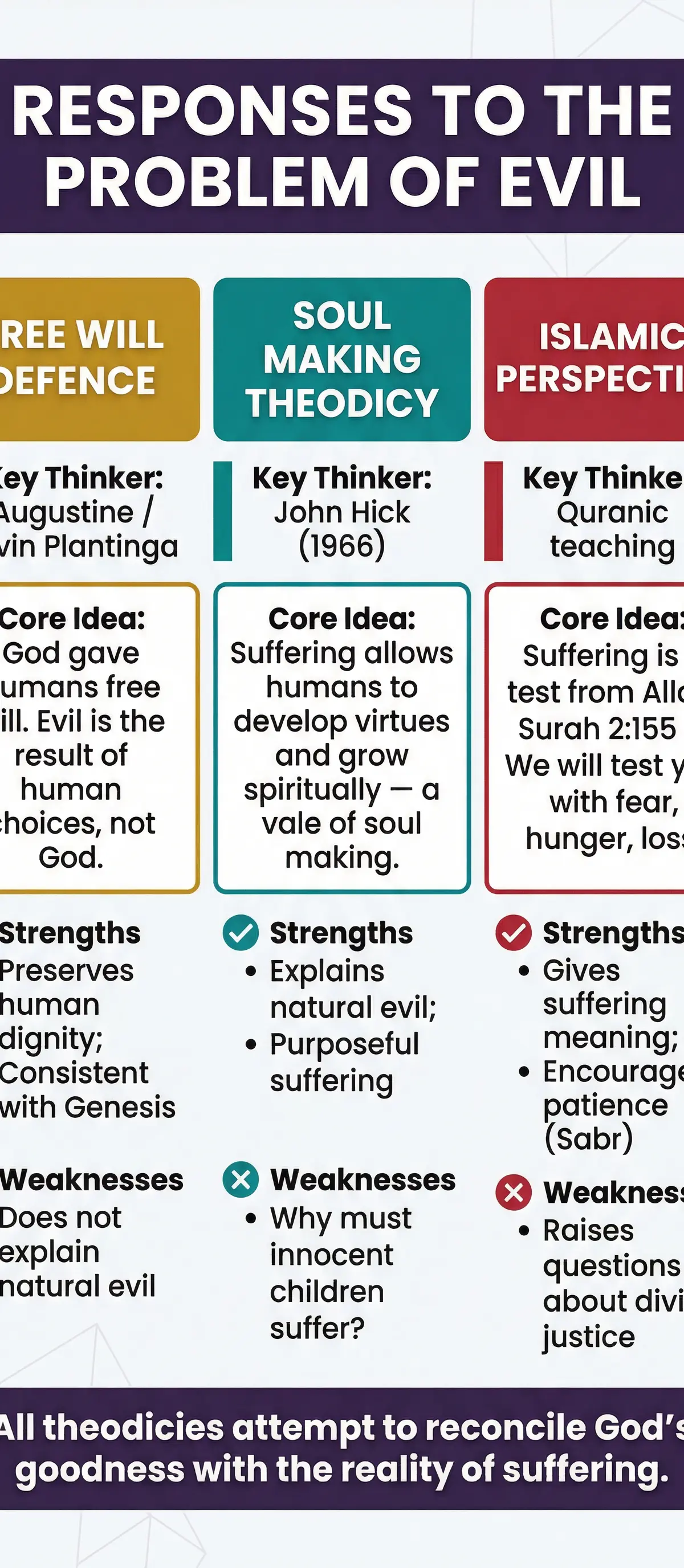
The Augustinian Theodicy (Free Will Defence)
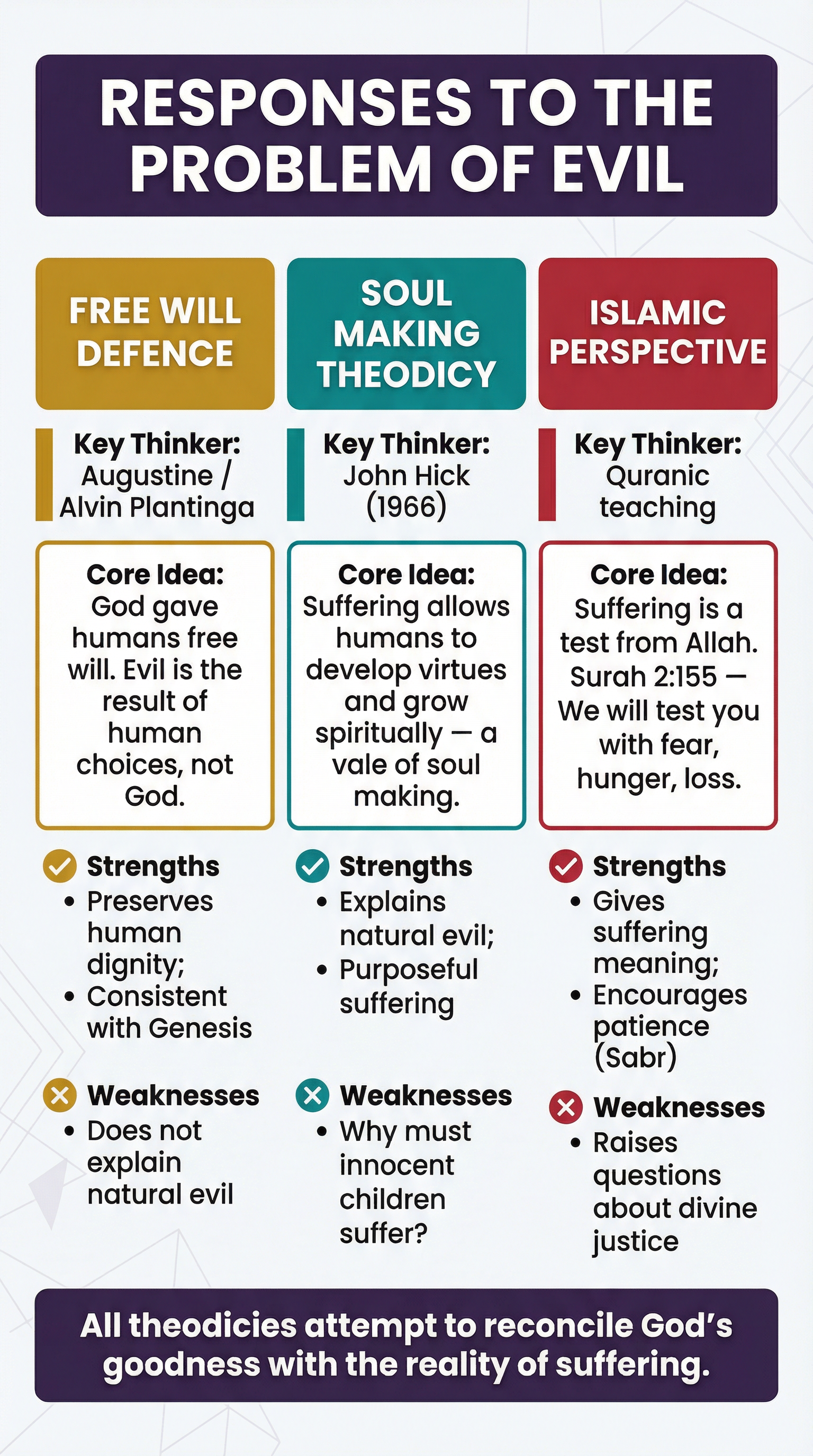
Key Thinker: St. Augustine of Hippo (4th Century CE), modernised by Alvin Plantinga.
Key Idea: God created a perfect world, and evil is not a substance or a thing God created, but rather a privation of good (a privatio boni). Moral evil arises from the misuse of free will by humans and angels (as described in the story of the Fall in Genesis 3). God is not responsible for evil; humans are. Natural evil is seen as a consequence of the disruption in the natural order caused by the Fall.
Impact: This is the classic Christian response. It preserves God's perfection and places responsibility squarely on humanity. Its strength lies in its explanation of moral evil. Its primary weakness is its explanation for natural evil, which many find unconvincing.
The Irenaean / Hick's Soul-Making Theodicy
Key Thinker: St. Irenaeus (2nd Century CE), developed by John Hick (1966).
Key Idea: The world was not created as a perfect paradise, but as a place for spiritual growth and development—a 'vale of soul-making'. Humans were created in God's image, but must grow into his likeness through responding to challenges, including suffering. Evil and suffering are necessary tools that allow humans to develop virtues like courage, compassion, and resilience.
Impact: This theodicy is powerful because it gives suffering a purpose and can account for both moral and natural evil. However, its major weakness is the problem of dysteleological suffering—evil that seems to serve no purpose, such as the suffering of innocent children or the immense scale of events like the Holocaust. Is such extreme suffering really necessary for soul-making?
The Islamic Perspective
Key Idea: In Islam, life on earth is seen as a period of testing from Allah. Suffering is a key part of this test. The appropriate response is Sabr (patience and perseverance), trusting in Allah's ultimate wisdom. The Quran is explicit on this point.
Key Actions: Muslims are expected to endure hardship without losing faith, believing that Allah does not burden a soul with more than it can bear. The story of the Prophet Ayyub (Job) is a key example of someone who maintained faith through immense suffering.
Impact: This perspective gives suffering a direct and clear meaning, framing it as a test of faith with the promise of reward. It encourages resilience and trust in God. A potential weakness, from a critical standpoint, is that it can raise questions about divine justice—why does a just God test people in such painful ways?
Second-Order Concepts
Causation
- Moral Evil Cause: The misuse of human free will.
- Natural Evil Cause: The functioning of natural laws, which may be seen as either a consequence of the Fall (Augustine) or a necessary part of a soul-making environment (Hick).
- Theological Cause: The existence of the Inconsistent Triad creates the philosophical problem that requires a theological response.
Consequence
- Immediate Consequence: Pain, suffering, and death for sentient beings.
- Long-Term Consequence: The development of virtues (Hick), the turning away from God (atheism), or the strengthening of faith through tests (Islam).
Significance
This topic is highly significant because the Problem of Evil is arguably the single greatest intellectual obstacle to religious faith. How a believer responds to this challenge is a defining aspect of their theology and worldview. For examiners, it is a test of a candidate's ability to think logically, critically, and synoptically across different areas of the specification.
Visual Resources
3 diagrams and illustrations
Interactive Diagrams
1 interactive diagram to visualise key concepts
Conceptual Flow Outline
Flowchart showing the logical steps from the Problem of Evil to the various theodicies.
Worked Examples
3 worked examples — open one to explore the question and available guidance.
Practice Questions
Test your understanding — click to reveal model answers
Explain two ways a Christian might respond to the problem of suffering. Refer to sacred writings in your answer. (5 marks)
Hint: Think about two different theodicies. You need one quote.
'The existence of natural evil is the strongest argument against the existence of God.' Evaluate this statement. (12 marks)
Hint: Focus on NATURAL evil. How well do the theodicies you know cope with it? The Free Will defence is weak here, but is Soul-Making strong enough?
Explain two religious beliefs about free will. (4 marks)
Hint: Think about why God might have given free will, and what the consequence of that is.
Explain two Muslim beliefs about suffering. (4 marks)
Hint: Think about the idea of a 'test' and the correct response.
'The Soul-Making Theodicy is not a good enough reason for the amount of suffering in the world.' Evaluate this statement. (12 marks)
Hint: This is a question about proportionality. Is the suffering we see *really* necessary for soul-making? Use examples.