AQA · GCSE · Religious Studies
Course version: 8062 · Version from Sept 2018
Key Beliefs: Buddhahood and the Pure Land.
Buddhahood is the ultimate goal of Buddhist practice, representing the state of perfect enlightenment and awakening to the true nature of reality.
Checked against the AQA 8062 specification (opens in a new tab) on .
- Point 13 of 24
- 2 key terms
Study notes
From the checked teaching notes for this specification point.
The idea
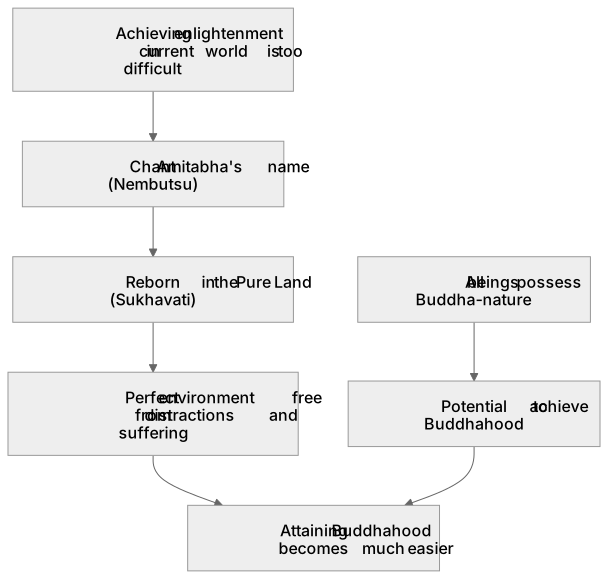
Buddhahood is the ultimate goal of Buddhist practice, representing the state of perfect enlightenment and awakening to the true nature of reality. In Mahayana Buddhism, it is believed that all beings possess 'Buddha-nature' and therefore have the inherent potential to achieve Buddhahood. The Pure Land refers to Sukhavati, a celestial realm created by Amitabha Buddha. Pure Land Buddhism, a popular Mahayana tradition, teaches that achieving enlightenment in our current world is too difficult. Instead, practitioners focus on chanting Amitabha's name (the Nembutsu) to be reborn in the Pure Land. In this perfect environment, free from worldly distractions and suffering, attaining Buddhahood becomes much easier.
What earns the marks
- Define Buddhahood as the state of perfect enlightenment and awakening to the truth.
- Explain the Mahayana concept of Buddha-nature, meaning all sentient beings have the potential to become a Buddha.
- Describe the Pure Land (Sukhavati) as a celestial realm free from suffering, created by Amitabha Buddha.
- Explain the practice of chanting Amitabha's name (Nembutsu) to achieve rebirth in the Pure Land.
- Contrast the Pure Land approach of relying on Amitabha's grace with other traditions that rely solely on self-effort.
Common mistakes and how to put them right
Confusing Amitabha Buddha with the historical Buddha (Siddhartha Gautama).
Put it right: Specify that Amitabha is a celestial Buddha central to Pure Land Buddhism, distinct from Siddhartha Gautama.
Stating that the Pure Land is the final goal of Buddhism.
Put it right: Clarify that the Pure Land is an ideal environment for achieving the actual final goal, which is Buddhahood or Nirvana.
Believing that only monks can achieve Buddhahood in Mahayana Buddhism.
Put it right: Emphasise that Mahayana teaches all beings possess Buddha-nature and can achieve Buddhahood.
Exam tips
- Use the term 'Nembutsu' when discussing how Pure Land Buddhists show devotion to Amitabha Buddha.
- Contrast Pure Land Buddhism's reliance on 'other-power' (Amitabha's grace) with Theravada's focus on 'self-power' (individual meditation).
- When evaluating the concept of Buddha-nature, use the analogy of a seed needing the right conditions to grow into a tree.
Try the lesson
The start of the Key Beliefs: Buddhahood and the Pure Land. lesson, made from checked teaching notes for this specification point.
Have a go first
In Pure Land Buddhism, what is the name of the Buddha who created the Pure Land (Sukhavati)?
Listen
Buddhahood is the ultimate goal of Buddhist practice, representing the state of perfect enlightenment and awakening to the true nature of reality. In Mahayana Buddhism, it is believed that all beings possess 'Buddha-nature' and therefore have the inherent potential to achieve Buddhahood. The Pure Land refers to Sukhavati, a celestial realm created by Amitabha Buddha. Pure Land Buddhism, a popular Mahayana tradition, teaches that achieving enlightenment in our current world is too difficult. Instead, practitioners focus on chanting Amitabha's name (the Nembutsu) to be reborn in the Pure Land. In this perfect environment, free from worldly distractions and suffering, attaining Buddhahood becomes much easier. A strong answer earns marks for these points. Define Buddhahood as the state of perfect enlightenment and awakening to the truth. Explain the Mahayana concept of Buddha-nature, meaning all sentient beings have the potential to become a Buddha. Describe the Pure Land (Sukhavati) as a celestial realm free from suffering, created by Amitabha Buddha. Explain the practice of chanting Amitabha's name (Nembutsu) to achieve rebirth in the Pure Land. A common slip: Confusing Amitabha Buddha with the historical Buddha (Siddhartha Gautama). Instead, Specify that Amitabha is a celestial Buddha central to Pure Land Buddhism, distinct from Siddhartha Gautama. Exam tip: Use the term 'Nembutsu' when discussing how Pure Land Buddhists show devotion to Amitabha Buddha.
See it
Key words
Say what each word means before you turn the card.
Mahayana Buddhism
Try answering aloud or in your head before turning the card.
Devotion
Try answering aloud or in your head before turning the card.
See every definition
- Mahayana Buddhism
- A tradition in which it is believed that all beings possess 'Buddha-nature' and therefore have the inherent potential to achieve Buddhahood.
- Devotion
- Shown by Pure Land Buddhists through chanting Amitabha's name, the Nembutsu, to be reborn in the Pure Land.
Label the diagram
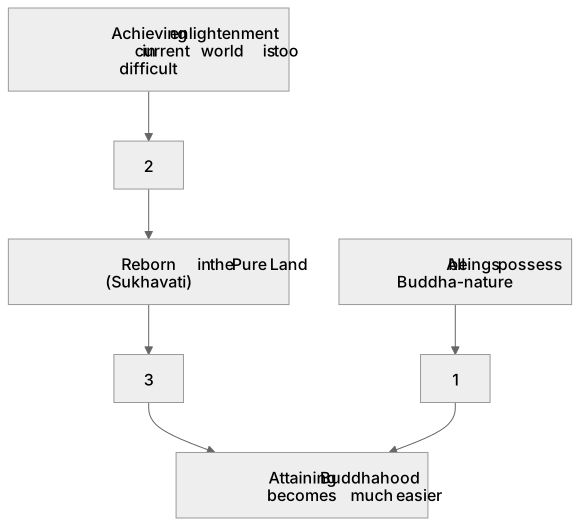
Some boxes have lost their names. Pick the right name for each number.
1Box 1
2Box 2
3Box 3
There is more to this lesson
The full lesson goes on to check your understanding and help you earn the marks. Create a free account to carry on, with your progress saved.
A week of Premium from your first lesson · Then the free plan continues · No card, no charge
Test your understanding of Key Beliefs: Buddhahood and the Pure Land.
Active recall beats re-reading. Take an instant quiz now to test what you’ve learned and lock it into long-term memory.
A week of Premium from your first lesson · Then the free plan continues · No card, no charge