Pearson Edexcel · A-Level · Religious Studies
Arguments for the Existence of God: Design (Teleological)
This study guide provides a comprehensive analysis of the Teleological Argument for the existence of God, a cornerstone of the Edexcel A-Level Religious Studies specification. It moves from Paley's classic watchmaker analogy to modern probabilistic arguments, equipping candidates with the critical tools to deconstruct and evaluate one of philosophy's most enduring questions."
- 17 min read
- 3 worked examples
- 3 practice questions
Study Notes
Overview
The Teleological Argument, or the argument from design, is a pivotal component of the Edexcel A-Level Philosophy of Religion paper. It is an a posteriori argument, meaning it is based on empirical observation of the world. The central claim is that the universe exhibits features of design—such as complexity, order, and purpose—which logically imply the existence of an intelligent designer, whom proponents identify as God. Examiners expect candidates to demonstrate a precise understanding of the argument's development, from William Paley's classical analogical formulation to the more sophisticated probabilistic versions presented by F.R. Tennant and Richard Swinburne. Furthermore, a high-level response requires a thorough engagement with the powerful critiques of David Hume and the scientific challenge posed by Charles Darwin's theory of evolution. Success in this topic hinges on the ability to not only explain these arguments (AO1) but also to critically evaluate their strengths and weaknesses (AO2), constructing a well-supported and nuanced judgment.

Key Developments & Thinkers
William Paley's Analogical Argument
Date(s): 1802 (Publication of 'Natural Theology')
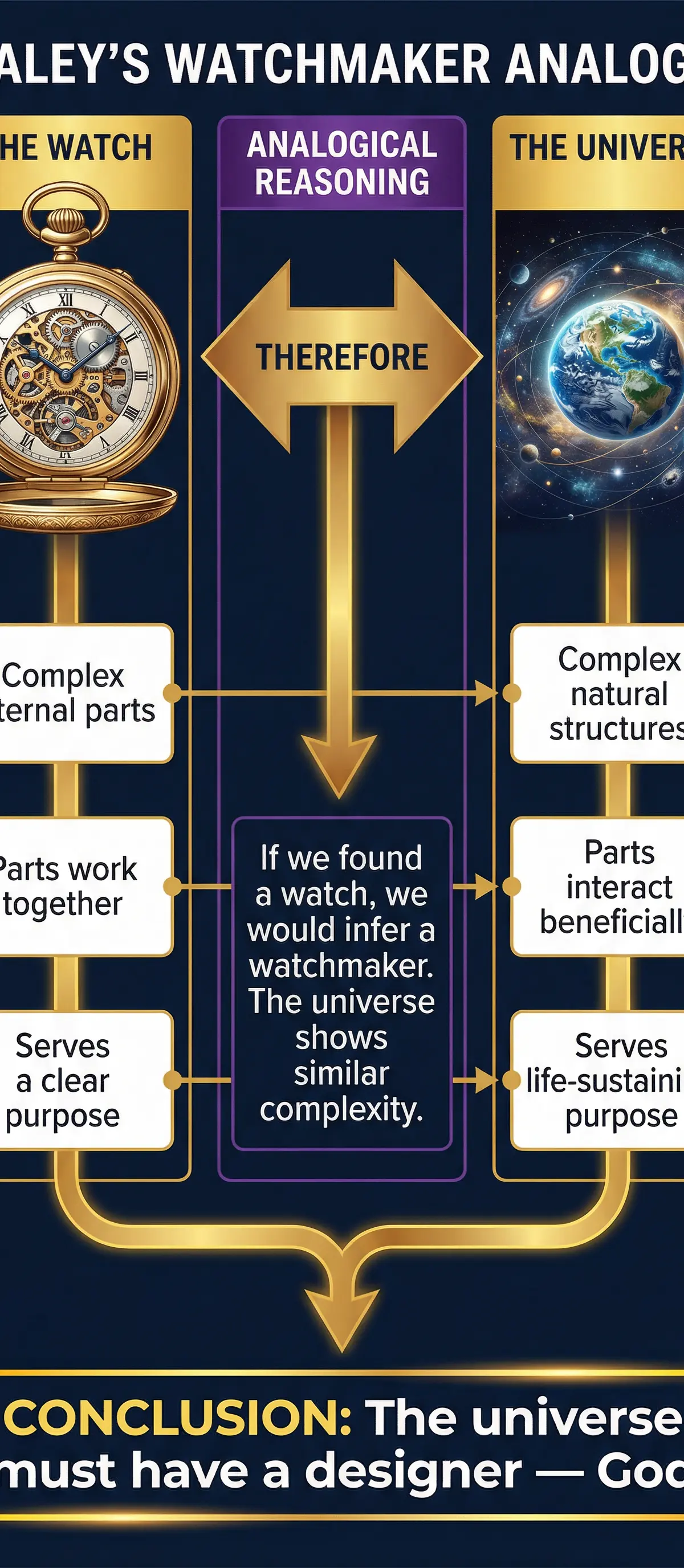
What happened: William Paley, an Archdeacon of Carlisle, formulated the most famous version of the design argument. He used the analogy of finding a watch on a heath. Unlike a stone, the watch's intricate mechanism, with its gears and springs working together for the purpose of telling time, would lead one to infer the existence of a watchmaker. Paley argued that the universe, with its far greater complexity and apparent purpose (e.g., the human eye), similarly points to a divine designer.
Why it matters: Paley's argument became the classic expression of 'Old Teleology'. It is an argument from analogy, moving from an observed effect (complexity and purpose) to a supposed cause (a designer). Examiners award marks for a clear explanation of his distinction between design qua regularity (the order of the universe, like planets orbiting the sun) and design qua purpose (the way parts of organisms are suited to a specific function, like the eye for seeing).
Specific Knowledge: William Paley, 'Natural Theology' (1802), watchmaker analogy, design qua regularity, design qua purpose.
David Hume's Critiques
Date(s): 1779 (Posthumous publication of 'Dialogues Concerning Natural Religion')
What happened: The Scottish empiricist philosopher David Hume launched a series of powerful objections to the design argument, voiced through the character Philo. These critiques pre-dated Paley but targeted the same logical structure.
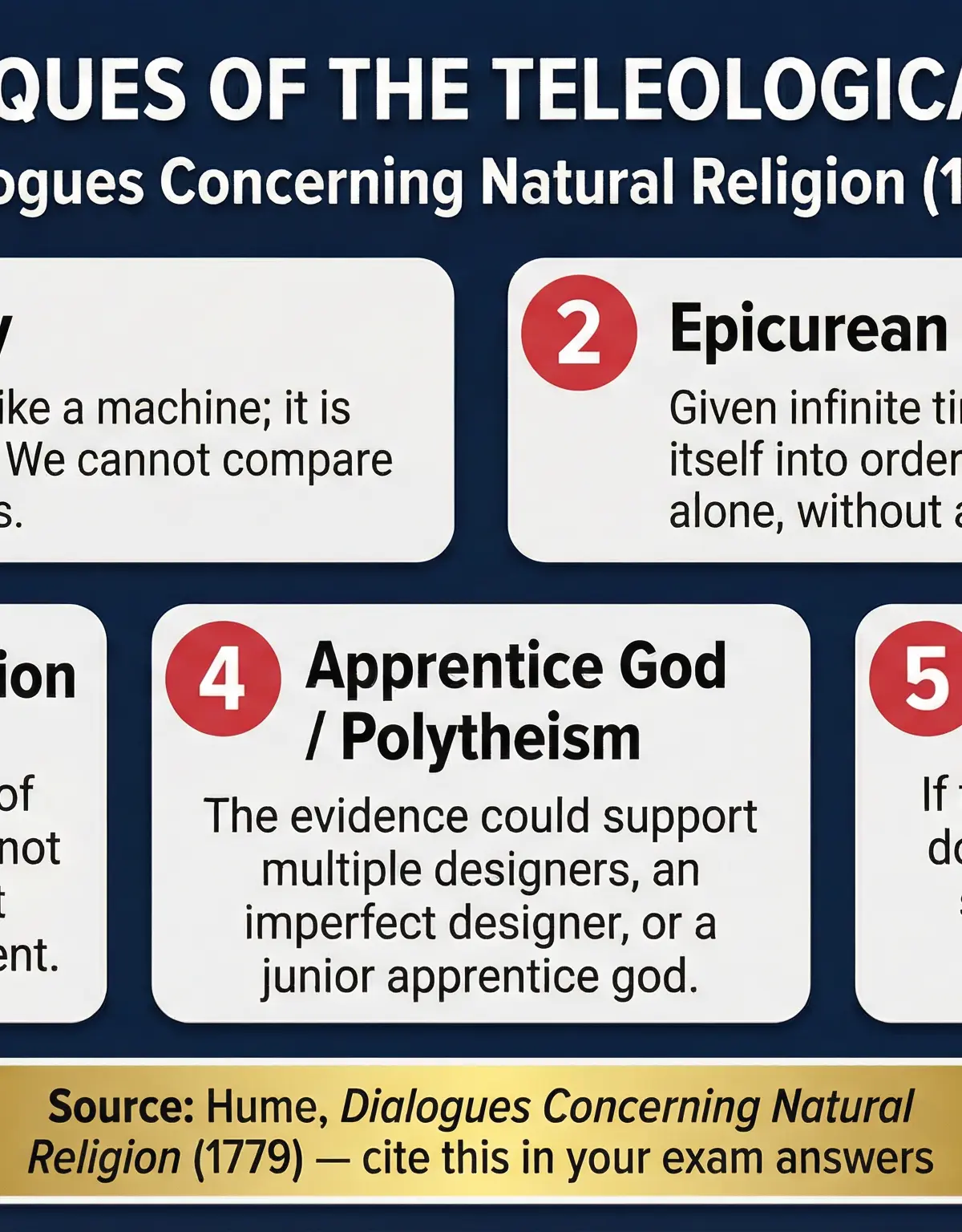
Why it matters: Hume's arguments remain the most significant philosophical challenges to the teleological argument. Candidates must be able to explain them individually. Key critiques include: the weakness of the analogy (the universe is not like a machine), the possibility of chance explaining order (the Epicurean Hypothesis), the problem of unique causation (we have no experience of universe-making), and the idea that the evidence could point to an imperfect or apprentice god, not the God of classical theism. Citing 'Dialogues Concerning Natural Religion' is essential for top marks.
Specific Knowledge: David Hume, 'Dialogues Concerning Natural Religion' (1779), Philo, weak analogy, Epicurean Hypothesis, apprentice god.
Charles Darwin and Natural Selection
Date(s): 1859 (Publication of 'On the Origin of Species')
What happened: Charles Darwin proposed the theory of evolution by natural selection, providing a scientific mechanism to explain the appearance of design in the biological world without recourse to a designer. Random variations that prove advantageous for survival are passed on, leading to the gradual development of complex organisms.
Why it matters: Darwin's theory provides a direct scientific counter-argument to Paley's biological examples (like the eye). It explains the 'purpose' observed in nature as a result of a blind, natural process. A common mistake is to say Darwin 'disproves God'; a better answer explains that he offers an alternative, non-theistic explanation for apparent design, thus undermining the necessity of inferring a designer.
Specific Knowledge: Charles Darwin, 'On the Origin of Species' (1859), natural selection, random variation, survival of the fittest.
The 'New Teleology': Tennant and Swinburne
Date(s): 1930 (Tennant's 'Philosophical Theology'), late 20th Century (Swinburne's work)
What happened: In response to Hume and Darwin, 20th-century philosophers developed more sophisticated, probabilistic versions of the design argument.
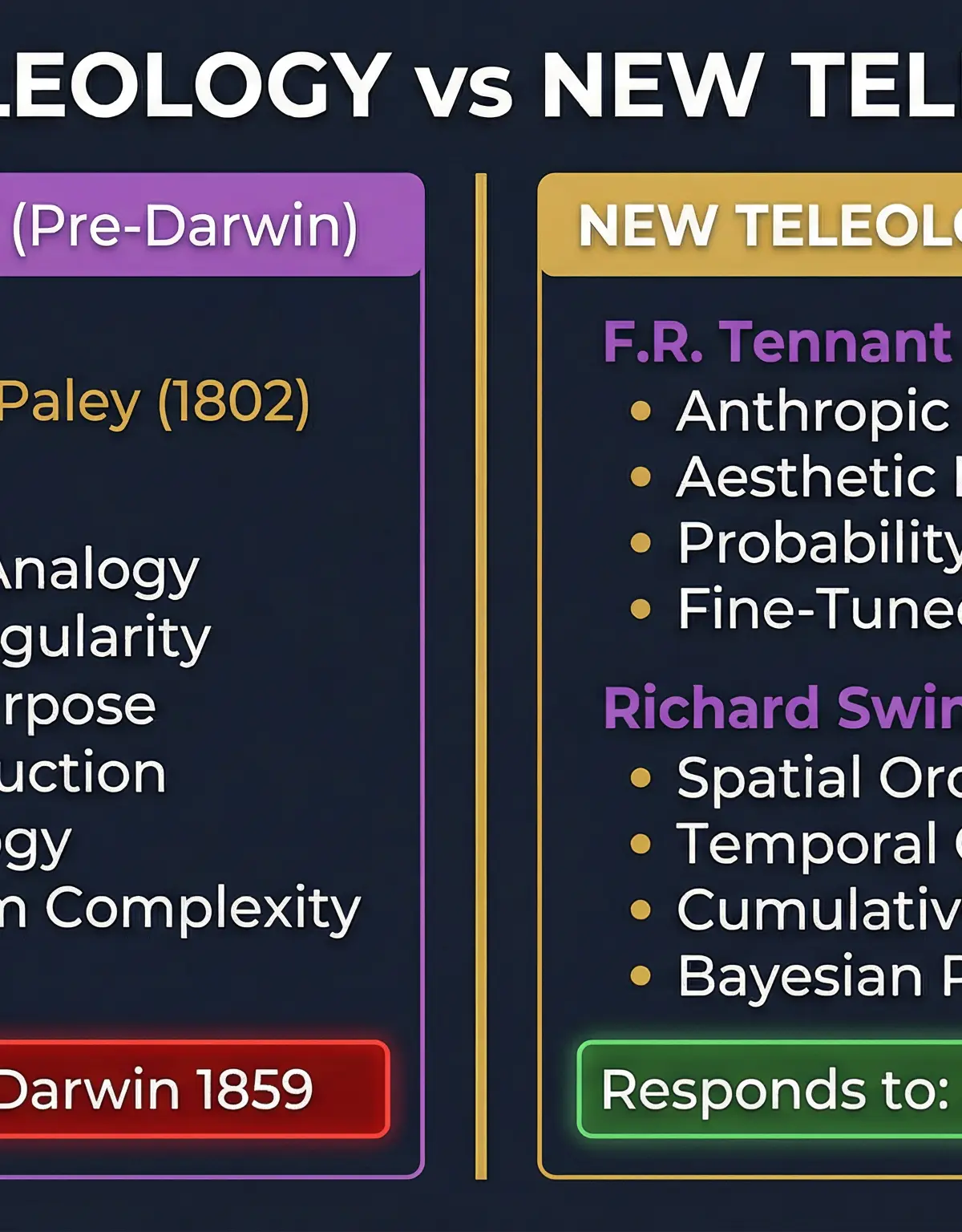
Why it matters: This demonstrates the evolution of the argument. F.R. Tennant proposed the Anthropic Principle (the universe is fine-tuned with the precise conditions for life to emerge) and the Aesthetic Principle (humans appreciate beauty beyond what is necessary for survival). Richard Swinburne distinguishes between spatial order (Paley's argument) and temporal order (the regularities of scientific laws over time), arguing that the latter is not explained by Darwin and is best explained by a divine mind. These are arguments from probability, not proof.
Specific Knowledge: F.R. Tennant, Anthropic Principle, Aesthetic Principle. Richard Swinburne, spatial order, temporal order, probability.
Second-Order Concepts
Causation
- The entire argument is an exercise in causal reasoning. Paley argues from the effect (design) to the cause (designer). Hume challenges this by questioning whether we can apply cause-and-effect logic to the universe as a whole, a unique entity for which we have no comparative experience.
Consequence
- The immediate consequence of Paley's argument was to provide a seemingly rational, evidence-based foundation for Christian belief in the Age of Enlightenment. The long-term consequence of Darwin's theory was a major crisis of faith for many and a re-evaluation of the relationship between science and religion.
Change & Continuity
- The core idea of inferring a designer from nature has been continuous since ancient philosophy. However, the argument has changed significantly. It moved from Paley's simple analogy to the complex, physics-based probability arguments of Tennant and Swinburne, demonstrating a clear shift in response to scientific and philosophical challenges.
Significance
- The Teleological Argument is significant because it represents one of the most intuitive and popular arguments for God's existence. Its ongoing debate highlights the fundamental tension between scientific explanation and religious belief, and forces a deep consideration of what constitutes evidence and proof in metaphysics.",
"podcast_script": "Welcome to Exam Ready Philosophy — the podcast that gets you from confused to confident, one argument at a time. I'm your tutor, and today we're diving deep into one of the most fascinating topics in your Edexcel A-Level Religious Studies specification: the Teleological Argument for the existence of God, also known as the Design Argument.
Whether you're sitting your exam in a few weeks or just starting to get to grips with this topic, by the end of this episode you'll be able to explain Paley's watchmaker analogy with precision, deploy Hume's critiques like a seasoned philosopher, and understand exactly what examiners mean when they award marks for distinguishing Old Teleology from New Teleology. So settle in — this is going to be a good one.
Let's start with the big picture. The Teleological Argument is a posteriori — that means it starts from observation of the world around us and reasons towards a conclusion. It's also inductive, meaning the conclusion is probable rather than certain. The word "teleological" comes from the Greek "telos," meaning purpose or end. The core claim is this: the universe shows evidence of design, and design implies a designer — and that designer is God.
Now, the argument has a long history. Thomas Aquinas gave us the Fifth Way back in the thirteenth century — his argument from direction, where he observed that unintelligent things act towards an end, and argued they must be directed by an intelligent being. But for your Edexcel exam, the version you need to know inside out is William Paley's, published in Natural Theology in 1802.
Paley asks you to imagine walking across a heath and finding a watch lying on the ground. Unlike a stone, you would immediately recognise that this watch could not have come about by chance. Why? Because of its complexity — the intricate arrangement of springs, gears, and cogs — and because of its framing, meaning all those parts work together to serve a clear purpose: telling the time. Paley argues that if any part were arranged differently, the watch would not function. This is what he calls design qua regularity — order and complexity working together.
Now here is a crucial distinction that examiners specifically reward: Paley actually makes two related but distinct claims. Design qua regularity refers to the spatial order of parts — the way components are arranged to work together, like the gears of a watch or the bones of the human eye. Design qua purpose refers to the beneficial order — the way natural things serve life-sustaining ends. The human eye, Paley's favourite example, is not just complex; it serves the purpose of sight. Candidates who conflate these two aspects, or who confuse Paley's argument with Aquinas's Fifth Way, will lose marks. Paley is arguing from complexity and purpose; Aquinas is arguing from direction.
Paley's argument is analogical induction: just as a watch implies a watchmaker, the universe — which is far more complex and purposeful than any watch — implies a universe-maker. And that universe-maker, Paley concludes, is God.
Now, before we move on to the critics, let me give you a memory hook for Paley. Think of the acronym C-F-D: Complexity, Framing, Designer. Complexity — the intricate parts. Framing — they work together for a purpose. Designer — therefore God. C-F-D. Paley's C-F-D. Write that down.
Right, now let's turn to the most important critic of the Teleological Argument: David Hume. Hume's Dialogues Concerning Natural Religion was published posthumously in 1779 — and you must cite this title in your exam answers to demonstrate engagement with the set text. Hume raises several devastating critiques through his character Philo, and you need to know them individually — examiners specifically penalise candidates who lump them together.
Critique one: the weak analogy. Hume argues that the universe is not like a watch or any human artefact. The universe is organic, unique, and unlike anything we have experience of making. We have experience of making watches, but we have no experience of making universes. The analogy therefore breaks down at the most fundamental level.
Critique two: the Epicurean Hypothesis. This is a particularly elegant challenge. Hume suggests that given infinite time, matter in random motion could eventually settle into an ordered arrangement by pure chance. Order does not require a designer — it could be the product of time and probability. This anticipates, in a remarkable way, the kind of probabilistic thinking that would later inform evolutionary theory.
Critique three: unique causation. Even if we accept that the universe has a cause, we have no basis for inferring what kind of cause it is. We have only ever observed one universe. We cannot apply the normal inductive principle — that similar effects have similar causes — to a unique event.
Critique four — and this one is a favourite of examiners: the apprentice god or polytheism objection. Hume points out that even if we accept the design argument, the evidence does not necessarily point to the God of classical theism — omnipotent, omniscient, omnibenevolent. The universe might have been designed by a team of gods, or by an apprentice god learning the craft, or by an imperfect deity who has since died. The argument, at best, establishes a designer — not the God of Christianity.
Critique five: the problem of evil. If the universe was designed by an all-good, all-powerful God, why does it contain so much suffering, disease, and natural disaster? The evidence of the universe seems to point to an indifferent or even malevolent designer, not a loving one.
Now, here is where it gets really interesting — and where the New Teleologists come in. The twentieth century saw a revival of the design argument in a more sophisticated form, specifically designed to respond to both Hume and Darwin.
F.R. Tennant, writing in Philosophical Theology in 1930, developed what he called the Anthropic Principle. Tennant observed that the universe appears to be fine-tuned for the emergence of conscious, rational life. The physical constants — the strength of gravity, the charge of the electron, the ratio of matter to antimatter — are set within extraordinarily narrow parameters. If any of them were even slightly different, life as we know it would be impossible. This is sometimes called the Goldilocks Zone: everything is just right. Tennant argues that the probability of this occurring by chance is so vanishingly small that a personal designer is the most reasonable explanation.
But Tennant goes further with what he calls the Aesthetic Principle. He observes that humans have the capacity to appreciate beauty — in art, in music, in mathematics, in nature — that goes far beyond what is necessary for mere survival. Natural selection can explain why we developed eyes, but it cannot easily explain why we find a sunset beautiful. Tennant argues that this aesthetic sense points to a personal designer who intended us to appreciate creation — not merely a blind mechanism.
Importantly, candidates must understand that Tennant is not claiming proof. He is making a probability argument. The Anthropic Principle is not a demonstration that God exists; it is a claim that theism is the most probable explanation for the fine-tuning of the universe. This distinction is critical — examiners penalise candidates who present the Anthropic Principle as a proof.
Richard Swinburne, the Oxford philosopher of religion, develops this probabilistic approach further using Bayesian reasoning. Swinburne distinguishes between two types of order. Spatial order is what Paley was talking about — the complex arrangement of parts at a given moment. Temporal order is more subtle: it refers to the regularities of nature over time — the laws of physics, the consistent behaviour of matter, the predictability of the universe. Swinburne argues that temporal order is actually more impressive than spatial order, because it cannot be explained by evolution. Evolution can explain why organisms appear designed, but it cannot explain why the laws of physics themselves are so regular and life-permitting. This is Swinburne's key move against Darwin: he shifts the argument from biological complexity to the laws of nature themselves.
Swinburne also argues that the simplest explanation for the existence of a universe governed by regular, intelligible laws is a single, personal God — because simplicity is a mark of good explanation, and one God is simpler than many gods or an infinite regress of causes.
Now let's talk exam technique — this is where marks are won and lost.
First, know your assessment objectives. For Edexcel A-Level Religious Studies, AO1 is worth 40% and AO2 is worth 60%. AO1 is knowledge and understanding — explaining arguments clearly and accurately. AO2 is analysis and evaluation — assessing the strength of arguments and reaching a justified conclusion. In a 10-mark AO1 question, you should focus entirely on explaining the argument with precision. Do not evaluate. In a 20 or 30-mark AO2 question, your conclusion must be earned by the dialectical argument that precedes it — not just stated at the end.
Second, know your command words. "Explore" or "Analyse" in a 10-mark question means: lay out the argument step by step, with specific names, dates, and technical vocabulary. "Assess" or "Evaluate" in a 20 or 30-mark question means: present the strongest version of the argument, then the strongest objections, then reach a reasoned conclusion.
Third, the most common mistakes. One: confusing Paley with Aquinas. They are different arguments. Paley argues from complexity and purpose; Aquinas argues from direction. Two: saying Darwin disproves God. Darwin offers an alternative mechanism for apparent design — natural selection — but this does not logically disprove a designer. A sophisticated candidate will say that Darwin undermines Paley's specific argument but does not refute Tennant or Swinburne. Three: presenting Hume's critiques as a single undifferentiated attack. Name them individually. Four: treating the Anthropic Principle as a proof rather than a probability argument.
Now, let's do a quick-fire recall quiz. I'll ask the questions — pause the podcast and try to answer before I give you the answer.
Question one: What year did Paley publish Natural Theology? Pause now. The answer is 1802.
Question two: What are the two types of design Paley identifies? Pause now. Design qua regularity and design qua purpose.
Question three: What is Hume's Epicurean Hypothesis? Pause now. Given infinite time, matter could arrange itself into ordered patterns by chance alone.
Question four: What does Tennant's Aesthetic Principle argue? Pause now. That humans have an aesthetic sense — the ability to appreciate beauty — that goes beyond survival necessity, pointing to a personal designer.
Question five: What is Swinburne's key distinction that responds to Darwin? Pause now. The distinction between spatial order and temporal order — Swinburne argues that the regularity of natural laws over time cannot be explained by evolution.
Question six: Name two of Hume's specific critiques from Dialogues Concerning Natural Religion. Pause now. Any two from: weak analogy, Epicurean Hypothesis, unique causation, apprentice god or polytheism, problem of evil.
How did you do? If you got all six, you're in great shape. If you struggled, go back and re-read the relevant sections of your notes.
Let's wrap up with the key takeaways. The Teleological Argument moves from the observation of order and complexity in the universe to the conclusion that a designer — God — is the most probable explanation. Paley's classical version relies on the watchmaker analogy and is vulnerable to Hume's critiques and Darwin's evolutionary mechanism. The New Teleologists — Tennant and Swinburne — respond by shifting the argument to fine-tuning, probability, and the laws of nature themselves. For your exam, the key skill is being able to distinguish between these versions, deploy Hume's critiques precisely, and construct a conclusion that is genuinely earned by your analysis.
Remember: in philosophy, it is not enough to know what the arguments are. You need to know why they succeed or fail, and be able to say so with precision and confidence.
That's it for today's episode of Exam Ready Philosophy. Good luck with your revision — you've got this."
Worked Examples
3 worked examples — open one to explore the question and available guidance.
Practice Questions
Test your understanding — click to reveal model answers
Explain Hume's criticisms of the design argument. (10 marks)
Hint: Focus on explaining at least three distinct critiques from 'Dialogues Concerning Natural Religion'.
To what extent is the Anthropic Principle a successful response to the challenges to the design argument? (20 marks)
Hint: Consider how the Anthropic Principle responds to both Hume and Darwin, but also evaluate the weaknesses of the principle itself.
Explain Swinburne's argument from temporal order. (10 marks)
Hint: Focus on the distinction between spatial and temporal order and why this is significant.