Pearson Edexcel · A-Level · Religious Studies
Arguments for the Existence of God: Ontological
The Ontological Argument is a unique philosophical proof for God's existence that uses pure reason rather than empirical evidence. This guide unpacks its complex logic, tracing its development from St. Anselm to modern debates, providing the critical analysis needed to excel in the Edexcel A-Level exam.
- 5 min read
- 3 worked examples
- 5 practice questions
- 7 key terms
Check what you remember
Read the wording for your board, then hide it and explain A Priori in your own words. Rough notes are fine. This is a self-check, with no mark or grade.
Reference: Pearson Edexcel
Knowledge that is independent of experience, derived from reason alone.
Study Notes
Overview
The Ontological Argument, falling under Edexcel's 9RS0/01 Philosophy of Religion paper, is a cornerstone of rationalist philosophy. It is an a priori, deductive argument, meaning it seeks to prove God's existence through logic and reason alone, without recourse to sensory experience. For candidates, mastery of this topic requires a precise understanding of its logical form, from Anselm's initial definition of God as "that than which nothing greater can be conceived" to the powerful critiques of Gaunilo and Kant. Examiners expect candidates to not only explain the argument but to critically evaluate its validity, assessing whether it successfully moves from a concept in the mind (in intellectu) to a reality (in re). This guide will deconstruct the key formulations, analyse the crucial objections, and provide the specific vocabulary and analytical techniques required to achieve the highest marks. We will also explore its historical significance as a purely philosophical attempt to bridge the gap between thought and being.
Key Developments & Thinkers
St. Anselm of Canterbury (c. 1033–1109)
Role: Archbishop of Canterbury and originator of the Ontological Argument.
Key Actions: In his Proslogion (c. 1077), Anselm laid out two distinct formulations of the argument.
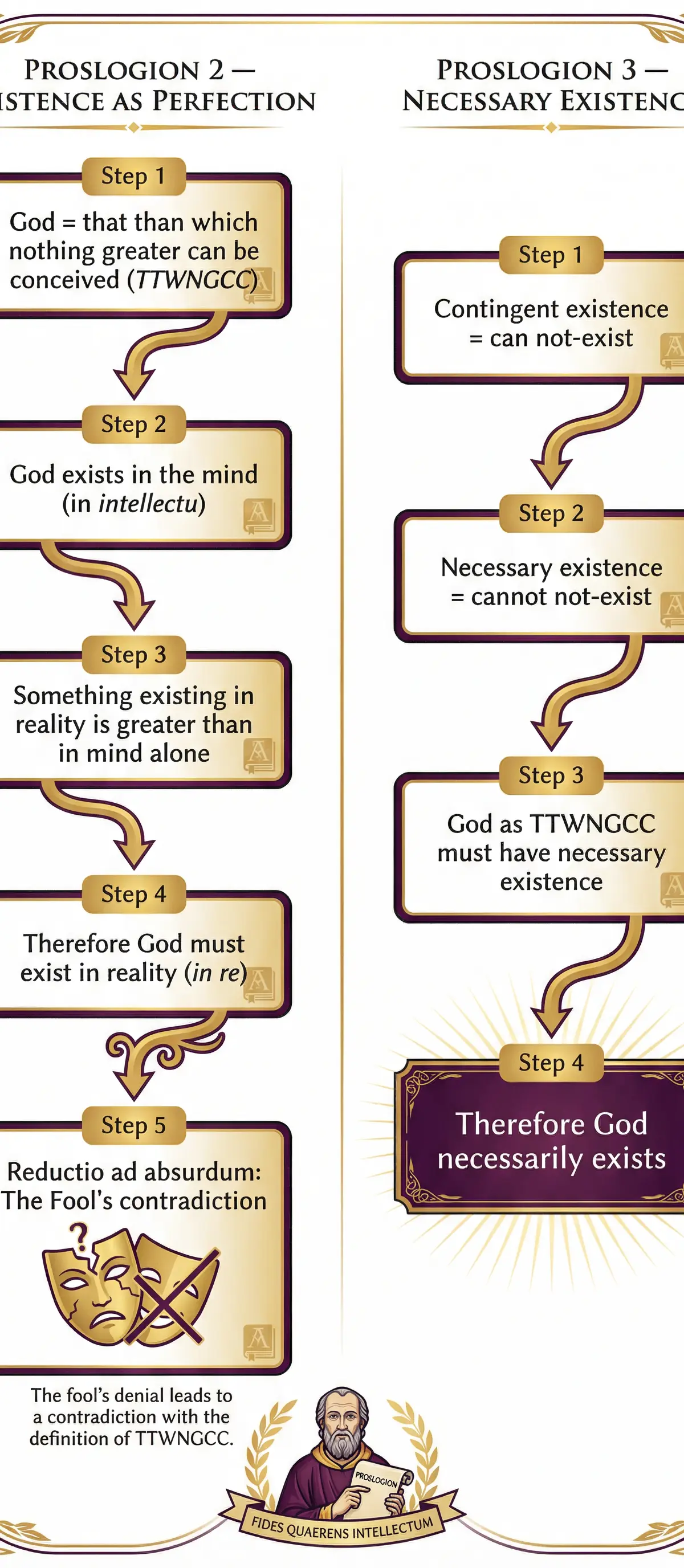
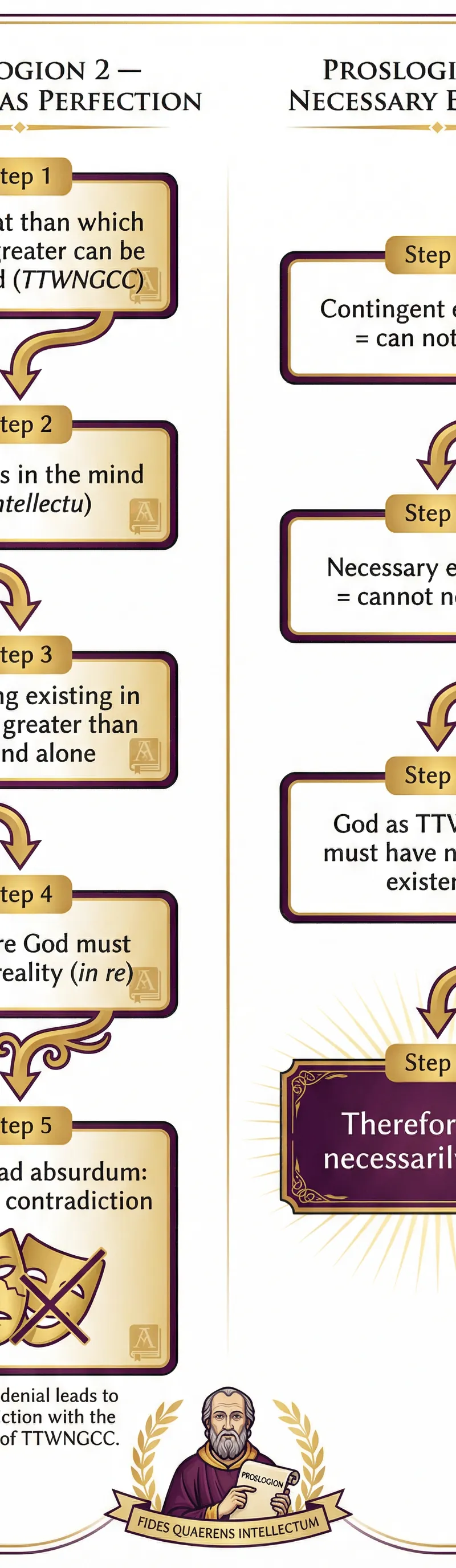
- Proslogion 2: Defines God as "that than which nothing greater can be conceived" (TTWNGCC). He argues that if this being existed only in the mind, a greater being could be conceived (one that exists in reality), which is a logical contradiction. This is a reductio ad absurdum.
- Proslogion 3: Introduces the concept of necessary existence. A being that cannot not exist is greater than one that can. Therefore, TTWNGCC must possess necessary existence.
Impact: Anselm established the foundation for all subsequent ontological arguments and framed the debate around the logical relationship between God's definition and God's existence.
Gaunilo of Marmoutiers (c. 1033)
Role: A contemporary monk and the first major critic of Anselm.
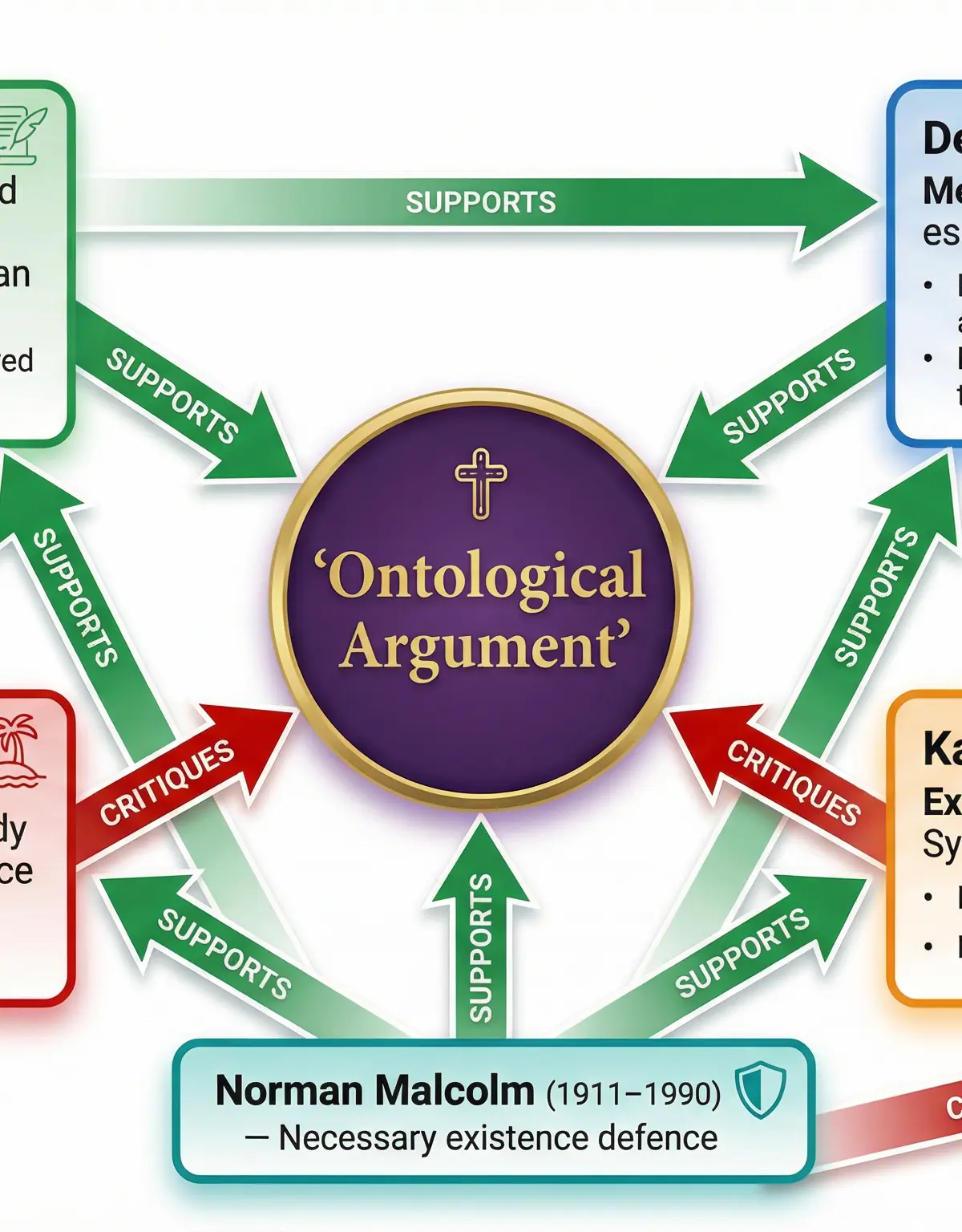
Key Actions: In his reply, "On Behalf of the Fool," Gaunilo created a parody argument using a "perfect island." He argued that if Anselm's logic were sound, one could define the greatest conceivable island into existence. Since this is absurd, the logic must be flawed.
Impact: Gaunilo's critique forces a crucial distinction: does the logic of the ontological argument apply only to God, a unique being with a proposed necessary existence, or can it be applied to any contingent object? Anselm's response is that the logic only applies to a being with an intrinsic maximum, which an island lacks.
René Descartes (1596–1650)
Role: French philosopher who developed his own version of the argument.
Key Actions: In Meditation V (1641), Descartes argued that existence is a perfection. Just as a triangle must have three sides as part of its essence, a "supremely perfect being" must have existence as part of its essence. One cannot conceive of a perfect being that lacks existence.
Impact: Descartes solidified the argument as an analytic proposition, where the predicate (existence) is contained within the subject (God). This framing became the primary target for Kant's later critique.
Immanuel Kant (1724–1804)
Role: German philosopher who offered the most famous and influential critique.
Key Actions: In his Critique of Pure Reason (1781), Kant argued that existence is not a predicate. A predicate adds to the concept of a subject (e.g., "the cat is black"). Stating "the cat exists" does not add a new property to the cat; it merely posits that the concept of the cat is instantiated in reality. You cannot define something into existence because existence is a synthetic, not an analytic, claim.
Impact: Kant's critique is widely seen as a fatal blow to the classical ontological argument. He demonstrated that the argument conflates the logical properties of a concept with the factual assertion of its existence.
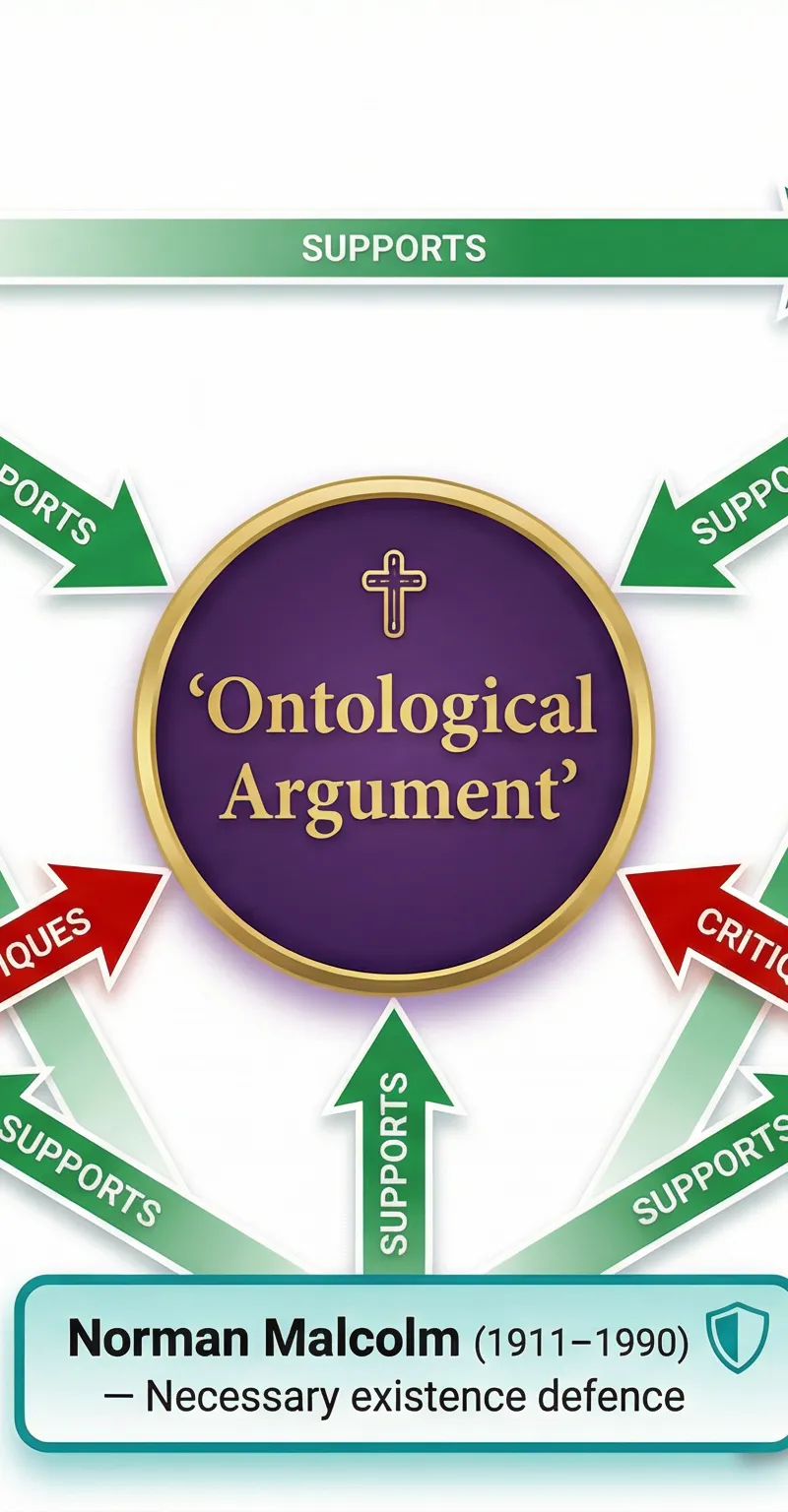
Norman Malcolm (1911–1990)
Role: 20th-century American philosopher who revived the argument.
Key Actions: Malcolm argued that while Kant successfully refuted Descartes and Anselm's Proslogion 2, he did not defeat Proslogion 3. Malcolm claimed that necessary existence is a predicate, as it describes a quality of a being (one that cannot be brought into or go out of existence). He argued that God's existence is either logically impossible or logically necessary, and since it is not impossible, it must be necessary.
Impact: Malcolm's modal version of the argument shifted the debate to the logic of possibility and necessity, reviving interest in the ontological argument in contemporary philosophy.
Worked Examples
3 worked examples — open one to explore the question and available guidance.
Practice Questions
Try the question, then reveal an answer plan or example response
Explain Descartes' version of the ontological argument. (10 marks)
Hint: Focus on the triangle analogy and the concept of a 'supremely perfect being'.
Assess the view that Gaunilo's 'perfect island' critique successfully undermines Anselm's argument. (15 marks)
Hint: Explain Gaunilo's parody, but also consider Anselm's potential response regarding contingency and necessity.
Explain Kant's critique of the ontological argument. (10 marks)
Hint: Your answer must focus on the phrase 'existence is not a predicate'.
Evaluate the success of the ontological argument. (25 marks)
Hint: This is a major essay. Structure your answer by moving through the key thinkers, offering evaluation at each stage, and building to a sustained conclusion.
Explain the difference between Anselm's two formulations of the ontological argument. (8 marks)
Hint: Clearly separate your explanation of Proslogion 2 (existence as perfection) from Proslogion 3 (necessary existence).
Exam technique
How to turn what you know into marks
How to approach the question
1. **Identify Command Word**: 'Examine' = AO1 only. 'Evaluate'/'Assess' = AO1 + AO2. 2. **Isolate Key Concepts**: What specific part of the argument is being targeted? 3. **Plan Structure**: Bullet point your paragraphs and the evidence for each.
How to structure your answer
- Essay questions
- Introduction setting out the debate and your line of argument -> For/Against paragraphs with evidence and mini-judgements -> A sustained, well-supported final conclusion.
- Source questions
- N/A for this topic.
- Explain questions
- Introduction defining terms -> Paragraph on Proslogion 2 -> Paragraph on Proslogion 3 -> Conclusion summarising the logic.
Timing
Approximately 1.2 minutes per mark. For a 10-mark question, spend 12 minutes; for a 15-mark, 18 minutes.
Common pitfalls
- Conflating Anselm's two arguments.
- Misunderstanding Kant's critique as a proof of God's non-existence.
- Describing Gaunilo's island without explaining *why* it is a critique of the *logic*.
- Failing to use precise philosophical language.
What the command words want
- Describe
- State the key features of the argument clearly.
- How useful
- Assess the strengths and weaknesses of a critique. How damaging is it? Does it have limitations?
- Explain why
- Analyse the logical steps that lead from premise to conclusion.
- How far do you agree
- Present both sides of the argument (e.g., Kant's critique vs. Malcolm's defence) and reach a justified conclusion.
Watch or listen (optional)
Test your understanding of Arguments for the Existence of God: Ontological
Active recall beats re-reading. Take an instant quiz now to test what you’ve learned and lock it into long-term memory.
7 days Premium · Then the free plan continues · No card, no charge