Pearson Edexcel · GCSE · Religious Studies
Human Rights and Freedom
This study guide explores the critical intersection of Human Rights and Freedom in Edexcel GCSE Religious Studies. It unpacks the dialogue between secular laws like the UDHR and the theological principles of Christianity and Islam, equipping students to analyse and evaluate complex ethical issues for top marks.
- 6 min read
- 3 worked examples
- 5 practice questions
- 6 key terms
Study Notes
Overview

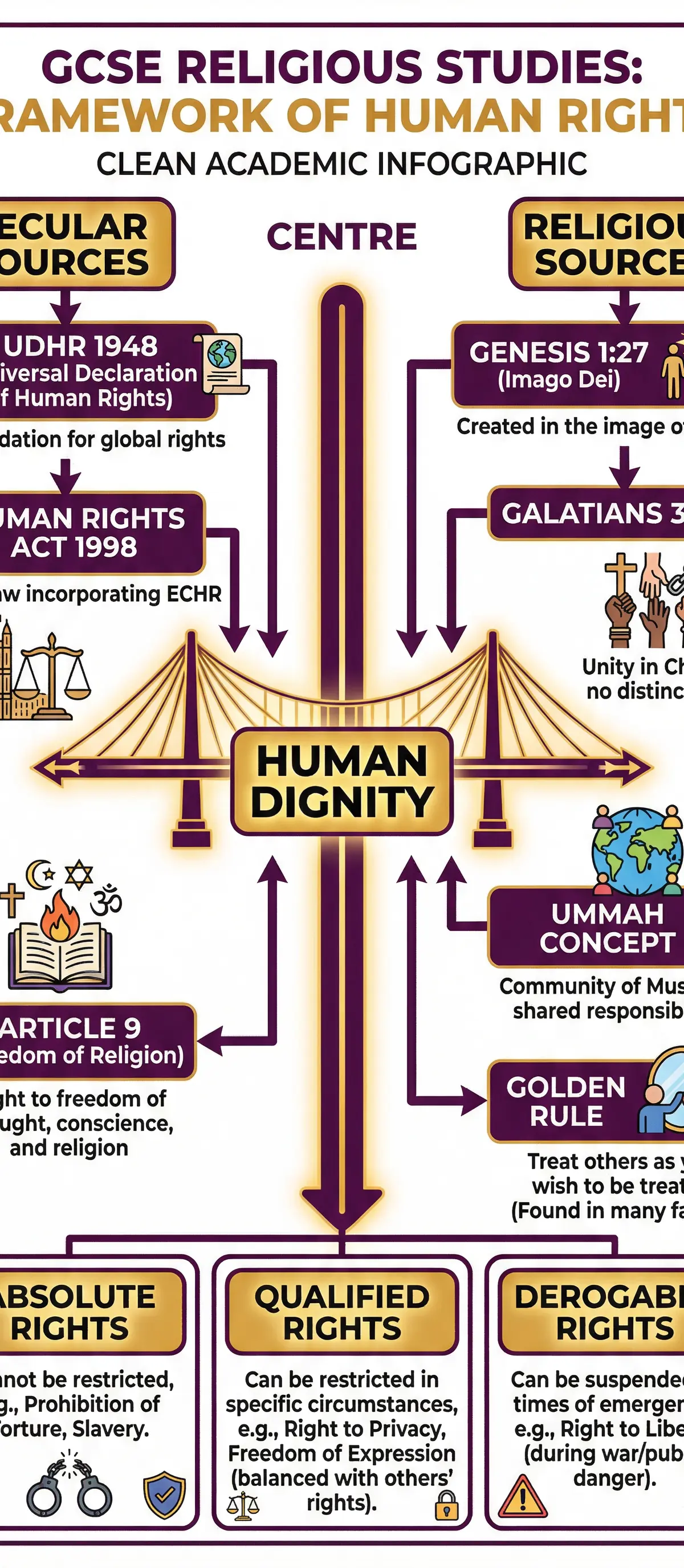
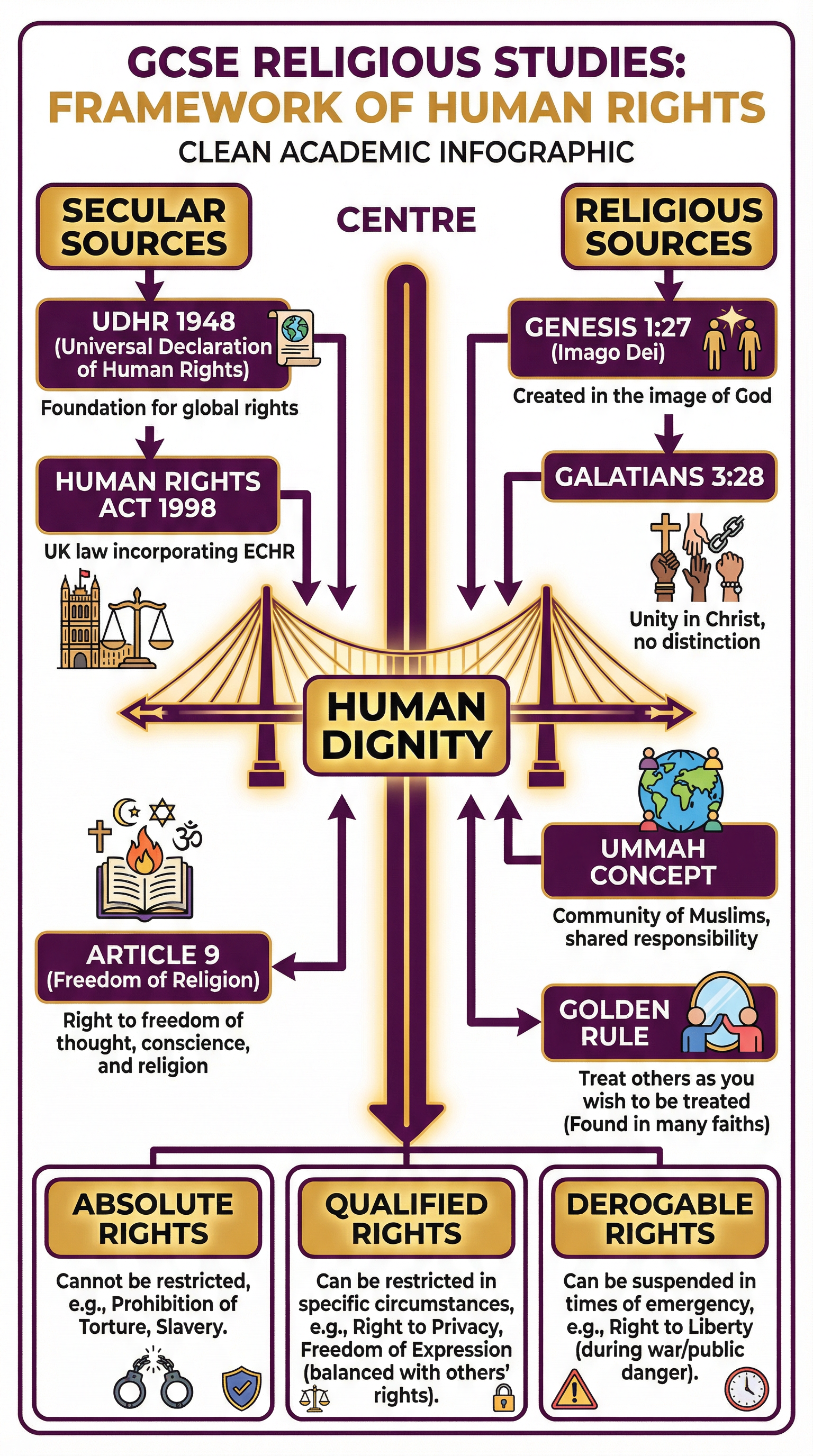
This topic requires candidates to move beyond a simple understanding of 'fairness' and engage with the specific legal and theological frameworks that underpin human rights. Examiners expect a dual analysis, contrasting the secular authority of the Universal Declaration of Human Rights (UDHR, 1948) and the Human Rights Act (1998) with religious Sources of Wisdom and Authority (SOWA). The core of this study is evaluating the tensions that arise between personal freedoms (like freedom of speech) and the responsibilities placed upon individuals by their faith and society. A successful candidate will be able to articulate not just what a religious text says, but how it informs a believer's stance on complex issues like social justice, prejudice, and censorship. Marks are awarded for demonstrating a clear understanding of how theological concepts like Imago Dei (the image of God) in Christianity and Ummah (the global community) in Islam provide a foundation for human dignity and rights.
Key Concepts & Developments
The Universal Declaration of Human Rights (UDHR)
Date(s): 1948
What happened: Following the atrocities of World War II, the United Nations General Assembly adopted this foundational document, outlining 30 fundamental rights and freedoms to be universally protected.
Why it matters: For the exam, the UDHR is the primary secular SOWA. Candidates must be able to reference specific articles (e.g., Article 1: 'All human beings are born free and equal in dignity and rights') to support their arguments. It establishes the principle of universal, inalienable rights.
Specific Knowledge: Know that it was created in 1948 in response to WWII. Be able to name at least 3-4 rights, such as the right to life, freedom from torture, and freedom of religion.
The Human Rights Act
Date(s): 1998
What happened: This Act of the UK Parliament incorporated the rights set out in the European Convention on Human Rights (ECHR) into domestic British law.
Why it matters: It makes human rights enforceable in UK courts. It also introduces the important distinction between absolute rights (which can never be limited, e.g., freedom from torture) and qualified rights (which can be limited to protect the rights of others, e.g., freedom of expression).
Specific Knowledge: Know that it was passed in 1998 and that it brought the ECHR into UK law. Understand the difference between absolute and qualified rights, as this is a key area for evaluation.
Key Individuals
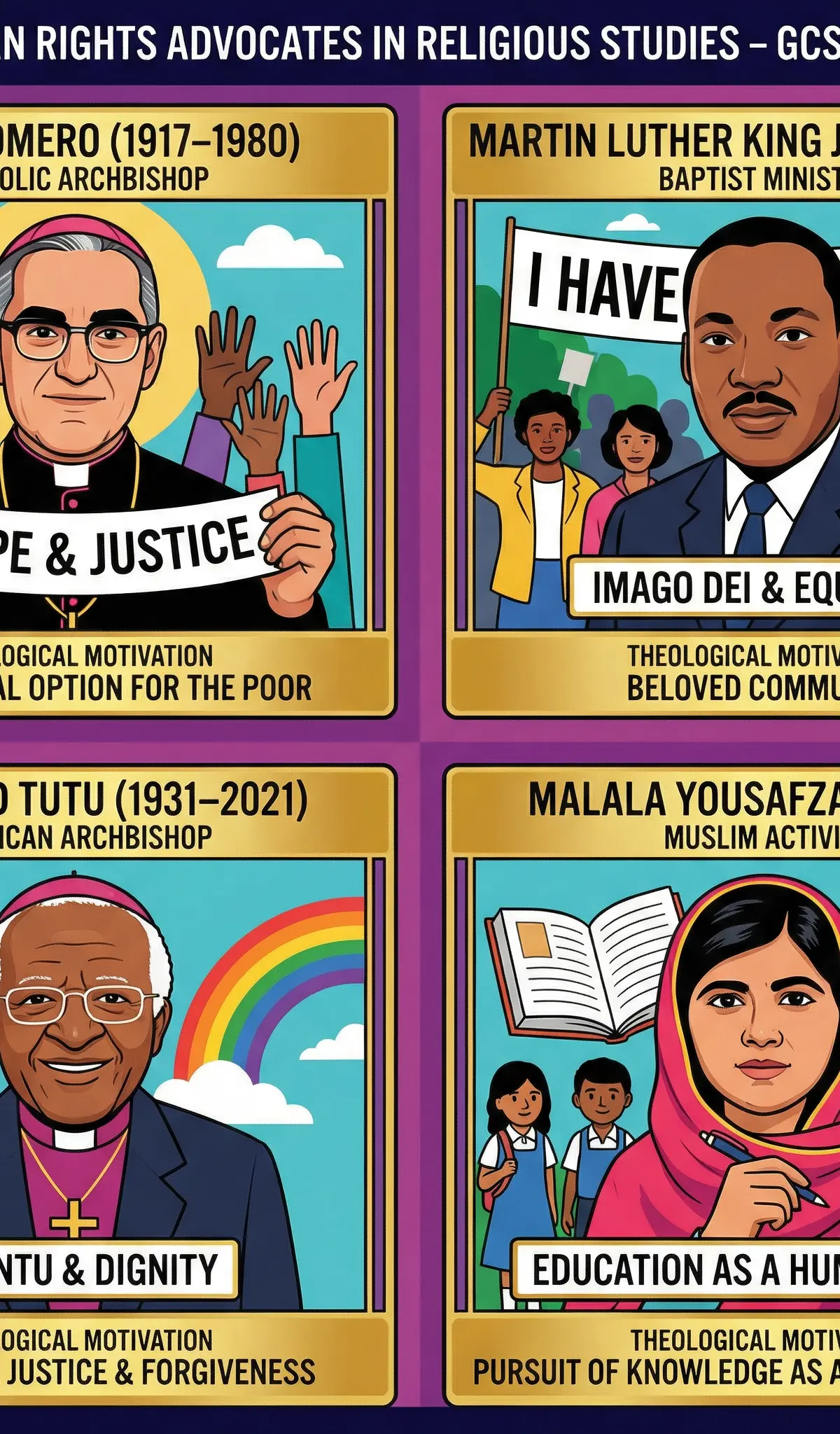
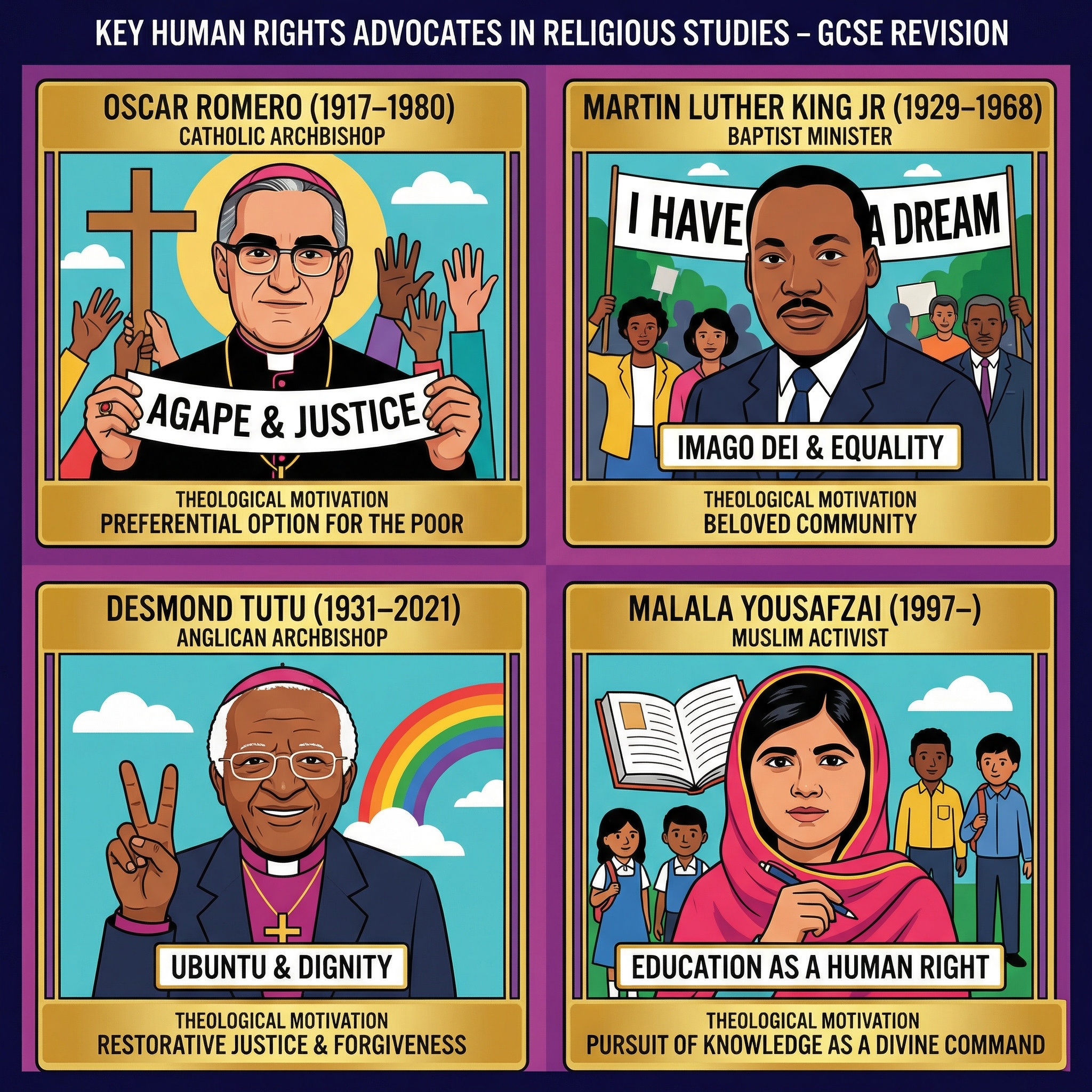
Martin Luther King Jr.
Role: Baptist Minister and leader of the American Civil Rights Movement.
Key Actions: Led non-violent protests against racial segregation in the USA, including the Montgomery Bus Boycott and the 1963 March on Washington, where he delivered his famous "I Have a Dream" speech.
Impact: His work was instrumental in the passage of the Civil Rights Act of 1964. For the exam, his importance lies in his theological motivation. He argued that segregation was a sin because it violated Imago Dei, treating Black people as less than human and denying their God-given dignity. His "Letter from Birmingham Jail" is a key text.
Oscar Romero
Role: Archbishop of San Salvador, El Salvador.
Key Actions: Spoke out against poverty, social injustice, and the torture and disappearances carried out by the government of El Salvador. He was assassinated in 1980 while celebrating Mass.
Impact: Romero is a prime example of faith in action. His work was motivated by the Christian concept of Agape (selfless love) and the Catholic principle of the "preferential option for the poor." Candidates should use him to show how religious belief can lead individuals to challenge state injustice, even at great personal cost.
Second-Order Concepts
Causation
Why did the modern human rights movement emerge? The primary cause was the global shock at the scale of the Holocaust and the atrocities of WWII. This created the political will for an international declaration to prevent such events from happening again. Religious causes include the long-standing theological principles of human dignity found in major world faiths.
Consequence
The UDHR and subsequent legislation have had profound consequences, creating a global standard for justice and holding nations to account. However, a key consequence for evaluation is the ongoing debate about the universality of these rights versus cultural and religious differences, and the tension between national sovereignty and international law.
Change & Continuity
Change: The 20th century saw a major change from rights being granted by a monarch or state to the idea that rights are inherent and universal. The language of human rights is now the dominant global language for justice.
Continuity: The core principles of human dignity and the value of human life have been present in religious teachings for thousands of years (e.g., the sanctity of life).
Significance
The development of human rights is significant because it represents a global attempt to create a common ethical framework. For religious believers, it is significant because it can be seen as the political and legal expression of core theological truths about the value of humanity.
Source Skills
When given a religious text (e.g., a Bible verse or Quranic passage) in the exam, do not just state what it says. You must explain how it applies to the issue in the question. For example, if the question is about social justice, and you are given Galatians 3:28 ("There is neither Jew nor Gentile..."), you must explain that this teaching breaks down social and racial barriers, creating a basis for equality and challenging discriminatory practices. The best answers will link the SOWA directly to the argument being made.
Visual Resources
2 diagrams and illustrations
Interactive Diagrams
1 interactive diagram to visualise key concepts
Conceptual Flow Outline
The dual foundations of Human Rights: Secular and Religious Sources.
Worked Examples
3 worked examples — open one to explore the question and available guidance.
Practice Questions
Test your understanding — click to reveal model answers
Explain two religious beliefs about the responsibility to help those living in poverty. Refer to sacred writings or another source of religious belief and teaching in your answer. (5 marks)
Hint: Choose one belief from Christianity and one from another religion. For each, state the belief, explain it, and provide a specific quote or concept.
"For a religious person, the law of God is more important than the law of the land." Evaluate this statement. (12 marks)
Hint: Consider situations where the laws might conflict. Use examples like Oscar Romero or conscientious objectors. Evaluate which law should take precedence and why.
Explain two ways religious believers can work for racial harmony. (4 marks)
Hint: Think about both internal attitudes and external actions.
Explain two contrasting beliefs in contemporary British society about the right to freedom of religious expression. (4 marks)
Hint: Think about the difference between religious views and secular humanist views.
Explain two religious teachings about wealth. (5 marks)
Hint: Use one teaching that sees wealth as a blessing and one that sees it as a danger or responsibility.