OCR · A-Level · Religious Studies
Conscience
This study guide provides a comprehensive analysis of the concept of conscience from the contrasting perspectives of Thomas Aquinas and Sigmund Freud, a core topic for the OCR A-Level Religious Studies (H573/02) paper. It delves into whether conscience is a God-given faculty of reason or a psychologically ingrained mechanism of guilt, equipping students to tackle high-mark comparison questions.
- 6 min read
- 2 worked examples
- 2 practice questions
- 6 key terms
Study Notes

Overview
For the OCR A-Level in Religion and Ethics, the debate between Aquinas and Freud on conscience is a cornerstone of the ethical theory section. Examiners are looking for candidates who can move beyond a simple description of each thinker and engage in rigorous, critical comparison. This guide will break down Aquinas's theological rationalism and Freud's psychological determinism, providing the specific knowledge and analytical frameworks required to achieve the highest marks. You will learn to dissect their views on the origin of conscience, its reliability as a moral guide, and the role of guilt. The key to success is not just knowing what they thought, but being able to argue which view is more convincing, using the precise technical vocabulary that demonstrates A-Level mastery.

Key Individuals
Thomas Aquinas (1225-1274)
Role: A Dominican friar and the foremost philosopher of the medieval scholastic period. His work sought to synthesise Aristotelian philosophy with Christian theology.
Key Actions: In his Summa Theologica, Aquinas articulated a complex theory of conscience based on reason (ratio). He proposed that all humans possess an innate principle of Synderesis ('do good and avoid evil') and use the act of Conscientia to apply this to real-world dilemmas.
Impact: Aquinas provides a framework where conscience is an objective, rational faculty linked to Natural and Eternal Law. This view posits that humans are fundamentally oriented towards the good and can, through reason, discern a correct moral path. His distinction between Vincible and Invincible ignorance offers a nuanced understanding of moral culpability.
Sigmund Freud (1856-1939)
Role: An Austrian neurologist and the founder of psychoanalysis, a clinical method for treating psychopathology through dialogue between a patient and a psychoanalyst.
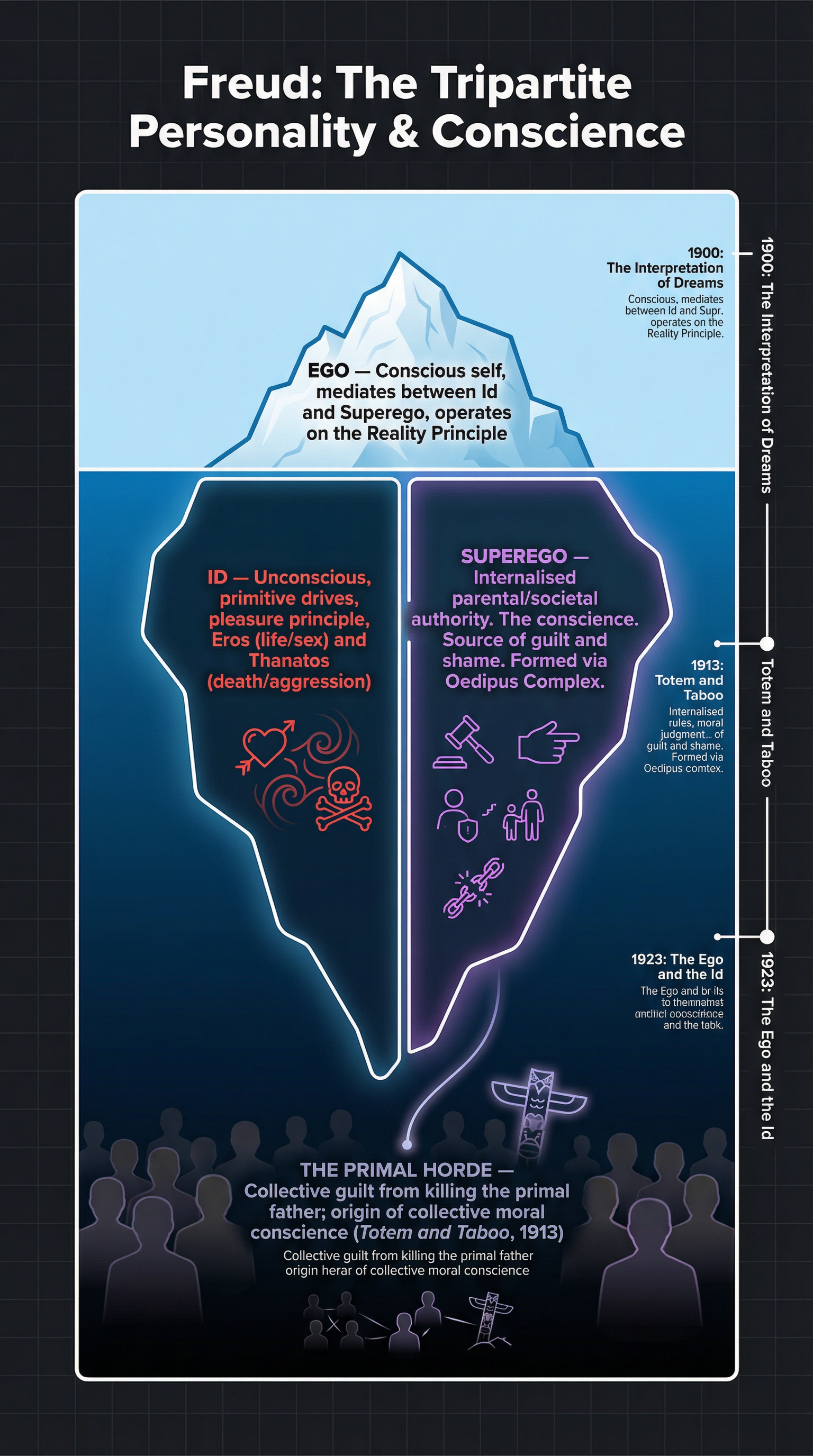
Key Actions: In works like The Ego and the Id (1923) and Totem and Taboo (1913), Freud proposed a secular, psychological model of the mind. He argued the conscience is not a guide to moral truth but is the punitive function of the Superego.
Impact: Freud completely secularised the concept of conscience, reducing it to a mechanism of guilt derived from internalised parental and societal commands. His theory suggests our moral feelings are not reliable indicators of right and wrong, but are instead subjective relics of our upbringing and primal psychological history (e.g., the Oedipus Complex, the Primal Horde).
Second-Order Concepts
Comparison
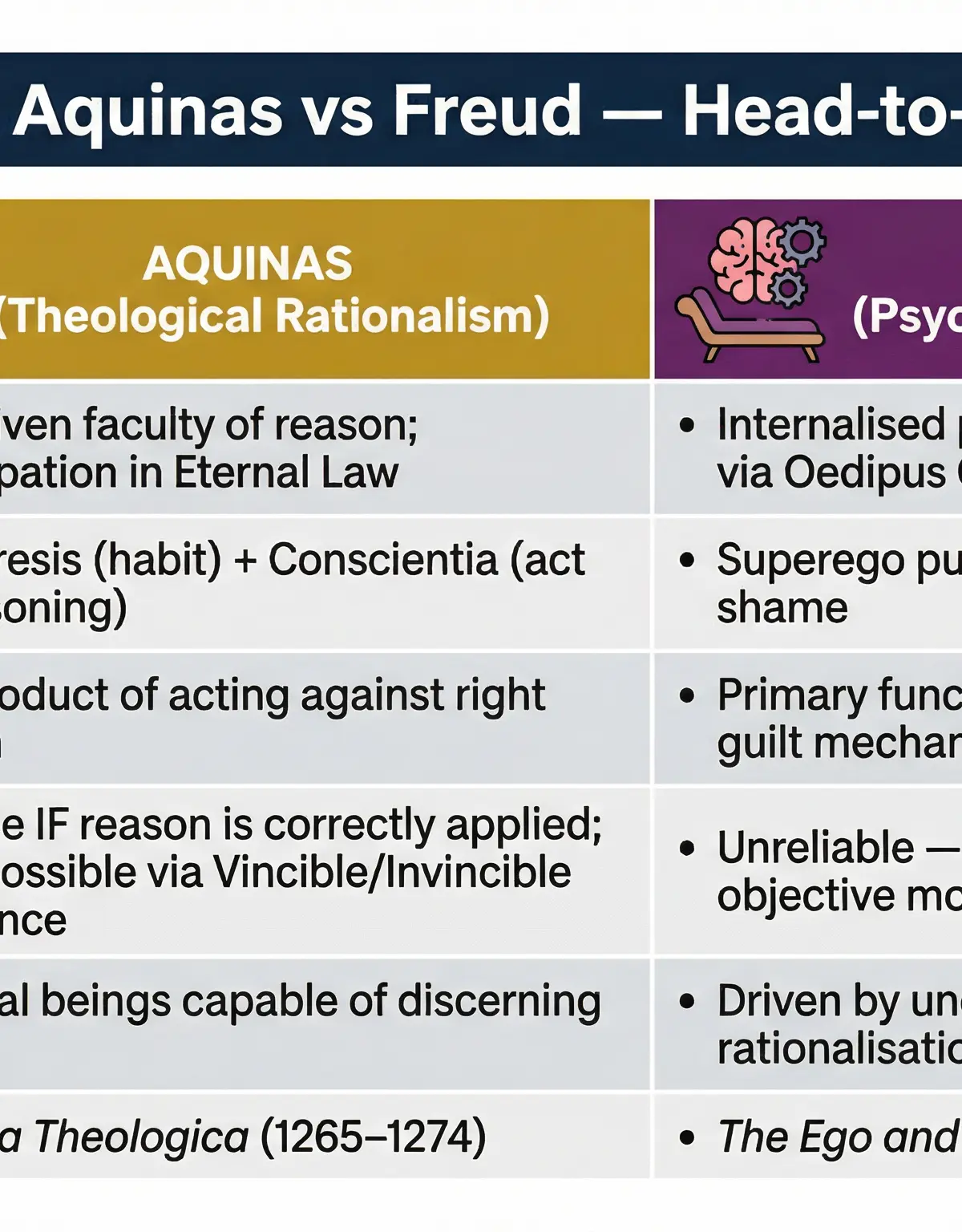
This topic is fundamentally about comparison. The highest marks are awarded for answers that are structured thematically, constantly weaving together the two thinkers' ideas. Avoid the common mistake of writing two separate essays.
Causation
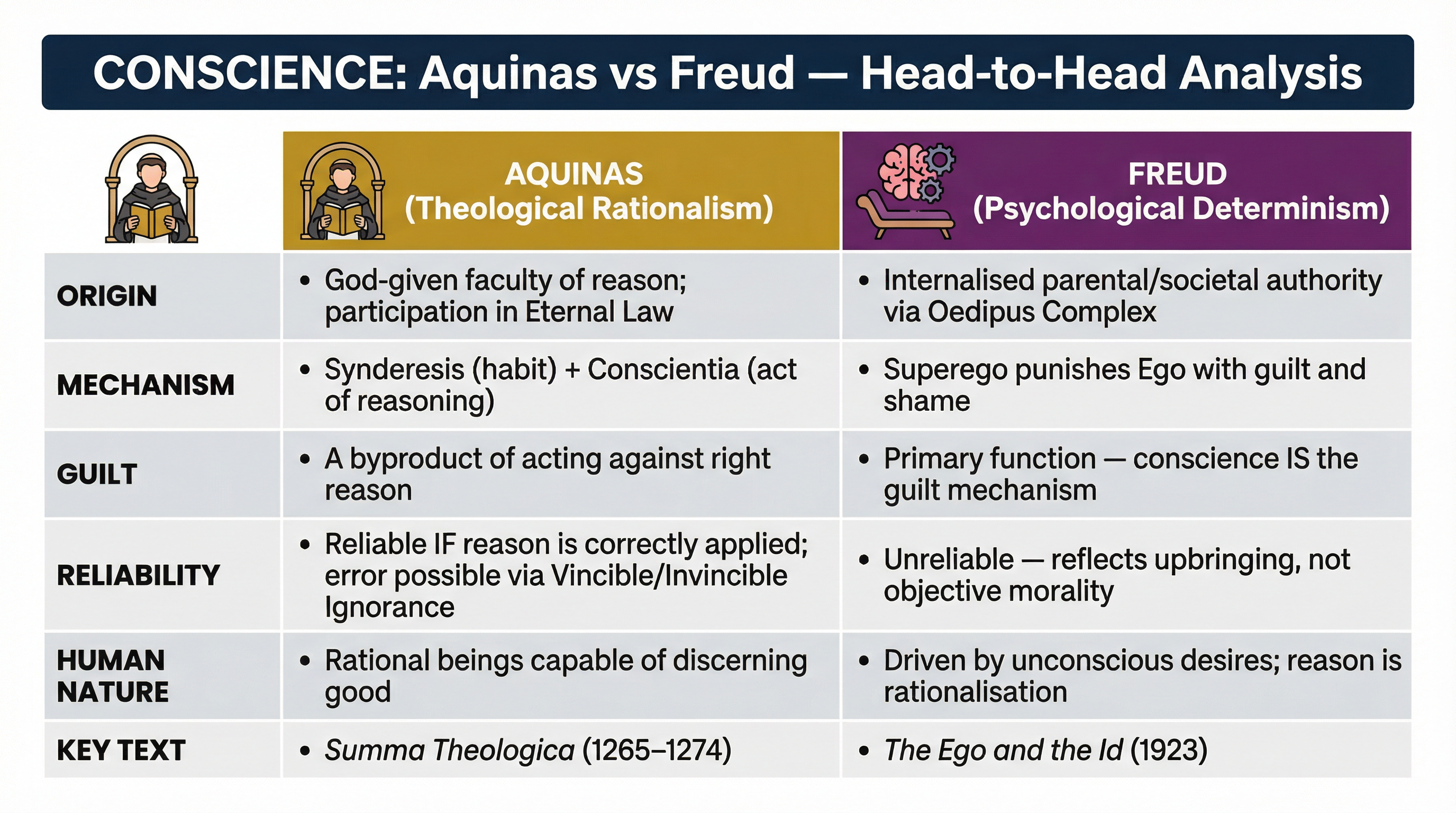
What causes the feeling of conscience? For Aquinas, the ultimate cause is God, who authors the Eternal Law and instils Synderesis in human reason. The proximate cause is the act of reasoning (Conscientia). For Freud, the cause is entirely developmental and psychological: the internalisation of authority figures during the resolution of the Oedipus complex, creating the Superego.
Significance
Why does this debate matter? It presents two radically different views of human nature and morality. Is morality objective and discoverable through reason, as Aquinas suggests? Or is it a subjective, culturally-relative illusion, as Freud's theory implies? A candidate's ability to weigh these implications demonstrates deep understanding.
Key Theories Explained
Aquinas's Rational Approach
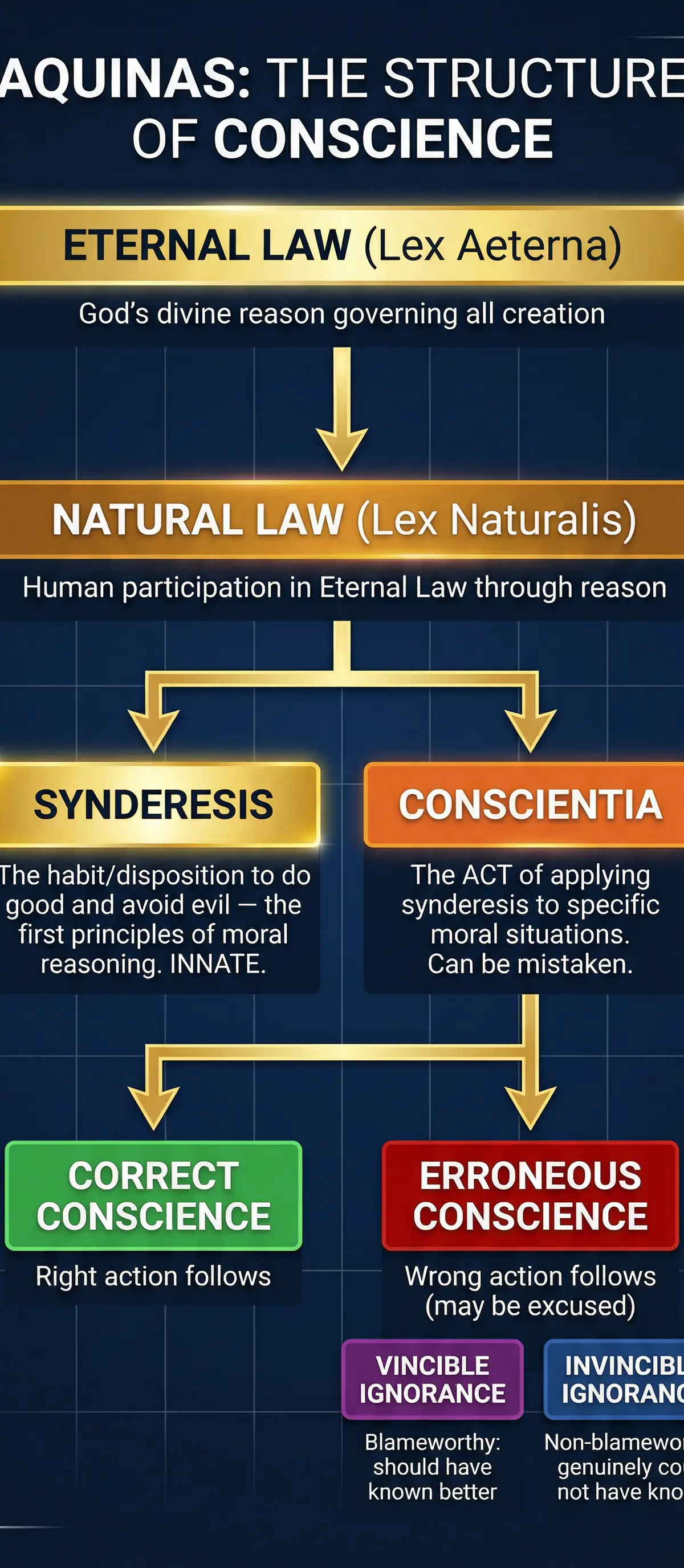
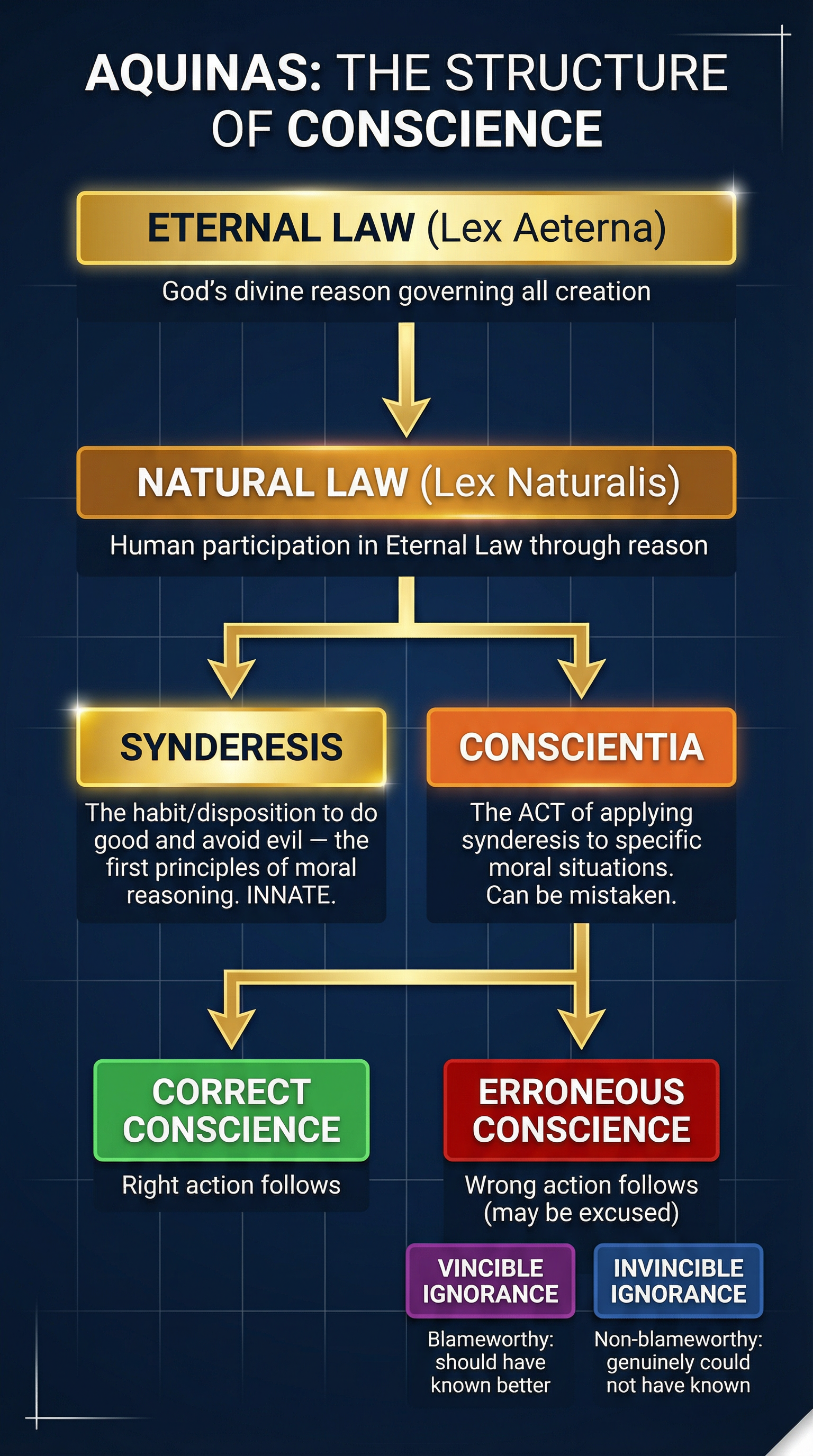
Aquinas's theory is not about an 'inner voice'. It is a structured process of reasoning. The Synderesis Rule is the foundational, unerring principle: all people have a rational inclination to pursue good and shun evil. Conscientia is the one-step intellectual process of applying this rule to a specific ethical problem. Because this is a human process, it can be flawed. An error in reasoning can lead to a mistaken conscience. If the ignorance that led to the error was Vincible (i.e., the person should have known better), they are blameworthy. If it was Invincible (they genuinely could not have known better), they are not blameworthy for following their conscience, even if it led to a wrong act.
Freud's Psychological Approach
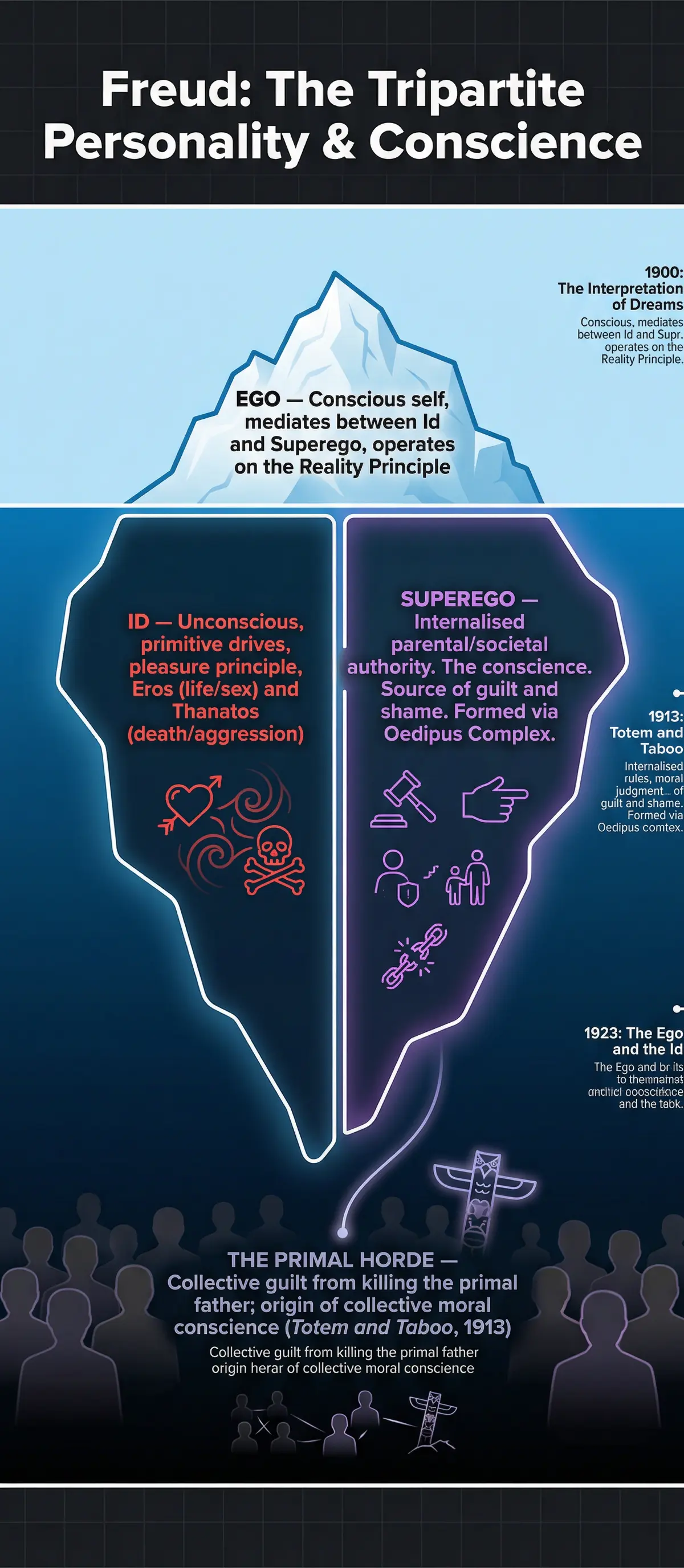
Freud's model is deterministic. The Superego acts as an internalised censor, representing the moral and social norms we absorb from our parents and culture. It is largely unconscious and operates by creating anxiety and guilt to punish the Ego (the conscious self) when it considers acting on the primal desires of the Id. Therefore, the 'voice' of conscience is nothing more than this internalised authority figure. Its commands are not based on objective truth but on the specific values of the society in which one was raised. The theory of the Primal Horde suggests this entire mechanism is rooted in a prehistoric event of patricide, leading to a collective, inherited guilt.
Worked Examples
2 worked examples — open one to explore the question and available guidance.
Practice Questions
Test your understanding — click to reveal model answers
'Freud's view of the conscience is more realistic than Aquinas's.' Evaluate this claim. (20 marks)
Hint: Consider what 'realistic' means. Does it mean it better describes our psychological experience, or that it's a more accurate account of morality? Structure your answer thematically, e.g., 'Realism about Guilt', 'Realism about Moral Disagreement', 'Realism about Human Nature'.
Explain Freud's concept of the Superego. (12 marks)
Hint: Make sure to include the tripartite personality, the role of parents/society, the Oedipus complex, and the function of guilt.