OCR · GCSE · Religious Studies
Sources of Authority
This study guide provides a deep dive into the crucial topic of Sources of Wisdom and Authority (SOWA) for OCR GCSE Religious Studies. It unpacks the complex hierarchy of authority in Christianity, exploring how sacred texts, tradition, and conscience shape belief and practice, which is essential for achieving top marks in the exam."
- 7 min read
- 3 worked examples
- 5 practice questions
Study Notes
Overview
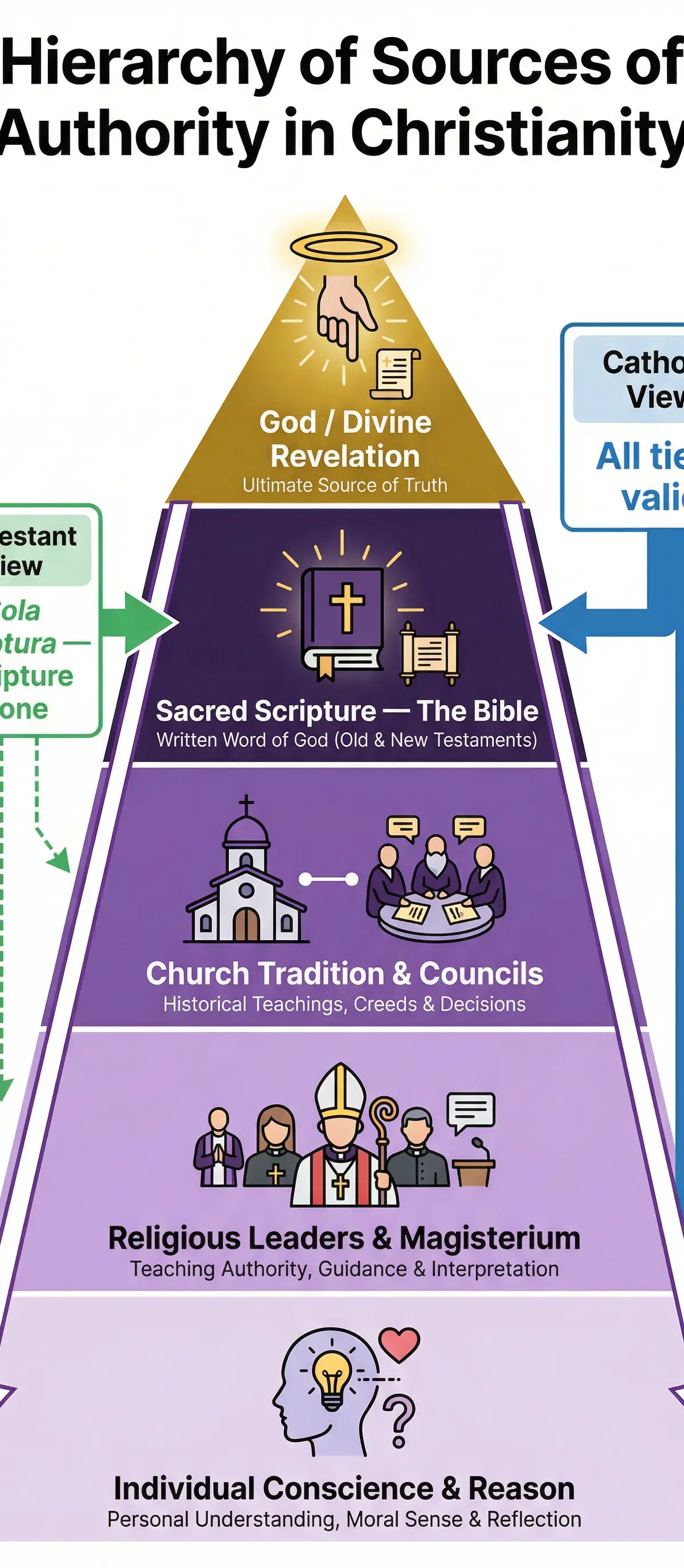
This unit explores the foundational principles of authority within Christianity, a core component of the OCR J625 specification. Candidates are expected to demonstrate a nuanced understanding of how different sources of wisdom and authority guide believers. This includes a detailed analysis of sacred texts (the Bible), the role of Church Tradition (especially in Catholicism), the significance of religious leaders, and the place of individual conscience and reason. Examiners award high credit for the ability to distinguish between denominational approaches, such as the Catholic acceptance of the Magisterium versus the Protestant principle of Sola Scriptura. A successful candidate will not only describe these sources but evaluate their relative importance and analyse how their interpretation leads to diversity in Christian thought and ethics. This guide will equip you with the specific knowledge, exam technique, and analytical skills to excel.
Key Concepts & Developments
The Bible as the Word of God
What it is: The Christian sacred scripture, comprising the Old and New Testaments. For Christians, it is the primary source of knowledge about God, Jesus, and the principles of faith.
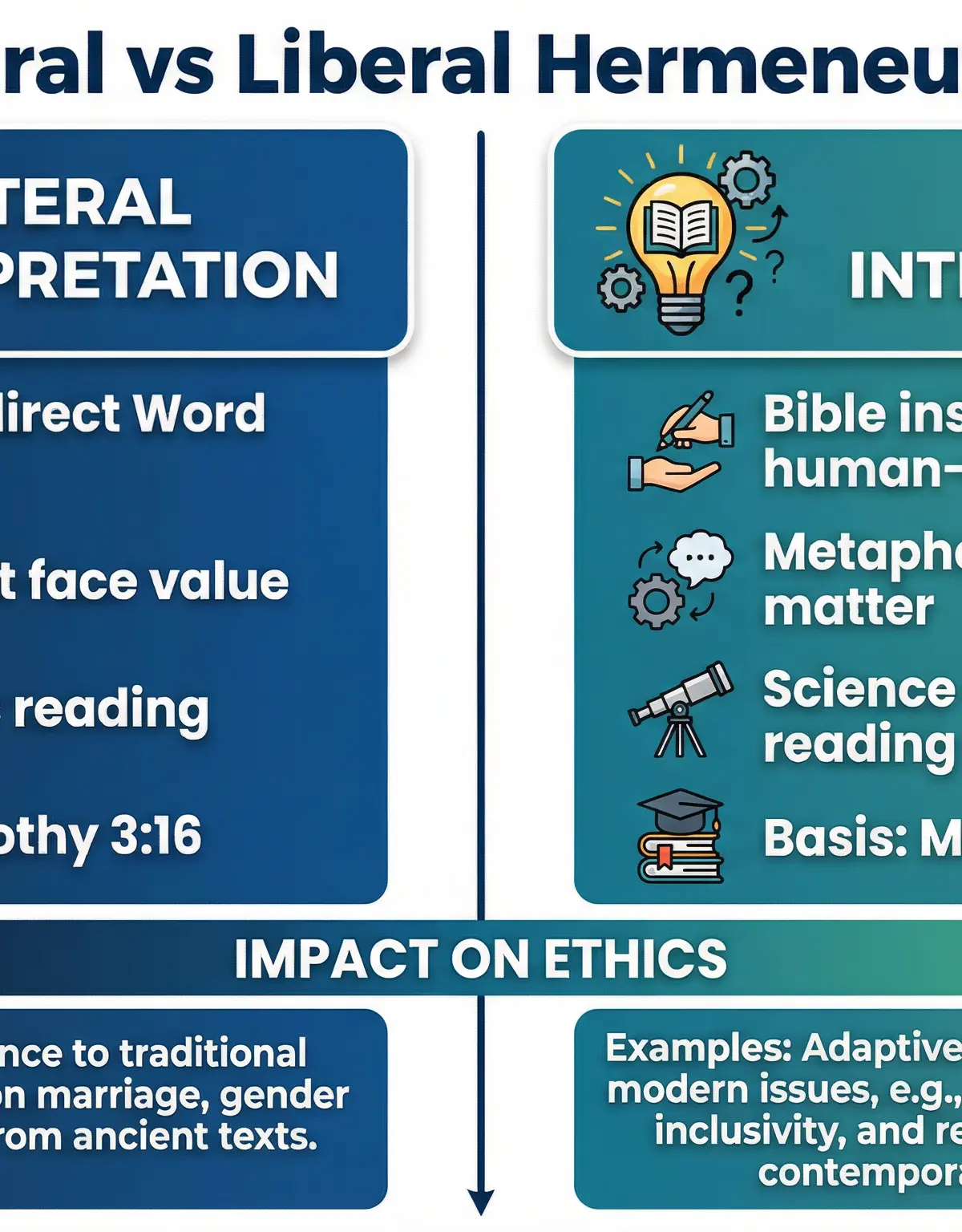
Why it matters: Examiners expect you to know that the Bible is not a single book but a library, and that its authority is understood differently. The key quote is 2 Timothy 3:16: "All Scripture is God-breathed...", which underpins the belief in its divine inspiration. Credit is given for explaining the difference between literal interpretation (the text is the inerrant, factual word of God) and liberal interpretation (the text is divinely inspired but written by humans and requires interpretation in light of context, science, and reason).
Specific Knowledge: You must be able to cite 2 Timothy 3:16. You should also be able to explain the concept of "theopneustos" (God-breathed) and hermeneutics (the theory of interpretation).
Sola Scriptura vs. Tradition
What happened: A major division during the Protestant Reformation (16th Century). Protestant reformers like Martin Luther championed Sola Scriptura ("Scripture Alone"), arguing that the Bible is the sole infallible source of authority for Christian faith and practice.
Why it matters: This directly contrasts with the Roman Catholic view, which upholds that authority rests on a combination of Scripture and Sacred Tradition, as interpreted by the Magisterium (the teaching authority of the Church). This is a fundamental difference that explains many of the divergences in belief and practice between Catholicism and Protestantism. High-level responses will analyse the implications of this for topics like the role of the Pope, the sacraments, and the ordination of women.
Specific Knowledge: Martin Luther, John Calvin, Protestant Reformation, Council of Trent (Catholic response), Magisterium, Papal Infallibility.
The Role of Conscience
What it is: The internal sense of right and wrong. In Christian theology, it is often seen as a God-given faculty.
Why it matters: Conscience can be a source of authority, but its reliability is debated. The Catholic Church teaches that a conscience must be "formed" and "informed" by Scripture and Church teaching to be reliable. Cardinal John Henry Newman famously called conscience "the aboriginal Vicar of Christ," highlighting its profound importance. For some traditions, like the Quakers (Religious Society of Friends), the "Inner Light" of conscience is the primary source of authority. Candidates should evaluate whether conscience is a reliable guide when it conflicts with other sources like the Bible or Church teaching.
Specific Knowledge: Thomas Aquinas (conscience as reason), Cardinal John Henry Newman, Quakers (Inner Light).
Key Individuals
Martin Luther (1483-1546)
Role: German theologian and a central figure in the Protestant Reformation.
Key Actions: Famously challenged the authority of the Pope and the Catholic Church. He translated the Bible into German, making it accessible to ordinary people. His Ninety-five Theses (1517) criticised Church practices, particularly the sale of indulgences.
Impact: His insistence on Sola Scriptura fundamentally reshaped Christianity, leading to the establishment of Protestant denominations. His actions forced a re-evaluation of where ultimate religious authority lies.
St. Thomas Aquinas (1225-1274)
Role: Immensely influential Catholic philosopher and theologian.
Key Actions: Synthesised Christian theology with Aristotelian philosophy. In his work, particularly the Summa Theologica, he argued that reason and faith work together. He described the Natural Law, an innate moral code accessible through reason, which is a reflection of God's Eternal Law.
Impact: Aquinas provides the intellectual framework for understanding how reason and conscience can be sources of authority that complement, rather than contradict, revelation (Scripture and Tradition). His ideas are foundational to Catholic moral teaching.
Second-Order Concepts
Causation
The Protestant Reformation was caused by a combination of factors: long-term corruption within the Catholic Church, the rise of humanism and a renewed focus on original texts, the political ambitions of European princes, and the invention of the printing press, which allowed reformers' ideas to spread rapidly. The immediate trigger was Martin Luther's protest against the sale of indulgences.
Consequence
The immediate consequence was the schism of Western Christianity into Catholic and Protestant branches. In the long term, this led to centuries of religious wars, the rise of nation-states, an emphasis on individual literacy and conscience, and a permanent diversity within Christianity.
Change & Continuity
Change: The Reformation brought about a radical change in the structure of authority for Protestants, rejecting the Pope and the Magisterium. Continuity: Both Catholics and Protestants continued to view the Bible as a sacred and authoritative text, and both continued to believe in the core tenets of the Nicene Creed.
Significance
The debate over sources of authority is historically significant because it was the central issue of the Reformation and continues to define the differences between Christian denominations today. It is the key to understanding Christian diversity.
Source Skills
When analysing a source (e.g., a biblical passage, a quote from a Pope or reformer), apply the following framework:
- Content: What does the source say about authority? Does it prioritise a particular source (e.g., scripture, tradition, reason)?
- Provenance: Who wrote it? When? What was their denomination and purpose? (e.g., A quote from the Pope will reflect a Catholic viewpoint on the Magisterium). This helps you evaluate its reliability and bias.
- Application: How would this source be used by a believer to make a moral decision? (e.g., How would a literalist use Genesis 1 to argue against euthanasia?)
- Evaluation: How does this source compare or contrast with other sources of authority? (e.g., How does a biblical passage on forgiveness compare with the Church's teaching on confession?)
"
Worked Examples
3 worked examples — open one to explore the question and available guidance.
Practice Questions
Test your understanding — click to reveal model answers
Explain two different Christian understandings of the authority of the Bible. (6 marks)
Hint: Think about the difference between a literal and a liberal approach to interpretation.
Explain why conscience is an important source of authority for some Christians. (6 marks)
Hint: Refer to at least one key thinker and one Christian group.
"For a Christian, the teachings of the Church are more important than the Bible." Evaluate this statement. (15 marks)
Hint: This is a question about Tradition vs. Sola Scriptura. Structure your answer as a debate between a Catholic and a Protestant.
Explain two reasons why Martin Luther promoted the idea of Sola Scriptura. (6 marks)
Hint: Think about what he was reacting against in the Catholic Church of his time.
Explain how a literal interpretation of the Bible might influence a Christian's view on the role of women in the church. (6 marks)
Hint: Find a specific biblical passage and explain how taking it at face value would affect this issue.