OCR · GCSE · Religious Studies
Terrorism and Weapons of Mass Destruction
This study guide provides a comprehensive analysis of Terrorism and Weapons of Mass Destruction for OCR GCSE Religious Studies. It delves into the complex ethical debates, contrasting religious perspectives and providing the specific knowledge needed to excel in the exam.
- 5 min read
- 3 worked examples
- 5 practice questions
- 6 key terms
Study Notes
Overview
This topic requires a critical analysis of religious attitudes toward Terrorism and Weapons of Mass Destruction (WMDs), focusing on the tension between Just War criteria and the indiscriminate nature of modern weaponry. OCR examiners expect candidates to evaluate Christian perspectives alongside one other religion (in this case, Islam), contrasting absolute pacifism with realism and deterrence theories. High-level responses will move beyond simple descriptions to analyse the nuances within religious traditions and apply theological concepts with precision. You will need to demonstrate an understanding of the root causes of terrorism versus the religious condemnation of the act itself, and critically assess whether the possession of nuclear weapons can ever be morally justified. Marks are awarded for the specific application of concepts like 'proportionality', 'discrimination', and 'Sanctity of Life', supported by relevant Sources of Wisdom and Authority (SoWA).
Key Concepts & Debates
Just War Theory
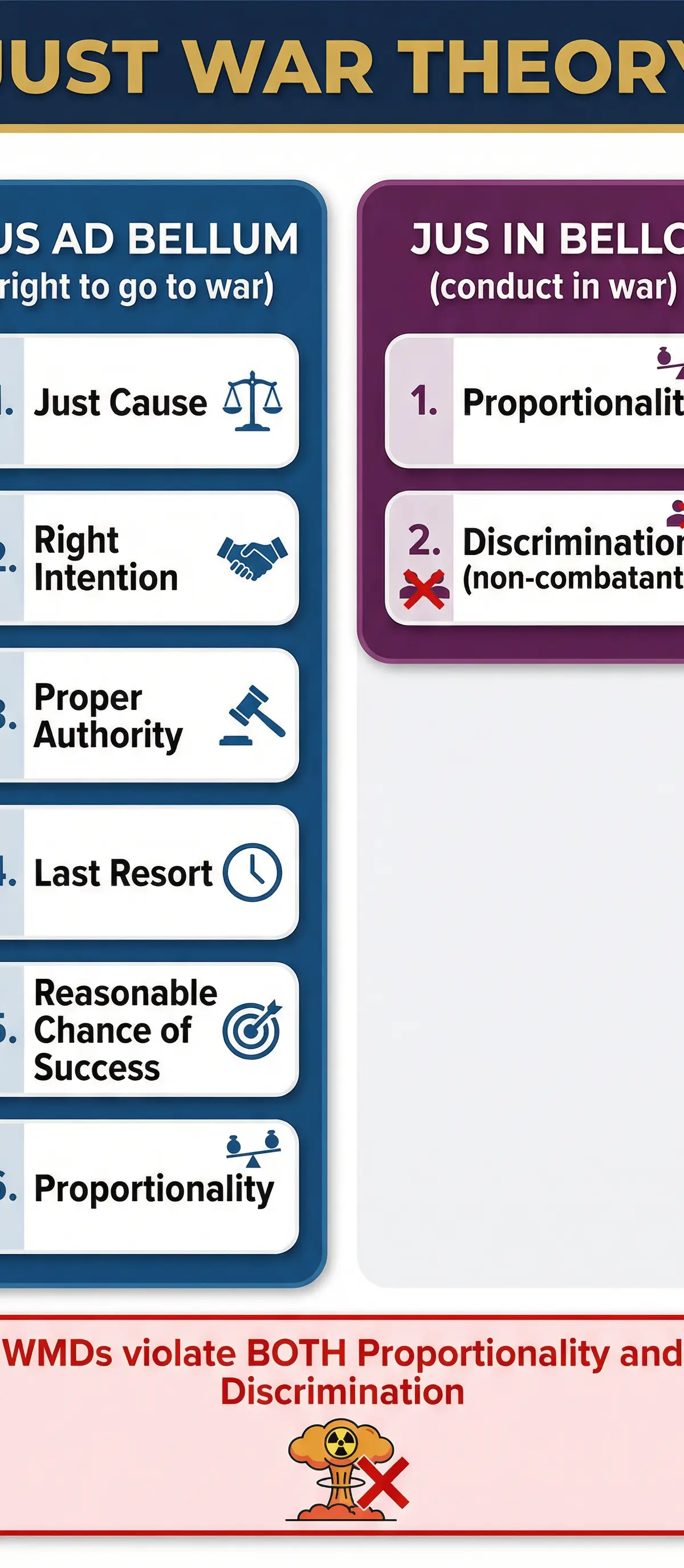
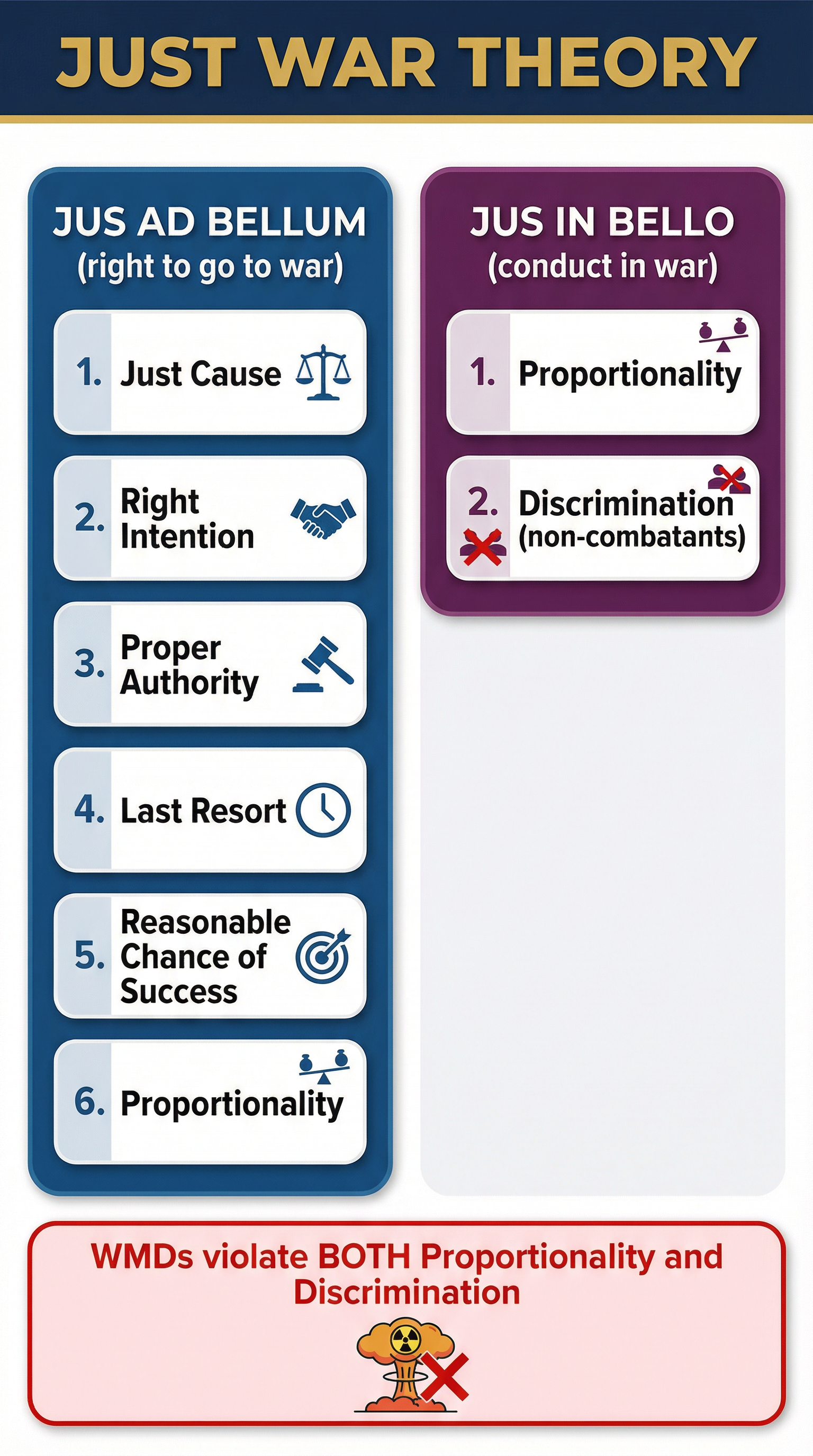
What it is: A set of ethical principles, originating with St. Augustine and developed by St. Thomas Aquinas, that determines whether a war is morally justifiable (Jus ad Bellum) and how it should be fought (Jus in Bello).
Why it matters: This is the central ethical framework for this topic. Examiners expect you to apply its criteria directly to WMDs. The core tension is that WMDs, by their very nature, violate the Jus in Bello principles of Proportionality and Discrimination, as they cause excessive harm and cannot distinguish between soldiers and civilians.
Specific Knowledge: You must know the difference between Jus ad Bellum (right to go to war) and Jus in Bello (conduct in war). Memorise the key criteria for each.
Christian & Islamic Perspectives
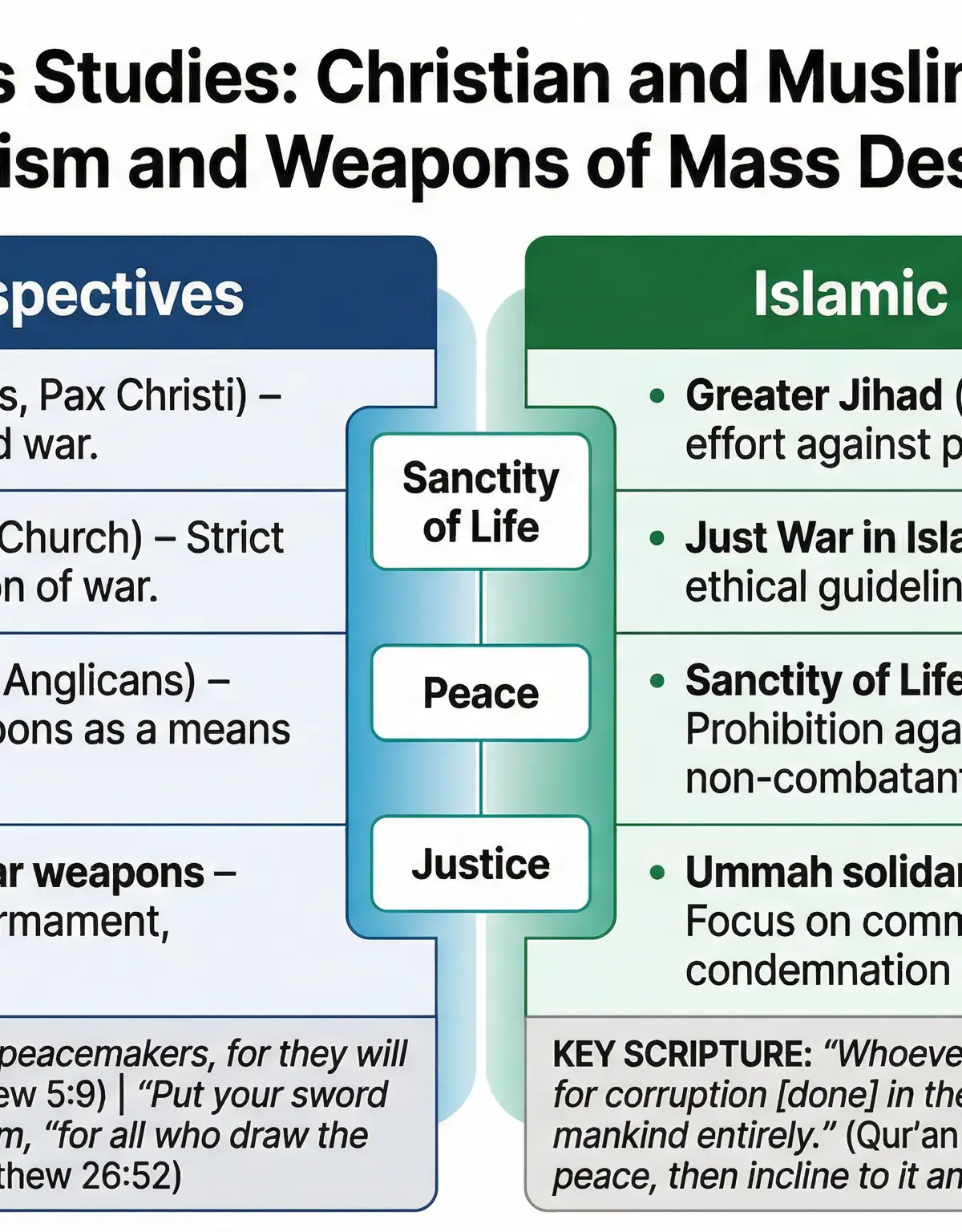
What it is: An exploration of the diverse views within Christianity and Islam on the ethics of war, terrorism, and WMDs. This is not about finding a single 'Christian' or 'Muslim' view, but understanding the range of beliefs.
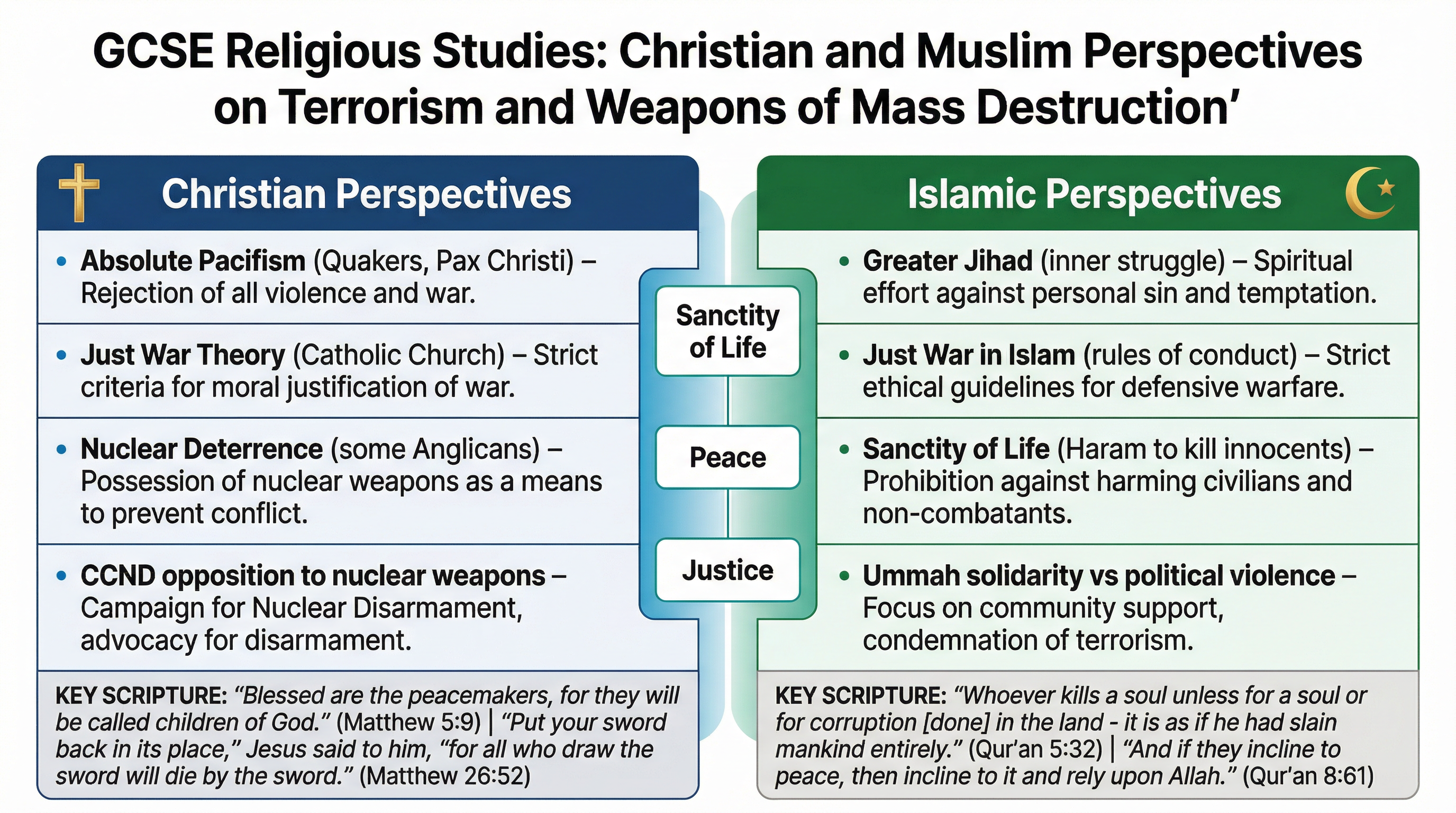
Why it matters: AO2 marks are awarded for comparing these religious perspectives. You need to contrast absolute pacifism (e.g., Quakers) with realist views (e.g., nuclear deterrence) within Christianity, and understand the principles of Lesser Jihad and the condemnation of targeting innocents in Islam.
Specific Knowledge: Name specific groups (Pax Christi, CCND), cite key scripture (Matthew 5:9, Qur'an 5:32), and understand core beliefs (Sanctity of Life, Ummah).
Second-Order Concepts
Causation
Terrorism is rarely caused by a single factor. Examiners credit answers that recognise a combination of root causes, such as political grievances (e.g., occupation), social injustice (e.g., poverty, discrimination), and ideological or religious extremism. It is crucial to distinguish these causes from the justification of the act, which all major religions condemn.
Consequence
The consequences of using WMDs are catastrophic and indiscriminate, affecting civilians, the environment (violating Stewardship), and future generations. This is the primary reason most religious perspectives argue their use is always immoral. The consequence of terrorism is fear and the breakdown of social cohesion, which is its strategic goal.
Change & Continuity
While the principles of Just War are ancient, their application has had to change in response to modern technology. The continuity lies in the core values (Sanctity of Life, justice). The change is the challenge posed by weapons that make traditional rules of engagement obsolete.
Significance
This topic is significant because it forces a confrontation between ancient ethical teachings and modern technological reality. It questions whether traditional religious ethics are still relevant in a world of nuclear weapons and global terrorism, making it a vital area of applied ethics.
Source Skills
When presented with a source (e.g., a quote from the Pope or a statement from a Muslim scholar), analyse it by considering:
- Content: What is the explicit message regarding peace, war, or violence?
- Provenance: Who is speaking? A pacifist Quaker will have a different view from a state-employed chaplain. This affects the source's perspective and authority.
- Application: How does this source support or challenge a key concept like Just War or Sanctity of Life? Use the source as evidence to support your arguments.
Worked Examples
3 worked examples — open one to explore the question and available guidance.
Practice Questions
Test your understanding — click to reveal model answers
Explain two contrasting religious beliefs about nuclear weapons. (6 marks)
Hint: Think about the difference between absolute pacifism and the idea of deterrence. Name specific groups.
Explain two reasons why a religious person might be against terrorism. (6 marks)
Hint: Focus on the core principles of Sanctity of Life and the rules against harming civilians.
'For a religious person, violence is never justified.' Evaluate this statement. (15 marks)
Hint: This is a classic evaluation question. You must argue both for and against the statement, using evidence. Contrast pacifism with Just War theory.
Compare the Christian and Islamic concepts of a 'Just War'. (12 marks)
Hint: You need to show both similarities and differences. Use comparative language.
Explain two religious teachings about stewardship. (6 marks)
Hint: Think about the role of humans as caretakers of the planet. Link this to the topic of WMDs.