OCR · GCSE · Religious Studies
Wealth and Poverty
This study guide for OCR GCSE Religious Studies delves into the complex relationship between wealth, poverty, and faith. It is designed to equip candidates with the precise theological knowledge and evaluative skills needed to excel in the exam, focusing on how Christian and Islamic traditions view the ethics of wealth, the causes of poverty, and the duty of charity."
- 5 min read
- 3 worked examples
- 5 practice questions
Study Notes
Overview
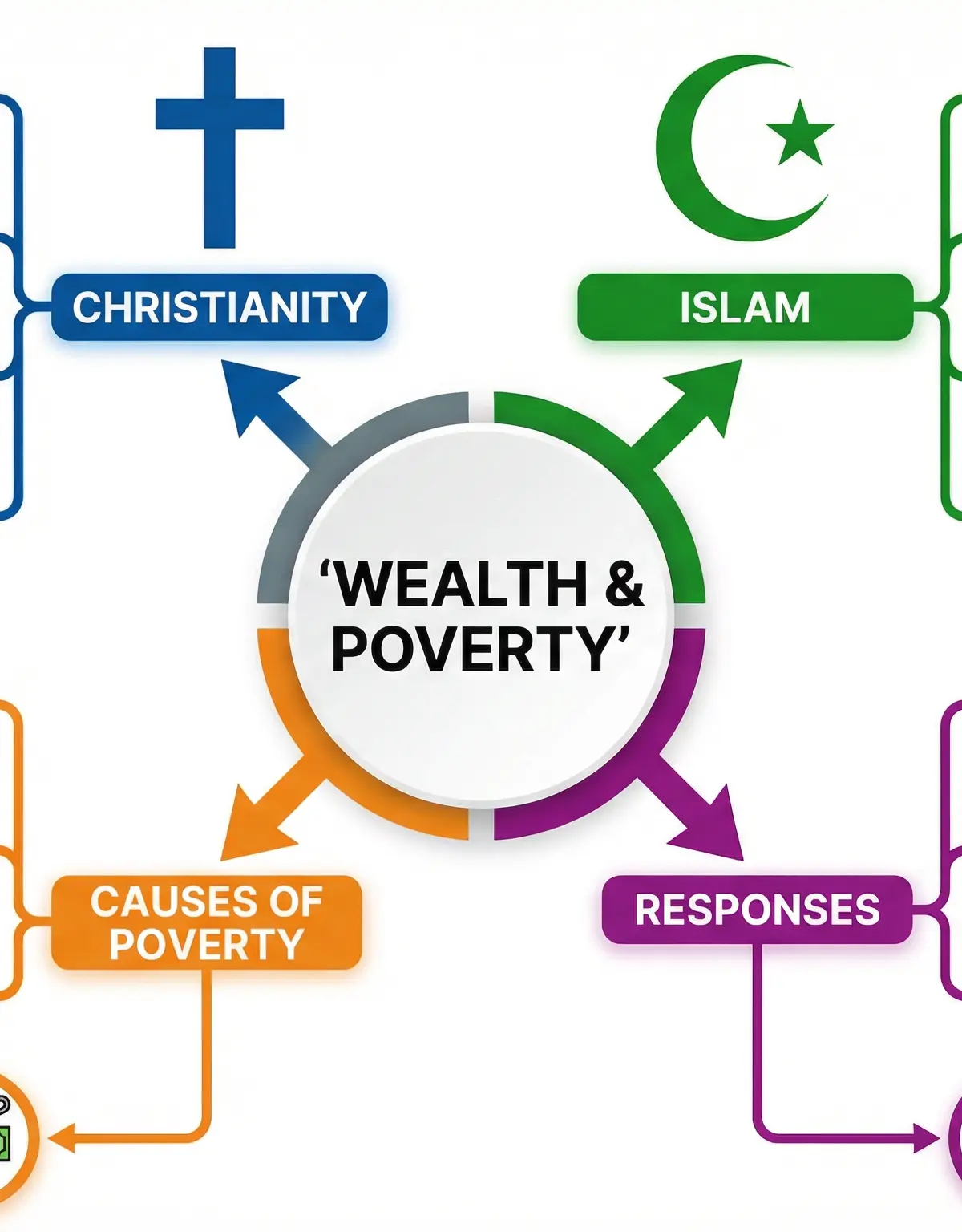
This topic explores the religious and ethical dimensions of wealth and poverty, a central theme in both Christianity and Islam. For the OCR J625 specification, candidates are expected to move beyond simple descriptions of charity to a nuanced analysis of theological concepts like Stewardship (Khalifah), the purpose of wealth, and the systemic causes of poverty. Examiners award high marks for the ability to integrate specific Sources of Wisdom and Authority (SOWA) and to distinguish between different religious traditions (e.g., Sunni vs. Shi'a Islam, Catholic vs. Protestant Christianity). This guide will provide the detailed knowledge and analytical frameworks necessary to deconstruct exam questions and formulate high-level responses. You will learn not just what religions teach, but why they teach it, and how to evaluate these teachings critically.

Key Concepts & Beliefs
Christian Beliefs on Wealth and Poverty
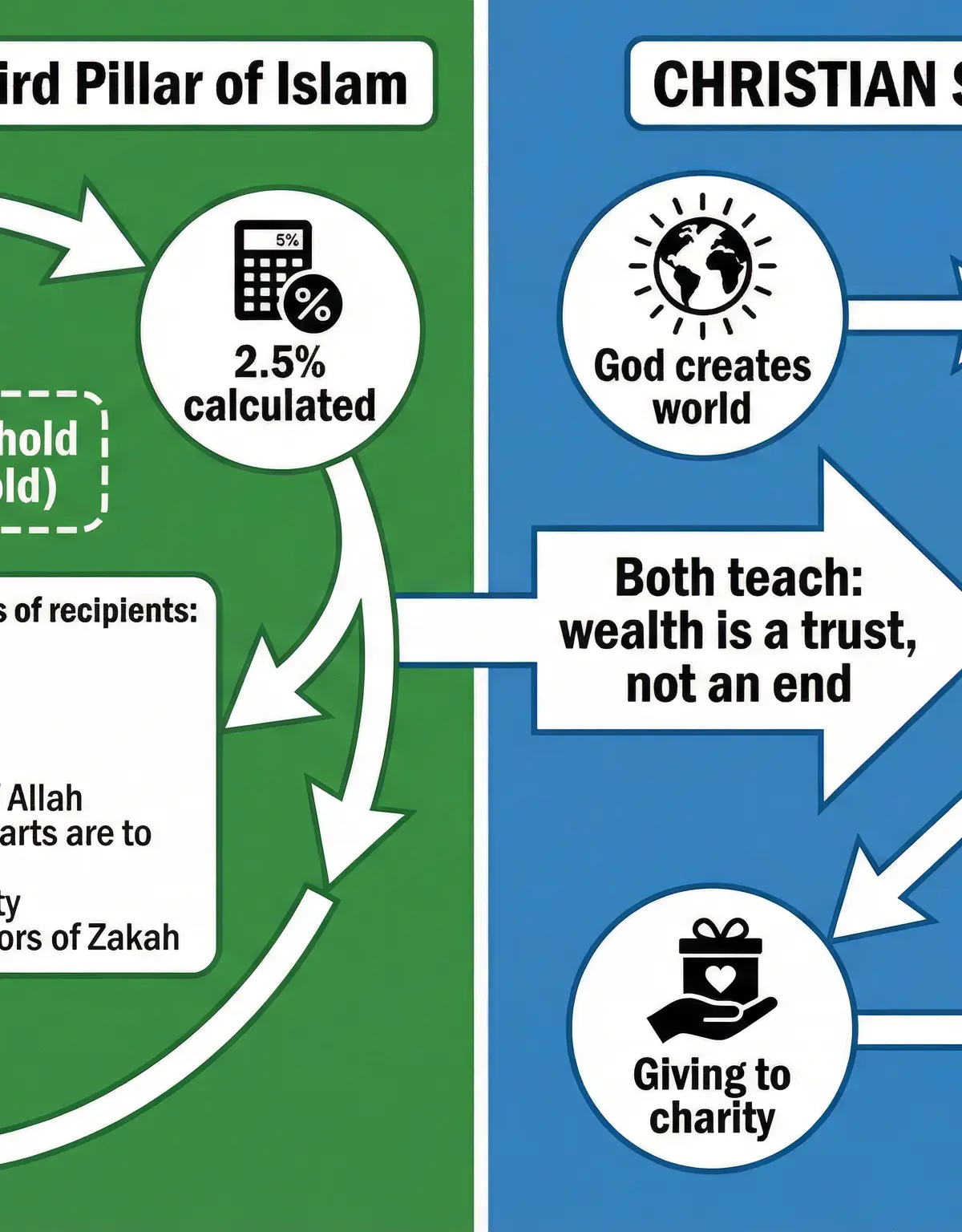
Stewardship and Dominion: A core Christian belief is that God created the world and everything in it. Humans are appointed as 'stewards' (Genesis 1:28), tasked with managing God's creation responsibly. This means wealth is not owned by individuals but is a trust from God to be used for the good of all. High-level responses will contrast this with the idea of 'dominion', often interpreted as unchecked exploitation, arguing that a stewardship mindset is essential for ethical wealth management.
The Dangers of Wealth: Christianity warns against the spiritual dangers of riches. This is most famously expressed in Mark 10:25: 'It is easier for a camel to go through the eye of a needle than for someone who is rich to enter the kingdom of God.' This is not a condemnation of wealth itself, but a warning against attachment to it. Another crucial quote, often misremembered, is 1 Timothy 6:10: 'For the love of money is a root of all kinds of evil.' Candidates must be precise: it is the love of money, not money itself, that is condemned.
The Imperative of Charity: The Parable of the Sheep and the Goats (Matthew 25:31-46) is the single most important teaching on this topic. Jesus states that at the Last Judgement, people will be judged on their practical actions towards the poor and suffering: 'Truly I tell you, whatever you did for one of the least of these brothers and sisters of mine, you did for me.' This elevates charity from a kind act to a fundamental duty of serving Christ himself. This is the theological driving force behind organisations like Christian Aid and CAFOD.
Islamic Beliefs on Wealth and Poverty
Khalifah (Stewardship): Similar to the Christian concept of stewardship, Islam teaches that all wealth belongs to Allah and humans are his 'vicegerents' or trustees (Khalifah) on Earth. This is a foundational concept that underpins all Islamic economic ethics. Wealth is a test, and individuals will be held accountable for how they acquire and use it.
Zakah - The Third Pillar: Zakah is a compulsory annual donation of 2.5% of a Muslim's surplus wealth (above the nisab threshold). It is not considered charity but a religious obligation and a form of worship, designed to purify the wealth of the giver and redistribute resources within the Ummah (global Muslim community). The recipients are specified in the Qur'an (Surah 9:60) and include the poor, the needy, and those in debt. Candidates MUST distinguish Zakah (obligatory) from Sadaqah (voluntary charity).
The Condemnation of Hoarding: The Qur'an strongly condemns the hoarding of wealth. Surah 9:34 warns: 'Those who hoard gold and silver and spend it not in the way of Allah - give them tidings of a painful punishment.' This reinforces the idea that wealth must circulate to benefit the community, not be accumulated for its own sake.
Key Organisations
Christian Aid
Role: An official agency of 41 sponsoring churches in the UK and Ireland, working to end poverty globally.
Key Actions: Provides emergency relief (e.g., after earthquakes), funds long-term development projects (e.g., sustainable farming), and campaigns on issues like climate justice and debt relief.
Impact: Christian Aid's work is a practical application of Christian ethics. When discussing them, candidates must link their actions (AO1) to the underlying theological motivations (AO2), such as the belief in Imago Dei (all are made in God's image) and the command to love one's neighbour.
Islamic Relief
Role: An international NGO founded in the UK in 1984, providing humanitarian aid and development programs.
Key Actions: Operates in over 40 countries, delivering food packs, providing clean water, running orphan sponsorship schemes, and implementing long-term development projects. Their work is guided by the teachings of the Qur'an and Sunnah.
Impact: Islamic Relief demonstrates the practical application of concepts like Zakah, Sadaqah, and the unity of the Ummah. Their work shows how Islamic principles are translated into action to alleviate global poverty."
Worked Examples
3 worked examples — open one to explore the question and available guidance.
Practice Questions
Test your understanding — click to reveal model answers
Explain two contrasting ways in which poverty can be caused. (4 marks)
Hint: Think about natural vs. man-made causes.
Explain two religious beliefs which might inspire a person to work to end poverty. Refer to scripture or sacred texts in your answer. (5 marks)",
"marks": 5
'Zakah is a better way of dealing with poverty than Christian charitable giving.' Evaluate this statement. (15 marks)",
"marks": 15
Explain two ways a religious organisation helps the poor. (4 marks)
Hint: Name a specific organisation and give two different types of aid they provide.
Explain two contrasting religious attitudes to having wealth. (5 marks)
Hint: Think about the \'Prosperity Gospel\' vs. the idea of wealth as a test.