WJEC · A-Level · Religious Studies
Dietrich Bonhoeffer's Theology
Dietrich Bonhoeffer (1906–1945) was a German Lutheran pastor whose theology was forged in direct confrontation with Nazism, making him one of the most important theological voices of the 20th century. His distinction between 'Cheap Grace' and 'Costly Grace' remains a foundational challenge to the institutional Church, while his concepts of 'Religionless Christianity' and the 'World Come of Age' anticipate the secularisation debates that dominate contemporary religious thought. For WJEC candidates, Bonhoeffer offers a uniquely rich intersection of historical context, ethical dilemma, and systematic theology — mastering his ideas is essential for top-band AO1 and AO2 performance.
- 12 min read
- 3 worked examples
- 5 practice questions
- 8 key terms
Study Notes
Overview
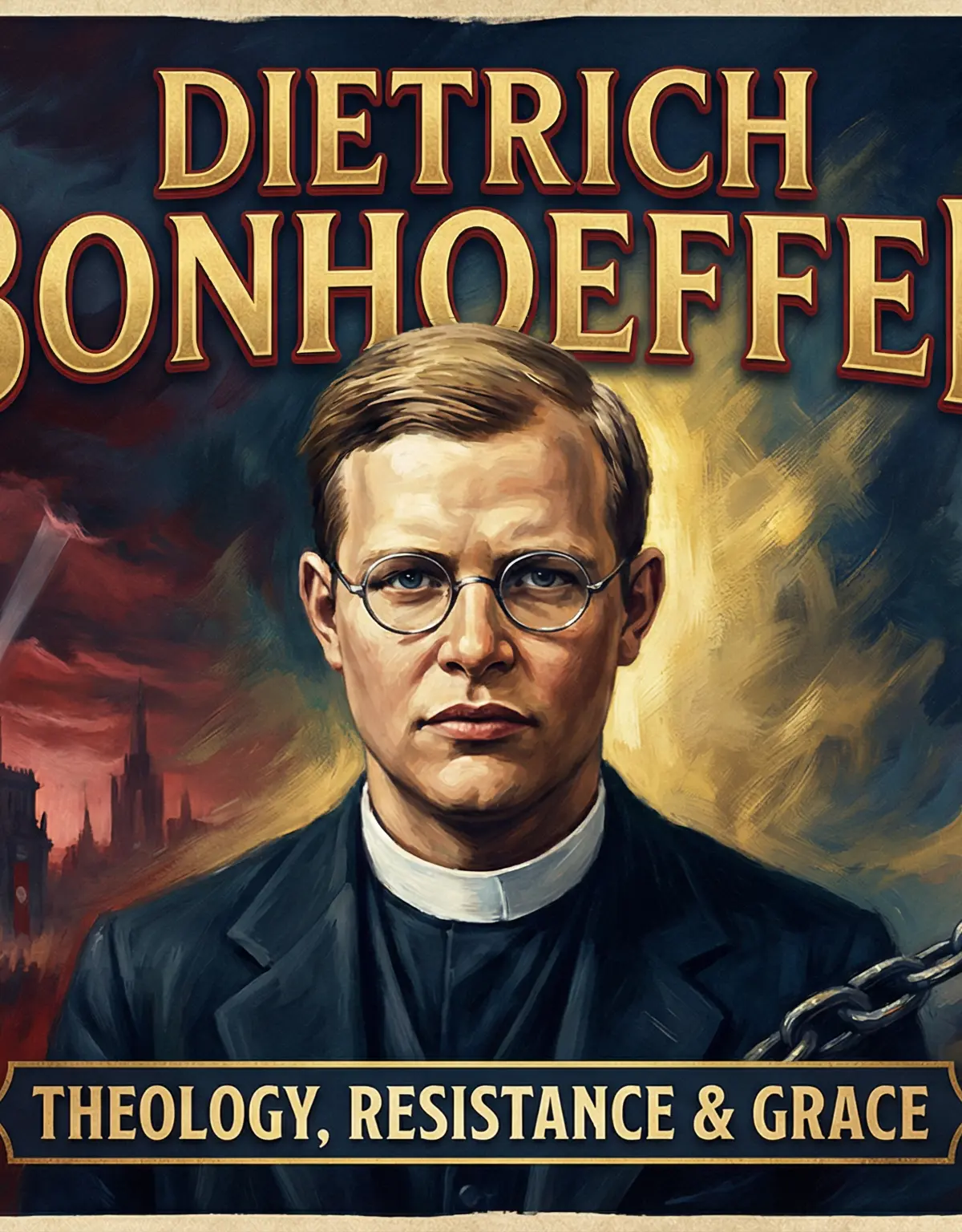
Dietrich Bonhoeffer's theology represents one of the most dramatic case studies in modern religious thought: a systematic theologian who moved from the lecture hall to the resistance movement, and ultimately to the gallows. WJEC A-Level candidates must engage with Bonhoeffer on two levels simultaneously. First, as a thinker who produced rigorous, textually grounded theological arguments — most notably in The Cost of Discipleship (1937) and the posthumously published Letters and Papers from Prison (1951). Second, as a practitioner whose life choices enacted the very theology he preached. Examiners reward candidates who can move fluidly between these two registers, demonstrating that Bonhoeffer's biography is not merely illustrative background, but the living proof of his theological claims. The WJEC specification focuses particularly on his response to secularisation, his critique of institutional religion, and the ethical implications of his civil disobedience — culminating in his execution at Flossenbürg concentration camp on 9 April 1945.
Key Events and Developments
The Barmen Declaration (May 1934)
Date(s): 29–31 May 1934, Barmen, Germany.
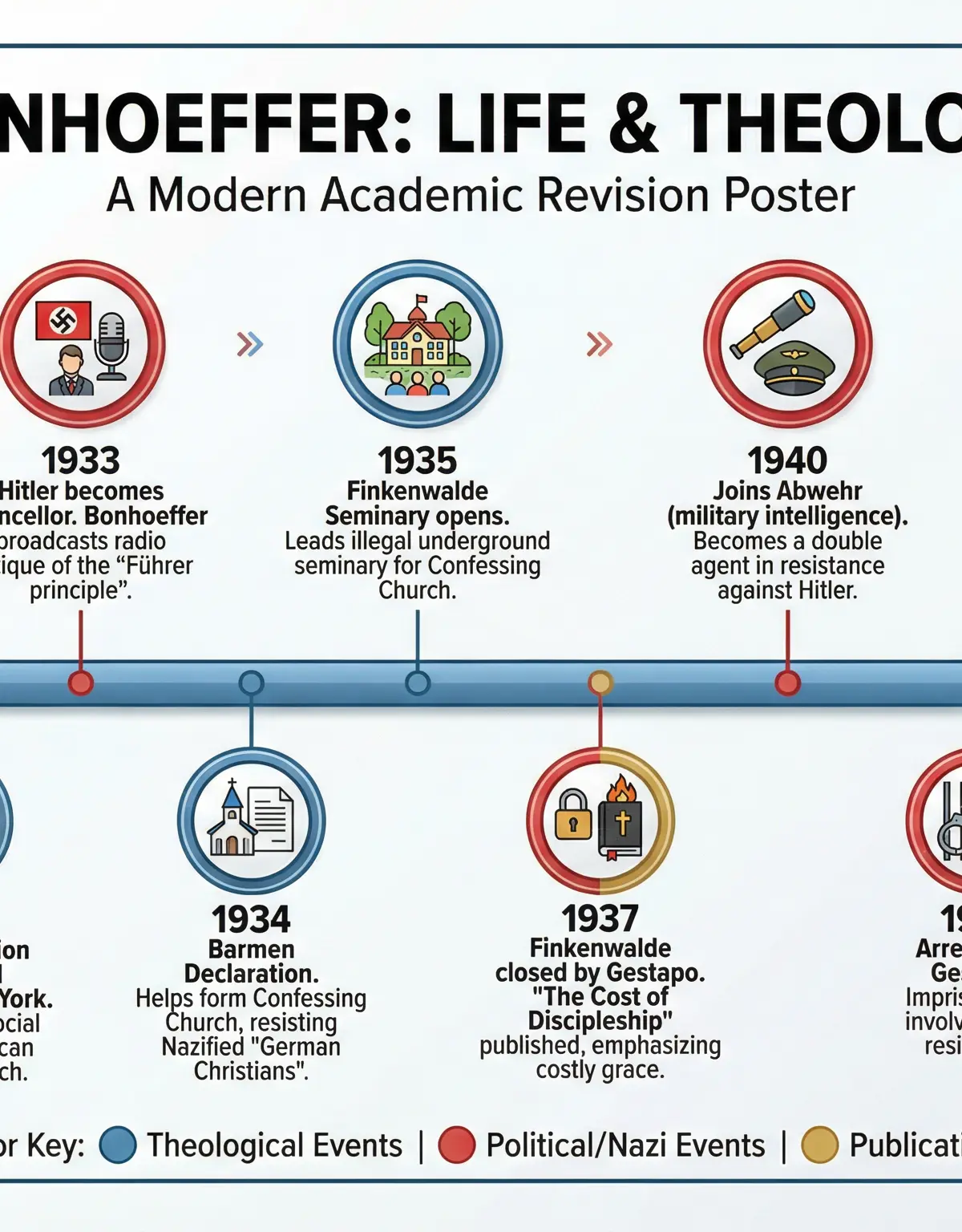
What happened: As the Nazi state sought to bring the German Protestant churches under its ideological control through the 'German Christian' movement — which sought to align Christianity with National Socialist ideology, including the 'Aryan Clause' that would have excluded Jewish Christians from ministry — a group of pastors and theologians convened at Barmen. The resulting Declaration, drafted primarily by the Reformed theologian Karl Barth, asserted that the Church's sole authority was Jesus Christ as revealed in Scripture, explicitly rejecting the claim that the state could be a source of divine revelation. Bonhoeffer was a key advocate for the Declaration and for the formation of the Confessing Church (Bekennende Kirche) that emerged from it.
Why it matters: The Barmen Declaration is the foundational act of ecclesial resistance to Nazism. For the exam, candidates must understand it as a theological document, not merely a political protest. Its core claim — that Jesus Christ alone is Lord of the Church — directly challenges the 'Führer principle' (Führerprinzip) and the Nazi conflation of national identity with religious identity. Bonhoeffer's support for Barmen demonstrates his early commitment to the idea that the Church must exist on its own terms, not as a servant of the state — a theme that runs through all his subsequent theology.
Specific Knowledge: The Declaration contained six theses. Thesis One rejected any 'other events, powers, historic figures, and truths' as sources of divine revelation alongside Jesus Christ. The Aryan Clause of April 1933 had sought to apply racial law to church appointments. Bonhoeffer had already publicly critiqued Hitler's 'Führer principle' in a radio broadcast on 1 February 1933, just two days after Hitler became Chancellor.
Finkenwalde Seminary (1935–1937)
Date(s): Opened September 1935; closed by the Gestapo in September 1937.
What happened: Following the Barmen Declaration, the Confessing Church needed to train its own pastors independently of the Nazi-controlled state church seminaries. Bonhoeffer was appointed to lead one of five such illegal seminaries, which he established at Finkenwalde, near Stettin (now Szczecin, Poland). Crucially, Bonhoeffer did not simply run a conventional theological college. He established a quasi-monastic community — a Bruderhaus (brothers' house) — where students lived together in structured prayer, confession, and service. This experiment in communal Christian living was documented in his book Life Together (Gemeinsames Leben, 1939).
Why it matters: Examiners specifically note that candidates must not treat Finkenwalde merely as a school. It was a theological experiment in what 'costly grace' looks like in practice. By choosing to live in intentional community under threat from the state, Bonhoeffer and his students were embodying the very discipleship he had theorised. The seminary also represents Bonhoeffer's conviction that authentic Christianity requires a visible, counter-cultural community — a direct challenge to the 'invisible' or merely doctrinal Christianity he associated with cheap grace.
Specific Knowledge: Approximately 25 students attended each cohort. The Gestapo closed Finkenwalde in 1937 and subsequently arrested several of its graduates. Bonhoeffer continued the work clandestinely through 'collective pastorates' until 1940. Life Together was written in just four weeks in 1938 and published in 1939.
The Concept of 'The World Come of Age' and Religionless Christianity (1943–1945)
Date(s): Developed in letters written from Tegel Military Prison, Berlin, from April 1943 onwards.
What happened: Following his arrest by the Gestapo in April 1943, Bonhoeffer was imprisoned at Tegel. During this period, he engaged in an extensive correspondence with his friend and biographer Eberhard Bethge. These letters, published posthumously as Letters and Papers from Prison, contain his most radical and unfinished theological ideas. Bonhoeffer argued that Western humanity had reached a point of intellectual and moral 'coming of age' (Mündigkeit) — it had developed science, philosophy, and political theory to the extent that it no longer needed God as a working hypothesis to explain the world. The old 'religious' framework of the Church — its metaphysical language, its appeal to human weakness and the 'boundaries' of life — was no longer effective or honest.
Why it matters: Bonhoeffer's response to this diagnosis was not despair but a radical theological proposal: 'Religionless Christianity'. He argued that the Church must learn to speak of God not at the boundaries of human experience (death, suffering, ignorance) but at the very centre of life. The Church must become a community that exists entirely 'for others', following the model of Christ who 'existed for others'. This is not atheism — a critical point for the exam — but a call for a new, non-religious form of authentic Christian devotion that engages the secular world on its own terms.
Specific Knowledge: The phrase 'world come of age' (mündige Welt) appears in a letter of 30 April 1944. Bonhoeffer explicitly critiques the apologetic strategy of theologians like Rudolf Bultmann and Paul Tillich for still relying on 'religious' frameworks. His concept of the 'Western Void' refers to the spiritual emptiness left by secularisation that the Church must address through service, not doctrine.
The Assassination Plot and Execution (1940–1945)
Date(s): Joined the Abwehr (German military intelligence) in 1940; arrested 5 April 1943; executed 9 April 1945.
What happened: From 1940, Bonhoeffer worked as a double agent within the Abwehr (German military intelligence), using his ecumenical church contacts to pass information to the Allies and to support resistance activities. He was connected to the group around Admiral Wilhelm Canaris and Hans von Dohnanyi (his brother-in-law) who were involved in multiple plots to assassinate Hitler. Following his arrest in 1943, evidence of his involvement in the July 1944 bomb plot (Operation Valkyrie) was discovered. He was transferred to Flossenbürg concentration camp and hanged on 9 April 1945 — just three weeks before Germany's surrender.
Why it matters: Bonhoeffer's decision to participate in tyrannicide represents the most acute ethical tension in his thought. He was a committed pacifist in his early career, deeply influenced by the Sermon on the Mount. His decision to participate in the plot to kill Hitler represents what he called 'taking responsibility' in a situation of radical evil — an act of costly grace that he knew might damn him. For AO2 evaluation, candidates must assess whether this represents a coherent development of his theology or a fundamental contradiction.
Key Individuals
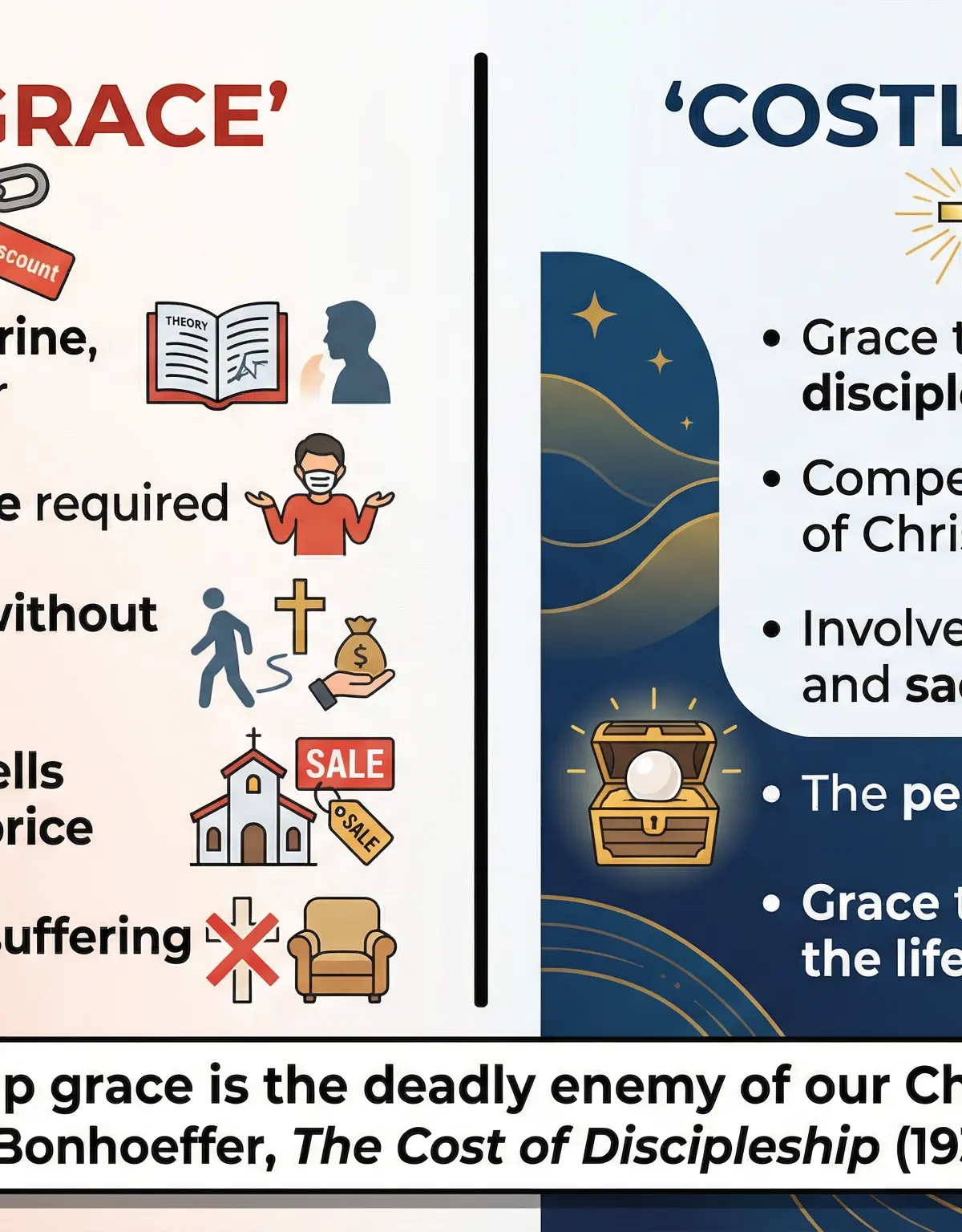
Dietrich Bonhoeffer (1906–1945)
Role: Lutheran pastor, systematic theologian, and resistance fighter.
Key Actions: Critiqued the Führer principle (1933); co-founded the Confessing Church (1934); led Finkenwalde Seminary (1935–37); wrote The Cost of Discipleship (1937) and Life Together (1939); joined the Abwehr resistance network (1940); wrote Letters and Papers from Prison (1943–45); executed at Flossenbürg (1945).
Impact: Bonhoeffer's life and thought provide the WJEC specification with its central case study in the relationship between theology and political action. His martyrdom gives his theological claims a weight that purely academic theology lacks.
Karl Barth (1886–1968)
Role: Swiss Reformed theologian; primary drafter of the Barmen Declaration.
Key Actions: Drafted the six theses of the Barmen Declaration; developed 'dialectical theology' (Nein! to natural theology); influenced Bonhoeffer's Christocentric approach.
Impact: Barth's influence on Bonhoeffer is significant for AO2 evaluation. Both rejected natural theology and insisted on the primacy of Christ. However, Bonhoeffer later critiqued Barth for remaining within a 'positivism of revelation' — still speaking in 'religious' terms that the secular world could not hear.
Adolf Hitler and the Nazi State
Role: Chancellor of Germany from 30 January 1933; the political context against which Bonhoeffer's entire theology was forged.
Key Actions: Introduced the Aryan Clause; supported the 'German Christian' movement; enabled the Gestapo's suppression of the Confessing Church.
Impact: Hitler functions in Bonhoeffer's theology not merely as a historical villain but as the embodiment of the 'Führer principle' — the idolatrous elevation of human leadership to divine authority. Bonhoeffer's distinction between 'leadership' (Führung) and 'office' (Amt) is directly aimed at this.
Second-Order Concepts
Causation
Bonhoeffer's theological development was caused by a convergence of intellectual and political forces. His early academic formation at Berlin University (under Adolf von Harnack) gave him a rigorous liberal Protestant foundation, while his year at Union Theological Seminary in New York (1930–31) exposed him to the African American church tradition and the Social Gospel, radicalising his understanding of Christian community and justice. The immediate cause of his turn to resistance theology was the Nazi seizure of power in 1933 and the Church's capitulation to it. The long-term cause was his conviction, developed through engagement with Barth and Luther, that grace without discipleship was a theological and moral catastrophe.
Consequence
Bonhoeffer's immediate consequence was the formation of the Confessing Church and the Finkenwalde community — a visible, counter-cultural Christian witness. In the longer term, his Letters and Papers from Prison became one of the most influential theological texts of the 20th century, shaping the Death of God theology of the 1960s, Liberation Theology in Latin America, and contemporary debates about the public role of religion. His execution made him a martyr whose image now stands alongside Martin Luther King Jr. and others in Westminster Abbey's modern martyrs' gallery.
Change and Continuity
A key theme for AO2 is the question of whether Bonhoeffer's thought represents a coherent development or a series of ruptures. His commitment to Christocentrism — the idea that all theology must begin and end with Jesus Christ — remains constant from his early academic work to his prison letters. What changes is his ecclesiology (his understanding of the Church) and his ethics, moving from a relatively conventional Lutheran framework to a radical situational ethics that could justify participation in assassination.
Significance
Bonhoeffer is historically significant as one of the few major theologians to have died as a direct consequence of his theological convictions. His significance for the WJEC specification lies in his ability to connect abstract theological concepts (grace, discipleship, secularisation) to concrete historical and ethical choices. He is also significant as a critic of the institutional Church from within — his challenge to 'cheap grace' remains a live debate in contemporary Christianity.
Source Skills
For this topic, candidates may encounter sources drawn from Bonhoeffer's own writings (The Cost of Discipleship, Letters and Papers from Prison, Life Together), from the Barmen Declaration itself, or from secondary historical and theological commentary. When evaluating such sources, candidates should consider: the context of composition (was Bonhoeffer writing for publication, for a seminary community, or from a prison cell?); the audience (fellow pastors, a close friend, or a general readership?); and the purpose (to instruct, to resist, to explore?). The prison letters, for example, are explicitly provisional and exploratory — Bonhoeffer himself acknowledged they were unfinished thoughts. Candidates who treat them as a fully systematic theology will misrepresent their character.

Visual Resources
2 diagrams and illustrations
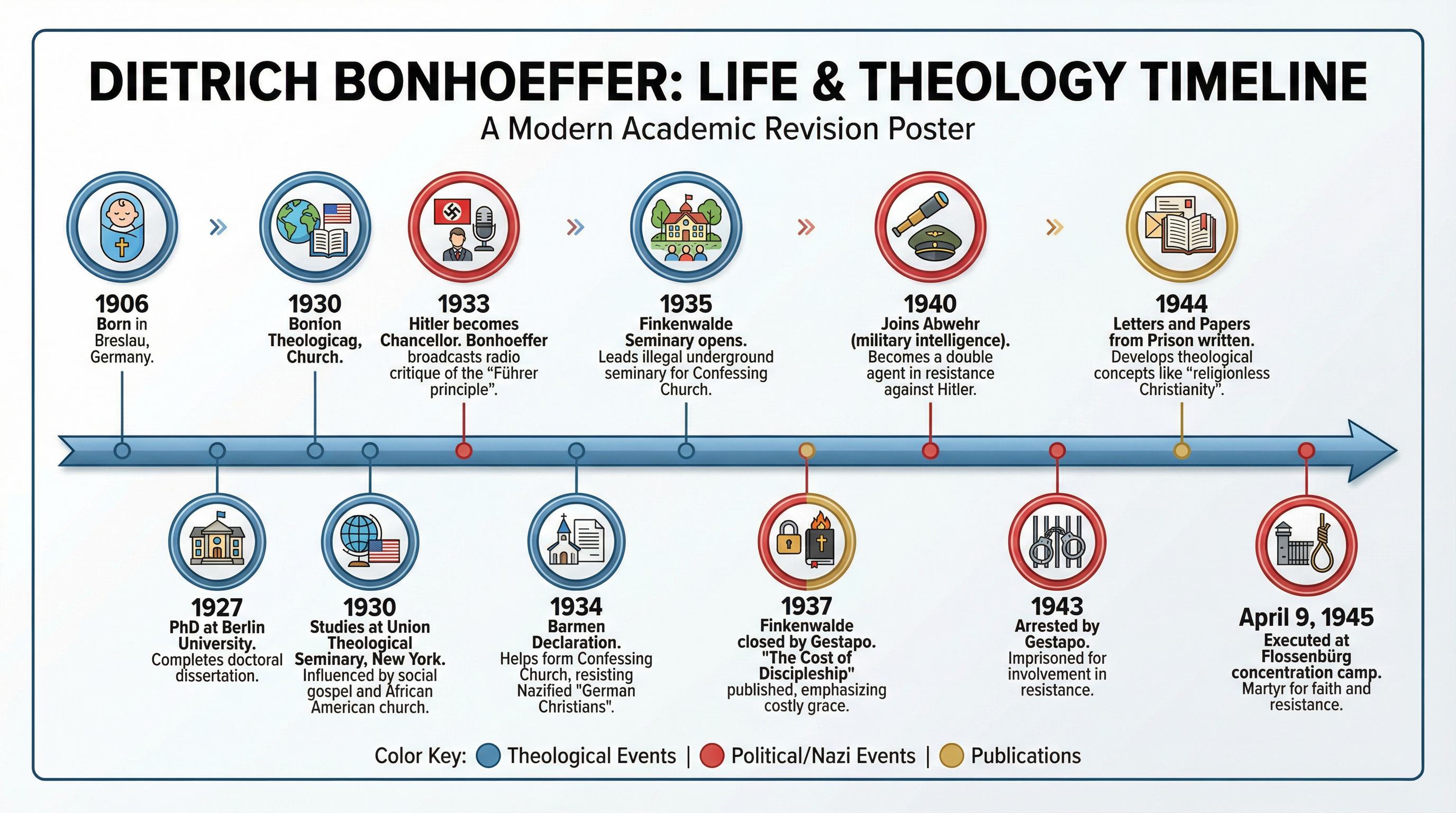
Interactive Diagrams
3 interactive diagrams to visualise key concepts
Diagram could not be rendered
Timeline of Dietrich Bonhoeffer's life and key theological events
Conceptual Flow Outline
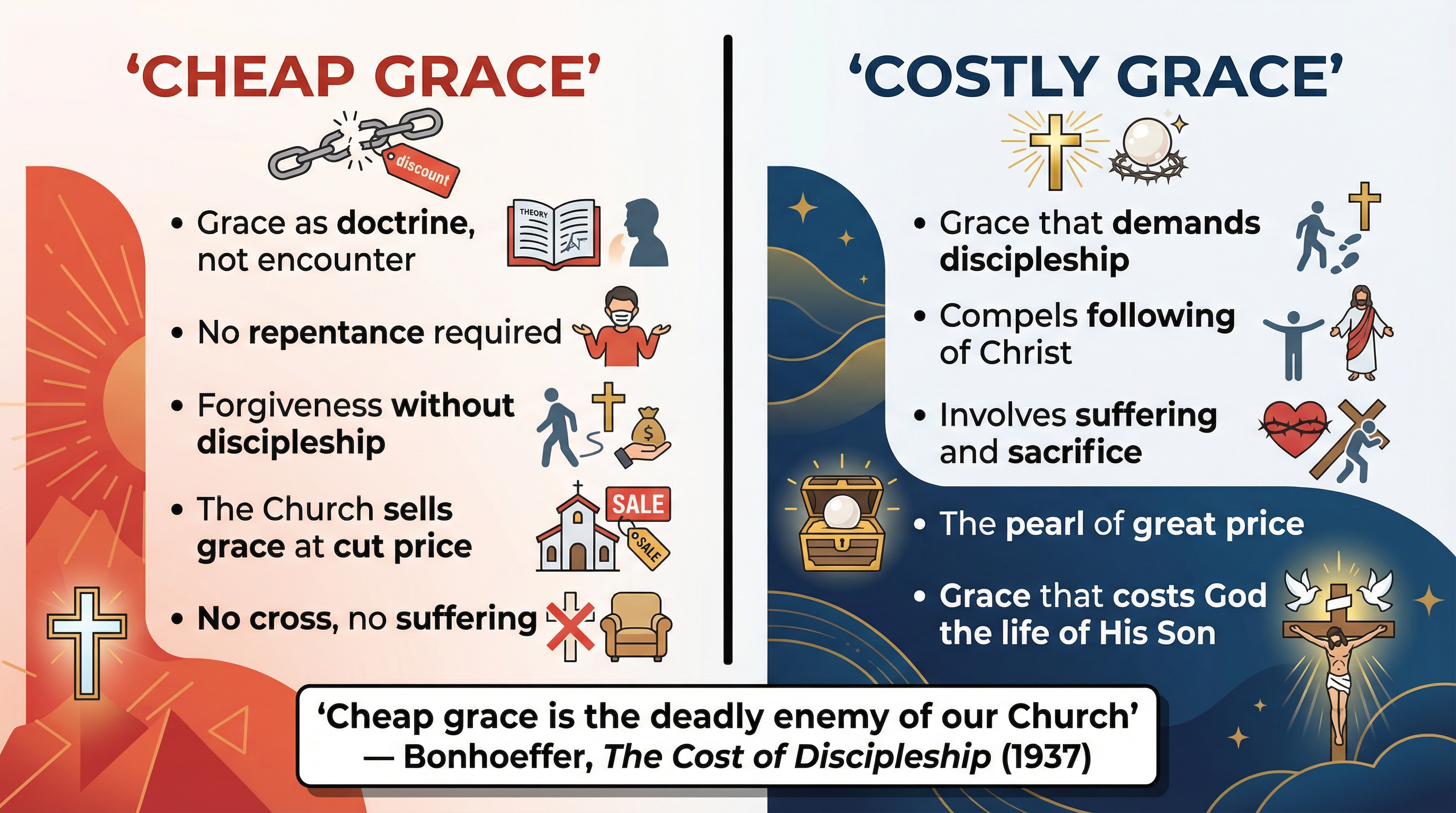
Conceptual map of Cheap Grace vs Costly Grace and their ecclesiological consequences
Conceptual Flow Outline
Bonhoeffer's theological response to the World Come of Age
Worked Examples
3 worked examples — open one to explore the question and available guidance.
Practice Questions
Test your understanding — click to reveal model answers
Explain the concept of 'Cheap Grace' as used by Bonhoeffer. (AO1, 20 marks)
Hint: Define the term precisely using *The Cost of Discipleship*, explain what is absent from cheap grace (discipleship, repentance, transformation), and contextualise it within Bonhoeffer's critique of the German Church.
'Bonhoeffer's decision to join the assassination plot against Hitler was a betrayal of his Christian principles.' Evaluate this claim. (AO2, 30 marks)
Hint: Consider his early pacifism (Sermon on the Mount), his theology of costly grace and responsibility, the concept of 'taking guilt upon oneself', and contrast with absolute pacifist positions. Reach a nuanced, evidenced judgement.
Explain the significance of the Finkenwalde Seminary for Bonhoeffer's theology. (AO1, 20 marks)
Hint: Analyse Finkenwalde as a theological experiment in 'Life Together' and costly grace, not merely as a school. Reference *Life Together* (1939) and connect the community's practices to Bonhoeffer's ecclesiology.
'The concept of the World Come of Age makes Bonhoeffer's theology ultimately secular.' Evaluate this claim. (AO2, 30 marks)
Hint: Define 'World Come of Age' precisely; distinguish between Bonhoeffer's diagnosis (secular world) and his prescription (Religionless Christianity, not atheism); engage with critics who see his theology as secular humanism; defend the Christological core of his position.
Explain Bonhoeffer's understanding of the role of the Church in a secular world. (AO1, 20 marks)
Hint: Draw on both his early ecclesiology (Confessing Church, Finkenwalde) and his later prison theology (Religionless Christianity, Church for others). Show how his understanding developed but remained consistent in its Christological foundation.