WJEC · GCSE · Religious Studies
Religious practices of Judaism
This guide provides a comprehensive, exam-focused overview of Jewish religious practices for WJEC GCSE Religious Studies. It delves into the significance of the synagogue, Shabbat, and key festivals, equipping candidates with the precise knowledge and terminology needed to achieve top marks."
- 9 min read
- 3 worked examples
- 5 practice questions
Study Notes
Overview
This study guide explores the rich tapestry of Jewish religious practices, a core component of the WJEC GCSE Religious Studies specification. For candidates to secure high marks, a sophisticated understanding of Jewish praxis is essential, moving beyond simple descriptions to a nuanced analysis of the interplay between ritual, community, and divine commandment. This guide will focus on the synagogue as the hub of community life, the detailed observances of Shabbat and major festivals, and the practical application of Kashrut laws. A crucial skill, which examiners reward highly, is the ability to link these practices directly to Sources of Wisdom and Authority, particularly the Torah and Talmud. We will also consistently differentiate between Orthodox and Reform traditions, a distinction vital for top-level responses. This guide is structured to provide you not just with the knowledge, but with the exam technique required to turn that knowledge into marks.
The Synagogue: Heart of the Community
The synagogue (from the Greek for 'assembly') is the central institution in Jewish life. In Hebrew, it is called the Beit Knesset (House of Assembly), the Beit T’filah (House of Prayer), and the Beit Midrash (House of Study), reflecting its multifaceted role. It is the focal point for prayer, learning, and social gathering.
Key Features of the Synagogue
Examiners expect candidates to identify and explain the significance of key features, using correct Hebrew terminology. Credit is explicitly given for this.
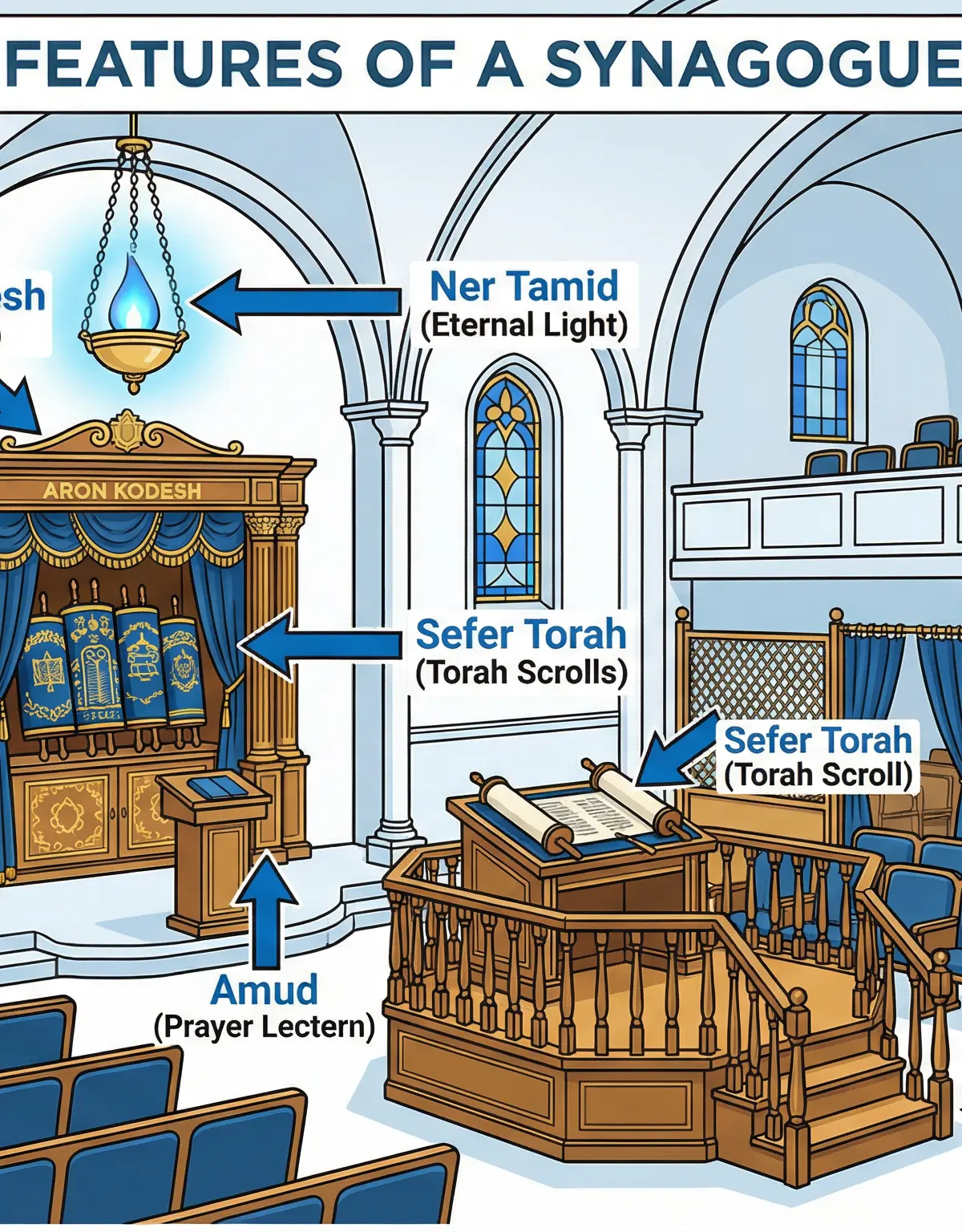
- Aron Kodesh (Holy Ark): This is the most important feature, an ornamental cabinet at the front of the synagogue, usually facing Jerusalem. It houses the Sefer Torah (Torah scrolls), the most sacred object in Judaism. The congregation stands whenever the Ark is opened as a mark of profound respect.
- Ner Tamid (Eternal Light): A light that is perpetually burning before the Aron Kodesh. It symbolises God's eternal and constant presence and recalls the menorah that was kept alight in the Temple in Jerusalem.
- Bimah (Reading Platform): A raised platform from which the Torah is read. In Orthodox synagogues, it is often in the centre, ensuring the whole congregation can hear the reading. In Reform synagogues, it is usually at the front with the Aron Kodesh.
- Mechitza (Partition): Found only in Orthodox synagogues, this is a screen or curtain that separates men and women during services. This practice is based on traditional interpretations of Jewish law regarding modesty and distraction during prayer. Reform Judaism, emphasizing gender equality, does not use a mechitza.
Worship in the Synagogue
Jewish prayer services are held daily, but the most important is on Shabbat morning. Services are led by a Rabbi or a cantor (chazzan). The prayers are taken from the Siddur, the Jewish prayer book. The service includes the Shema (a declaration of faith in one God) and the Amidah (the 'standing prayer'), a series of blessings and petitions. A key part of the service is the public reading of a section of the Torah.
Orthodox vs. Reform Worship: This is a critical area of distinction. Orthodox services are conducted almost entirely in Hebrew, with the Rabbi being male. In Reform services, there is a mixture of Hebrew and the vernacular (e.g., English), musical instruments may be used, and women can be ordained as Rabbis and lead prayers. Men and women sit together.
Shabbat: A Taste of the World to Come
Shabbat is the Jewish day of rest, observed from sunset on Friday until three stars appear on Saturday night. It is a cornerstone of Judaism, based directly on two of the Ten Commandments: to remember (zakhor) and to observe (shamor) the Sabbath. It commemorates God's rest on the seventh day of creation.
Shabbat Observance
- Welcoming Shabbat: Shabbat begins with the lighting of two candles by the woman of the household, symbolizing joy and holiness. This is followed by the Kiddush, a blessing recited over wine to sanctify the day.
- The Prohibition of Melachah: This is a key concept often misunderstood by candidates. Shabbat is not just a day off; it involves refraining from 39 specific categories of creative work (melachah), derived from the activities required to build the Tabernacle in the wilderness. This includes actions like writing, cooking, and kindling a fire. Orthodox Jews interpret this strictly, avoiding driving or using electricity. Reform Jews focus more on the spirit of rest and may interpret the rules more liberally.
- Ending Shabbat: Shabbat concludes with the Havdalah ceremony (meaning 'separation'). Blessings are recited over wine, spices (to carry the sweetness of Shabbat into the week), and a multi-wicked candle, marking the division between the holy day and the secular week.
Festivals: The Rhythm of the Jewish Year
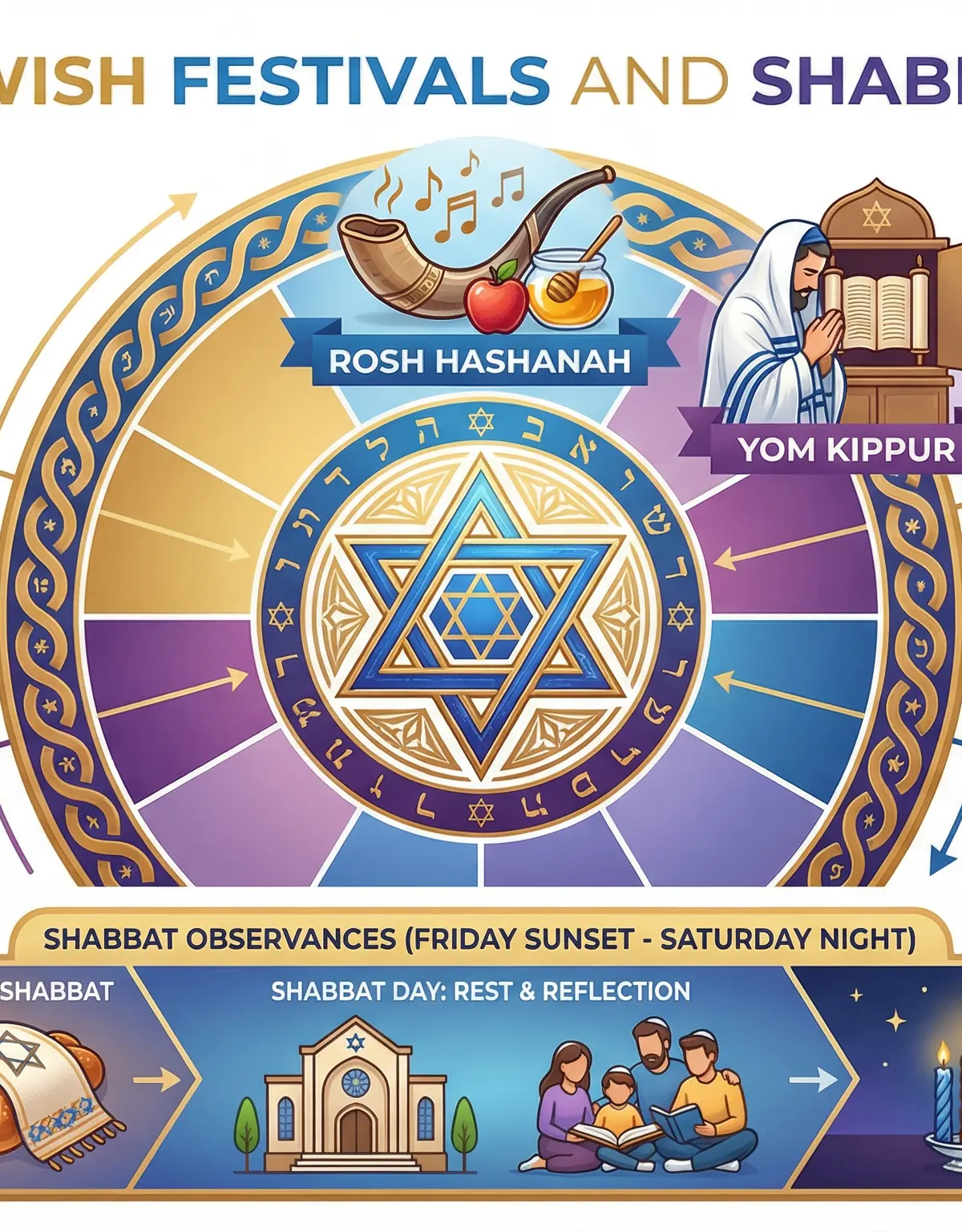
Jewish festivals punctuate the year, each with its unique rituals and theological significance.
- Rosh Hashanah (New Year): This two-day festival marks the start of the Jewish year and begins the Ten Days of Awe, a period of repentance. The central ritual is the sounding of the Shofar (ram's horn), a call to spiritual awakening and repentance. It is considered a day of judgment when God assesses people's deeds.
- Yom Kippur (Day of Atonement): The holiest day of the year. It is a day of solemn fasting for 25 hours, intense prayer, and seeking forgiveness for sins. The focus is on atonement and reconciliation with God.
- Pesach (Passover): A major eight-day festival commemorating the liberation of the Israelites from slavery in Egypt. The highlight is the Seder meal, where the story of the Exodus is retold using the Haggadah. During Pesach, Jews abstain from eating chametz (leavened products) and eat matzah (unleavened bread) instead.
- Sukkot (Tabernacles): A harvest festival where Jews build temporary huts or booths (sukkahs) to live in for a week. This commemorates the 40 years the Israelites spent wandering in the desert, living in temporary shelters.
Life Cycle Events
- Brit Milah (Circumcision): Performed on the eighth day of a Jewish boy's life, this is the ritual circumcision that serves as a physical sign of the covenant God made with Abraham (Genesis 17). It is a fundamental rite of entry into the Jewish community.
- Bar/Bat Mitzvah: A coming-of-age ceremony. At 13, a boy becomes a Bar Mitzvah (Son of the Commandment). In Reform and some Conservative communities, a girl becomes a Bat Mitzvah (Daughter of the Commandment) at 12 or 13. They are now considered responsible for observing the mitzvot. The ceremony usually involves reading from the Torah in the synagogue.
- Marriage: Jewish marriage is sanctified under a chuppah (canopy), symbolizing the home the couple will build together. The ceremony includes the exchange of rings and the signing of the Ketubah (marriage contract). It ends with the groom breaking a glass underfoot, a reminder of the destruction of the Temple in Jerusalem even at a moment of great joy.
Kashrut: The Jewish Dietary Laws
Kashrut refers to the body of Jewish law dealing with what foods can and cannot be eaten and how those foods must be prepared. The word kosher means 'fit' or 'proper'.
- Permitted and Forbidden Foods: The Torah (Leviticus 11) specifies which animals are permitted. Land animals must have a cloven hoof and chew the cud (e.g., cows, sheep). Pork is forbidden. Seafood must have fins and scales (e.g., salmon, tuna). Shellfish like prawns and lobster are forbidden.
- Ritual Slaughter (Shechitah): Permitted animals must be slaughtered in a specific manner by a trained shochet to be kosher. The method is designed to be as swift and painless as possible.
- Separation of Meat and Dairy: A fundamental principle of kashrut is the complete separation of meat and dairy products, based on the Torah's prohibition: "You shall not boil a kid in its mother's milk" (Exodus 23:19). Observant Jews have separate sets of dishes, utensils, and cooking equipment for meat and dairy.
Again, observance varies. Orthodox Jews adhere strictly to all kashrut laws, while many Reform Jews view them as optional, a matter of personal choice.
Second-Order Concepts
Significance
Why do these practices matter? For Jews, they are not merely ancient customs. They are the framework of a life lived in relationship with God. The rituals provide a rhythm to the day (prayer), the week (Shabbat), and the year (festivals). They connect the individual to the community, and the community to its history and its covenant with God. For the WJEC exam, explaining why a practice is significant is the key to unlocking higher marks.
Change & Continuity
While the core principles of Jewish practice are ancient, their application has evolved. The rise of Reform Judaism in the 19th century introduced significant changes, particularly regarding gender roles and the interpretation of Jewish law (Halakha). Yet, the core elements—the Torah, Shabbat, the major festivals—remain constants, providing a thread of continuity through millennia of Jewish history. Candidates should be able to discuss both what has changed and what has endured.
Diversity
It is a common mistake to write about 'Jews' as a monolithic group. The distinction between Orthodox and Reform/Liberal/Progressive Judaism is fundamental. Examiners look for this understanding. Orthodox Judaism views the Torah and Talmudic law as divinely inspired and binding. Reform Judaism sees the Torah as divinely inspired but open to interpretation by each generation. This philosophical difference underpins the variations in practice seen in the synagogue, in the home, and in the application of kashrut.
"
Worked Examples
3 worked examples — open one to explore the question and available guidance.
Practice Questions
Test your understanding — click to reveal model answers
Explain why the Torah is important in Judaism. (8 marks)
Hint: Think about its role as a source of law, history, and its use in worship. Make two separate, developed points.
Describe the rituals of Rosh Hashanah. (5 marks)
Hint: Focus on the key actions and symbolic foods. Aim for three distinct points.
Explain the differences between Orthodox and Reform Jewish attitudes to the mitzvot. (8 marks)
Hint: Contrast the view of Halakha as binding vs. inspirational. Use examples like Shabbat or kashrut.
Describe the Havdalah ceremony. (5 marks)
Hint: Mention the three key symbolic items used and what they represent.
"Observing the dietary laws is the most important part of being a religious Jew." Discuss. (15 marks)
Hint: Evaluate the importance of kashrut against other practices like Shabbat observance, prayer, and ethical behaviour.