Sources of Authority — WJEC GCSE Study Guide
Exam Board: WJEC | Level: GCSE
This study guide explores the crucial concept of 'Sources of Authority' in WJEC GCSE Religious Studies, examining how sacred texts, religious leaders, and conscience guide believers in Christianity and Islam. Understanding this topic is fundamental for tackling ethical and theological questions across the exam.
## Overview
This unit delves into the foundational sources of wisdom and authority for Christians and Muslims, a cornerstone of the WJEC GCSE specification. Candidates are expected to analyse the hierarchy and application of these sources, focusing on the dynamic relationship between sacred texts (the Bible and Qur'an), the authority of religious leaders (like the Magisterium or scholarly consensus), and the role of individual conscience and reason in ethical decision-making. Examiners will award marks for specific knowledge of texts like the Decalogue and the Sermon on the Mount, and for understanding divergent interpretations, such as the Catholic reliance on Tradition versus the Protestant principle of Sola Scriptura. A high-level response requires evaluating how these ancient sources are applied to contemporary moral issues, from personal ethics to debates on secular law.

## Key Concepts & Developments
### The Decalogue (The Ten Commandments)
**Source**: Exodus 20 (Old Testament)
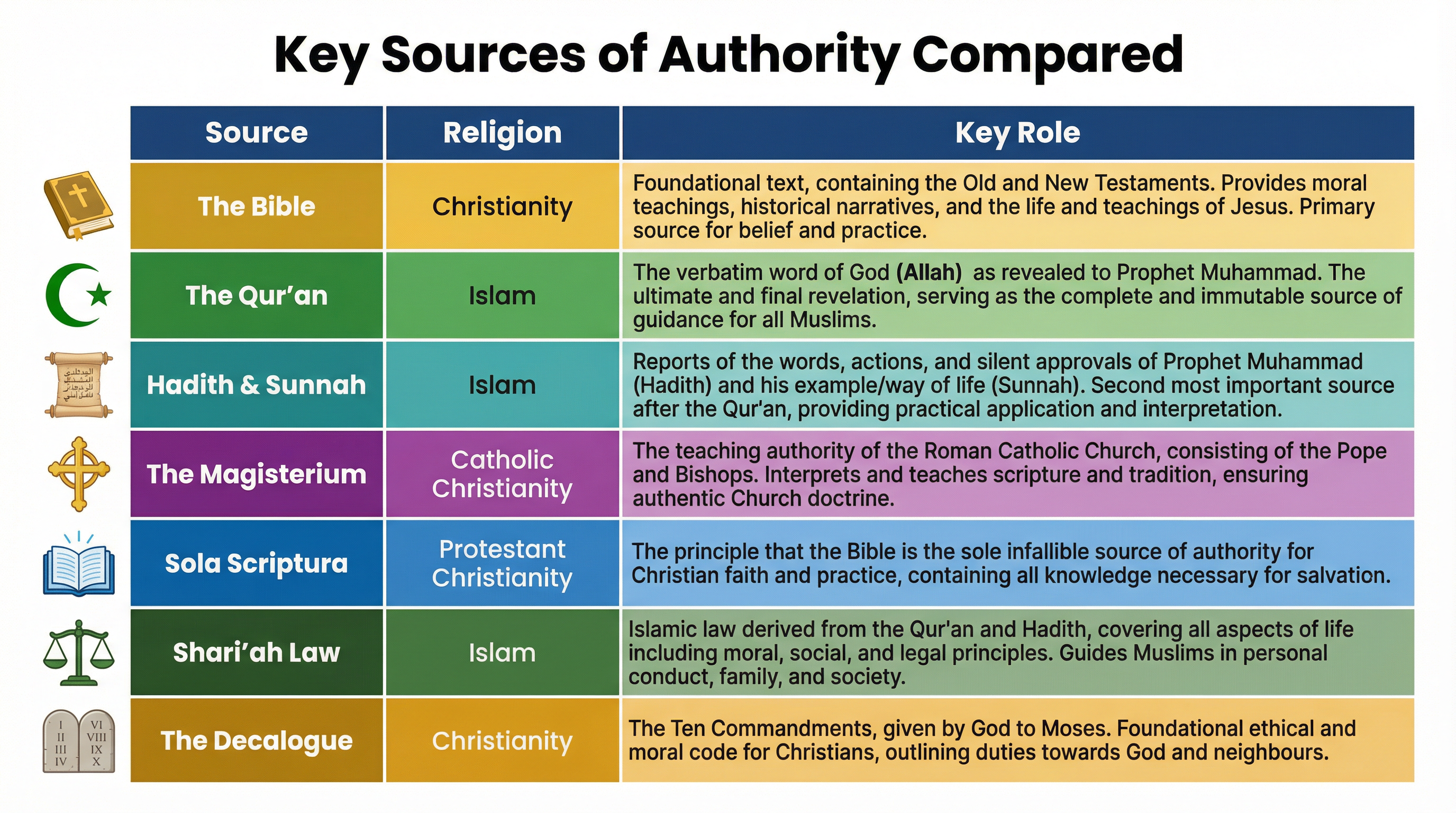
**What it is**: A set of divine laws given by God to Moses on Mount Sinai. They form the bedrock of Judeo-Christian morality.
**Why it matters**: The Decalogue provides absolute moral commands that influence both personal ethics and modern legal systems. Candidates must be able to cite specific commandments (e.g., "You shall not murder") and explain their impact. Marks are awarded for linking these biblical laws to contemporary societal values.
**Specific Knowledge**: The first four commandments relate to duties to God; the remaining six relate to duties to one's neighbour.
### The Sermon on the Mount
**Source**: Matthew 5-7 (New Testament)
**What it is**: Jesus' most extensive teaching, which includes the Beatitudes (e.g., "Blessed are the peacemakers"). It presents an ethic focused on inner character and righteousness, not just outward actions.
**Why it matters**: It represents a radical internalisation of the law, moving from 'do not murder' to 'do not be angry'. For examiners, this shows a deeper understanding of Christian ethics beyond simple rule-following. It is a key text for understanding Jesus' moral authority.
**Specific Knowledge**: The Beatitudes, the Lord's Prayer, teachings on anger, lust, divorce, and loving one's enemies.
### The Magisterium
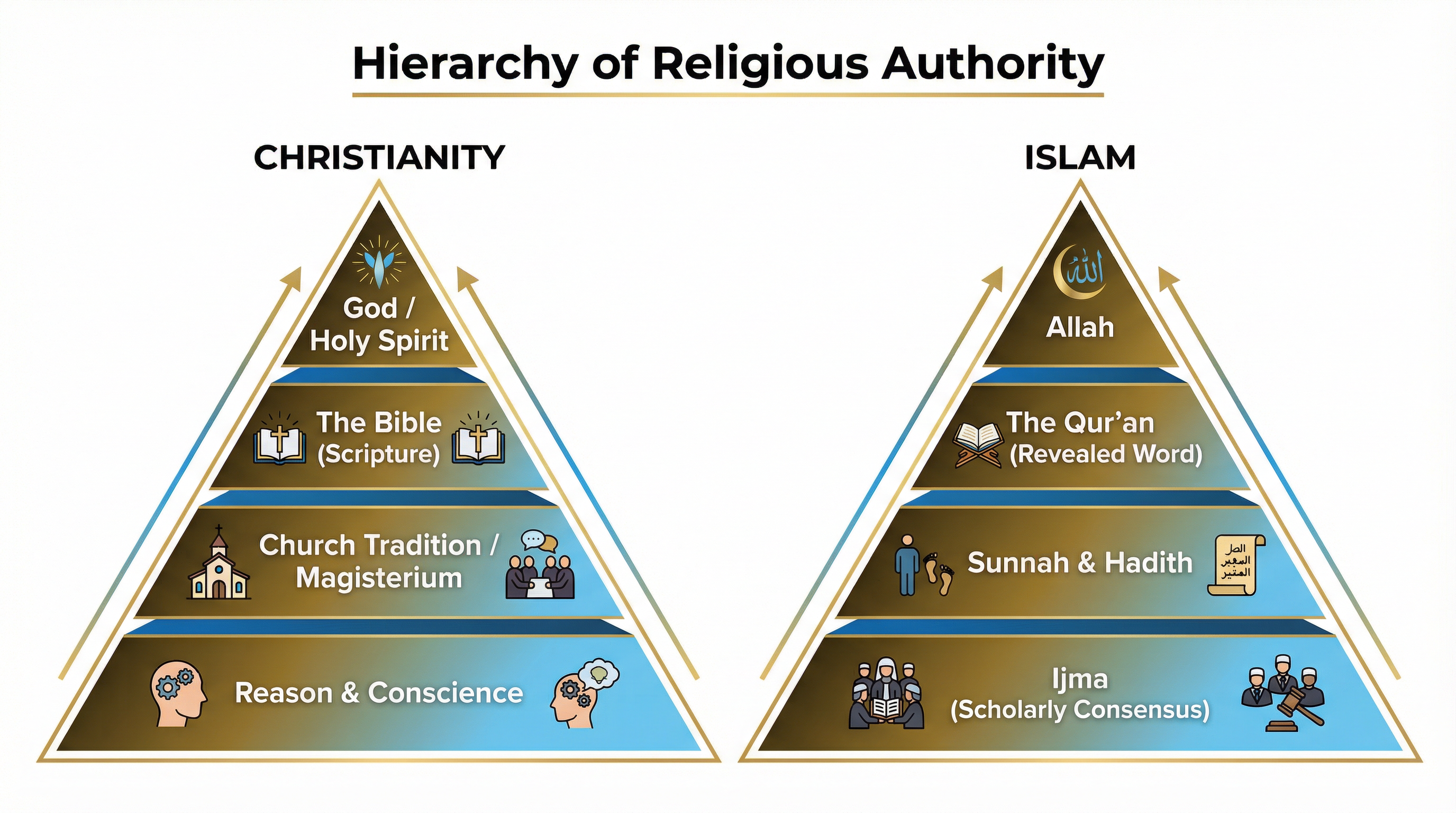
**What it is**: The official teaching authority of the Roman Catholic Church, comprising the Pope and the bishops in communion with him.
**Why it matters**: For Catholics, the Magisterium provides an infallible guarantee of truth when interpreting Scripture and Tradition. This is a key point of difference with Protestantism. Candidates must be able to explain this unique source of authority and contrast it with other Christian denominations.
**Specific Knowledge**: Papal Infallibility (defined at the First Vatican Council, 1870), Encyclicals (letters from the Pope), Catechism of the Catholic Church.
### Sola Scriptura
**What it is**: A Latin phrase meaning "Scripture Alone". It is a core principle of the Protestant Reformation.
**Why it matters**: It asserts that the Bible is the sole infallible source of authority for Christian faith and practice. This principle underpins the rejection of the Pope's authority and the emphasis on individual Bible reading in Protestant traditions. It is a crucial concept for explaining denominational differences.
**Specific Knowledge**: Key figures of the Reformation like Martin Luther and John Calvin. The translation of the Bible into vernacular languages.
### Shari'ah Law
**Source**: Derived from the Qur'an and the Sunnah (the Prophet Muhammad's example).
**What it is**: The comprehensive legal and ethical framework of Islam, guiding all aspects of a Muslim's life.
**Why it matters**: Shari'ah demonstrates how divine revelation is translated into a practical, lived reality for a community. Candidates must understand that it is not a single book but a complex system of jurisprudence (fiqh) derived by scholars. It covers worship, family life, finance, and justice.
**Specific Knowledge**: The four main sources of Islamic law: Qur'an, Sunnah, Ijma (scholarly consensus), and Qiyas (analogical reasoning).
## Source Skills
When presented with a source in the exam (e.g., a Bible passage or a quote from the Pope), candidates must analyse its authority. Use the following framework:
1. **Identify**: What is the source? (e.g., The Bible, specifically St. Paul's letter to the Romans).
2. **Explain**: Why is this source authoritative for believers? (e.g., Christians believe the Bible is the inspired Word of God).
3. **Apply**: How does this source guide belief or action regarding the issue in the question? (e.g., This passage commands believers to obey governing authorities, influencing Christian views on law and order).
4. **Evaluate**: How does its authority compare to other sources? (e.g., A Protestant might see this as the final word, while a Catholic would consider how the Magisterium interprets it).