Corporate objectives — Edexcel A-Level Business
Verified courseTeaching note checked against the official specification.
Corporate objectives explained
Corporate objectives covers 2 specification points, including A) Development of corporate objectives from… and B) Critical appraisal of mission….
Read the full explanation
Open a point below for its explanation and revision guidance.
a) Development of corporate objectives from mission statement/corporate aims
A mission says why the organisation exists and what it stands for, the aims turn that into broad long term goals, and the targets beneath them are specific, measurable and time bound, such as a stated rise in market share, a target return on capital employed or a carbon cut by a named year. Those targets are cascaded into marketing, operations, finance and human resource goals so every function pulls the same way. The chain earns its keep through coordination, through motivating managers with something concrete, and through control, because a target doubles as the benchmark a board reviews against. The weakness is drift, since a mission written for the website can be too vague to test, targets can conflict when growth eats margin, and a rigid plan can trap a firm while its market moves underneath it.
b) Critical appraisal of mission statements/corporate aims
A mission is a short qualitative sentence about why the business exists, and aims are the broad long term goals that follow from it, so appraising one means asking whether it changes any actual decision. The tests worth applying are whether it is specific enough to rule an option out, whether staff and customers believe it, and whether observed behaviour matches the words. Tesla saying it exists to accelerate the transition to sustainable energy filters investment choices; a bank promising to put customers first while selling unsuitable products invites the charge of window dressing. The payoff is motivation, a marketing point of difference and shared direction; the cost is that wording broad enough to include every stakeholder guides nobody, and none of it is measurable until it is converted into SMART objectives and departmental targets.
Watch and listen
Listen: Corporate objectives audio lesson
Read the full guide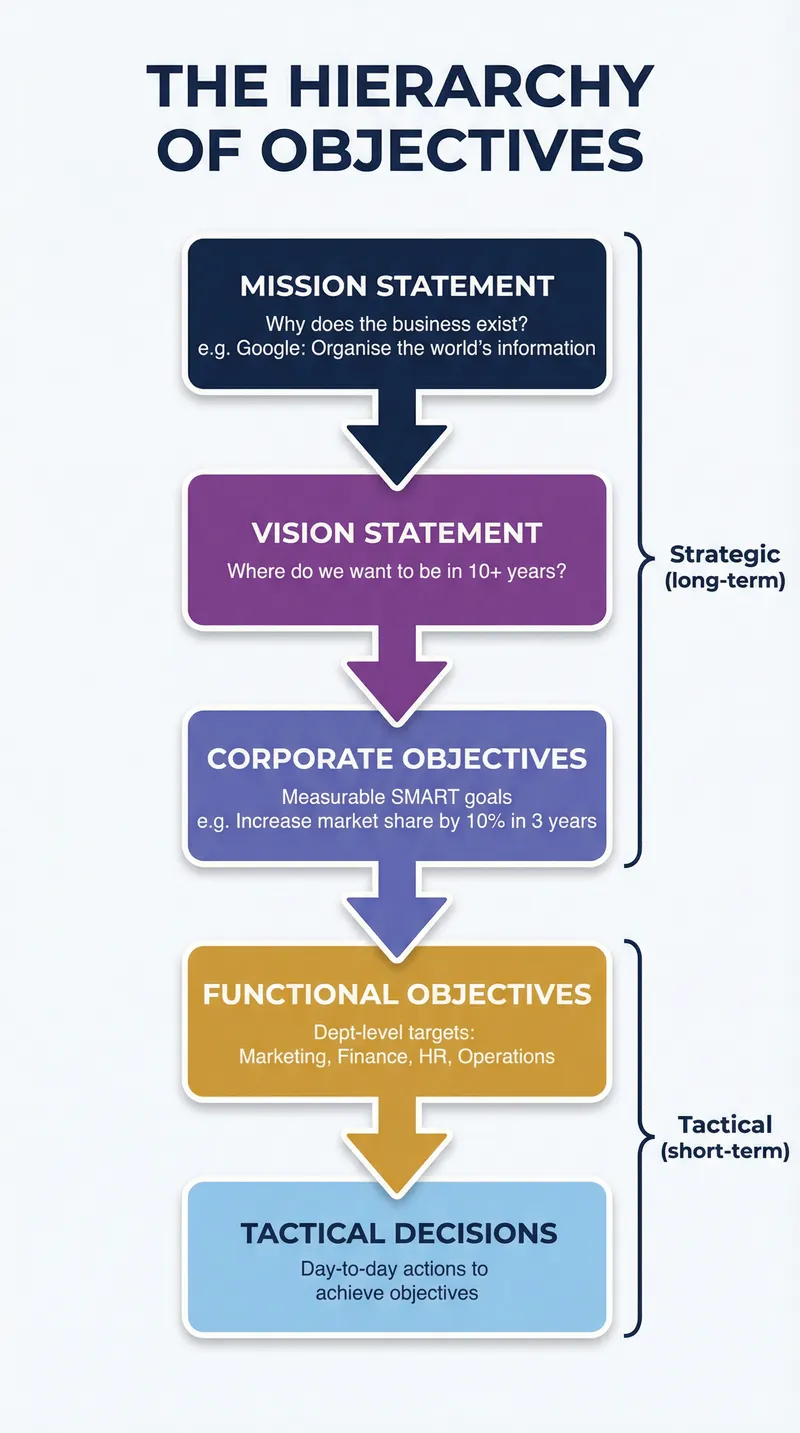
Your focus
- a) Development of corporate objectives from mission statement/corporate aims
- b) Critical appraisal of mission statements/corporate aims
Corporate objectives exam tips
Marking Points
- Set the hierarchy out in order and show the link between the levels rather than simply listing them.
- Make any target you apply measurable and time bound, for example a named percentage of market share by a stated year.
- Explain the purpose in a decision, such as coordinating functions, motivating managers or giving the board a benchmark for control.
- Evaluate by testing whether the targets in the case genuinely follow from the stated mission, because many of them do not.
- Define the mission as a qualitative statement of purpose and aims as broad long term goals in a single clause, then spend the answer on the named business rather than on the definition.
- Judge the wording against evidence in the extract: does the spending, recruitment or product range match the claim, or is the claim contradicted by what the business actually does.
- Explain one concrete benefit and tie it to a stakeholder, such as a clearer decision filter for managers, a stronger employer brand in recruitment, or a reason for customers to pay more.
- Show the limitation and the fix: a mission cannot be measured, so credit comes from explaining how it is turned into SMART objectives and then into targets a department can be held to.
- Reach a supported judgement with a stated criterion, for example that the mission earns its keep only if staff can recall it and point to a decision it changed.
Examiner Tips
- 💡Questions often ask whether a stated objective is appropriate, so test it against the mission, the resources available and the market conditions in the extract.
- 💡Use the idea that targets change with circumstances, since a business in survival mode drops growth targets, and build the judgement on that.
- 💡This is usually an assess or evaluate question of ten to twelve marks with the mission quoted in the extract, so lift a phrase from it and test that phrase against the data given.
- 💡A two sided shape scores best: one developed chain for why the statement helps this business, one for why it may be empty words, then a judgement with a criterion.
- 💡Carry the mission forward into later parts of the paper, because examiners reward candidates who show it filtering an Ansoff growth choice or an ethical decision.
Common Mistakes
- Using aim and objective as the same word, when the objective is the quantified, time bound version of the aim.
- Writing targets that cannot be measured, such as being the best, which cannot be reviewed or used for control.
- Ignoring conflict, for example rapid growth against short term profit, or ethical sourcing costs against a price promise.
- Confusing the mission with an objective and writing a measurable sales target as though it were the statement of purpose.
- Listing generic advantages of having a mission statement without one quotation or figure from the case, which caps the answer at knowledge marks.
- Treating the mission as automatically honest, so the answer never tests it for greenwashing, mission drift, or the gap between words and behaviour.