Number - Fractions, decimals and percentages — Edexcel GCSE Mathematics
Teaching note checked against the official specification.
Fractions, decimals and percentages are three interchangeable ways of expressing the same proportional value. For Pearson Edexcel GCSE Mathematics, you must convert fluently between all three, compare and order them, and apply them to calculations including percentage change, reverse percentages, and compound interest.
Test yourself on Number - Fractions, decimals and percentages with PEARSON EDEXCEL GCSE practice questions.
A week of Premium from your first lesson · Then the free plan continues · No card, no charge
Number - Fractions, decimals and percentages explained
Number - Fractions, decimals and percentages covers 4 specification points, including Converting fractions and decimals and Converting recurring decimals to fractions.
Read the full explanation
Open a point below for its explanation and revision guidance.
work interchangeably with terminating decimals and their corresponding fractions (such as 3.5 and 7/2 or 0.375 or 3/8) (Foundation tier)
This skill is required for the Foundation tier. A terminating decimal has a finite number of digits. To convert it to a fraction, use the place value of the final digit for the denominator. For example, 0.375 ends in the thousandths column, so it is written as 375/1000, which simplifies to 3/8 by dividing the numerator and denominator by their highest common factor, 125. To convert a fraction to a decimal, either divide the numerator by the denominator (e.g., 3 ÷ 8) or, if possible, scale the fraction to have a denominator of 10, 100, or 1000 (e.g., 7/2 = 35/10 = 3.5). A fraction in its simplest form will only terminate if its denominator's prime factors are just 2s and 5s. Exam questions often require ordering a mix of decimals and fractions.
work interchangeably with terminating decimals and their corresponding fractions (such as 3.5 and 7/2 or 0.375 or 3/8); change recurring decimals into their corresponding fractions and vice versa (Higher tier)
This is Higher tier only. On top of the terminating conversions, you have to turn a repeating decimal into an exact fraction and back again. The algebraic method removes the repeat by subtraction. Let x = 0.454545..., where a block of two digits repeats forever. Multiply by a hundred so the repeating tails line up: 100x = 45.454545... Subtract the first line from the second and every repeating digit cancels, leaving 99x = 45, so x = 45/99, which cancels to 5/11. Multiply by ten when a single digit repeats and by a hundred when two do, and if the repeat starts late, multiply twice and subtract those two results. In the other direction, short division produces the decimal, and the repeating block appears as soon as a remainder comes round again, so 3/11 gives 0.272727... repeating in pairs.
identify and work with fractions in ratio problems
A ratio splits an amount into parts, and a fraction of the whole is the number of parts you want out of the total number of parts. If red counters to blue counters are in the ratio 3:5, there are eight parts altogether, so red is 3/8 of the counters and blue is 5/8. With forty counters, red is 3/8 of forty, which is fifteen. The same ratio also says red is 3/5 of the number of blue, which is a fraction comparing one share with another rather than with the whole. It runs backwards too: if 2/7 of a group are left handed, the other five of the seven parts are right handed, so left handed to right handed is 2:5. Questions often hide the total and give you one share or the difference between shares, so find the value of one part first and build everything else from it.
interpret fractions and percentages as operators
Used as an operator, a fraction or a percentage acts on a number, and the word 'of' means multiply. So 3/4 of 20 is 3/4 × 20, which is 15, and 35% of 80 is 0.35 × 80, which is 28. Wherever you can, work with one multiplier instead of two steps: 15% more than an amount is that amount × 1.15, and 15% less is the amount × 0.85, because a fall of 15% keeps 85% of the value. Multiplying a positive number by a multiplier between 0 and 1 makes it smaller, and a multiplier greater than 1 makes it larger. The idea reverses as well, so if a price after a 20% rise is £54, the original is 54 ÷ 1.2, which is £45. Expect questions that chain two operators, a rise then a fall, where you multiply the multipliers together rather than adding the percentages.
Watch and listen
Listen: Number - Fractions, decimals and percentages audio lesson
Read the full guide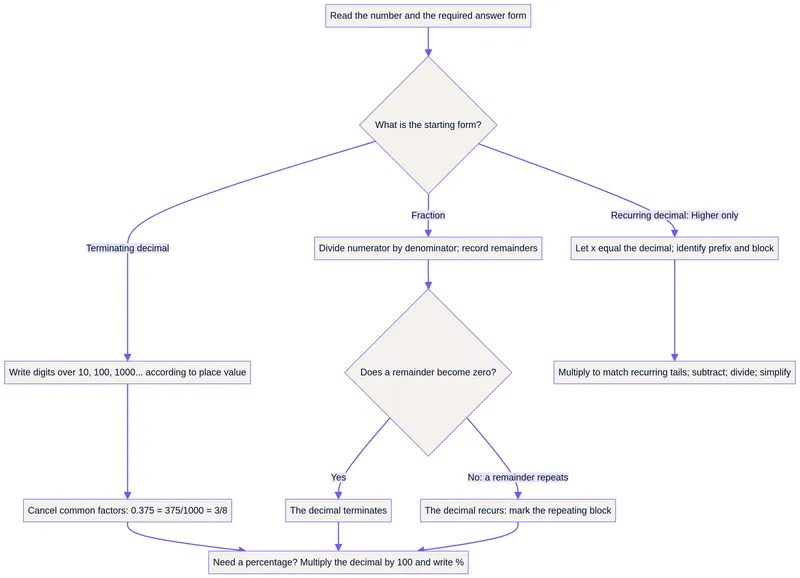
Your focus
- Explain why 3/8 terminates and 1/3 does not, by considering the prime factors of the denominator when the fraction is in its simplest form.
- Work out 0.375 as a fraction by writing it over the correct power of ten as 375/1000 and cancelling to 3/8.
- Use whichever route is quicker, short division or scaling the denominator to a power of ten, to convert a fraction to a decimal.
Show all 13 objectives
- Write down the power of ten to multiply by for a recurring block, ten for one repeating digit and a hundred for two.
- Show that 0.454545... equals 5/11 by forming 100x, subtracting x to reach 99x = 45, and cancelling the fraction.
- Prove that a recurring decimal equals a given fraction, closing with a line tying the cancelled fraction back to the decimal.
- Explain why a ratio of 3:5 makes red 3/8 of the whole but 3/5 of the blue, separating part to whole from part to part.
- Work out each share when only one share or the difference is given, by finding the value of one part first.
- Show that shares found from a ratio are right by checking that they add back to the total the question gives.
- Explain why 'of' means multiply and why a fall of 15% keeps 85% of the value, giving a multiplier of 0.85.
- Calculate 35% of 80 as 0.35 × 80 = 28, and a rise of 15% as a single multiplication by 1.15.
- Work out the original amount before a 20% rise by dividing £54 by 1.2, rather than taking 20% off the new price.
- Work out a rise followed by a fall by multiplying the two multipliers together instead of adding the percentages.
Number - Fractions, decimals and percentages flashcards
Card 1 of 12
Ratio to fraction
Which command word is this?
In Edexcel GCSE Mathematics, 'Write' requires a direct answer, often in a specified form. For example, 'Write 0.6 as a fraction' expects 3/5 without further explanation, but showing working is still advisable.
Number - Fractions, decimals and percentages exam tips
Topic Overview
This topic covers the relationships between fractions, decimals and percentages, and how to convert between them fluently. You will learn to compare and order these forms, and apply them to real-world problems such as percentage increase, decrease, reverse percentages, and compound interest. Mastery of these skills is essential for many other areas of GCSE Mathematics, including ratio, proportion, and algebra.
In Pearson Edexcel GCSE exams, this topic appears across both calculator and non-calculator papers, often in problem-solving contexts. You need to be confident with mental and written methods, and know when to use a multiplier for efficiency. Understanding these concepts also supports financial literacy and data interpretation in everyday life.
Key Concepts
- →Converting between fractions, decimals and percentages: divide numerator by denominator for decimal; multiply decimal by 100 for percentage.
- →Using multipliers for percentage change: increase = 1 + rate, decrease = 1 - rate.
- →Reverse percentages: to find the original amount, divide by the multiplier.
- →Compound interest: use the formula Final = Initial x (multiplier)^n, where n is the number of time periods.
- →Comparing and ordering fractions, decimals and percentages by converting them to the same form.
Marking Points
- Writing the decimal over the correct power of ten, such as 375/1000 for 0.375, even if the cancelling is then incorrect.
- Cancelling by a correct common factor to reach the simplest form.
- Setting out a short division correctly when converting a fraction to a decimal, even if a calculation error is made.
- Writing the final value in the form the question asked for, whether decimal or fraction.
- setting up the equation, writing x as the recurring decimal with enough digits to show the repeat
- multiplying by the correct power of ten so that the recurring tails match, such as reaching 100x for a two digit block
- the subtraction that clears the recurring part, giving a whole number on the right
- the fraction cancelled to its simplest form, and for a proof question a closing statement tying it back to the decimal you started with
- finding the total number of parts, such as eight parts from the ratio 3:5
- the correct fraction of the whole written down before any arithmetic
- the value of one part when the question supplies a single share or a difference, even if the final answer is wrong
- the final quantities, with the check that they add back to the total given
- turning the percentage into a decimal multiplier, such as 1.15 for a rise of 15%
- a correct method seen, such as finding 10% and 5% and adding them, even if the arithmetic slips
- dividing rather than multiplying when the question gives the value after the change and asks for the original
- the final value written with its units or its pound sign, rounded as the question directs
Examiner Tips
- 💡Learn common conversions by heart, such as 1/8 = 0.125, 1/4 = 0.25, and 3/4 = 0.75, to save time in non-calculator questions.
- 💡Check a conversion by multiplying back: if you found 3/8 = 0.375, check that 0.375 × 8 = 3.
- 💡When ordering a list of mixed decimals and fractions, it is usually easiest to convert everything to decimals first, order them, then write the answer using the original numbers.
- 💡Write both lines one under the other with the decimal points aligned, so the subtraction is obviously exact.
- 💡Test your fraction on the calculator when the paper allows one; it should reproduce the recurring digits.
- 💡If the question says show that, finish with a line naming the fraction you were asked to reach rather than stopping at the algebra.
- 💡Sketch a bar split into the parts and label one part; most ratio questions then read straight off the bar.
- 💡Add your final shares together and compare with the total in the question as a check before moving on.
- 💡Decide first whether the fraction asked for is part to whole or part to part, because the two answers differ.
- 💡Write the multiplier down before you touch the calculator; most method marks here are for the multiplier.
- 💡Ask whether the answer should be bigger or smaller than the starting number, and check your result against that.
- 💡For money, give two decimal places, so an answer of 45.5 is written as £45.50.
- 💡Always show your working clearly, especially when using multipliers, as method marks are often available even if the final answer is wrong.
- 💡For non-calculator papers, simplify fractions fully and show conversions step by step to secure all marks.
- 💡Read the question carefully to identify whether it asks for a percentage increase, decrease, or reverse percentage, and check if the answer requires a monetary unit or percentage sign.
Common Mistakes
- Writing 0.375 as 375/100 instead of 375/1000. Correction: Count the decimal places carefully; three places means the denominator is 1000.
- Stopping at 375/1000 when the question asks for the simplest form. Correction: Always check if the numerator and denominator share common factors.
- Reading 3.5 as 3/5 rather than as three and a half (7/2). Correction: The number before the decimal point is a whole number.
- Dividing the denominator by the numerator, so turning 3/8 into 8 ÷ 3 = 2.666... instead of 3 ÷ 8 = 0.375. Correction: The fraction bar means divide the top by the bottom.
- multiplying by ten when the repeating block has two digits, so the tails do not line up and nothing cancels
- writing only the digits shown on the page rather than continuing the decimal, which hides the fact that the tails are identical
- leaving the answer as 45/99 when the question asks for the simplest form
- treating a decimal such as 0.375 as recurring and starting the algebra on it when short cancelling would finish the job
- reading the ratio 3:5 as the fraction 3/5 of the whole instead of 3/8
- sharing the difference between two shares as if it were the total
- writing the parts in the wrong order when the question names the quantities in a different order from the ratio
- forgetting to simplify a ratio built from fractions with unlike denominators before using it
- taking a 10% rise followed by a 10% fall back to the starting value, when the multipliers give 1.1 × 0.9 = 0.99
- multiplying by 0.15 for a 15% increase instead of by 1.15
- finding the percentage of the wrong amount in a two stage question, using the original where the new value is needed
- multiplying by 1.2 to reverse a 20% rise instead of dividing by it
- Students often think that 0.5% is the same as 50%. Correction: 0.5% = 0.005 as a decimal, while 50% = 0.5.
- When converting a fraction to a decimal, students may incorrectly divide the denominator by the numerator. Correction: always divide numerator by denominator.
- In percentage increase, students may add the percentage as a whole number instead of using a multiplier. Correction: use 1 + rate as a decimal.
Revision Plan
- 1Day 1-2: Revise conversion methods between fractions, decimals and percentages. Practice with a variety of examples, including recurring decimals.
- 2Day 3-4: Learn and apply multipliers for percentage increase and decrease. Solve problems involving simple interest and depreciation.
- 3Day 5-6: Master reverse percentages and compound interest. Work through exam-style questions, checking your steps.
- 4Day 7-8: Practice comparing and ordering fractions, decimals and percentages. Use past paper questions to test your speed and accuracy.
- 5Day 9-10: Complete a full past paper section on this topic under timed conditions. Review mistakes and revisit weak areas.
Exam Question Types
- 📋Conversion questions: e.g., 'Write 0.45 as a fraction in its simplest form.' Advice: simplify fully and show your method.
- 📋Percentage change problems: e.g., 'Increase 240 by 17%.' Advice: use a multiplier and show the calculation.
- 📋Reverse percentage problems: e.g., 'After a 20% discount, a TV costs 320. Find the original price.' Advice: divide by the multiplier (0.8) and explain your reasoning.
- 📋Compound interest problems: e.g., 'Calculate the value of an investment after 3 years with 5% compound interest.' Advice: use the formula and show each year's calculation or the power.
Command Word Expectations (PEARSON EDEXCEL)
In Edexcel GCSE Mathematics, 'Write' requires a direct answer, often in a specified form. For example, 'Write 0.6 as a fraction' expects 3/5 without further explanation, but showing working is still advisable.
'Calculate' means you must work out a numerical answer, showing sufficient working to justify your method. Marks are awarded for correct steps and final answer.
'Show that' requires you to demonstrate a given result through clear, logical steps. You must provide a full method that leads to the stated answer, often with no marks for just the answer.
How Students Lose Marks (Examiner Pitfalls)
Step-by-Step Worked Solutions
Question: Express 0.375 as a fraction in its simplest form and as a percentage.
- 1.Step 1: Write 0.375 as 375/1000.
- 2.Step 2: Simplify by dividing numerator and denominator by 125: 375/1000 = 3/8.
- 3.Step 3: To convert to a percentage, multiply 0.375 by 100: 0.375 x 100 = 37.5%.
Question: A car depreciates by 12% in the first year. If the car was bought for 15,000, what is its value after one year?
- 1.Step 1: Identify the multiplier for a 12% decrease: 1 - 0.12 = 0.88.
- 2.Step 2: Multiply the original value by the multiplier: 15000 x 0.88 = 13200.
- 3.Step 3: State the final value with units: 13,200.