Topic 11 – Static electricity — Edexcel GCSE Physics
Verified courseTeaching note checked against the official specification.
Topic 11 – Static electricity explained
Insulators such as polythene, perspex or a dry cloth hold their electrons tightly, so charge cannot flow through them.
Read the full explanation
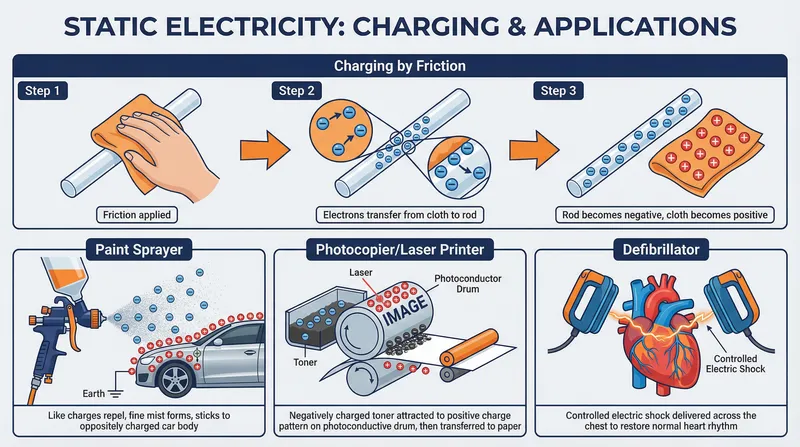
When two different insulating materials are rubbed together, contact between their surfaces lets electrons be transferred from one material to the other. The material that loses electrons is left with a net positive charge; the material that gains them carries a net negative charge. Only electrons move; protons stay fixed in the material. The two rubbed objects always end up with opposite charges, and the total charge is conserved. Rubbing harder or for longer generally transfers more electrons, so the charge built up increases.
Watch and listen
Listen: Topic 11 – Static electricity audio lesson
Read the full guideVisual Resources
1 diagram and illustration
Interactive Diagrams
1 interactive diagram to visualise key concepts
Conceptual Flow Outline
Flowchart showing the process of charging two insulators by friction.
Your focus
- Describe how rubbing two insulators transfers electrons between them
- State that electrons, not protons, are transferred
- Explain why the two materials gain equal and opposite charges
Topic 11 – Static electricity flashcards
Card 1 of 12
Charging by friction
Topic 11 – Static electricity exam tips
Marking Points
- States that rubbing two different insulating materials together transfers electrons from one surface to the other
- Identifies electrons as the charged particles that move, while protons remain fixed in place
- Explains that the material losing electrons becomes positively charged and the material gaining electrons becomes negatively charged
- Recognises that the two materials acquire equal and opposite charges, so total charge is conserved
- Links a longer or firmer rub to a greater transfer of electrons and therefore a larger charge
Examiner Tips
- 💡Name the two materials and state clearly which one gains electrons and which one loses them
- 💡Use the word transfer rather than create when describing the charge
- 💡Check that your answer keeps the charges opposite and equal in size
Common Mistakes
- Claims that protons are transferred between the materials; correct this by stating that only electrons move
- Says both materials become negatively charged; correct this by noting that one gains electrons and the other loses them, giving opposite charges
- Describes charge as created by friction rather than transferred; correct this by explaining that electrons are moved, not made