Component 01: Development - Key Concepts — OCR GCSE Psychology
Verified courseTeaching note checked against the official specification.
In OCR GCSE Psychology Component 01, Development covers how the brain grows from pre-natal stages through childhood and how cognitive abilities mature over time. It integrates core neurological structures with foundational theories from Piaget, Dweck, and Willingham to evaluate how children learn and develop.
Component 01: Development - Key Concepts explained
Component 01: Development - Key Concepts covers 3 specification points, including Stages of development; pre-natal; childhood;… and The development of brain structures and….
Read the full explanation
Open a point below for its explanation and revision guidance.
Stages of development; pre-natal; childhood; adolescence; and adulthood
Development is described in this specification as a sequence of stages, and each stage is defined by characteristic physical, cognitive and social changes rather than by a single birthday. The pre-natal stage runs from conception to birth, when the brain and body are built in the womb. Childhood follows birth and covers rapid growth, language acquisition and early social learning. Adolescence is the transitional stage marked by puberty and by growing independence and identity formation. Adulthood is the longest stage, associated with maturity, work, relationships and later ageing. Learn the order and one defining feature of each stage, and be ready to match a described change to the correct stage in a multiple-choice question.
The development of brain structures and functions; the nervous system; neurons; synapses; and their interaction in development of the brain
The brain develops as neurons form, connect and are pruned. The nervous system is divided into the central nervous system, comprising the brain and spinal cord, and the peripheral nervous system, which carries signals to and from the body. A neuron has a cell body, dendrites that receive signals and an axon that carries impulses away. Where two neurons meet, a synapse allows a signal to pass by releasing neurotransmitter across a small gap. Brain structures and functions develop as these connections form and strengthen: pathways used often are retained while unused synapses are pruned. Learn the parts, their roles and how they interact, then match a described process to the correct structure or term in a multiple-choice question.
IQ tests as a measure of intelligence.
IQ tests are standardised assessments that produce a numerical score, usually standardised so that the average is 100, and they are one way psychology measures intelligence. Learners should know what such a test produces, how it is administered and scored consistently, and what it can and cannot tell us. A high score reflects performance on the test's particular tasks, such as reasoning, vocabulary or pattern-finding, not a complete measure of a person's ability. IQ scores are also used to identify learning difficulties and to compare individuals, so reliability and validity matter. A key evaluation point is that IQ tests measure only certain abilities and may be influenced by culture, education and test practice, so they capture part of intelligence rather than all of it.
Watch and listen
Interactive Diagrams
1 interactive diagram to visualise key concepts
Conceptual Flow Outline
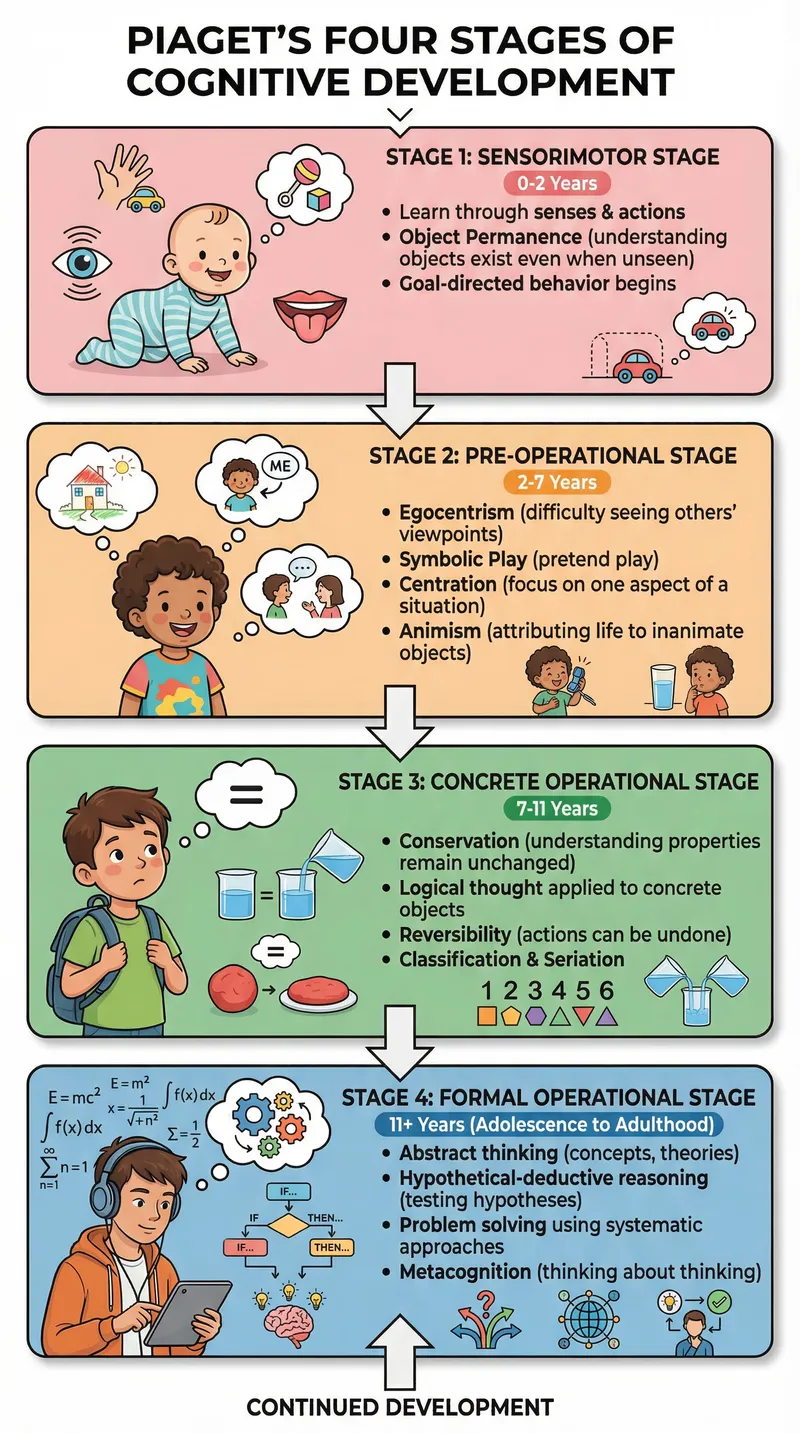
Flowchart of Piaget's Stages of Cognitive Development
Your focus
- State the order of the developmental stages named in the specification.
- Describe one characteristic feature of each stage.
- Match a described change to the correct developmental stage.
Show all 9 objectives
- Identify the main divisions of the nervous system and their components.
- Describe the structure and role of a neuron and of a synapse.
- Explain how neuron and synapse activity contributes to the development of brain structures and functions.
- Describe what an IQ test produces and how it is scored.
- Explain what IQ tests can and cannot measure.
- Evaluate IQ tests as a measure of intelligence using reliability, validity and cultural factors.
Which command word is this?
Provide a brief, precise fact, structure, or stage name without explanation (1 mark).
Component 01: Development - Key Concepts exam tips
Topic Overview
Development examines how human cognitive processes, behaviors, and the nervous system change from conception through childhood and adolescence. Within OCR GCSE Psychology Component 01, this topic establishes the biological foundations of brain development alongside classical and contemporary developmental theories.
Students study how neurological structures like the medulla and cerebellum emerge pre-natally, how Piaget mapped progressive stages of cognitive maturation, and how modern educational models from Dweck and Willingham impact classroom learning. Mastering this topic provides the conceptual baseline for understanding nature versus nurture debates throughout the entire syllabus.
Key Concepts
- →Brain Development: Structural development of the neural tube, cortex, cerebellum, thalamus, and brain stem from pre-natal stages to early childhood.
- →Piaget's Cognitive Theory: The role of schemas, assimilation, and accommodation across four developmental stages (sensorimotor, pre-operational, concrete operational, and formal operational).
- →Conservation and Egocentrism: Key cognitive abilities assessing whether children understand volume/mass invariance and whether they can take another person's perspective (e.g., Three Mountains Task).
- →Dweck's Mindset Theory: The distinction between fixed and growth mindsets, and the differing impacts of effort praise versus ability praise on resilience.
- →Willingham's Learning Theory: Rejection of sensory learning styles and emphasis on factual knowledge, working memory limits, and deliberate practice for skill acquisition.
Marking Points
- Identifies the pre-natal stage as the period from conception to birth.
- Places childhood after birth and before adolescence in the developmental sequence.
- Links adolescence to puberty and to growing independence or identity formation.
- Recognises adulthood as the stage following adolescence, associated with maturity and later ageing.
- Selects the stage that matches a described change rather than choosing by age alone.
- Names the central nervous system as the brain and spinal cord and the peripheral nervous system as the nerves linking them to the body.
- Describes a neuron as having dendrites that receive signals and an axon that carries impulses away.
- Explains that a synapse is the junction where a signal passes between neurons via neurotransmitter.
- Links the formation, strengthening and pruning of synapses to the development of brain structures and functions.
- Selects the structure or process that matches a described role rather than choosing by name alone.
- Identifies that an IQ test produces a numerical score, typically standardised with an average of 100.
- Explains that IQ tests measure performance on specific tasks such as reasoning, vocabulary or pattern recognition rather than all abilities.
- States that standardisation and consistent administration make scores comparable between people.
- Recognises that IQ tests are used to identify learning difficulties and to compare individuals.
- Evaluates that IQ tests may be affected by culture, education or practice, so they measure only part of intelligence.
Examiner Tips
- 💡Read the whole stem before looking at the options, and note which feature is being described.
- 💡Eliminate options that put the stages in the wrong order.
- 💡Check that the chosen stage fits every part of the description, not just one word.
- 💡Revise one defining feature per stage so you can justify your choice quickly.
- 💡Identify which part of the nervous system or neuron the stem describes before reading the options.
- 💡Eliminate options that swap the roles of dendrites and axon.
- 💡Check that the chosen option fits the whole description, including how the structures interact.
- 💡Use precise terms such as central nervous system, neuron and synapse rather than everyday words.
- 💡Link each point to what the test actually measures, not just to the number produced.
- 💡Use the terms reliability and validity when judging IQ tests as a measure.
- 💡Give a concrete example, such as a reasoning or vocabulary item, to show what the test samples.
- 💡Always state the specific age ranges associated with Piaget's four stages: Sensorimotor (0-2 years), Pre-operational (2-7 years), Concrete operational (7-11 years), and Formal operational (11+ years).
- 💡In 6-mark or 9-mark evaluation questions, use P.E.E.L. paragraphs (Point, Evidence, Explain, Link) to ensure your critique explicitly evaluates the usefulness or validity of the developmental theory.
- 💡When discussing brain development, distinguish accurately between the thalamus (relay station for sensory inputs) and the brain stem (autonomic survival functions).
Common Mistakes
- Treats adolescence as beginning at birth; place adolescence after childhood and link it to puberty.
- Confuses pre-natal with infancy; keep pre-natal as the period before birth.
- Assumes development stops at adulthood; recognise that change and ageing continue through adulthood.
- Chooses a stage from a single age number; match the described feature to the stage as well.
- Reverses the roles of dendrites and axon; keep dendrites receiving and the axon carrying impulses away.
- Treats the synapse as a physical join between neurons; describe it as a junction across which a signal passes.
- Places the spinal cord outside the central nervous system; include the brain and spinal cord within it.
- Assumes all synapses formed in development are kept; recognise that unused connections are pruned.
- Assumes an IQ score measures all of a person's intelligence; recognise that it reflects performance on particular test tasks only.
- Treats a single IQ score as fixed and unchangeable; note that scores can vary with practice, education and test conditions.
- Ignores cultural or educational influences on test performance; consider how these factors affect validity.
- Believing that object permanence is present from birth, whereas Piaget showed infants only develop it around 8 months of age.
- Assuming that Willingham supported learning styles (visual, auditory, kinaesthetic), when in fact his theory explicitly refutes them, arguing that content should be taught according to its meaning rather than student preference.
- Equating growth mindset purely with 'trying hard', ignoring Dweck's emphasis on seeking new strategies and learning actively from mistakes.
Revision Plan
- 1Step 1: Memorise the 4 major pre-natal and early brain structures (cortex, cerebellum, thalamus, brain stem) and their specific functions.
- 2Step 2: Create a comparative timeline of Piaget's 4 stages of cognitive development, noting key milestones like object permanence, egocentrism, and conservation.
- 3Step 3: Contrast Carol Dweck's mindset theory with Daniel Willingham's learning theory using a two-column summary sheet highlighting practical applications in education.
- 4Step 4: Practice 2-mark definitions and 4-mark application questions using past OCR exam paper scenarios.
- 5Step 5: Write a timed 6-mark or 9-mark evaluation essay comparing the strengths and limitations of Piaget's or Dweck's theories.
Exam Question Types
- 📋Short-answer definitions: Typically 1 to 2 marks asking you to define terms like 'schema', 'conservation', or 'growth mindset'.
- 📋Application scenarios: 3 to 4 marks asking you to explain a child's behavior in a classroom or home setting using Piaget's or Dweck's concepts.
- 📋Extended response / Evaluation essays: 6 to 9 marks requiring you to describe and evaluate a developmental theory (e.g., Piaget, Dweck, or Willingham) with supporting and opposing research evidence.
Command Word Expectations (OCR)
Provide a brief, precise fact, structure, or stage name without explanation (1 mark).
Give a detailed account of the key characteristics, principles, or procedures of a theory or study (typically 2-4 marks).
Present balanced arguments detailing strengths and limitations, supported by psychological evidence, research methodology, or real-world applicability (typically 6 marks).
How Students Lose Marks (Examiner Pitfalls)
Step-by-Step Worked Solutions
Question: Outline Piaget's sensorimotor stage of cognitive development and explain one limitation of his theory of cognitive development. (4 marks)
- 1.Step 1: Define the age range and key feature of the sensorimotor stage.
- 2.Step 2: Explicitly mention the development of object permanence during this stage.
- 3.Step 3: State a specific, valid limitation of Piaget's theory.
- 4.Step 4: Explain why this limitation weakens his theory using psychological evidence.
Question: Evaluate Carol Dweck's mindset theory in relation to educational achievement. (6 marks)
- 1.Step 1: Outline the core premises of Dweck's theory (growth vs fixed mindset, types of praise).
- 2.Step 2: Provide a supporting point demonstrating practical application in schools.
- 3.Step 3: Provide a counter-argument or limitation regarding other influences on achievement.
- 4.Step 4: Write a balanced concluding judgement.