OCR · GCSE · Psychology
Key Concepts in Development
This study guide explores the core principles of cognitive and biological development in OCR GCSE Psychology. It unpacks the essential theories of Piaget, Dweck, and Willingham, providing a clear pathway to understanding how our minds grow and learn. Master these concepts to excel in your exam and gain a profound insight into the foundations of human psychology.
- 7 min read
- 3 worked examples
- 5 practice questions
- 6 key terms
Study Notes
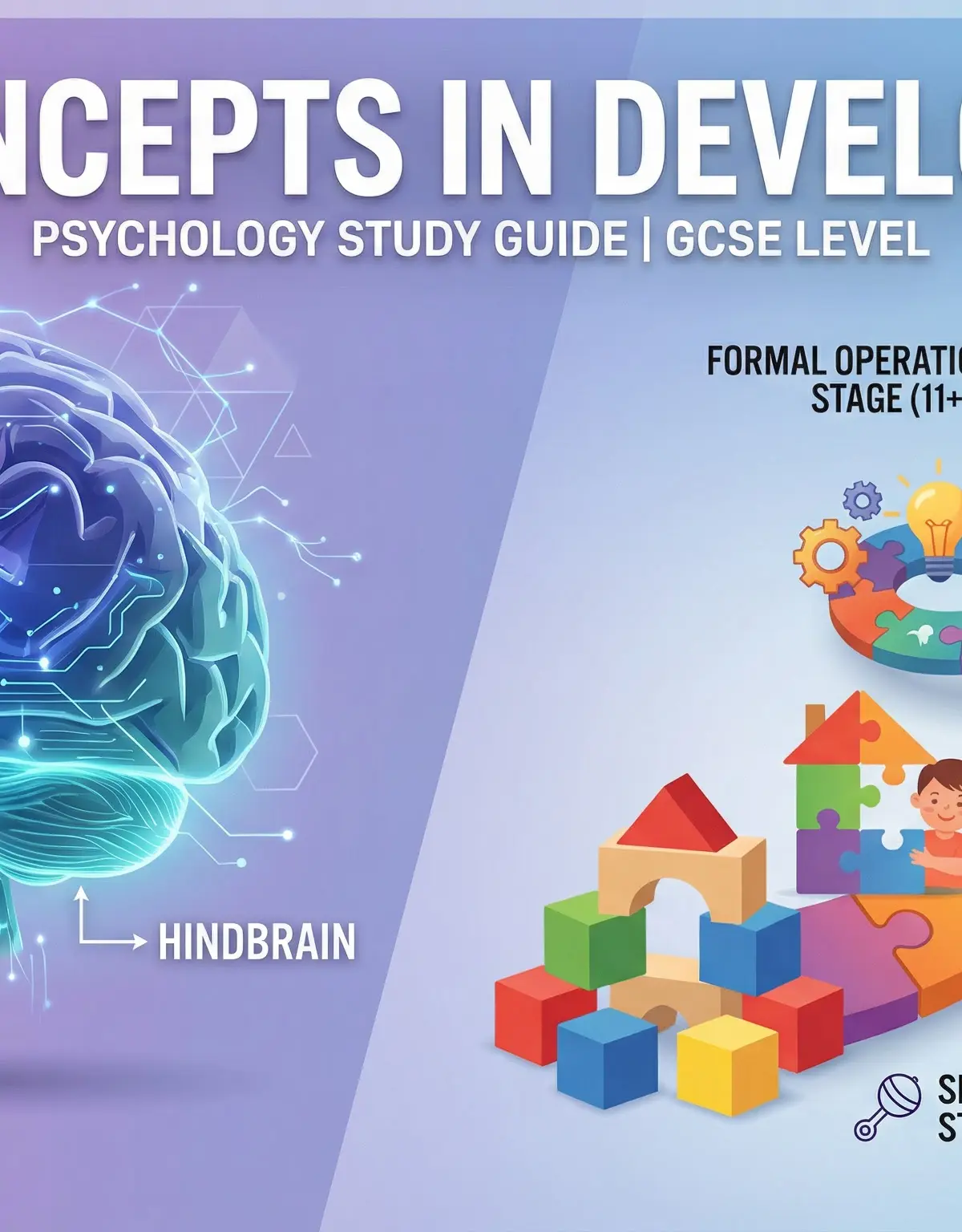
Overview
Welcome to the study of Development, a cornerstone of the OCR GCSE Psychology specification (J203). This topic investigates the fascinating journey of human development, from the biological maturation of the brain to the complex cognitive shifts we experience from infancy to adolescence. Examiners expect candidates to demonstrate a robust understanding of key theories, apply them to novel scenarios, and critically evaluate their contributions and limitations. This guide will equip you with the knowledge of Piaget's stage theory, the structure and function of the developing brain, and the educational implications proposed by Dweck and Willingham. A firm grasp of these concepts is essential for achieving high marks, as they form the basis of many application (AO2) and evaluation (AO3) questions.
Key Theories in Cognitive Development
Jean Piaget's Stage Theory of Cognitive Development
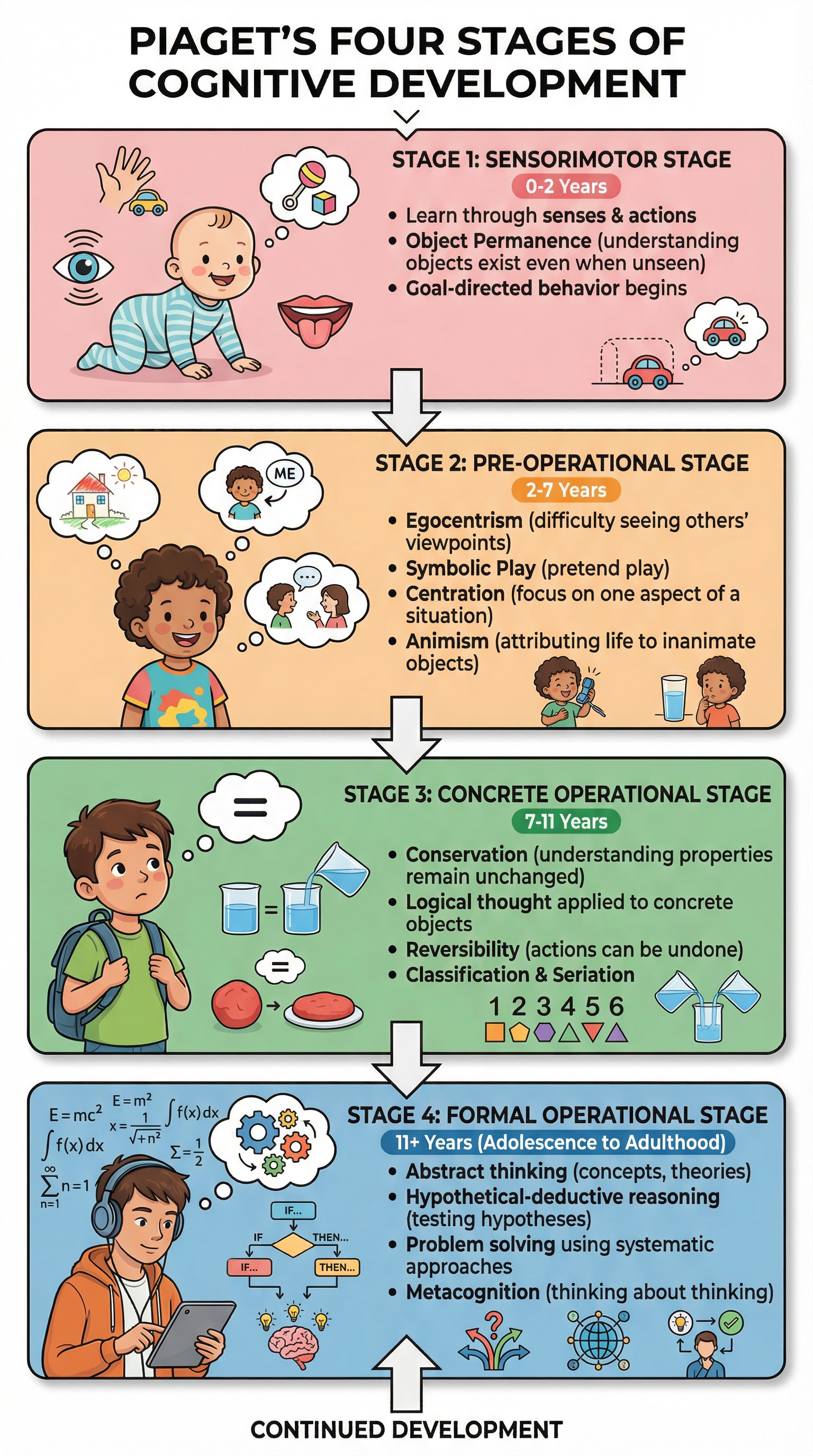
Piaget's theory is a foundational concept, proposing that children are active learners who construct their understanding of the world. He argued that cognitive development occurs in four universal, sequential stages. It is critical that candidates can name, describe, and apply these stages.
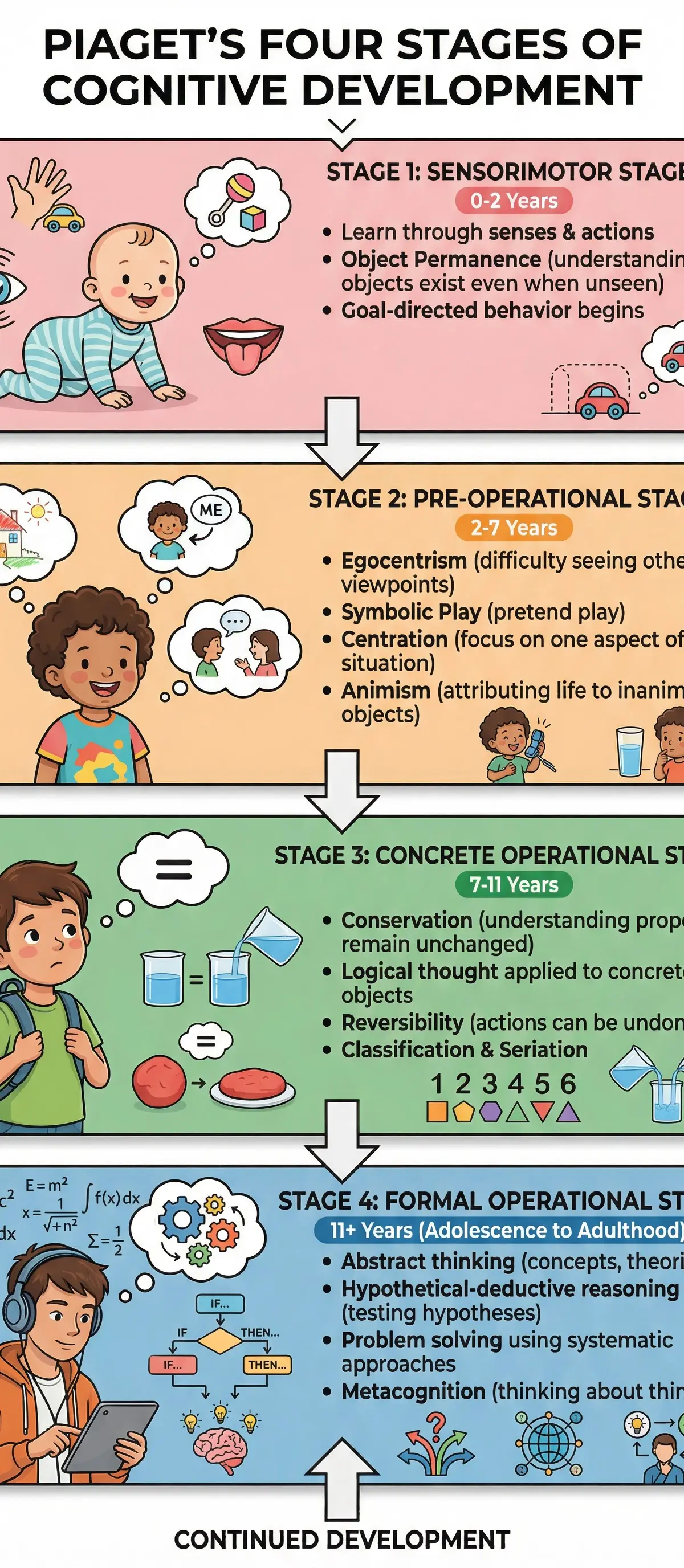
Key Concepts within Piaget's Theory:
- Schemas: These are mental frameworks or 'units' of knowledge that we use to interpret the world. A young child might have a schema for a 'dog' that includes having four legs and fur. This schema is adapted through two key processes:
- Assimilation: Fitting new information into an existing schema. The child sees a cat and calls it a 'dog' because it fits their current schema.
- Accommodation: Modifying an existing schema or creating a new one to fit new information. When corrected, the child creates a new schema for 'cat', accommodating the new information.
- Conservation: The understanding that a quantity remains the same even if its appearance changes. This is a key achievement of the Concrete Operational stage. Pre-operational children famously fail conservation tasks.
- Egocentrism: The inability to see a situation from another person's point of view. This is a hallmark of the Pre-operational stage.
Carol Dweck's Mindset Theory
Dweck's theory focuses on the beliefs we hold about our own intelligence and abilities. This is a popular topic for application questions where candidates must identify a mindset in a scenario and explain its implications for learning.
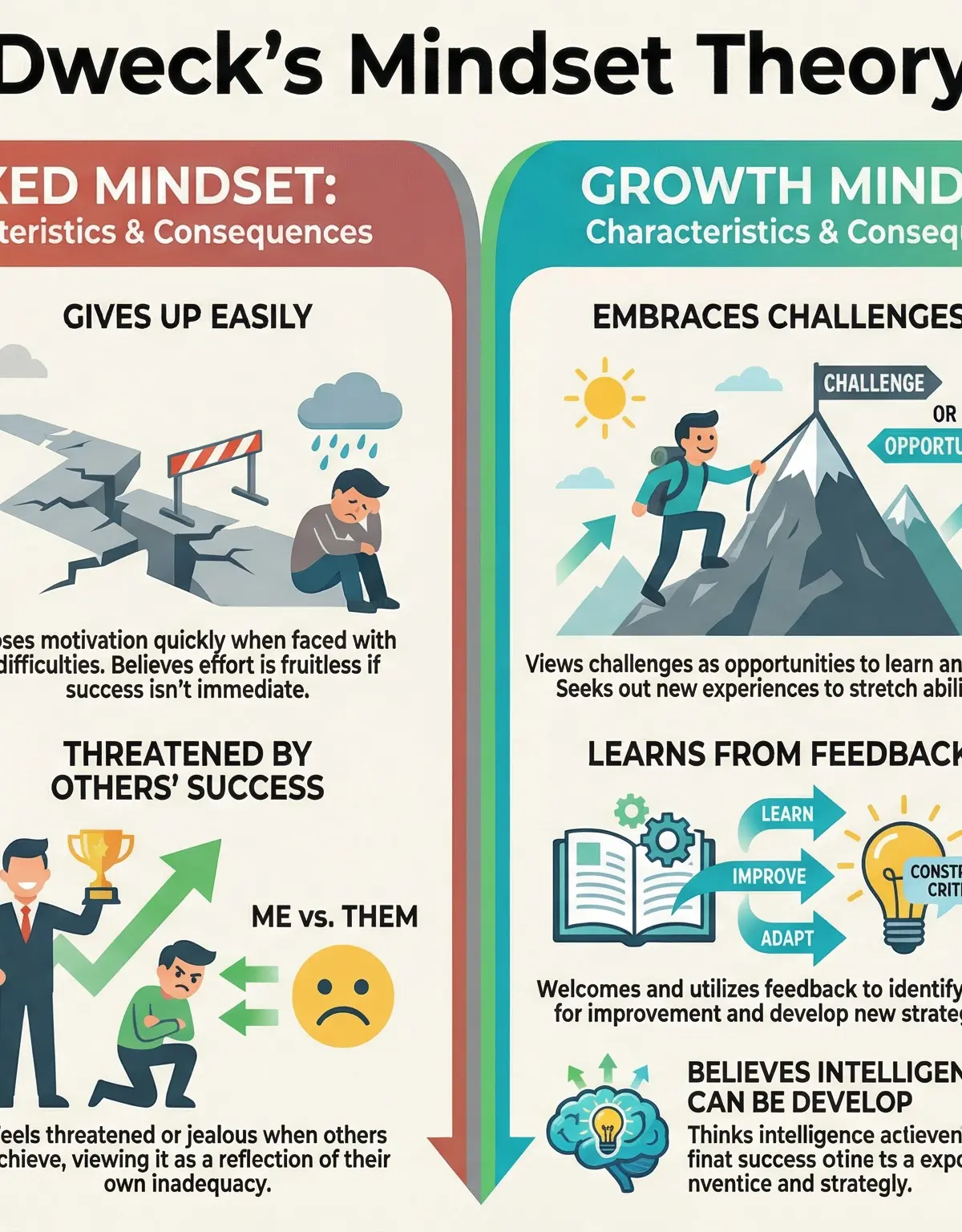
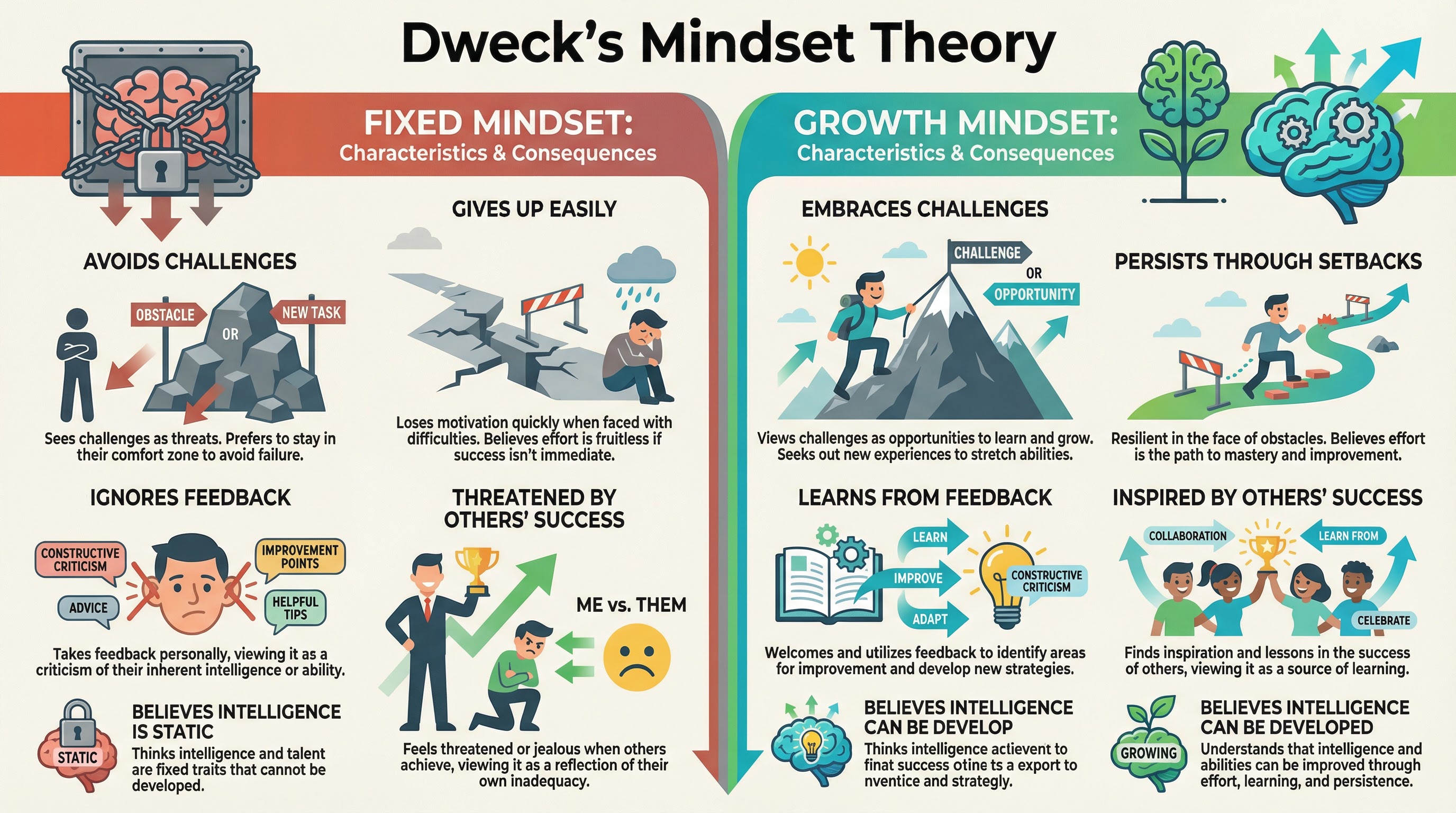
- Fixed Mindset: The belief that intelligence is a fixed trait that cannot be changed. Individuals with a fixed mindset tend to avoid challenges, give up easily when faced with obstacles, and feel threatened by the success of others. They fear failure as they see it as a negative reflection of their innate ability.
- Growth Mindset: The belief that intelligence can be developed through effort, good strategies, and input from others. Individuals with a growth mindset embrace challenges, persist in the face of setbacks, learn from criticism, and find inspiration in the success of others. Praise for effort, not intelligence, is seen as key to fostering a growth mindset.
Daniel Willingham's Learning Theory
Willingham, a cognitive scientist, offers a critique of popular learning theories and provides evidence-based strategies for effective learning. A common mistake is to confuse his ideas with support for 'learning styles'.
- Critique of Learning Styles: Willingham argues there is no credible evidence that students learn better when teaching is tailored to their preferred learning style (e.g., visual, auditory, kinesthetic). He states that the meaning of the content should determine the best way to present it.
- The Importance of Meaning for Memory: Willingham's key principle is that 'memory is the residue of thought'. To remember something, you must think about it. Therefore, the goal of education should be to make students think deeply about the meaning of the material. Factual knowledge is also seen as crucial, as it provides the foundation for developing skills like problem-solving and critical thinking.
The Developing Brain
Understanding the link between biological maturation and cognitive development is vital. Examiners will credit candidates who can accurately describe the functions of different brain areas and link them to developmental changes.
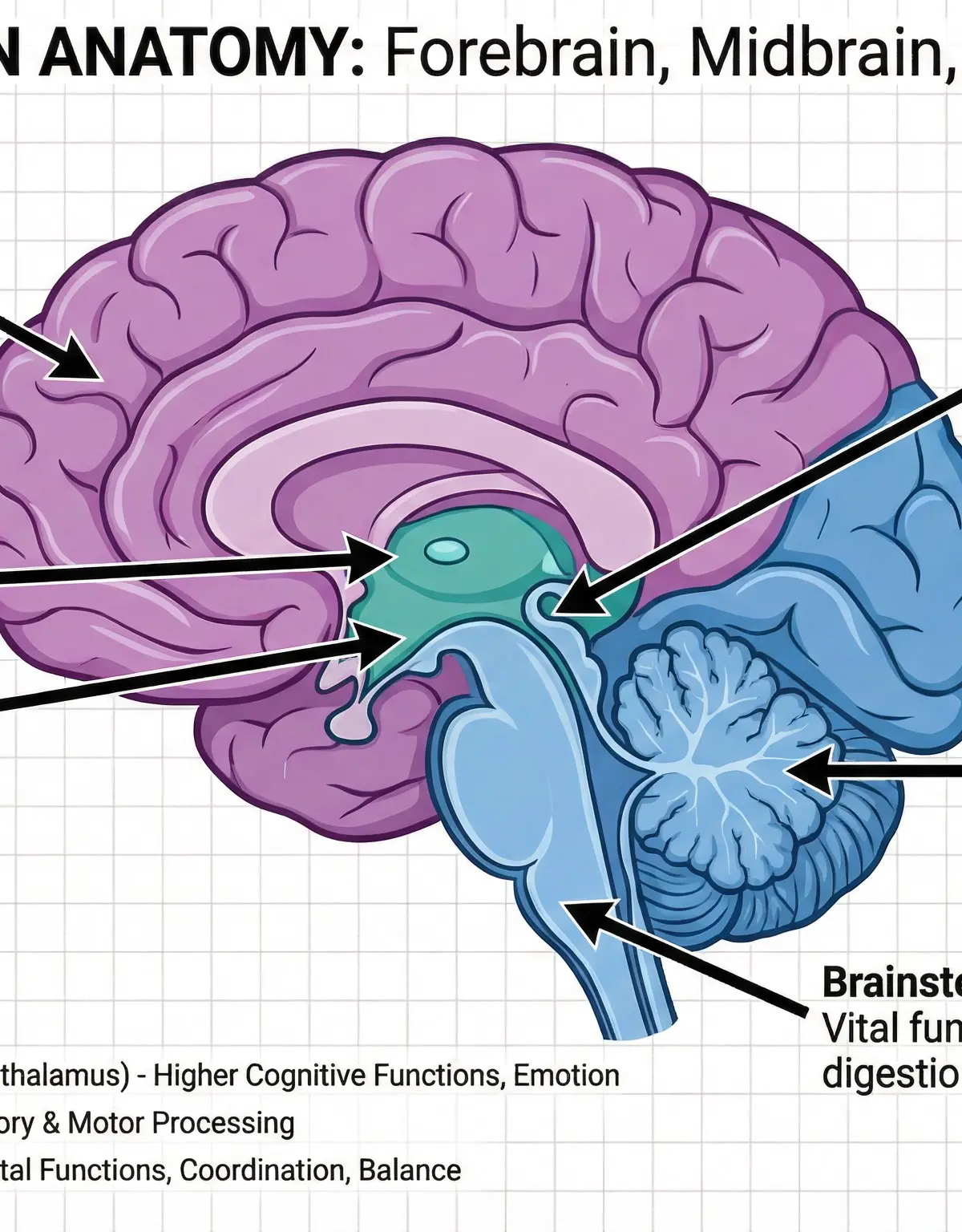
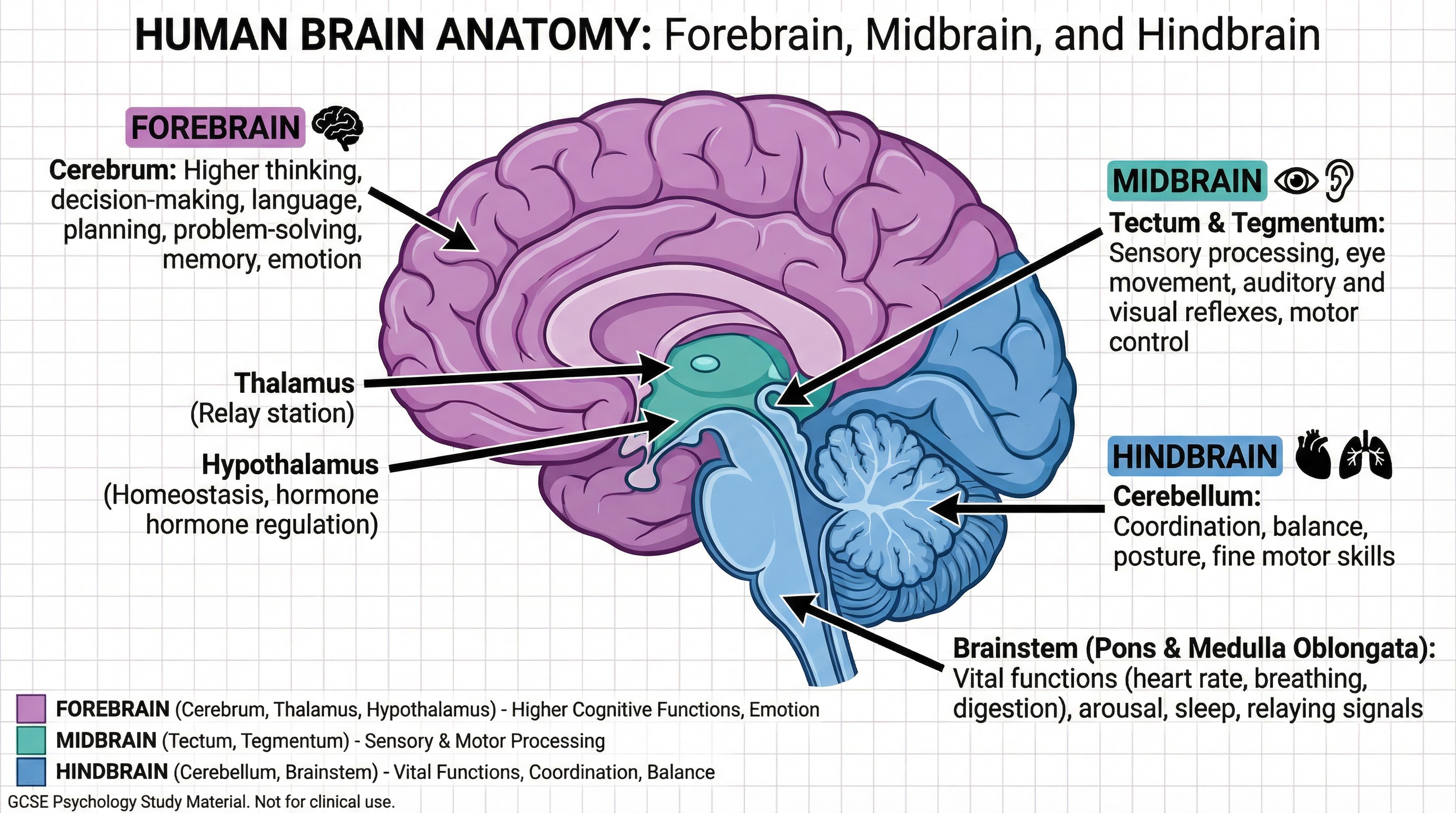
- Forebrain: The largest and most complex part of the brain. It includes the cerebrum, which is responsible for higher-order thinking, such as problem-solving, planning, language, and decision-making. The prefrontal cortex, a key part of the forebrain, continues to develop into early adulthood, which has implications for adolescent behaviour.
- Midbrain: This region acts as a relay station for sensory information, connecting it to the appropriate parts of the forebrain. It is involved in processing auditory and visual information and plays a role in motor control.
- Hindbrain: Located at the back of the head, the hindbrain includes the cerebellum and brainstem. The cerebellum is crucial for coordinating movement and balance, while the brainstem controls essential autonomic functions like breathing, heart rate, and sleep.
Evaluating the Theories
For top marks, candidates must move beyond description (AO1) and engage in critical evaluation (AO3). This involves identifying strengths, weaknesses, and supporting or contradictory evidence.
- Evaluating Piaget: A key piece of evidence to use is the 'Naughty Teddy' study by McGarrigle and Donaldson (1974). They found that when a teddy bear 'accidentally' messed up a row of counters, 62% of children correctly conserved the number, compared to only 16% in Piaget's original task. This challenges Piaget's conclusions by suggesting that the demand characteristics of his formal questioning style may have led children to give incorrect answers, thus underestimating their true abilities.
- Evaluating Dweck: Dweck's theory has had a huge positive impact on education, promoting resilience and a love of learning. However, some critics argue that the theory can be oversimplified, leading to a 'false growth mindset' where students are praised for effort alone, without focusing on the outcomes or the effectiveness of their strategies.
- Evaluating Willingham: Willingham's work is praised for being evidence-based and for debunking the pervasive myth of learning styles. His focus on the importance of factual knowledge and meaningful thinking provides a clear and practical framework for educators.
Visual Resources
3 diagrams and illustrations
Interactive Diagrams
1 interactive diagram to visualise key concepts
Conceptual Flow Outline
Flowchart of Piaget's Stages of Cognitive Development
Worked Examples
3 worked examples — open one to explore the question and available guidance.
Practice Questions
Test your understanding — click to reveal model answers
Outline the function of the forebrain. (2 marks)
Hint: Think about higher-order thinking.
A 5-year-old child is shown two identical balls of clay. One is then rolled into a sausage shape. The child claims the sausage has more clay. Using Piaget's theory, explain this child's thinking. (3 marks)
Hint: Which stage is a 5-year-old in, and what are its limitations?
Explain one strength of Dweck's mindset theory. (3 marks)
Hint: Think about its real-world impact.
Explain why Willingham is critical of the idea of 'learning styles'. (4 marks)
Hint: What does he believe is more important than matching teaching to a preferred style?
Discuss the role of maturation in development. (8 marks)
Hint: Link biological development (brain) to cognitive development (Piaget/Willingham).