The self — Edexcel GCSE Psychology
Verified courseTeaching note checked against the official specification.
The self explained
The self covers 6 specification points, including Lewis (1990) a.
Read the full explanation
existential self b.… and A. Erikson (1959) the eight stages of identity…. Open a point below for its explanation and revision guidance.
7.1.1 Understand the concepts of the self and self-concept, including: Lewis (1990) a. existential self b. categorical self Rogers (1959) c. self-image d. self-esteem e. ideal self f. self-actualisation g. congruence h. incongruence
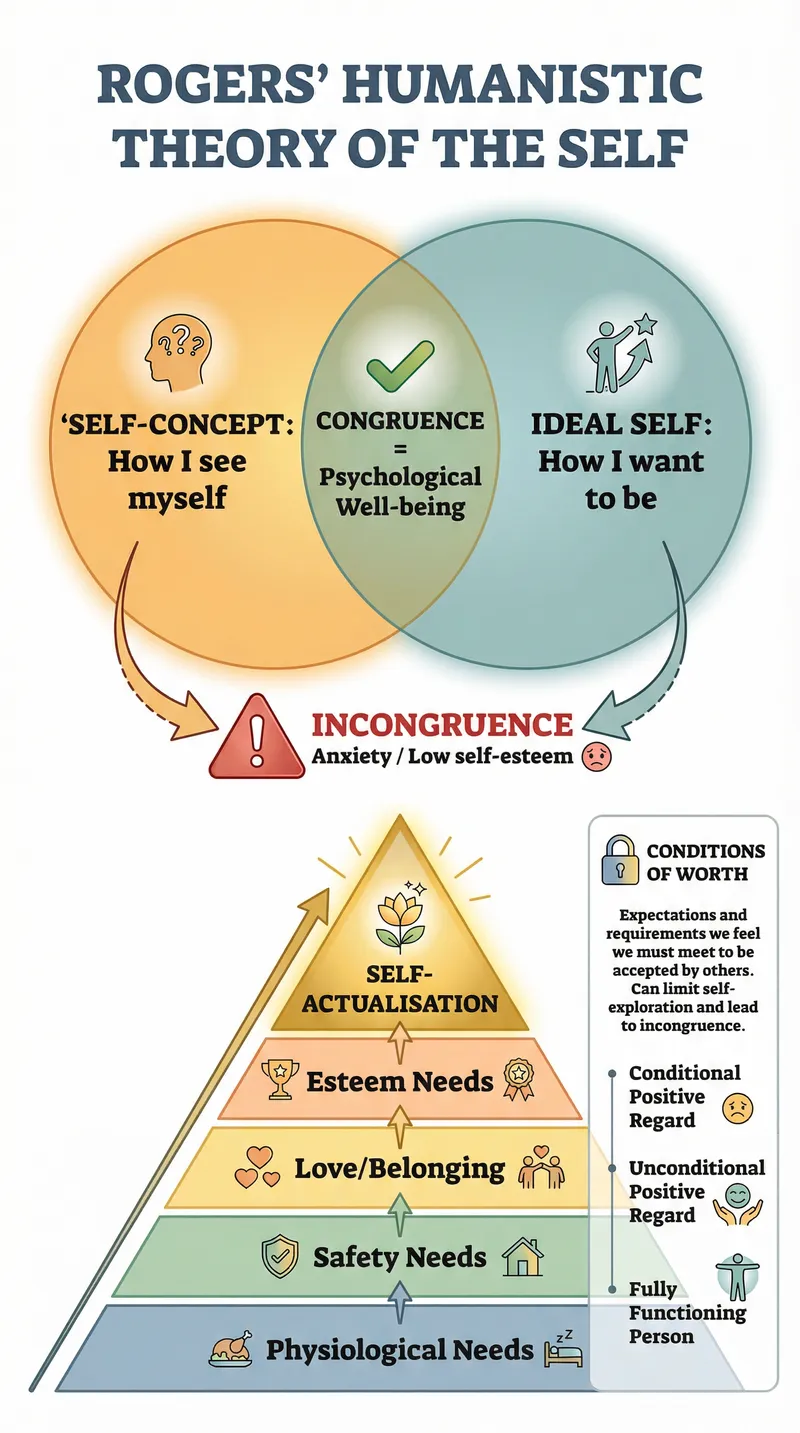
The self-concept encompasses how individuals perceive themselves. Lewis (1990) divided this into the existential self (the realisation that one is a distinct, continuous entity) and the categorical self (defining oneself by properties like age or gender). Rogers (1959) expanded this within humanistic psychology, identifying three components: self-image (how we see ourselves), self-esteem (our self-worth), and the ideal self (who we wish to be). Rogers argued that achieving self-actualisation requires congruence, where the self-image and ideal self closely align. Incongruence occurs when there is a significant gap between them, often leading to psychological distress.
7.1.2 Understand the role of identity and free will in the development of self, including strengths and weaknesses of each theory: a. Erikson (1959) the eight stages of identity development b. Baumeister (2008) the consequence of belief in free will
Erikson (1959) proposed that identity develops through eight psychosocial stages across the lifespan, each presenting a crisis to resolve. For example, adolescents face 'identity versus role confusion', where success leads to a strong sense of self. A strength is its lifespan approach; a weakness is its lack of empirical evidence. Baumeister (2008) explored the consequences of believing in free will, suggesting it promotes prosocial behaviour and personal accountability. When people believe they control their actions, they are more likely to help others and less likely to cheat. A strength is its application to improving societal behaviour, but a weakness is the difficulty in objectively measuring free will.
7.1.3 Understand the Humanistic Theory of Self, including strengths and weaknesses of each theory: a. humanistic explanations of the development of self-esteem b. humanistic explanations of the development of personality Rogers (1951) c. conditional positive regard d. unconditional positive regard e. conditions of worth f. congruence g. incongruence h. Maslow (1943) hierarchy of needs
The Humanistic Theory of Self focuses on personal growth and self-esteem. Rogers (1951) explained personality development through the self-concept. Unconditional positive regard (love without conditions) fosters healthy self-esteem, whereas conditional positive regard creates conditions of worth, where individuals feel they must meet expectations to be valued. Congruence occurs when the ideal self aligns with the actual self, leading to well-being. Incongruence causes distress. Maslow (1943) proposed a hierarchy of needs, culminating in self-actualisation. Strengths include the positive focus on free will; weaknesses include the lack of objective measurement and potential cultural bias towards individualistic societies.
7.1.4 Understand the role of internal and external influences on the self and self-esteem, including: a. temperament b. experience
The development of the self and self-esteem is shaped by internal and external influences. Internal influences include temperament, which refers to innate, biologically based traits we are born with, such as being naturally outgoing. A child with an easy temperament often receives positive reactions, boosting self-esteem. External influences involve our life experiences and interactions. For example, a student who experiences repeated success or receives consistent praise is likely to develop higher self-esteem than someone facing frequent criticism. Understanding both factors is crucial because they interact; an individual's innate temperament can significantly affect how they interpret and respond to their external experiences.
7.1.5 Understand how personality can be measured, including: a. personality scales b. personality types
Psychologists measure personality using various methods, primarily through personality scales and personality types. Personality scales measure traits on a continuum. For example, an individual might score anywhere along a scale from highly introverted to highly extroverted, providing a nuanced profile of their traits. In contrast, personality types categorise individuals into distinct groups based on shared characteristics, such as Type A (competitive) or Type B (relaxed). While scales offer detailed, quantitative data about the degree to which a person possesses certain traits, type theories provide a broader, categorical approach that is easier to apply but may oversimplify complex human behaviour by forcing people into rigid boxes.
7.1.6 Understand the use of trait theory as a measure of personality, including strengths and weaknesses of trait theory: a. Allport (1936) cardinal, central and secondary personality traits b. Cattell (1946) 16PF personality factor assessment
Trait theory measures personality by identifying stable characteristics that influence behaviour. Allport (1936) categorised traits into three levels: cardinal traits (rare, dominant traits defining a person's whole life), central traits (general characteristics forming the personality foundation), and secondary traits (preferences appearing only in specific situations). Cattell (1946) reduced thousands of traits to 16 core factors, developing the 16PF questionnaire to assess them quantitatively. Strengths include its objective approach and practical application in psychometric testing. Weaknesses include failing to account for situational factors and relying on self-report methods, which risk bias.
Watch and listen
Visual Resources
1 diagram and illustration
Interactive Diagrams
1 interactive diagram to visualise key concepts
Conceptual Flow Outline
Rogers' model: the relationship between self-concept, ideal self, congruence, and self-actualisation
Your focus
- Distinguish between the existential self and the categorical self as proposed by Lewis (1990).
- Define Rogers' (1959) concepts of self-image, self-esteem, ideal self, and self-actualisation.
- Explain the difference between congruence and incongruence and their impact on psychological well-being.
Show all 18 objectives
- Describe Erikson's eight stages of identity development and the concept of psychosocial crises.
- Explain Baumeister's research on the consequences of believing in free will.
- Evaluate the strengths and weaknesses of both Erikson's and Baumeister's theories of the self.
- Explain Rogers' concepts of positive regard, conditions of worth, congruence, and incongruence.
- Describe Maslow's hierarchy of needs and its role in the development of the self.
- Evaluate the strengths and weaknesses of humanistic explanations of self-esteem and personality.
- Define temperament and explain its role as an internal influence on the self.
- Describe how external experiences impact the development of self-esteem.
- Analyse the interaction between innate temperament and environmental experiences.
- Distinguish between personality scales and personality types as methods of measurement.
- Explain how personality scales assess traits on a continuum.
- Evaluate the strengths and weaknesses of categorising individuals into personality types.
- Differentiate between Allport's cardinal, central, and secondary personality traits.
- Explain how Cattell's 16PF assessment measures personality factors.
- Evaluate the strengths and weaknesses of trait theory as a measure of personality.
The self flashcards
Card 1 of 11
Internal influence
The self exam tips
Marking Points
- Define the existential self as the awareness of being a separate and unique entity, and the categorical self as categorising oneself by traits.
- Identify Rogers' three components of self-concept: self-image, self-esteem, and ideal self.
- Explain congruence as the alignment between self-image and ideal self, facilitating personal growth.
- Describe incongruence as a mismatch between self-image and ideal self, which hinders self-actualisation.
- Define self-actualisation as the innate drive to achieve one's full potential.
- Identify Erikson's eight stages of psychosocial development and the concept of a psychosocial crisis.
- Explain how resolving crises at different stages contributes to identity formation.
- Describe Baumeister's (2008) findings on how belief in free will affects prosocial and antisocial behaviours.
- Evaluate Erikson's theory by discussing its strengths (e.g., lifespan perspective) and weaknesses (e.g., cultural bias).
- Evaluate Baumeister's theory by discussing its strengths (e.g., practical applications) and weaknesses (e.g., reliance on self-report).
- Define unconditional and conditional positive regard and explain their impact on self-esteem.
- Explain how conditions of worth develop and affect personality according to Rogers (1951).
- Distinguish between congruence and incongruence in relation to the actual and ideal self.
- Describe the stages of Maslow's (1943) hierarchy of needs, from physiological needs to self-actualisation.
- Evaluate humanistic theories by discussing strengths (e.g., holistic approach) and weaknesses (e.g., unscientific concepts).
- Identify temperament as an internal, biological influence on the development of the self.
- Explain how specific temperaments can positively or negatively affect an individual's self-esteem.
- Identify life experiences, such as parenting styles or peer interactions, as external influences.
- Describe the interaction between internal temperament and external experiences in shaping self-concept.
- Define personality scales as tools that measure traits along a continuous dimension.
- Identify personality types as systems that classify individuals into distinct, categorical groups.
- Provide an example of a personality scale, such as measuring extroversion against introversion.
- Evaluate the limitations of personality types, such as oversimplifying complex individual differences.
- Identify Allport's three trait levels: cardinal, central, and secondary.
- Describe Cattell's 16PF as a quantitative assessment of 16 core personality factors.
- Evaluate trait theory by explaining a strength, such as its objective measurement or practical use in testing.
- Evaluate trait theory by explaining a weakness, such as ignoring situational influences on behaviour or relying on self-report questionnaires.
Examiner Tips
- 💡Use a Venn diagram mentally to remember congruence: the more the 'self-image' and 'ideal self' circles overlap, the greater the congruence.
- 💡Clearly distinguish between Lewis's developmental stages of the self and Rogers' humanistic components of the self-concept.
- 💡Apply the concept of incongruence to explain why an individual might experience anxiety or low mood in a scenario question.
- 💡Use specific examples of Erikson's stages, such as 'identity versus role confusion' in adolescence, to illustrate identity development.
- 💡When evaluating Baumeister, mention how belief in free will can be manipulated in experiments to observe changes in cheating or helping behaviour.
- 💡Clearly distinguish between the concepts of identity development (Erikson) and the behavioural consequences of free will beliefs (Baumeister).
- 💡Use a diagrammatic description of Maslow's hierarchy to help structure answers about humanistic explanations of motivation and self-esteem.
- 💡Apply Rogers' concepts to real-life scenarios, such as a parent only praising a child for good grades, to illustrate conditional positive regard.
- 💡When evaluating, contrast the humanistic approach's emphasis on free will with more deterministic psychological theories.
- 💡Use clear examples to distinguish between internal influences like temperament and external influences like experience.
- 💡When evaluating, discuss how temperament and experience interact rather than viewing them in isolation.
- 💡Ensure you can define both 'self' and 'self-esteem' accurately before explaining what influences them.
- 💡Be prepared to compare the advantages and disadvantages of using scales versus types to measure personality.
- 💡Use specific examples, like Type A and Type B personality or introversion and extroversion scales, to illustrate your points.
- 💡Remember to mention self-report methods and their potential biases when discussing how these measures are administered.
- 💡Use specific examples to distinguish between Allport's trait levels, such as 'Machiavellian' for a cardinal trait.
- 💡When evaluating trait theory, link the reliance on self-report questionnaires to the risk of social desirability bias.
- 💡Remember that Cattell used factor analysis to narrow down Allport's extensive list of traits to his 16 personality factors.
Common Mistakes
- Confusing existential and categorical self. Correction: The existential self develops first (awareness of existence), followed by the categorical self (applying labels like 'boy' or 'tall').
- Using self-image and self-esteem interchangeably. Correction: Self-image is descriptive (how you see yourself), while self-esteem is evaluative (how much you value yourself).
- Assuming incongruence means having low self-esteem. Correction: Incongruence specifically refers to the discrepancy between the self-image and the ideal self, though it can subsequently affect self-esteem.
- Confusing Erikson's psychosocial stages with Freud's psychosexual stages. Correction: Focus on social and identity crises (e.g., trust versus mistrust) rather than erogenous zones.
- Assuming Baumeister proved free will exists. Correction: Baumeister studied the consequences of believing in free will, not whether free will itself is a scientific reality.
- Failing to evaluate both theories. Correction: Ensure you can provide at least one strength and one weakness for both Erikson's and Baumeister's theories.
- Confusing congruence with unconditional positive regard. Correction: Congruence is the alignment of the actual and ideal self, while unconditional positive regard is receiving acceptance from others without conditions.
- Misordering Maslow's hierarchy. Correction: Ensure the needs are ordered correctly from bottom to top: physiological, safety, love and belonging, esteem, and self-actualisation.
- Treating humanistic concepts as easily measurable. Correction: Acknowledge that concepts like self-actualisation and congruence are subjective and difficult to test scientifically.
- Confusing internal and external influences; correction: remember that temperament is internal and innate, while experiences are external and environmental.
- Assuming temperament is learned; correction: temperament is biologically based and present from birth, whereas personality develops over time.
- Treating self and self-esteem as identical concepts; correction: the self is the overall identity, while self-esteem is the evaluative judgment of one's own worth.
- Confusing scales with types; correction: scales measure the degree of a trait on a continuum, whereas types place people into distinct categories.
- Assuming personality types are highly accurate for everyone; correction: acknowledge that type theories often oversimplify behaviour and ignore situational factors.
- Believing personality scales are entirely objective; correction: recognise that self-report scales can be affected by social desirability bias.
- Confusing cardinal and central traits. Cardinal traits are rare and dominate a person's entire life, whereas central traits are common building blocks of personality.
- Assuming Cattell identified 16 traits in total. Cattell identified 16 underlying personality factors that form the basis of all surface traits.
- Stating trait theory explains how personality develops. Trait theory focuses on measuring and describing personality traits, not explaining their origins or development.