7 Probability Trees Questions to Master in 2026
You know the multiplication rule. You can multiply the probabilities along a path, and you know that different paths are added. Then an exam question changes the wording, removes a branch label, or asks what happened given that a particular result occurred, and suddenly easy marks disappear. That's a common place to lose confidence, especially when you're revising late and every question seems to expose a different mistake.
These probability trees questions move from familiar GCSE skills to A-Level challenge. Use the same routine each time: draw, label, multiply along complete branches, add the relevant paths, then check the answer. Teachers can use the sequence for focused intervention, while students can use it to recover missed basics or push towards top marks. MasteryMind is another optional revision route, offering examiner-aligned maths practice and step-by-step verification, but the methods below should stand on their own.
1. Two-Stage Dependent Events with Conditional Probability
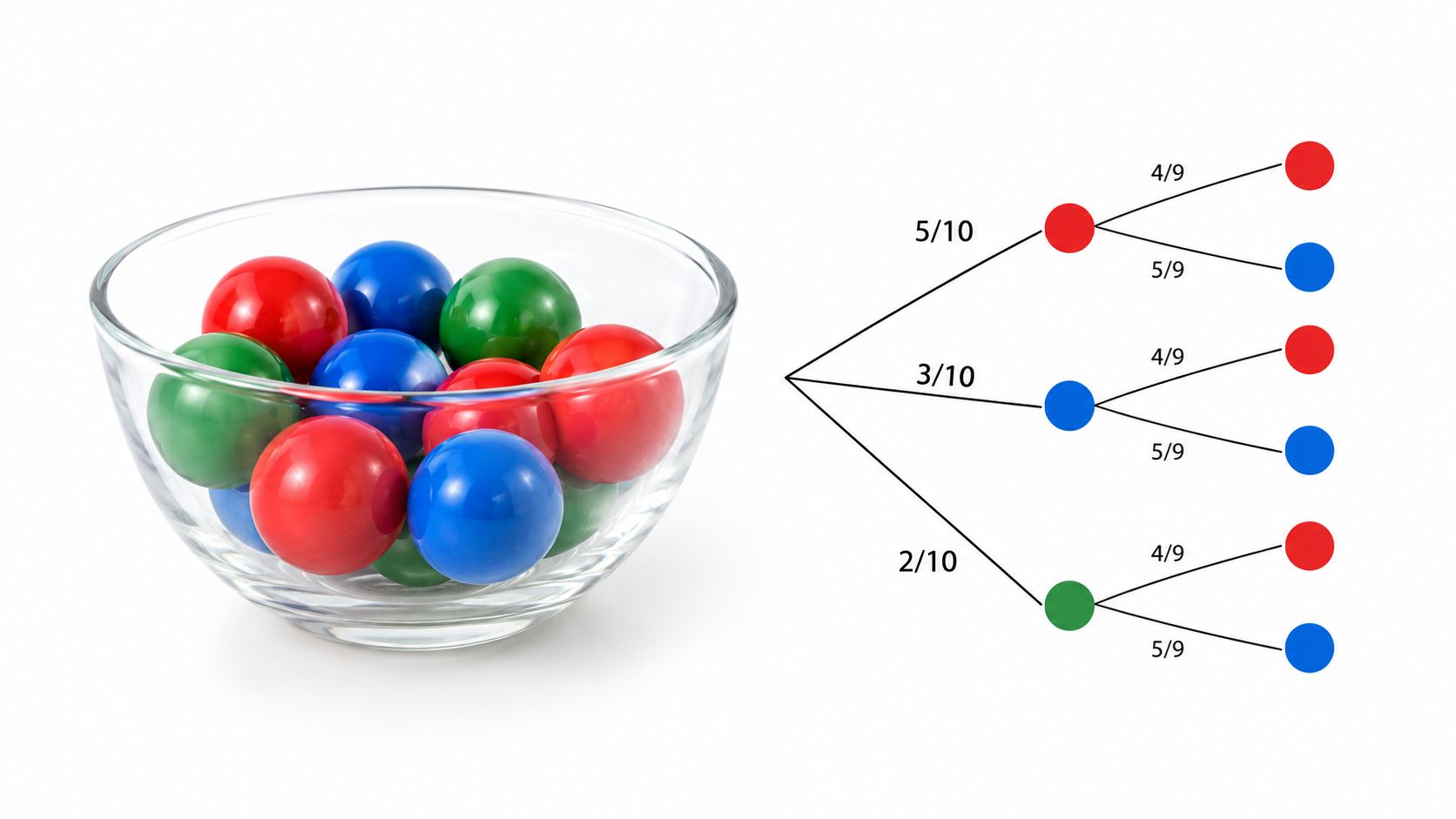
A bag contains 5 red counters and 5 blue counters. Two counters are taken without replacement. What's the probability of taking a red counter followed by a blue counter?
The phrase without replacement controls the whole tree. On the first draw, the probability of red is (5/10), and blue is (5/10). If the first counter is red, the bag now contains 4 red and 5 blue counters, so the next blue probability is (5/9).
Draw two branches from the start, then two branches from each first-stage outcome. Label every branch before calculating:
- Red then blue: (5/10 \times 5/9 = 25/90)
- Blue then red: (5/10 \times 5/9 = 25/90)
If the question asks for one red and one blue in either order, add both complete paths. If it asks specifically for red followed by blue, use only the first path. That wording decision matters as much as the multiplication.
Practical rule: Probabilities at every branch point must add to 1. If the first branch is red, the second-stage probabilities must reflect the changed contents of the bag.
Write the fractions before simplifying. This makes your method visible and gives you something to inspect if the final answer looks wrong. For more examples and specification-focused practice, use these Edexcel probability revision notes.
Try it: Change the bag to 6 red counters and 4 blue counters. Find the probability of drawing two red counters without replacement. Check that your second red probability is smaller than your first.
2. Three-Stage Probability Trees with Multiple Outcomes
Three stages can look intimidating because the tree spreads quickly, but the underlying process hasn't changed. You still follow one route at a time. The risk is losing a path, using the wrong probability after an outcome, or adding paths that don't answer the question.
Consider three draws from a bag without replacement. The possible colour sequences might include RRR, RRB, RBR, BRR, and other arrangements. If the question asks for exactly two red counters, the order matters while you're listing paths, even though the final event does not.
Start with a generous layout. Put the first-stage outcomes on the left, then extend every branch fully before calculating. A small pathway table can help:
- List the target outcomes: Write every sequence that satisfies the wording.
- Calculate each path: Multiply the three branch probabilities in order.
- Combine the paths: Add only the sequences that match the event.
- Check the tree: Make sure no valid sequence has been missed or counted twice.
Suppose the first route is red, red, blue. Its probability is the first red probability multiplied by the second red probability, then the third blue probability. The denominator may change at every draw if counters aren't replaced, so don't copy the same label down the page.
A neat tree isn't just presentation. It protects your reasoning when several routes lead to the same final result.
For a best-of-three game, the same structure applies, but the probabilities may depend on who won the previous round. Work from left to right and avoid jumping to a later branch before you've established what happened earlier.
Try it: Draw a three-stage tree for three coin tosses. Mark every path containing exactly two heads, then explain why those paths must be added.
3. Probability Trees with “At Least” Scenarios
“At least” means that amount or more. So “at least one success” includes one success, two successes, and every larger possible number. Listing each successful route can work, but the complement is often cleaner.
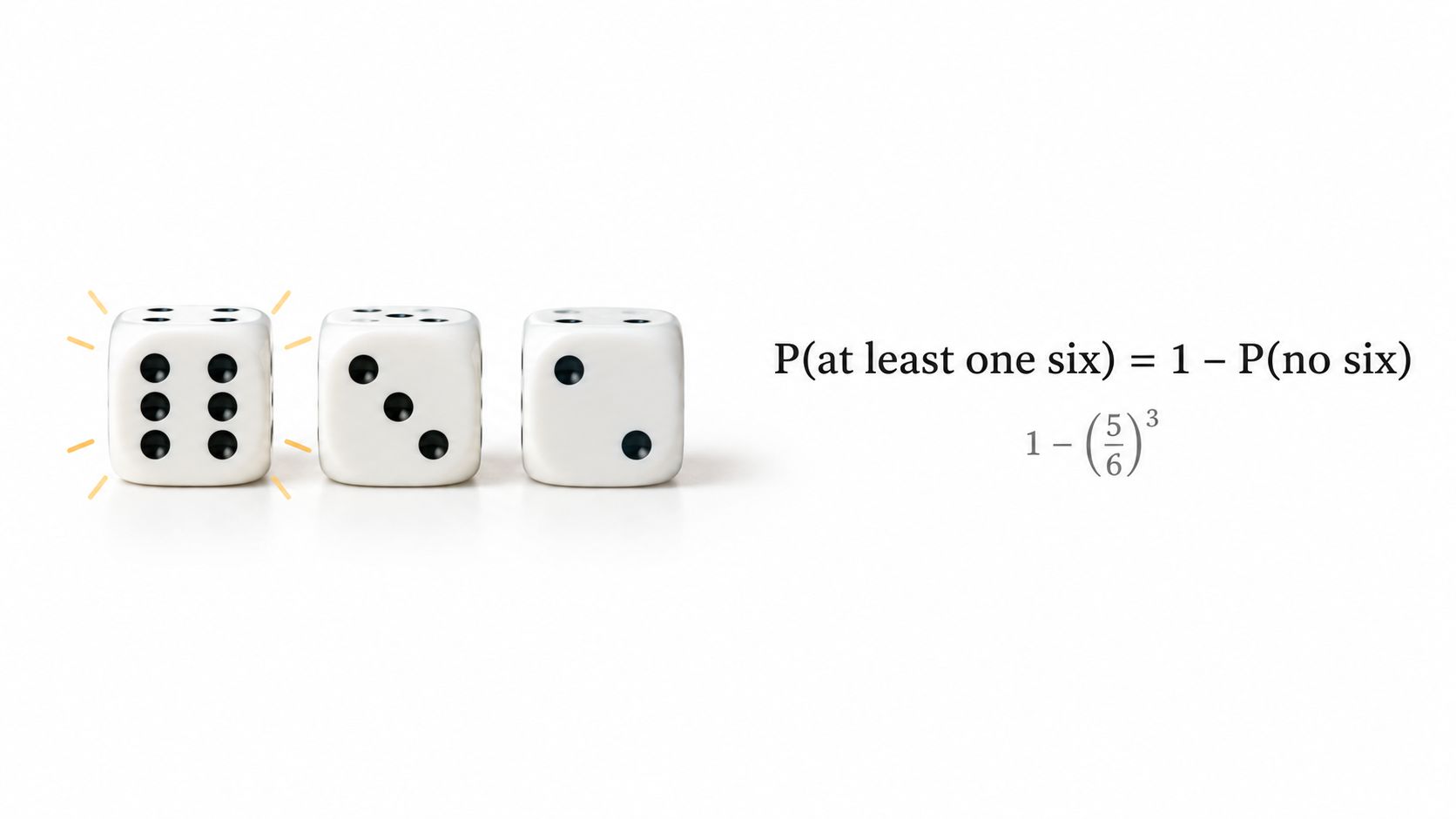
For the probability of at least one six in three die rolls, find the opposite event first: no sixes. The probability of no six on one roll is (5/6), so the probability of no sixes across three independent rolls is:
[
\frac{5}{6} \times \frac{5}{6} \times \frac{5}{6}
]
Then subtract from 1:
[
P(\text{at least one six}) = 1 - P(\text{no sixes})
]
This avoids separately calculating the paths for exactly one six, exactly two sixes, and exactly three sixes. If the trials aren't independent, you can still use the complement idea, but you must use the correct changing branch probabilities.
Read the wording before drawing
“At most two” means two or fewer. “More than two” excludes two. “Exactly two” means no other outcome belongs in the calculation. Students often lose marks because they calculate a nearby event rather than the one in the question.
- Underline the key phrase: Identify whether the question says at least, at most, more than, or exactly.
- Name the opposite: For “at least one”, the opposite is “none”.
- Show the subtraction: Write (1 - P(\text{opposite})), not just the decimal answer.
- Sense-check the result: At least one includes exactly one, so it should not be smaller than the probability of exactly one.
Try it: A player has a constant chance of success on each attempt. Set up the complement calculation for at least one success in three attempts, leaving the success probability as (p).
4. Probability Trees with Independent Repeated Trials
A repeated trial is independent when the outcome of one trial doesn't change the probabilities for the next. Tossing a coin, rolling a die, or drawing a card with replacement can all create this structure, provided the stated conditions keep the probabilities constant.
Suppose a biased coin has probability (p) of heads and (1-p) of tails. On every stage of the tree, the heads branch has probability (p), and the tails branch has probability (1-p). The branches repeat because the previous result hasn't changed the next trial.
For a short sequence, a tree shows the routes clearly. The probability of heads, tails, heads is:
[
p(1-p)p
]
If the question asks for exactly two heads in three tosses, identify every route with two heads, calculate each route, and add them. At A-Level, a binomial calculation may be more efficient for repeated independent trials, but your method still depends on recognising independence first. You can revise discrete random variables on MasteryMind if you need more practice connecting repeated trials with distributions.
Examiner-aware check: Identical-stage branches should have identical probabilities. If they don't, ask whether the question describes dependence, replacement, or a changing condition.
A tree becomes awkward when there are many repetitions. That isn't a reason to abandon the question. It's a prompt to choose a suitable method, such as a binomial formula at A-Level, while still explaining the event you're calculating.
Try it: A fair coin is tossed three times. Write the probability of the path tails, heads, tails, then list the other paths containing exactly one head.
5. Reverse Probability Trees Working Backwards from Outcomes
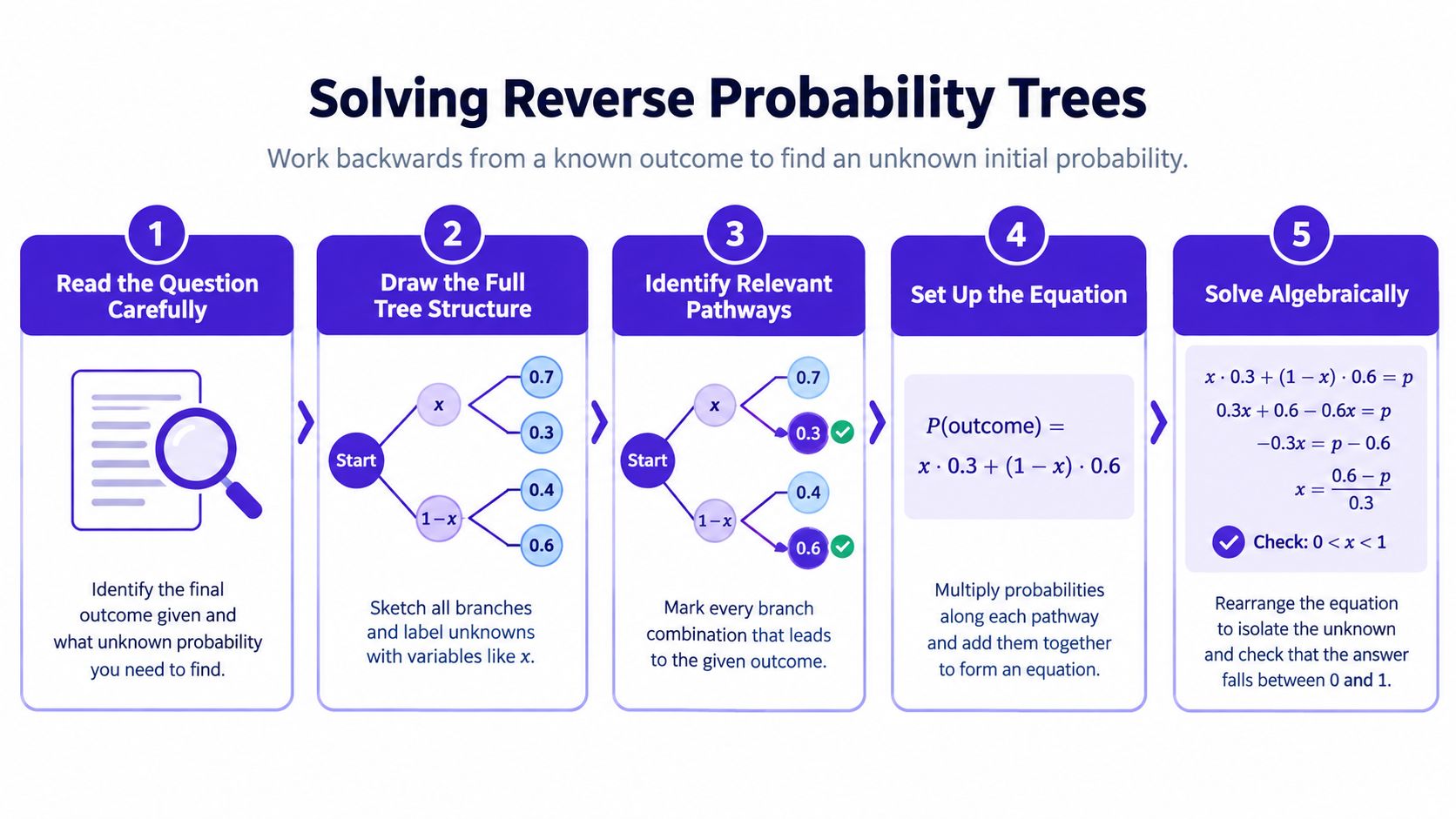
Some of the hardest questions give you a final probability and ask you to recover a missing starting value. You can't solve these by moving mechanically from left to right. Draw the full tree, use a letter such as (x) for the unknown branch, and translate the stated outcome into an equation.
Suppose the probability of success on the first trial is (x), and the probability of success on the second trial is (1/2), regardless of the first result. If the probability of two successes is given as (3/16), the relevant path gives:
[
x \times \frac{1}{2} = \frac{3}{16}
]
Solving the equation gives the missing first-stage probability. The important point isn't the algebra alone. You must first identify which complete path the information describes.
If the given outcome could happen through more than one route, add the routes before solving. For example, a final outcome might be “one success”, which could mean success then failure or failure then success. In that case, write both products and add them.
Work backwards safely
- Mark the known outcome: Circle the end result described in the question.
- Trace every route: Include all paths that produce that result.
- Use an unknown carefully: Label the missing branch (x), then label its complement (1-x) where appropriate.
- Check the solution: A probability must lie between 0 and 1, and complementary branches must add to 1.
Reread the exact wording before rearranging. “The probability of two successes” is not the same as “the probability of at least one success”, and confusing those events produces tidy algebra with the wrong answer.
Try it: Let the first success probability be (x), with a constant second success probability of (2/3). If two successes have probability (1/3), form and solve the equation for (x).
6. Probability Trees with Conditional Probability and Bayes' Theorem
Conditional probability reverses the direction of the question. Instead of asking, “What result will the test produce?”, you're asked, “Given this result, what was the original cause?” A medical test example might ask for the probability that a person has a condition given that the test is positive.
Build the tree with possible causes first. One starting branch represents having the condition, and the other represents not having it. From each cause, draw the test outcomes, such as positive and negative. Label the test's true-positive and false-positive probabilities exactly as provided in the question.
Then calculate the complete paths that end in a positive result. The positive outcome can come from more than one starting cause. Bayes' theorem selects the path you want from all paths consistent with the given information:
[
P(A \mid B) = \frac{P(A \text{ and } B)}{P(B)}
]
Here, (P(B)) is the total probability of the given result. It's found by adding every relevant path ending in that result, not by using just the path you hope is the answer.
Keep the denominator honest
If the question says “given that the test is positive”, the denominator is the probability of a positive test. It includes positive tests from people with the condition and positive tests from people without it. That's the step students most often skip.
- Start with causes: Put the original possibilities on the first set of branches.
- Add outcomes: Place the evidence or test result on the next branches.
- Multiply paths: Find the joint probability for each complete route.
- Divide correctly: Desired positive path divided by all positive paths.
For further examples involving conditional probability, use the MasteryMind probability study guide.
A short visual explanation can also help you see why the denominator includes every route that matches the given evidence.
Try it: Create a two-stage test tree with “condition” and “no condition” first. Leave the starting probabilities as symbols, then write the formula for the probability of the condition given a positive result.
7. Mixed-Topic Probability Trees Combining Other Concepts
Mixed questions reward organisation more than speed. A tree might provide the probabilities for a distribution, while the rest of the question asks for an expected value, a comparison, or a further probability. Treat the tree as the first calculation, not the entire task.
Imagine drawing two counters without replacement and receiving a score based on the colours drawn. First, create every valid pathway and calculate its probability. Next, combine paths that produce the same score. Finally, use the resulting distribution for the requested calculation, such as an expected value.
For an expected value, multiply each possible score by its probability and add the products:
[
E(X) = \sum xP(X=x)
]
The tree supplies the probabilities. It doesn't automatically tell you which later formula to use. Read the command words and split the question into jobs.
- Identify the first job: Decide whether you need a tree, a distribution, or both.
- Complete the pathways: Label outcomes and calculate their probabilities.
- Group matching results: Several paths may lead to the same score.
- Apply the next idea: Use expected value, variance, standard deviation, or another stated method.
- Check each stage: An early tree error will affect every later answer.
A cumulative question may compare selection with replacement against selection without replacement. In the first case, probabilities can stay constant. In the second, they can change. That contrast may be the mathematical point, so don't assume the same method applies throughout.
Students who want to browse mathematics subjects can use mixed practice to connect separate topics rather than revising each formula in isolation.
Try it: Build a tree for two draws, assign a score to each final outcome, combine equal scores, and write the expected-value expression without evaluating it.
Comparison of 7 Probability Tree Question Types
| Topic | Implementation complexity 🔄 | Resource / Effort ⚡ | Expected outcomes ⭐📊 | Ideal use cases 💡 | Key advantages ⭐ |
|---|---|---|---|---|---|
| Two-Stage Dependent Events with Conditional Probability | Medium, two sequential stages, probabilities change after first event | Low, simple tree, few branches, quick to draw & compute | ⭐⭐⭐⭐, clear combined probabilities; good for checking understanding of conditional rules 📊 | GCSE-level problems, draws without replacement, short diagnostic questions | Visual clarity; enforces correct use of conditional probability |
| Three-Stage Probability Trees with Multiple Outcomes | High, more branches and bookkeeping across three levels 🔄 | Medium, more time and space; risk of messy diagrams ⚡ | ⭐⭐⭐⭐, stronger practice in multi-step calculation and organization 📊 | A‑Level or higher-tier GCSE; multi-round scenarios and complex pathway enumeration | Builds systematic tracking and resilience with multi-step problems |
| Probability Trees with "At Least" Scenarios | Medium, conceptually simple if complement is used 🔄 | Very efficient if using complement (1 − P(opposite)); otherwise costly ⚡ | ⭐⭐⭐⭐, very efficient solutions and fewer errors when complement applied 📊 | Questions asking "at least one/at most k" across repeated trials | Encourages strategic thinking; reduces calculation burden using complement |
| Probability Trees with Independent Repeated Trials | Low, identical-stage branches, no probability updates 🔄 | Moderate, trees get large for many trials; binomial formula often preferable ⚡ | ⭐⭐⭐, solid understanding of independence; clear mapping to binomial models 📊 | Repeated trials with replacement, coin flips, binomial practice at GCSE/A‑Level | Reinforces independence concept; links to binomial distribution |
| Reverse Probability Trees: Working Backwards from Outcomes | Very high, requires setting unknowns and algebraic inversion 🔄 | High, algebraic setup and careful identification of pathways required ⚡ | ⭐⭐⭐⭐, deep conceptual gains; tests true understanding rather than procedure 📊 | Challenge/A‑Level questions or examiner-style problem solving | Develops algebraic manipulation and pathway-identification skills |
| Probability Trees with Conditional Probability (Bayes' Theorem) | High, must organize causes and outcomes, apply Bayes correctly 🔄 | Medium, careful calculations and summing of pathways; can be intensive ⚡ | ⭐⭐⭐⭐⭐, high exam value and real‑world applicability; strong inference results 📊 | Medical testing, quality control, forensic or diagnostic inference at A‑Level | Teaches conditional inference; directly applies to real-world decision problems |
| Mixed-Topic Probability Trees: Combining Tree Diagrams with Other Concepts | Very high, integrates trees with combinations, expectation, distributions 🔄 | Very high, broad knowledge and more time; multi-step computations ⚡ | ⭐⭐⭐⭐⭐, demonstrates comprehensive mastery; high marks in integrated questions 📊 | A‑Level cumulative problems, exam long answers requiring multiple techniques | Tests holistic understanding; prepares students for complex, real-world problems |
Turn Each Tree into Exam Marks
A strong probability tree solution follows a repeatable order. First, identify whether the events are independent or dependent. If an item is replaced, probabilities may stay the same. If it isn't replaced, or if the first result changes the next situation, update the second-stage labels.
Next, draw enough space for every branch and label each probability before calculating. Multiply along a complete path. Then add only the complete paths that answer the wording. “One red and one blue” may require several routes, while “red then blue” may require only one.
Use this compact routine when you're practising:
- Classify the events: Decide whether probabilities change.
- Translate the wording: Mark exactly, at least, at most, and given that.
- Build the tree: Include every outcome and its complement.
- Calculate in order: Multiply along paths, then add matching paths.
- Check the result: Confirm branch totals, the event meaning, and whether the answer is sensible.
Don't just repeat questions you've already seen. Sort mistakes by type. Did you copy a dependent probability as though it were independent? Did you forget a second path? Did you use the probability of a positive result as the numerator when the question asked for a particular cause? Each error needs a slightly different repair.
For students, the progression above creates a sensible route from two-stage trees to reverse probability and mixed-topic problems. After every attempt, cover the final answer and explain the tree aloud. For teachers, the same sequence can support targeted intervention, with one question type used to isolate one misconception before introducing a more demanding combination.
Exam preparation also rewards wider mathematical confidence. If you're building skills for a functional maths route, you can unlock your university place with maths while continuing to practise precise interpretation and clear working. MasteryMind can also provide step-by-step maths verification, so students can compare their reasoning with structured feedback rather than checking only the final number.
The best final check is simple. Ask yourself: Did I draw the right tree, label every branch, multiply every required path, add only relevant paths, and answer the specific question asked? If the answer is yes, you're turning a diagram into method marks and a final result you can trust.
MasteryMind offers UK-focused GCSE and A-Level practice with examiner-aligned questions, step-by-step maths verification, and feedback that helps identify where a probability tree solution went wrong. Visit MasteryMind to practise dependent, conditional, reverse, and mixed-topic probability questions with a clearer revision routine.
Ready to master this topic?
Practise with quizzes, blurt exercises and exam questions on MasteryMind.
7 days Premium · Then free forever · No card, no charge