AQA · GCSE · Biology
Course version: 8461 · Version from Sept 2018
Adaptations: These adaptations may be structural, behavioural or functional.
Adaptations are grouped by what they involve.
Checked against the AQA 8461 specification (opens in a new tab) on .
- Point 3 of 6
- 4 key terms
Study notes
From the checked teaching notes for this specification point.
The idea
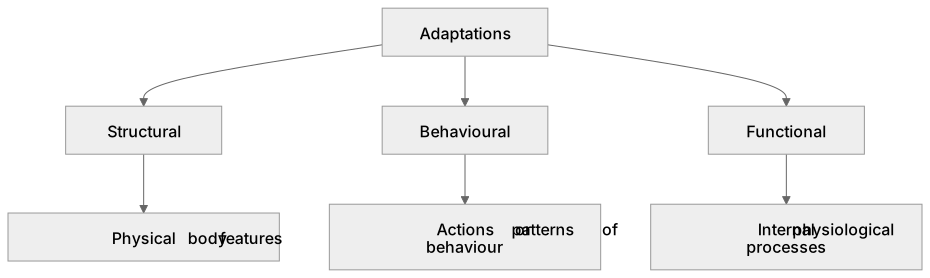
Adaptations are grouped by what they involve. Structural adaptations are physical body features, such as the thick fur of a polar bear, the streamlined shape of a dolphin or the waxy cuticle of a leaf. Behavioural adaptations are actions or patterns of behaviour, such as migrating, hibernating, basking in the sun or hunting at night. Functional adaptations are internal physiological processes, such as producing concentrated urine, reducing metabolic rate during dormancy or tolerating high salt concentrations in cells. Some features can be described in more than one way, so classify by the main process involved and justify your choice. In an answer, name the adaptation, place it in the correct category and explain how it helps the organism survive in its habitat.
What earns the marks
- States that structural adaptations are physical features of the body or surface of an organism.
- States that behavioural adaptations are actions or patterns of behaviour carried out by the organism.
- States that functional adaptations are internal physiological or metabolic processes.
- Classifies a named example correctly and justifies the classification with reference to the feature or process involved.
- Explains how the classified adaptation improves survival or reproduction in the organism's habitat.
Common mistakes and how to put them right
Calling a behaviour a structural adaptation.
Put it right by checking whether the feature is a body part or an action.
Treating a functional adaptation as an external feature.
Put it right by identifying the internal process, such as water balance or metabolic rate.
Giving an example without a category or explanation.
Put it right by naming the type and linking it to survival.
Exam tips
- Use the labels structural, behavioural and functional explicitly in your answer.
- For each example, add one sentence explaining the survival benefit.
- If an example could fit two categories, state your chosen category and justify it briefly.
Try the lesson
The start of the Adaptations: These adaptations may be structural, behavioural or functional. lesson, made from checked teaching notes for this specification point.
Have a go first
Which of these is a behavioural adaptation?
Listen
Adaptations are grouped by what they involve. Structural adaptations are physical body features, such as the thick fur of a polar bear, the streamlined shape of a dolphin or the waxy cuticle of a leaf. Behavioural adaptations are actions or patterns of behaviour, such as migrating, hibernating, basking in the sun or hunting at night. Functional adaptations are internal physiological processes, such as producing concentrated urine, reducing metabolic rate during dormancy or tolerating high salt concentrations in cells. Some features can be described in more than one way, so classify by the main process involved and justify your choice. In an answer, name the adaptation, place it in the correct category and explain how it helps the organism survive in its habitat. A strong answer earns marks for these points. States that structural adaptations are physical features of the body or surface of an organism. States that behavioural adaptations are actions or patterns of behaviour carried out by the organism. States that functional adaptations are internal physiological or metabolic processes. Classifies a named example correctly and justifies the classification with reference to the feature or process involved. A common slip: Calling a behaviour a structural adaptation. Instead, checking whether the feature is a body part or an action. Exam tip: Use the labels structural, behavioural and functional explicitly in your answer.
See it
Key words
Say what each word means before you turn the card.
Structural adaptations
Try answering aloud or in your head before turning the card.
Behavioural adaptations
Try answering aloud or in your head before turning the card.
Functional adaptations
Try answering aloud or in your head before turning the card.
Classification of adaptations
Try answering aloud or in your head before turning the card.
See every definition
- Structural adaptations
- Physical features of the body or surface of an organism, such as the thick fur of a polar bear or the waxy cuticle of a leaf.
- Behavioural adaptations
- Actions or patterns of behaviour carried out by the organism, such as migrating, hibernating, basking in the sun or hunting at night.
- Functional adaptations
- Internal physiological or metabolic processes, such as producing concentrated urine or reducing metabolic rate during dormancy.
- Classification of adaptations
- Grouping adaptations by the main process involved, naming the adaptation, placing it in the correct category and explaining how it helps the organism survive in its habitat.
Label the diagram
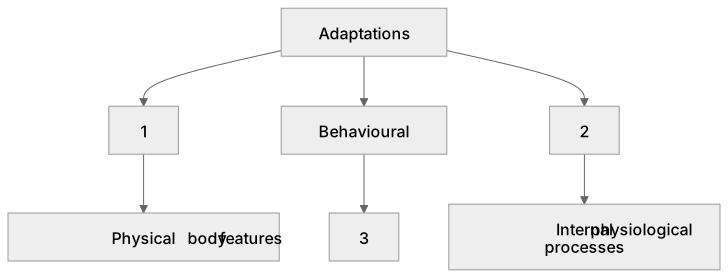
Some boxes have lost their names. Pick the right name for each number.
1Box 1
2Box 2
3Box 3
There is more to this lesson
The full lesson goes on to check your understanding and help you earn the marks. Create a free account to carry on, with your progress saved.
A week of Premium from your first lesson · Then the free plan continues · No card, no charge
Test your understanding of Adaptations: These adaptations may be structural, behavioural or functional.
Active recall beats re-reading. Take an instant quiz now to test what you’ve learned and lock it into long-term memory.
A week of Premium from your first lesson · Then the free plan continues · No card, no charge