AQA · GCSE · Biology
Course version: 8461 · Version from Sept 2018
They may infect plants or animals and can be spread by direct contact, by…
Full specification wording
Communicable (infectious) diseases: They may infect plants or animals and can be spread by direct contact, by water or by air.
Pathogens are not restricted to humans: they infect plants and other animals too, impacting food security and ecosystems.
Checked against the AQA 8461 specification (opens in a new tab) on .
- Point 5 of 8
- 3 key terms
Study notes
From the checked teaching notes for this specification point.
The idea
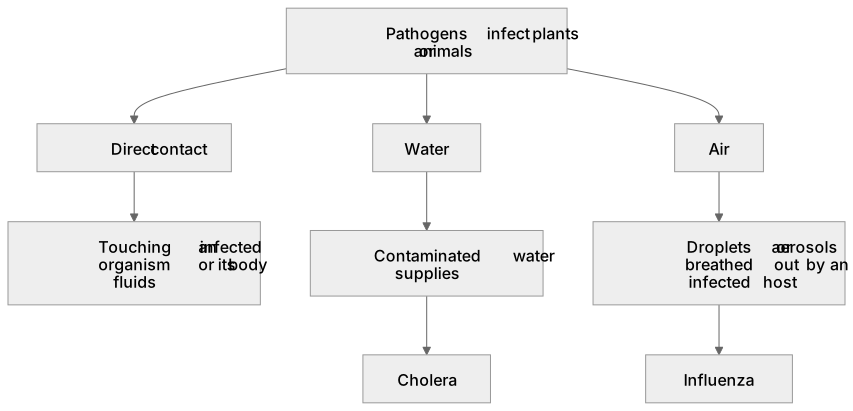
Pathogens are not restricted to humans: they infect plants and other animals too, impacting food security and ecosystems. Transmission routes include direct contact, water and air. Direct contact covers touching an infected organism, contact with body fluids, or transfer between plant leaves. Water-borne spread occurs when pathogens contaminate drinking water, as with cholera. Airborne spread occurs when pathogens are carried in droplets or aerosols breathed out by an infected host, as with influenza. For plants, vectors such as insects also matter, but the specification examples are direct contact, water and air.
What earns the marks
- States that pathogens can infect both plants and animals.
- Describes direct contact as transfer by touching an infected organism or its body fluids.
- Describes water-borne transmission through contaminated water supplies.
- Describes airborne transmission through droplets or aerosols inhaled by a new host.
- Links a named disease, such as cholera to water or influenza to air, to its main transmission route.
- Explains how a transmission route allows a pathogen to reach and enter a new host.
Common mistakes and how to put them right
Assuming only humans are affected.
Put it right by giving a plant disease example such as rose black spot.
Confusing water-borne with airborne spread by stating droplets are water-borne.
Put it right by classifying droplet transmission as airborne.
Describing a route without linking it to a named disease.
Put it right by pairing each route with an example.
Exam tips
- Use the phrase direct contact, water or air exactly when listing routes to match the specification.
- For each route, add one sentence explaining how the pathogen reaches a new host.
- Remember that cholera is spread by contaminated water, whereas droplet infection is an example of airborne transmission.
Try the lesson
The start of the Communicable (infectious) diseases: They may infect plants or animals and can be spread by direct contact, by water or by air. lesson, made from checked teaching notes for this specification point.
Have a go first
Pathogens cause communicable diseases in plants and animals. Which of the following is a common way that these pathogens can be spread?
Listen
Pathogens are not restricted to humans: they infect plants and other animals too, impacting food security and ecosystems. Transmission routes include direct contact, water and air. Direct contact covers touching an infected organism, contact with body fluids, or transfer between plant leaves. Water-borne spread occurs when pathogens contaminate drinking water, as with cholera. Airborne spread occurs when pathogens are carried in droplets or aerosols breathed out by an infected host, as with influenza. For plants, vectors such as insects also matter, but the specification examples are direct contact, water and air. A strong answer earns marks for these points. States that pathogens can infect both plants and animals. Describes direct contact as transfer by touching an infected organism or its body fluids. Describes water-borne transmission through contaminated water supplies. Describes airborne transmission through droplets or aerosols inhaled by a new host. A common slip: Assuming only humans are affected. Instead, giving a plant disease example such as rose black spot. Exam tip: Use the phrase direct contact, water or air exactly when listing routes to match the specification.
See it
Key words
Say what each word means before you turn the card.
Transmission routes
Try answering aloud or in your head before turning the card.
Direct contact
Try answering aloud or in your head before turning the card.
Airborne spread
Try answering aloud or in your head before turning the card.
See every definition
- Transmission routes
- Direct contact, water or air, by which pathogens spread to a new host.
- Direct contact
- Transfer by touching an infected organism or its body fluids, or transfer between plant leaves.
- Airborne spread
- Pathogens carried in droplets or aerosols breathed out by an infected host, as with influenza.
Label the diagram
Some boxes have lost their names. Pick the right name for each number.
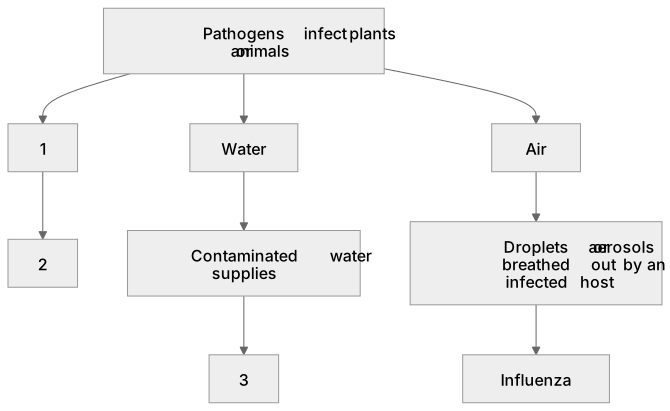
1Box 1
2Box 2
3Box 3
There is more to this lesson
The full lesson goes on to check your understanding and help you earn the marks. Create a free account to carry on, with your progress saved.
A week of Premium from your first lesson · Then the free plan continues · No card, no charge
Test your understanding of Communicable (infectious) diseases: They may infect plants or animals and can be spread by direct contact, by water or by air.
Active recall beats re-reading. Take an instant quiz now to test what you’ve learned and lock it into long-term memory.
A week of Premium from your first lesson · Then the free plan continues · No card, no charge