AQA · GCSE · Biology
Course version: 8461 · Version from Sept 2018
Pathogens may be viruses, bacteria, protists or fungi.
Full specification wording
Communicable (infectious) diseases: Pathogens may be viruses, bacteria, protists or fungi.
Pathogens belong to four broad groups: viruses, bacteria, protists and fungi.
Checked against the AQA 8461 specification (opens in a new tab) on .
- Point 4 of 8
- 4 key terms
Study notes
From the checked teaching notes for this specification point.
The idea
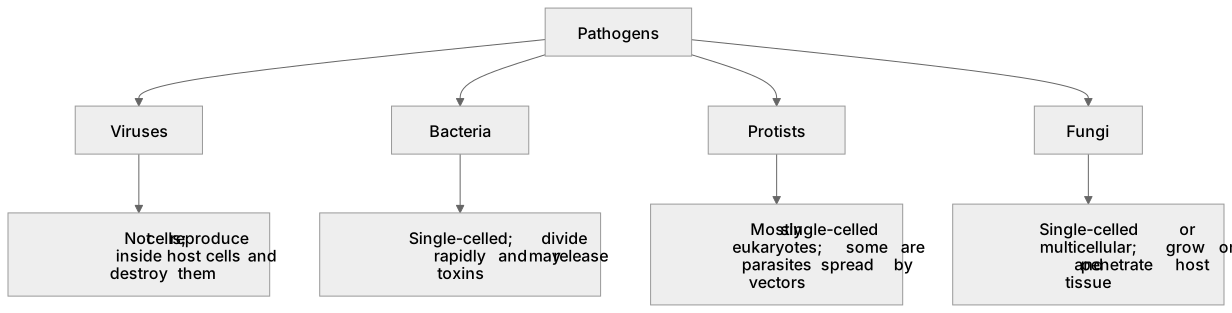
Pathogens belong to four broad groups: viruses, bacteria, protists and fungi. Each group has a different cell structure and method of causing harm, so treatment differs. Viruses are not cells; they reproduce inside host cells and destroy them. Bacteria are single-celled organisms that can divide rapidly and may release toxins. Protists are mostly single-celled eukaryotes, and some are parasites transmitted by vectors. Fungi may be single-celled or multicellular and can grow on and penetrate host tissue. Examples include influenza virus, the bacterium causing cholera, the protist causing malaria and the fungus causing rose black spot.
What earns the marks
- Lists viruses, bacteria, protists and fungi as the four pathogen groups.
- Describes viruses as non-cellular agents that reproduce inside host cells.
- Describes bacteria as single-celled organisms that divide rapidly and may release toxins.
- Describes protists as eukaryotic microorganisms, some of which are parasites spread by vectors.
- Describes fungi as organisms that can grow on and penetrate host tissue, causing damage.
- Classifies a named pathogen correctly into one of the four groups.
Common mistakes and how to put them right
Treating viruses as cells.
Put it right by stating they are non-cellular and reproduce only inside host cells.
Assuming all bacteria are pathogens.
Put it right by noting many are harmless or beneficial.
Placing malaria in the wrong group.
Put it right by identifying the malarial pathogen as a protist.
Exam tips
- Learn one named example for each of the four groups so classification questions are quick.
- Use structural features, such as presence of a cell or mode of reproduction, to justify the group.
- If asked to compare groups, give one similarity and one difference rather than two separate descriptions.
Try the lesson
The start of the Communicable (infectious) diseases: Pathogens may be viruses, bacteria, protists or fungi. lesson, made from checked teaching notes for this specification point.
Have a go first
A student is classifying different causes of infectious diseases. Which list correctly identifies the four main types of pathogen?
Listen
Pathogens belong to four broad groups: viruses, bacteria, protists and fungi. Each group has a different cell structure and method of causing harm, so treatment differs. Viruses are not cells; they reproduce inside host cells and destroy them. Bacteria are single-celled organisms that can divide rapidly and may release toxins. Protists are mostly single-celled eukaryotes, and some are parasites transmitted by vectors. Fungi may be single-celled or multicellular and can grow on and penetrate host tissue. Examples include influenza virus, the bacterium causing cholera, the protist causing malaria and the fungus causing rose black spot. A strong answer earns marks for these points. Lists viruses, bacteria, protists and fungi as the four pathogen groups. Describes viruses as non-cellular agents that reproduce inside host cells. Describes bacteria as single-celled organisms that divide rapidly and may release toxins. Describes protists as eukaryotic microorganisms, some of which are parasites spread by vectors. A common slip: Treating viruses as cells. Instead, stating they are non-cellular and reproduce only inside host cells. Exam tip: Learn one named example for each of the four groups so classification questions are quick.
See it
Key words
Say what each word means before you turn the card.
Viruses
Try answering aloud or in your head before turning the card.
Bacteria
Try answering aloud or in your head before turning the card.
Protists
Try answering aloud or in your head before turning the card.
Fungi
Try answering aloud or in your head before turning the card.
See every definition
- Viruses
- Non-cellular agents that reproduce inside host cells and destroy them.
- Bacteria
- Single-celled organisms that can divide rapidly and may release toxins.
- Protists
- Mostly single-celled eukaryotes, some of which are parasites transmitted by vectors.
- Fungi
- Organisms that may be single-celled or multicellular and can grow on and penetrate host tissue.
Label the diagram
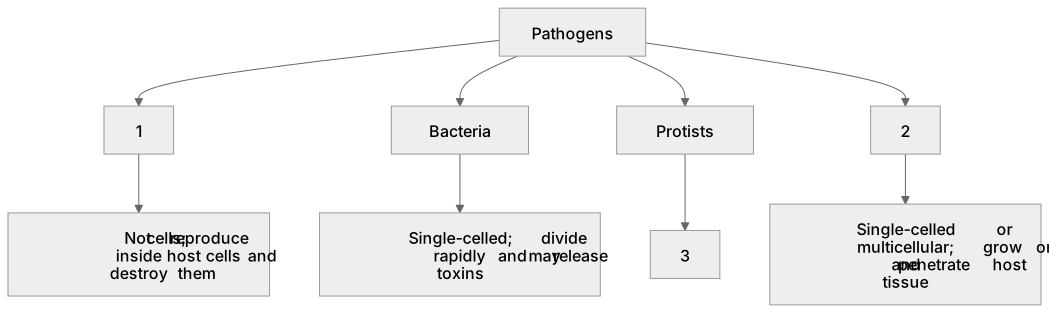
Some boxes have lost their names. Pick the right name for each number.
1Box 1
2Box 2
3Box 3
There is more to this lesson
The full lesson goes on to check your understanding and help you earn the marks. Create a free account to carry on, with your progress saved.
A week of Premium from your first lesson · Then the free plan continues · No card, no charge
Test your understanding of Communicable (infectious) diseases: Pathogens may be viruses, bacteria, protists or fungi.
Active recall beats re-reading. Take an instant quiz now to test what you’ve learned and lock it into long-term memory.
A week of Premium from your first lesson · Then the free plan continues · No card, no charge