AQA · GCSE · Biology
Course version: 8461 · Version from Sept 2018
Students should be able to, when provided with appropriate information: •…
Full specification wording
Communities: Students should be able to, when provided with appropriate information: • suggest the factors for which organisms are competing in a given habitat • suggest how organisms are adapted to the conditions in which they live.
When data or a description of a habitat is supplied, you must reason from the evidence rather than recall a list.
Checked against the AQA 8461 specification (opens in a new tab) on .
- Point 2 of 11
- 4 key terms
Study notes
From the checked teaching notes for this specification point.
The idea
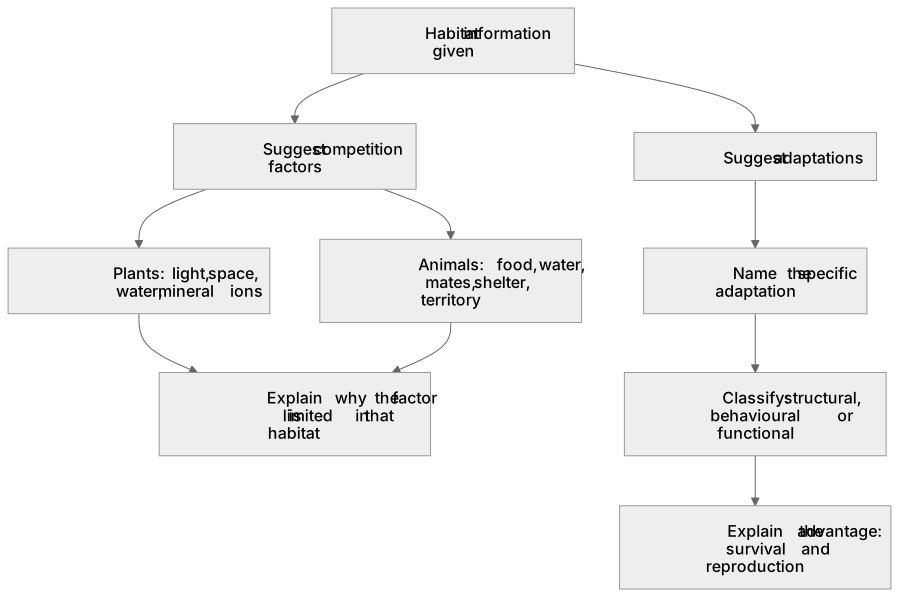
When data or a description of a habitat is supplied, you must reason from the evidence rather than recall a list. To suggest competition factors, identify limited resources: plants compete for light, space, water and mineral ions; animals compete for food, water, mates, shelter and territory. For example, in a dense wood, tall trees shade smaller plants, so light is a key factor. To suggest adaptations, link a feature to its advantage in that habitat. A camel has a humped fat store and concentrated urine for dry conditions; a polar bear has thick fur, a white coat and a layer of fat for cold and camouflage. Structural adaptations are body features, behavioural adaptations are actions, and functional adaptations are internal processes. Always name the feature, then explain how it helps the organism survive and reproduce there.
What earns the marks
- Identify competition factors from the information given, such as light, space, water and mineral ions for plants, or food, mates, shelter and territory for animals.
- Explain why the named factor is limited in that habitat, using evidence from the data or description.
- Name a specific adaptation of the organism rather than describing it vaguely.
- Classify the adaptation as structural, behavioural or functional where the question requires it.
- Explain how the adaptation gives an advantage in the stated conditions, linking it to survival and reproduction.
- Use comparative language, such as more likely to survive, when explaining the benefit of an adaptation.
Common mistakes and how to put them right
Listing competition factors without linking them to the habitat.
Put it right: State why that resource is scarce in the given conditions.
Naming an adaptation without explaining its advantage.
Put it right: Add how the feature helps the organism survive or reproduce.
Mixing up structural and behavioural adaptations.
Put it right: Check whether the feature is a body part or an action.
Exam tips
- Read the habitat description carefully and quote or refer to the data when suggesting competition factors.
- Use the structure: feature → how it works → advantage in this habitat.
- If the question says suggest, use the information provided and apply your biological knowledge rather than repeating the stem.
Try the lesson
The start of the Communities: Students should be able to, when provided with appropriate information: • suggest the factors for which organisms are competing in a given habitat • suggest how organisms are adapted to the conditions in which they live. lesson, made from checked teaching notes for this specification point.
Have a go first
Two foxglove plants grow close together in a woodland. Which of the following lists the main resources these plants compete for?
Listen
When data or a description of a habitat is supplied, you must reason from the evidence rather than recall a list. To suggest competition factors, identify limited resources: plants compete for light, space, water and mineral ions; animals compete for food, water, mates, shelter and territory. For example, in a dense wood, tall trees shade smaller plants, so light is a key factor. To suggest adaptations, link a feature to its advantage in that habitat. A camel has a humped fat store and concentrated urine for dry conditions; a polar bear has thick fur, a white coat and a layer of fat for cold and camouflage. Structural adaptations are body features, behavioural adaptations are actions, and functional adaptations are internal processes. Always name the feature, then explain how it helps the organism survive and reproduce there. A strong answer earns marks for these points. Identify competition factors from the information given, such as light, space, water and mineral ions for plants, or food, mates, shelter and territory for animals. Explain why the named factor is limited in that habitat, using evidence from the data or description. Name a specific adaptation of the organism rather than describing it vaguely. Classify the adaptation as structural, behavioural or functional where the question requires it. A common slip: Listing competition factors without linking them to the habitat. Instead, state why that resource is scarce in the given conditions. Exam tip: Read the habitat description carefully and quote or refer to the data when suggesting competition factors.
See it
Key words
Say what each word means before you turn the card.
Competition for limited resources
Try answering aloud or in your head before turning the card.
Adaptation to environmental conditions
Try answering aloud or in your head before turning the card.
Structural, behavioural and functional adaptations
Try answering aloud or in your head before turning the card.
Using evidence from data
Try answering aloud or in your head before turning the card.
See every definition
- Competition for limited resources
- Plants compete for light, space, water and mineral ions, while animals compete for food, water, mates, shelter and territory.
- Adaptation to environmental conditions
- A feature linked to its advantage in a habitat, named and then explained in how it helps the organism survive and reproduce there.
- Structural, behavioural and functional adaptations
- Structural adaptations are body features, behavioural adaptations are actions, and functional adaptations are internal processes.
- Using evidence from data
- Reasoning from the supplied data or habitat description rather than recalling a list, quoting or referring to the data when suggesting competition factors.
Label the diagram
Some boxes have lost their names. Pick the right name for each number.
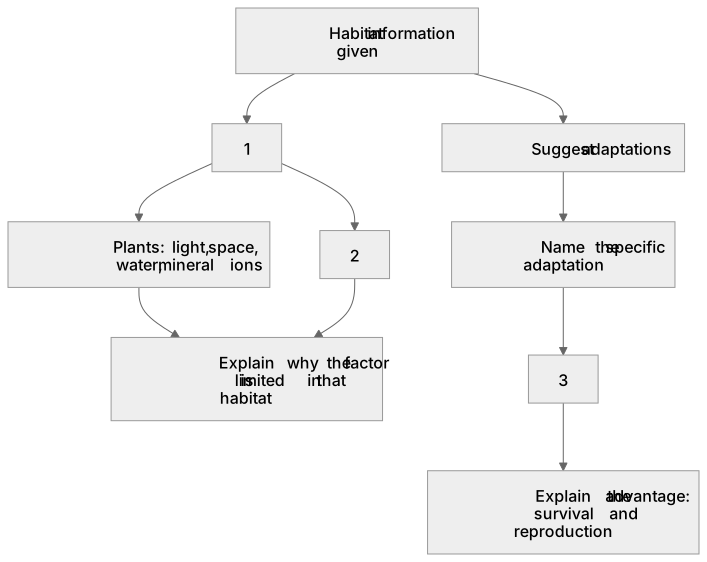
1Box 1
2Box 2
3Box 3
There is more to this lesson
The full lesson goes on to check your understanding and help you earn the marks. Create a free account to carry on, with your progress saved.
A week of Premium from your first lesson · Then the free plan continues · No card, no charge
Test your understanding of Communities: Students should be able to, when provided with appropriate information: • suggest the factors for which organisms are competing in a given habitat • suggest how organisms are adapted to the conditions in which they live.
Active recall beats re-reading. Take an instant quiz now to test what you’ve learned and lock it into long-term memory.
A week of Premium from your first lesson · Then the free plan continues · No card, no charge