AQA · GCSE · Biology
Course version: 8461 · Version from Sept 2018
Bacterial cells (prokaryotic cells) are much smaller in comparison.
Full specification wording
Eukaryotes and prokaryotes: Bacterial cells (prokaryotic cells) are much smaller in comparison.
Bacterial cells are prokaryotic and are far smaller than eukaryotic cells.
Checked against the AQA 8461 specification (opens in a new tab) on .
- Point 2 of 6
- 4 key terms
Study notes
From the checked teaching notes for this specification point.
The idea
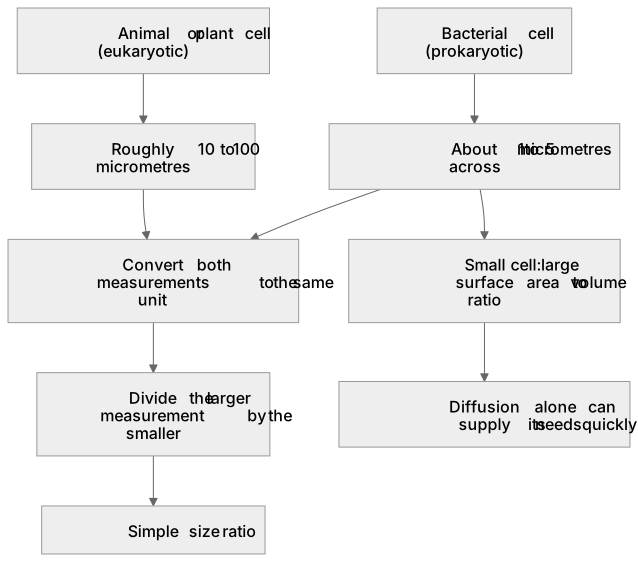
Bacterial cells are prokaryotic and are far smaller than eukaryotic cells. A typical bacterium is about 1 to 5 micrometres across, while a typical animal or plant cell is roughly 10 to 100 micrometres. That size gap matters because it explains why bacteria require higher magnification to observe internal structures compared to eukaryotic cells, and why they pass through filters that trap eukaryotic cells. Size also links to surface area to volume ratio: a small cell has a large surface area relative to its volume, so diffusion alone can supply its needs quickly. When comparing, use the same unit for both cells, for example convert 0.002 mm to 2 micrometres before stating the ratio. A useful method is to divide the larger measurement by the smaller to give a simple size ratio.
What earns the marks
- States that bacterial cells are prokaryotic and smaller than eukaryotic cells.
- Gives a sensible order of magnitude, such as bacteria being roughly 1 to 5 micrometres across.
- Uses the same unit for both measurements before comparing cell sizes.
- Calculates a size ratio by dividing the larger measurement by the smaller.
- Links small size to a large surface area to volume ratio and rapid diffusion.
Common mistakes and how to put them right
Comparing a measurement in millimetres with one in micrometres without converting.
Put it right by converting both to the same unit first.
Writing that bacteria are smaller because they lack a nucleus.
Put it right by treating size and nucleus as separate differences.
Giving a single vague word such as tiny.
Put it right by quoting approximate measurements or a ratio.
Exam tips
- Convert all lengths to micrometres before you compare, and show the conversion in your working.
- Quote a numerical ratio such as 20:1 rather than saying much smaller.
- If a scale bar is given, measure the cell in the image and use the scale bar to convert to real size.
Try the lesson
The start of the Eukaryotes and prokaryotes: Bacterial cells (prokaryotic cells) are much smaller in comparison. lesson, made from checked teaching notes for this specification point.
Have a go first
How does the size of a bacterial cell compare with the size of a plant cell?
Listen
Bacterial cells are prokaryotic and are far smaller than eukaryotic cells. A typical bacterium is about 1 to 5 micrometres across, while a typical animal or plant cell is roughly 10 to 100 micrometres. That size gap matters because it explains why bacteria require higher magnification to observe internal structures compared to eukaryotic cells, and why they pass through filters that trap eukaryotic cells. Size also links to surface area to volume ratio: a small cell has a large surface area relative to its volume, so diffusion alone can supply its needs quickly. When comparing, use the same unit for both cells, for example convert 0.002 mm to 2 micrometres before stating the ratio. A useful method is to divide the larger measurement by the smaller to give a simple size ratio. A strong answer earns marks for these points. States that bacterial cells are prokaryotic and smaller than eukaryotic cells. Gives a sensible order of magnitude, such as bacteria being roughly 1 to 5 micrometres across. Uses the same unit for both measurements before comparing cell sizes. Calculates a size ratio by dividing the larger measurement by the smaller. A common slip: Comparing a measurement in millimetres with one in micrometres without converting. Instead, converting both to the same unit first. Exam tip: Convert all lengths to micrometres before you compare, and show the conversion in your working.
See it
Watch it explained
What is the one idea the video explains? Say it in a sentence.
Read the described scene instead
Bacterial cells are prokaryotic, and they are far smaller than eukaryotic cells. A typical bacterium is about one to five micrometres across. A typical animal or plant cell is roughly ten to one hundred micrometres. That size gap matters because it changes how we study them. So what separates the two groups? Prokaryotic cells, like bacteria, have no nucleus, while eukaryotic cells do. But keep these two differences apart: bacteria are not smaller because they lack a nucleus. Size and the presence of a nucleus are separate differences. Bacteria need higher magnification to show internal structures, and they pass through filters that trap eukaryotic cells. Before you compare any two cells, put both measurements in the same unit. For example, convert 0.002 millimetres to micrometres: multiply by one thousand, giving two micrometres. Only then state the ratio. A useful method is to divide the larger measurement by the smaller, which gives a simple size ratio. Let's try it. Pause here and think: an animal cell is 40 micrometres across, and a bacterium is 2 micrometres across. What is the size ratio? Convert first — both are already in micrometres. Then divide the larger by the smaller: 40 divided by 2 is 20. So the ratio is 20 to 1. Show that working, not just a word like tiny. Watch for three common slips. First, comparing millimetres with micrometres without converting — fix it by converting both first. Second, writing that bacteria are smaller because they lack a nucleus — treat those as separate differences. Third, giving a vague word such as tiny — instead quote approximate measurements or a ratio. Finally, why does size matter? A small cell has a large surface area relative to its volume, so diffusion alone can supply its needs quickly. If you are given a scale bar, measure the cell in the image and use the scale bar to convert to real size. Convert, compare, then quote the ratio.
Key words
Say what each word means before you turn the card.
Prokaryotic cell structure
Try answering aloud or in your head before turning the card.
Scale and measurement in biology
Try answering aloud or in your head before turning the card.
Surface area to volume ratio
Try answering aloud or in your head before turning the card.
Use of the microscope
Try answering aloud or in your head before turning the card.
See every definition
- Prokaryotic cell structure
- Bacterial cells are prokaryotic cells and are much smaller in comparison with eukaryotic cells.
- Scale and measurement in biology
- Use the same unit for both cells when comparing, for example convert 0.002 mm to 2 micrometres before stating the ratio.
- Surface area to volume ratio
- A small cell has a large surface area relative to its volume, so diffusion alone can supply its needs quickly.
- Use of the microscope
- Bacteria require higher magnification to observe internal structures compared to eukaryotic cells.
Label the diagram
Some boxes have lost their names. Pick the right name for each number.
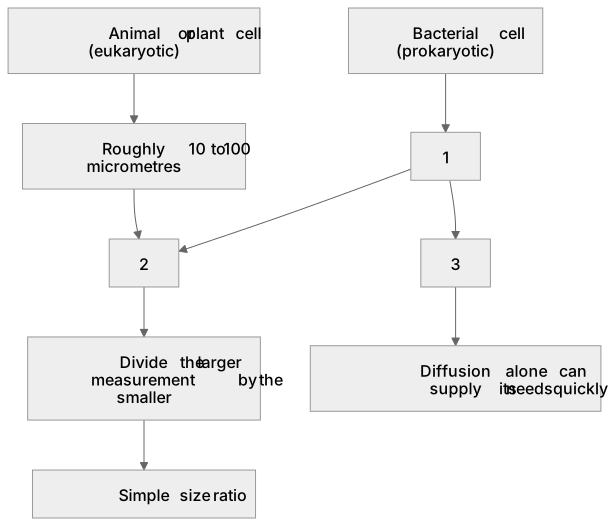
1Box 1
2Box 2
3Box 3
There is more to this lesson
The full lesson goes on to check your understanding and help you earn the marks. Create a free account to carry on, with your progress saved.
A week of Premium from your first lesson · Then the free plan continues · No card, no charge
Test your understanding of Eukaryotes and prokaryotes: Bacterial cells (prokaryotic cells) are much smaller in comparison.
Active recall beats re-reading. Take an instant quiz now to test what you’ve learned and lock it into long-term memory.
A week of Premium from your first lesson · Then the free plan continues · No card, no charge