AQA · GCSE · Biology
Course version: 8461 · Version from Sept 2018
The pituitary gland in the brain is a ‘master gland’ which secretes…
Full specification wording
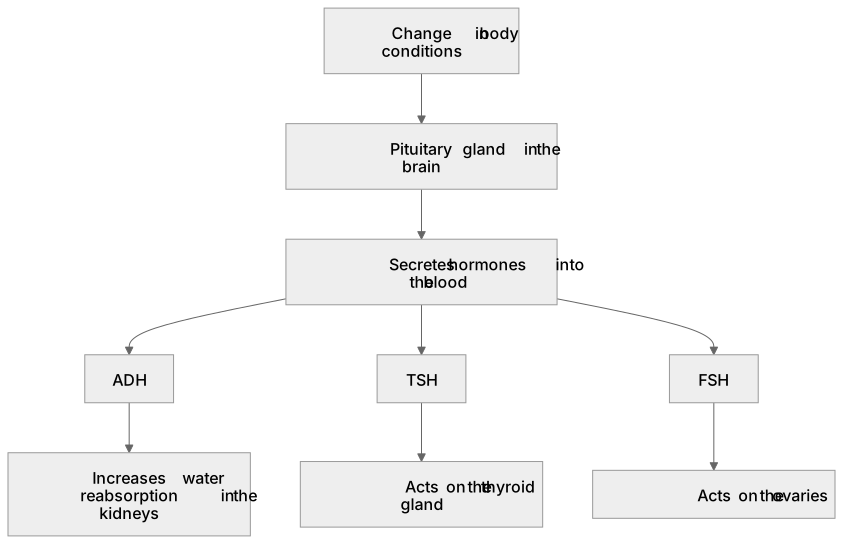
Human endocrine system: The pituitary gland in the brain is a ‘master gland’ which secretes several hormones into the blood in response to body conditions.
The pituitary gland is a small endocrine gland located at the base of the brain, just below the hypothalamus.
Checked against the AQA 8461 specification (opens in a new tab) on .
- Point 5 of 7
Study notes
From the checked teaching notes for this specification point.
The idea
The pituitary gland is a small endocrine gland located at the base of the brain, just below the hypothalamus. It is called the master gland because it secretes several hormones into the blood in response to changing body conditions, and some of those hormones control other endocrine glands. For example, when body water content falls, the pituitary releases antidiuretic hormone (ADH), which increases water reabsorption in the kidneys. The pituitary also releases thyroid-stimulating hormone (TSH), which acts on the thyroid gland, and follicle-stimulating hormone (FSH), which acts on the ovaries. Because its secretions influence so many other glands and processes, the pituitary coordinates much of the endocrine system.
What earns the marks
- The pituitary gland is located in the brain, below the hypothalamus.
- Its secretions are triggered by changes in body conditions, for example a fall in blood water content.
- Hormones from the pituitary travel in the blood to target organs, where they bring about specific effects.
- The pituitary itself is controlled by releasing factors from the hypothalamus.
Common mistakes and how to put them right
Saying the pituitary gland is in the abdomen.
Put it right: It is in the brain, at the base of the brain below the hypothalamus.
Writing that the pituitary secretes all the body's hormones.
Put it right: It secretes several hormones, some of which stimulate other glands to release their own hormones.
Confusing the pituitary with the pancreas.
Put it right: The pancreas secretes insulin and glucagon to control blood glucose, while the pituitary secretes hormones such as ADH and TSH.
Exam tips
- Name at least one pituitary hormone and its effect, such as ADH increasing water reabsorption in the kidneys.
- Explain the term master gland by linking it to control of other glands, not just to hormone release.
- Use the phrase in response to body conditions to show that secretion is regulated by internal change.
Try the lesson
The start of the Human endocrine system: The pituitary gland in the brain is a ‘master gland’ which secretes several hormones into the blood in response to body conditions. lesson, made from checked teaching notes for this specification point.
Have a go first
Which gland in the brain is described as the ‘master gland’ because it secretes several hormones into the blood?
Listen
The pituitary gland is a small endocrine gland located at the base of the brain, just below the hypothalamus. It is called the master gland because it secretes several hormones into the blood in response to changing body conditions, and some of those hormones control other endocrine glands. For example, when body water content falls, the pituitary releases antidiuretic hormone (ADH), which increases water reabsorption in the kidneys. The pituitary also releases thyroid-stimulating hormone (TSH), which acts on the thyroid gland, and follicle-stimulating hormone (FSH), which acts on the ovaries. Because its secretions influence so many other glands and processes, the pituitary coordinates much of the endocrine system. A strong answer earns marks for these points. The pituitary gland is located in the brain, below the hypothalamus. Its secretions are triggered by changes in body conditions, for example a fall in blood water content. Hormones from the pituitary travel in the blood to target organs, where they bring about specific effects. The pituitary itself is controlled by releasing factors from the hypothalamus. A common slip: Saying the pituitary gland is in the abdomen. Instead, it is in the brain, at the base of the brain below the hypothalamus. Exam tip: Name at least one pituitary hormone and its effect, such as ADH increasing water reabsorption in the kidneys.
See it
Label the diagram
Some boxes have lost their names. Pick the right name for each number.
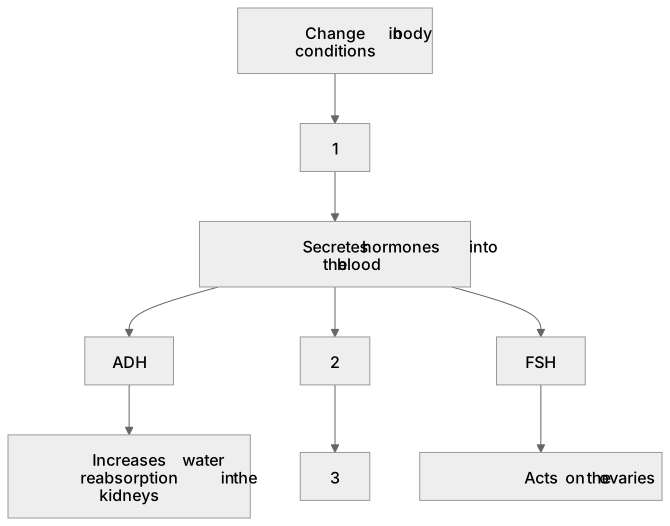
1Box 1
2Box 2
3Box 3
There is more to this lesson
The full lesson goes on to check your understanding and help you earn the marks. Create a free account to carry on, with your progress saved.
A week of Premium from your first lesson · Then the free plan continues · No card, no charge
Test your understanding of Human endocrine system: The pituitary gland in the brain is a ‘master gland’ which secretes several hormones into the blood in response to body conditions.
Active recall beats re-reading. Take an instant quiz now to test what you’ve learned and lock it into long-term memory.
A week of Premium from your first lesson · Then the free plan continues · No card, no charge