AQA · GCSE · Biology
Course version: 8461 · Version from Sept 2018
The roots, stem and leaves form a plant organ system for transport of…
Full specification wording
Plant organ system: The roots, stem and leaves form a plant organ system for transport of substances around the plant.
A plant organ system is a group of organs working together to transport substances.
Checked against the AQA 8461 specification (opens in a new tab) on .
- Point 5 of 13
- 4 key terms
Study notes
From the checked teaching notes for this specification point.
The idea
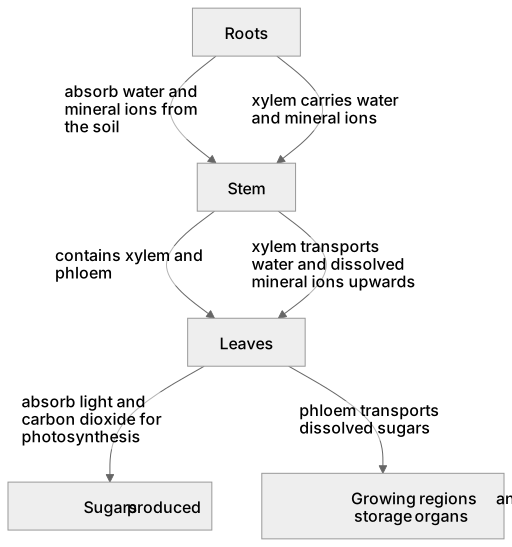
A plant organ system is a group of organs working together to transport substances. Roots absorb water and mineral ions from the soil. The stem contains xylem and phloem and holds the leaves in a position to absorb light. Leaves absorb light and carbon dioxide and carry out photosynthesis, producing sugars that are transported to other parts of the plant. Xylem transports water and dissolved mineral ions from the roots upwards to the stem and leaves. Phloem transports dissolved sugars and other products of photosynthesis from the leaves to growing regions and storage organs. Together these organs form a continuous transport system that connects sources and sinks throughout the plant.
What earns the marks
- Identify roots, stem and leaves as the main organs of the plant transport system and state that they work together.
- Describe the role of roots in absorbing water and mineral ions from the soil.
- Describe the role of the stem in supporting the plant and containing xylem and phloem vessels that carry substances.
- Describe the role of leaves in absorbing light and carbon dioxide for photosynthesis and in producing sugars for transport.
- State that xylem transports water and dissolved mineral ions upwards from roots to leaves.
- State that phloem transports dissolved sugars from leaves to other parts of the plant, including growing regions and storage organs.
Common mistakes and how to put them right
Confusing xylem and phloem.
Put it right: Remember that xylem carries water and mineral ions while phloem carries dissolved sugars.
Thinking that transport occurs only in one direction in all vessels.
Put it right: State that xylem transport is mainly upwards while phloem transport can move substances to different parts of the plant.
Describing the stem as only a support and omitting its transport role.
Put it right: Include the xylem and phloem vessels within the stem.
Stating that leaves absorb water from the soil.
Put it right: State that roots absorb water and leaves absorb light and carbon dioxide.
Exam tips
- Use the phrase 'organ system' and name all three organs when describing transport in a plant.
- Link each organ to its function in one clear sentence, for example roots absorb water, stem transports it, leaves use it.
- When comparing xylem and phloem, state the substance carried and the direction of movement for each.
Try the lesson
The start of the Plant organ system: The roots, stem and leaves form a plant organ system for transport of substances around the plant. lesson, made from checked teaching notes for this specification point.
Have a go first
Which plant organs form the organ system that transports substances around a plant?
Listen
A plant organ system is a group of organs working together to transport substances. Roots absorb water and mineral ions from the soil. The stem contains xylem and phloem and holds the leaves in a position to absorb light. Leaves absorb light and carbon dioxide and carry out photosynthesis, producing sugars that are transported to other parts of the plant. Xylem transports water and dissolved mineral ions from the roots upwards to the stem and leaves. Phloem transports dissolved sugars and other products of photosynthesis from the leaves to growing regions and storage organs. Together these organs form a continuous transport system that connects sources and sinks throughout the plant. A strong answer earns marks for these points. Identify roots, stem and leaves as the main organs of the plant transport system and state that they work together. Describe the role of roots in absorbing water and mineral ions from the soil. Describe the role of the stem in supporting the plant and containing xylem and phloem vessels that carry substances. Describe the role of leaves in absorbing light and carbon dioxide for photosynthesis and in producing sugars for transport. A common slip: Confusing xylem and phloem. Instead, remember that xylem carries water and mineral ions while phloem carries dissolved sugars. Exam tip: Use the phrase 'organ system' and name all three organs when describing transport in a plant.
See it
Key words
Say what each word means before you turn the card.
Plant organ system
Try answering aloud or in your head before turning the card.
Xylem
Try answering aloud or in your head before turning the card.
Phloem
Try answering aloud or in your head before turning the card.
Roots
Try answering aloud or in your head before turning the card.
See every definition
- Plant organ system
- The roots, stem and leaves form a plant organ system for transport of substances around the plant.
- Xylem
- Transports water and dissolved mineral ions from the roots upwards to the stem and leaves.
- Phloem
- Transports dissolved sugars and other products of photosynthesis from the leaves to growing regions and storage organs.
- Roots
- Absorb water and mineral ions from the soil.
Label the diagram
Some boxes have lost their names. Pick the right name for each number.
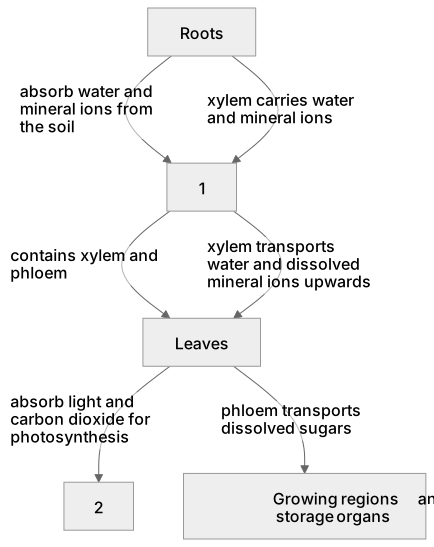
1Box 1
2Box 2
There is more to this lesson
The full lesson goes on to check your understanding and help you earn the marks. Create a free account to carry on, with your progress saved.
A week of Premium from your first lesson · Then the free plan continues · No card, no charge
Test your understanding of Plant organ system: The roots, stem and leaves form a plant organ system for transport of substances around the plant.
Active recall beats re-reading. Take an instant quiz now to test what you’ve learned and lock it into long-term memory.
A week of Premium from your first lesson · Then the free plan continues · No card, no charge