AQA · GCSE · Biology
Course version: 8461 · Version from Sept 2018
(HT only) These factors interact and any one of them may be the factor…
Full specification wording
Rate of photosynthesis: (HT only) These factors interact and any one of them may be the factor that limits photosynthesis.
In higher tier, you must understand that light intensity, carbon dioxide concentration, temperature and chlorophyll amount do not act in isolation.
Checked against the AQA 8461 specification (opens in a new tab) on .
- Point 3 of 9
- 4 key terms
Study notes
From the checked teaching notes for this specification point.
The idea
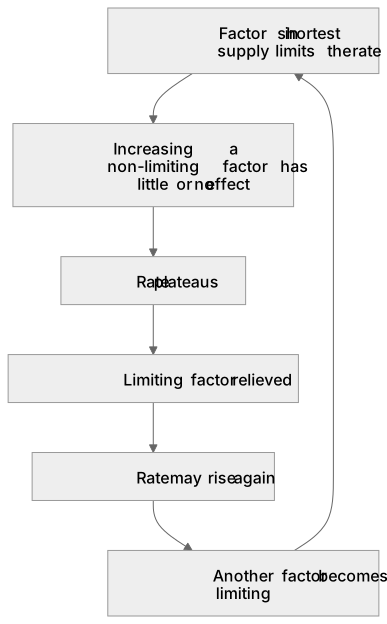
In higher tier, you must understand that light intensity, carbon dioxide concentration, temperature and chlorophyll amount do not act in isolation. At any moment, the factor in shortest supply limits the rate, and changing other factors has little effect until that limiting factor is relieved. For example, if carbon dioxide is limiting, increasing light intensity will not raise the rate further; the graph plateaus. If carbon dioxide is then increased, the rate may rise again until another factor, such as temperature, becomes limiting. Explaining these interactions requires linking each factor to its biological role and using the limiting factor concept to account for plateaus and changes in gradient.
What earns the marks
- State that the factor in shortest supply limits the rate of photosynthesis at any given time.
- Explain that increasing a non-limiting factor has little or no effect on the rate until the limiting factor is relieved.
- Describe interactions, for example that raising carbon dioxide concentration can increase the rate until temperature or light becomes limiting.
- Use the limiting factor concept to explain plateaus and changes in the gradient of rate graphs.
Common mistakes and how to put them right
Claiming that all factors affect the rate equally at all times.
Put it right: Only the factor in shortest supply limits the rate.
Saying that increasing light intensity always increases the rate.
Put it right: It only does so if light is the limiting factor.
Stating that increasing temperature relieves a carbon dioxide limitation.
Put it right: Only increasing carbon dioxide can relieve a carbon dioxide limitation.
Exam tips
- Use the phrase 'the factor in shortest supply' when defining the limiting factor.
- When explaining a plateau, name the limiting factor and say what would happen if it were increased.
- Link each factor to its role, such as carbon dioxide as a reactant or temperature as affecting enzymes.
Try the lesson
The start of the Rate of photosynthesis: (HT only) These factors interact and any one of them may be the factor that limits photosynthesis. lesson, made from checked teaching notes for this specification point.
Have a go first
In an investigation, the rate of photosynthesis increases when carbon dioxide concentration is raised, but only when the temperature is also increased. What does this show about limiting factors?
Listen
In higher tier, you must understand that light intensity, carbon dioxide concentration, temperature and chlorophyll amount do not act in isolation. At any moment, the factor in shortest supply limits the rate, and changing other factors has little effect until that limiting factor is relieved. For example, if carbon dioxide is limiting, increasing light intensity will not raise the rate further; the graph plateaus. If carbon dioxide is then increased, the rate may rise again until another factor, such as temperature, becomes limiting. Explaining these interactions requires linking each factor to its biological role and using the limiting factor concept to account for plateaus and changes in gradient. A strong answer earns marks for these points. State that the factor in shortest supply limits the rate of photosynthesis at any given time. Explain that increasing a non-limiting factor has little or no effect on the rate until the limiting factor is relieved. Describe interactions, for example that raising carbon dioxide concentration can increase the rate until temperature or light becomes limiting. Use the limiting factor concept to explain plateaus and changes in the gradient of rate graphs. A common slip: Claiming that all factors affect the rate equally at all times. Instead, only the factor in shortest supply limits the rate. Exam tip: Use the phrase 'the factor in shortest supply' when defining the limiting factor.
See it
Key words
Say what each word means before you turn the card.
Limiting factors
Try answering aloud or in your head before turning the card.
Factor interactions
Try answering aloud or in your head before turning the card.
Graph interpretation
Try answering aloud or in your head before turning the card.
Enzyme activity
Try answering aloud or in your head before turning the card.
See every definition
- Limiting factors
- The factor in shortest supply limits the rate of photosynthesis at any given time.
- Factor interactions
- Increasing a non-limiting factor has little or no effect on the rate until the limiting factor is relieved.
- Graph interpretation
- The limiting factor concept explains plateaus and changes in the gradient of rate graphs.
- Enzyme activity
- Temperature is linked to its role as affecting enzymes.
Label the diagram
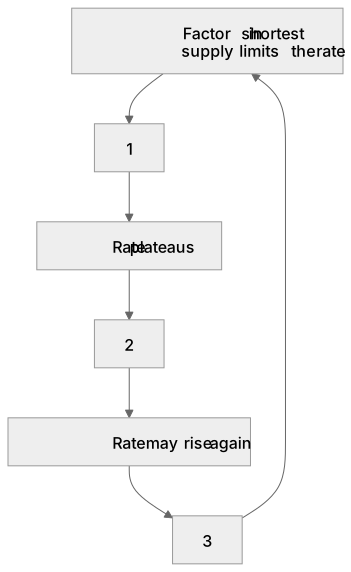
Some boxes have lost their names. Pick the right name for each number.
1Box 1
2Box 2
3Box 3
There is more to this lesson
The full lesson goes on to check your understanding and help you earn the marks. Create a free account to carry on, with your progress saved.
A week of Premium from your first lesson · Then the free plan continues · No card, no charge
Test your understanding of Rate of photosynthesis: (HT only) These factors interact and any one of them may be the factor that limits photosynthesis.
Active recall beats re-reading. Take an instant quiz now to test what you’ve learned and lock it into long-term memory.
A week of Premium from your first lesson · Then the free plan continues · No card, no charge