AQA · GCSE · Biology
Course version: 8461 · Version from Sept 2018
The fungus Fusarium is useful for producing mycoprotein, a protein-rich…
Full specification wording
Role of biotechnology: The fungus Fusarium is useful for producing mycoprotein, a protein-rich food suitable for vegetarians.
Fusarium is a filamentous fungus that can be grown industrially to produce mycoprotein.
Checked against the AQA 8461 specification (opens in a new tab) on .
- Point 3 of 6
- 3 key terms
Study notes
From the checked teaching notes for this specification point.
The idea
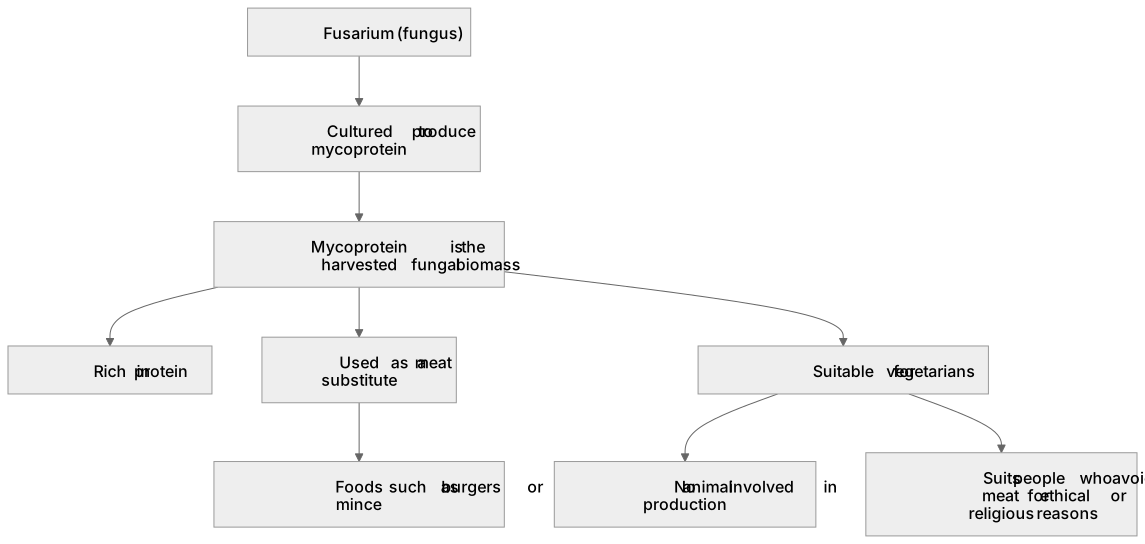
Fusarium is a filamentous fungus that can be grown industrially to produce mycoprotein. Mycoprotein is the fungal biomass itself, harvested and purified, and it contains a high proportion of protein together with fibre and little fat. It is used as a meat substitute in foods such as burgers, mince and nuggets. Because it is produced from a fungus rather than from an animal, it is suitable for vegetarians and can be eaten by people who avoid meat for religious or ethical reasons. Growing Fusarium is also efficient: it multiplies rapidly on a cheap sugar substrate and can be produced all year round in a fermenter. The skill is to identify Fusarium as the organism, mycoprotein as the product and to explain why the product suits particular diets.
What earns the marks
- Fusarium is a fungus that can be cultured to produce mycoprotein.
- Mycoprotein is the harvested fungal biomass and is rich in protein.
Common mistakes and how to put them right
Confusing Fusarium with a bacterium.
Put it right: Fusarium is a fungus, whereas bacteria are used in other biotechnology processes such as insulin production.
Thinking mycoprotein is extracted from the fungus as a separate chemical.
Put it right: Mycoprotein is the fungal biomass itself, harvested and purified.
Claiming mycoprotein is suitable for everyone.
Put it right: It is suitable for vegetarians, but individuals with allergies or other dietary needs should check suitability.
Exam tips
- Name both the organism and the product clearly: Fusarium produces mycoprotein.
- Give a specific food example, such as mycoprotein mince, to show understanding of its use.
- Explain the vegetarian link by stating that no animal is involved in production.
Try the lesson
The start of the Role of biotechnology: The fungus Fusarium is useful for producing mycoprotein, a protein-rich food suitable for vegetarians. lesson, made from checked teaching notes for this specification point.
Have a go first
Which microorganism is cultured to produce mycoprotein?
Listen
Fusarium is a filamentous fungus that can be grown industrially to produce mycoprotein. Mycoprotein is the fungal biomass itself, harvested and purified, and it contains a high proportion of protein together with fibre and little fat. It is used as a meat substitute in foods such as burgers, mince and nuggets. Because it is produced from a fungus rather than from an animal, it is suitable for vegetarians and can be eaten by people who avoid meat for religious or ethical reasons. Growing Fusarium is also efficient: it multiplies rapidly on a cheap sugar substrate and can be produced all year round in a fermenter. The skill is to identify Fusarium as the organism, mycoprotein as the product and to explain why the product suits particular diets. A strong answer earns marks for these points. Fusarium is a fungus that can be cultured to produce mycoprotein. Mycoprotein is the harvested fungal biomass and is rich in protein. A common slip: Confusing Fusarium with a bacterium. Instead, Fusarium is a fungus, whereas bacteria are used in other biotechnology processes such as insulin production. Exam tip: Name both the organism and the product clearly: Fusarium produces mycoprotein.
See it
Key words
Say what each word means before you turn the card.
Fusarium
Try answering aloud or in your head before turning the card.
Mycoprotein
Try answering aloud or in your head before turning the card.
Meat substitute
Try answering aloud or in your head before turning the card.
See every definition
- Fusarium
- A filamentous fungus that can be grown industrially and cultured to produce mycoprotein.
- Mycoprotein
- The harvested and purified fungal biomass itself, rich in protein with fibre and little fat.
- Meat substitute
- A food such as burgers, mince or nuggets in which mycoprotein is used in place of meat.
Label the diagram
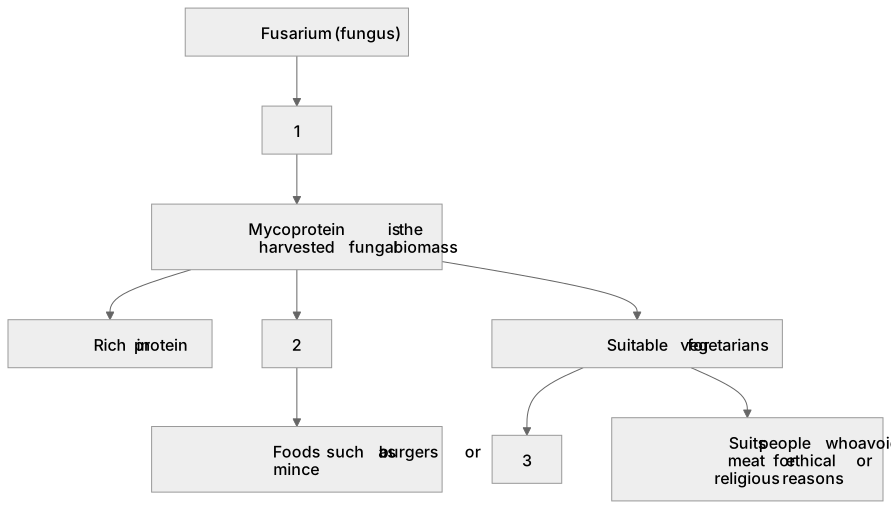
Some boxes have lost their names. Pick the right name for each number.
1Box 1
2Box 2
3Box 3
There is more to this lesson
The full lesson goes on to check your understanding and help you earn the marks. Create a free account to carry on, with your progress saved.
A week of Premium from your first lesson · Then the free plan continues · No card, no charge
Test your understanding of Role of biotechnology: The fungus Fusarium is useful for producing mycoprotein, a protein-rich food suitable for vegetarians.
Active recall beats re-reading. Take an instant quiz now to test what you’ve learned and lock it into long-term memory.
A week of Premium from your first lesson · Then the free plan continues · No card, no charge