AQA · GCSE · Biology
Course version: 8461 · Version from Sept 2018
In therapeutic cloning an embryo is produced with the same genes as the…
Full specification wording
Stem cells: In therapeutic cloning an embryo is produced with the same genes as the patient.
Therapeutic cloning is a technique that produces an embryo genetically identical to a patient.
Checked against the AQA 8461 specification (opens in a new tab) on .
- Point 7 of 11
- 4 key terms
Study notes
From the checked teaching notes for this specification point.
The idea
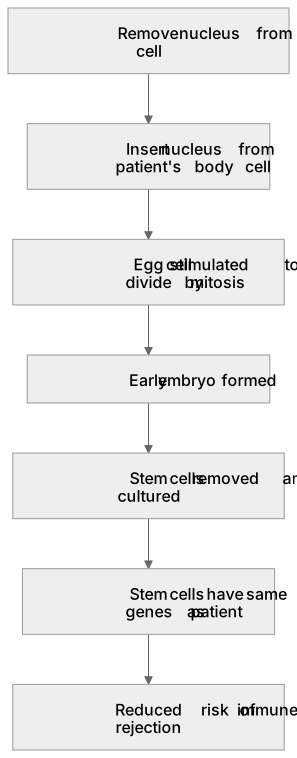
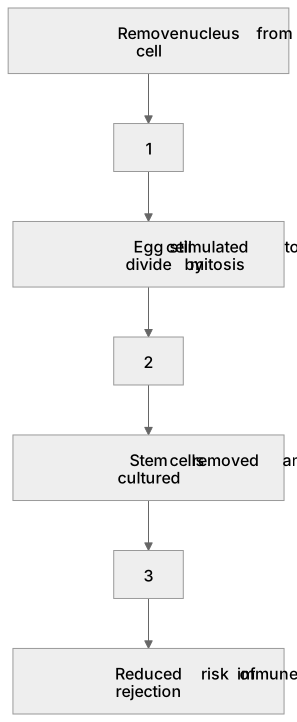
Therapeutic cloning is a technique that produces an embryo genetically identical to a patient. The nucleus is removed from an egg cell, and a nucleus from one of the patient's body cells is inserted into the empty egg cell. The egg cell is stimulated to divide by mitosis, forming an early embryo. Stem cells are then removed from this embryo and cultured. Because the embryo's genes came from the patient, the stem cells have the same genes as the patient. This reduces the risk that the patient's immune system will reject the transplanted cells. The embryo is not allowed to develop into a baby; it is used as a source of stem cells for treatment.
What earns the marks
- Define therapeutic cloning as a method of producing an embryo with the same genes as the patient.
- Describe removing the nucleus from an egg cell.
- Describe inserting a nucleus from a patient's body cell into the egg cell.
- State that the egg cell divides by mitosis to form an early embryo.
- Explain that stem cells from the embryo have the same genes as the patient, reducing the chance of immune rejection.
Common mistakes and how to put them right
Saying the embryo is produced from the patient's sperm and egg.
Put it right by describing the transfer of a body cell nucleus into an egg cell whose nucleus has been removed.
Confusing therapeutic cloning with reproductive cloning.
Put it right by stating that the embryo is used as a source of stem cells, not implanted to produce a baby.
Claiming the embryo has half the patient's genes.
Put it right by explaining that the embryo has the same genes as the patient because its nucleus came from the patient.
Exam tips
- Sequence the steps clearly: remove egg nucleus, insert patient nucleus, stimulate division, collect stem cells.
- Use the phrase same genes as the patient when explaining why rejection is less likely.
- Distinguish therapeutic cloning from reproductive cloning if the question asks for a comparison.
Try the lesson
The start of the Stem cells: In therapeutic cloning an embryo is produced with the same genes as the patient. lesson, made from checked teaching notes for this specification point.
Have a go first
In therapeutic cloning, the embryo that is produced has the same genes as which person?
Listen
Therapeutic cloning is a technique that produces an embryo genetically identical to a patient. The nucleus is removed from an egg cell, and a nucleus from one of the patient's body cells is inserted into the empty egg cell. The egg cell is stimulated to divide by mitosis, forming an early embryo. Stem cells are then removed from this embryo and cultured. Because the embryo's genes came from the patient, the stem cells have the same genes as the patient. This reduces the risk that the patient's immune system will reject the transplanted cells. The embryo is not allowed to develop into a baby; it is used as a source of stem cells for treatment. A strong answer earns marks for these points. Define therapeutic cloning as a method of producing an embryo with the same genes as the patient. Describe removing the nucleus from an egg cell. Describe inserting a nucleus from a patient's body cell into the egg cell. State that the egg cell divides by mitosis to form an early embryo. A common slip: Saying the embryo is produced from the patient's sperm and egg. Instead, describing the transfer of a body cell nucleus into an egg cell whose nucleus has been removed. Exam tip: Sequence the steps clearly: remove egg nucleus, insert patient nucleus, stimulate division, collect stem cells.
See it
Put it in order
Put these steps in the order they happen.
- 1. Reduced risk of immune rejection
- 2. Stem cells have same genes as patient
- 3. Egg cell stimulated to divide by mitosis
- 4. Stem cells removed and cultured
- 5. Remove nucleus from egg cell
- 6. Insert nucleus from patient's body cell
- 7. Early embryo formed
Watch it explained
What is the one idea the video explains? Say it in a sentence.
Read the described scene instead
Therapeutic cloning is a technique that produces an embryo genetically identical to a patient. The embryo is made so that its genes match the patient. This lesson explains how the embryo is made and how its stem cells can be used. First, the nucleus is removed from an egg cell. This leaves an empty egg cell. Next, a nucleus from one of the patient's body cells is inserted into the empty egg cell. The egg cell is then stimulated to divide by mitosis, forming an early embryo. The early embryo is a source of stem cells. Stem cells are removed from the embryo and cultured. The embryo is not allowed to develop into a baby. It is used as a source of stem cells for treatment. Because the embryo's genes came from the patient, the stem cells have the same genes as the patient. This reduces the risk that the patient's immune system will reject the transplanted cells. The stem cells are therefore a close genetic match to the patient. Do not say the embryo is made from the patient's sperm and egg. The method transfers a body cell nucleus into an egg cell whose nucleus has been removed. Do not confuse therapeutic cloning with reproductive cloning. The embryo is used as a source of stem cells, not implanted to produce a baby. Also, the embryo does not have half the patient's genes; it has the same genes as the patient. In summary, therapeutic cloning removes an egg cell nucleus and inserts a patient's body cell nucleus. The egg cell divides by mitosis to form an early embryo. Stem cells are removed and cultured. Because their genes match the patient, immune rejection is less likely. The embryo is not allowed to develop into a baby; it is used for stem cell treatment.
Key words
Say what each word means before you turn the card.
Therapeutic cloning
Try answering aloud or in your head before turning the card.
Cell nucleus transfer
Try answering aloud or in your head before turning the card.
Stem cells and immune rejection
Try answering aloud or in your head before turning the card.
Ethics of embryo use
Try answering aloud or in your head before turning the card.
See every definition
- Therapeutic cloning
- A method of producing an embryo with the same genes as the patient, used as a source of stem cells for treatment.
- Cell nucleus transfer
- The nucleus is removed from an egg cell, and a nucleus from one of the patient's body cells is inserted into the empty egg cell.
- Stem cells and immune rejection
- Because the embryo's genes came from the patient, the stem cells have the same genes as the patient, reducing the risk that the immune system will reject the transplanted cells.
- Ethics of embryo use
- The embryo is not allowed to develop into a baby; it is used as a source of stem cells for treatment.
Label the diagram
Some boxes have lost their names. Pick the right name for each number.
1Box 1
2Box 2
3Box 3
There is more to this lesson
The full lesson goes on to check your understanding and help you earn the marks. Create a free account to carry on, with your progress saved.
A week of Premium from your first lesson · Then the free plan continues · No card, no charge
Test your understanding of Stem cells: In therapeutic cloning an embryo is produced with the same genes as the patient.
Active recall beats re-reading. Take an instant quiz now to test what you’ve learned and lock it into long-term memory.
A week of Premium from your first lesson · Then the free plan continues · No card, no charge