AQA · GCSE · Biology
Course version: 8461 · Version from Sept 2018
Stem cells from meristems in plants can be used to produce clones of…
Full specification wording
Stem cells: Stem cells from meristems in plants can be used to produce clones of plants quickly and economically.
Meristems are regions of a plant where unspecialised cells divide rapidly, for example at the tips of roots and shoots.
Checked against the AQA 8461 specification (opens in a new tab) on .
- Point 10 of 11
- 3 key terms
Study notes
From the checked teaching notes for this specification point.
The idea
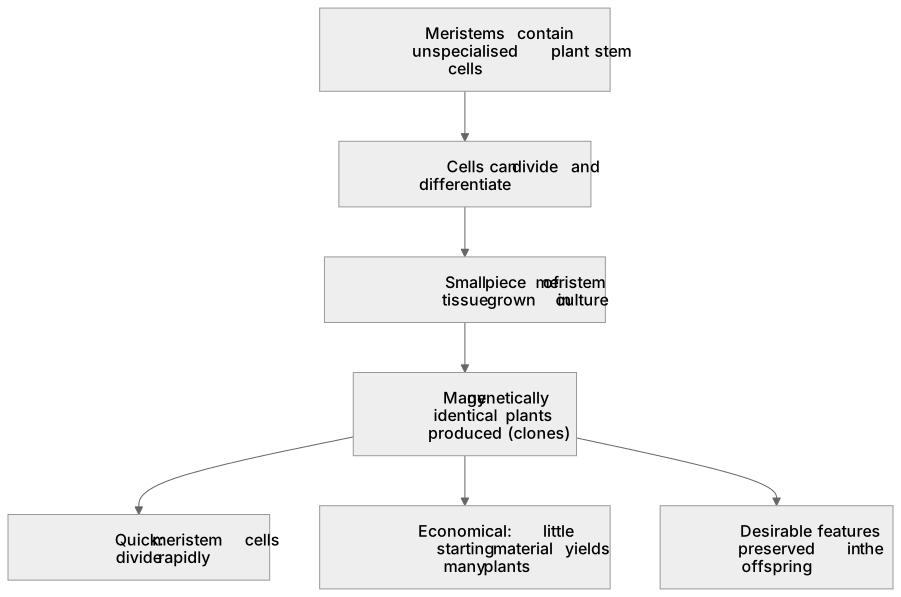
Meristems are regions of a plant where unspecialised cells divide rapidly, for example at the tips of roots and shoots. These cells are plant stem cells. Because they can divide and differentiate into any plant cell type, a small piece of meristem tissue can be grown in culture to produce many genetically identical plants, called clones. The process is quick because meristem cells divide rapidly, and it is economical because a large number of plants can be produced from a small amount of starting material in a controlled space. Growers can use this to multiply a plant with desirable features, such as disease resistance or high yield, without waiting for seeds. The statement links the source of the cells, the method of cloning, and the advantages of speed and low cost.
What earns the marks
- Meristems contain unspecialised plant stem cells that can divide and differentiate.
- Meristem cells can be grown in culture to produce genetically identical plants, which are clones.
- The process is quick because meristem cells divide rapidly and many plants can be produced in a short time.
- The process is economical because a small amount of starting tissue can yield many plants, saving money and space.
- Cloning plants in this way allows desirable features to be preserved in the offspring.
Common mistakes and how to put them right
Confusing meristems with gametes.
Put it right by stating that meristems are regions of unspecialised dividing cells, not sex cells.
Saying cloned plants are genetically different.
Put it right by stating that clones are genetically identical to the parent plant.
Giving only one advantage.
Put it right by explaining both the speed and the economic benefit.
Exam tips
- Name the plant tissue as meristem and describe its cells as unspecialised and dividing.
- Use the word clone correctly to mean a genetically identical organism.
- Link each advantage to a reason, for example quick because cells divide rapidly, economical because little starting material is needed.
Try the lesson
The start of the Stem cells: Stem cells from meristems in plants can be used to produce clones of plants quickly and economically. lesson, made from checked teaching notes for this specification point.
Have a go first
Which part of a plant contains the stem cells that can be used to produce clones quickly and economically?
Listen
Meristems are regions of a plant where unspecialised cells divide rapidly, for example at the tips of roots and shoots. These cells are plant stem cells. Because they can divide and differentiate into any plant cell type, a small piece of meristem tissue can be grown in culture to produce many genetically identical plants, called clones. The process is quick because meristem cells divide rapidly, and it is economical because a large number of plants can be produced from a small amount of starting material in a controlled space. Growers can use this to multiply a plant with desirable features, such as disease resistance or high yield, without waiting for seeds. The statement links the source of the cells, the method of cloning, and the advantages of speed and low cost. A strong answer earns marks for these points. Meristems contain unspecialised plant stem cells that can divide and differentiate. Meristem cells can be grown in culture to produce genetically identical plants, which are clones. The process is quick because meristem cells divide rapidly and many plants can be produced in a short time. The process is economical because a small amount of starting tissue can yield many plants, saving money and space. A common slip: Confusing meristems with gametes. Instead, stating that meristems are regions of unspecialised dividing cells, not sex cells. Exam tip: Name the plant tissue as meristem and describe its cells as unspecialised and dividing.
See it
Key words
Say what each word means before you turn the card.
Meristems
Try answering aloud or in your head before turning the card.
Plant stem cells
Try answering aloud or in your head before turning the card.
Clones
Try answering aloud or in your head before turning the card.
See every definition
- Meristems
- Regions of a plant where unspecialised cells divide rapidly, for example at the tips of roots and shoots.
- Plant stem cells
- Unspecialised cells in meristems that can divide and differentiate into any plant cell type.
- Clones
- Genetically identical plants produced by growing a small piece of meristem tissue in culture.
Label the diagram
Some boxes have lost their names. Pick the right name for each number.
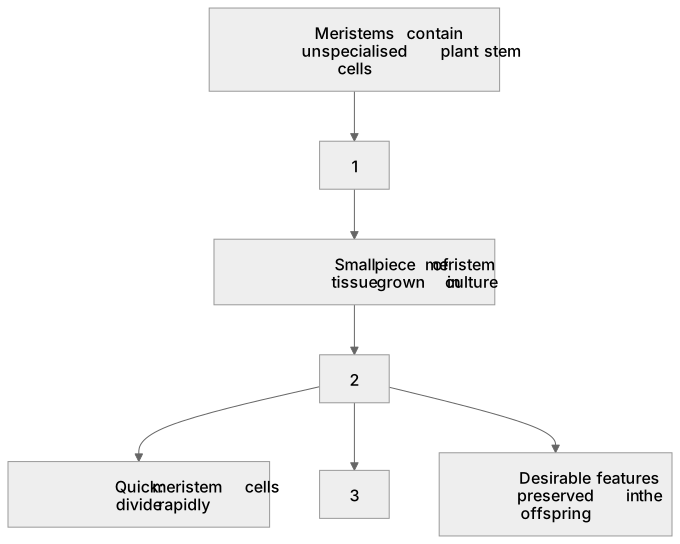
1Box 1
2Box 2
3Box 3
There is more to this lesson
The full lesson goes on to check your understanding and help you earn the marks. Create a free account to carry on, with your progress saved.
A week of Premium from your first lesson · Then the free plan continues · No card, no charge
Test your understanding of Stem cells: Stem cells from meristems in plants can be used to produce clones of plants quickly and economically.
Active recall beats re-reading. Take an instant quiz now to test what you’ve learned and lock it into long-term memory.
A week of Premium from your first lesson · Then the free plan continues · No card, no charge