AQA · GCSE · Biology
Course version: 8461 · Version from Sept 2018
Many diseases are caused by the interaction of a number of factors.
Full specification wording
The effect of lifestyle on some non-communicable diseases: Many diseases are caused by the interaction of a number of factors.
Non-communicable diseases often arise from several interacting factors rather than a single cause.
Checked against the AQA 8461 specification (opens in a new tab) on .
- Point 6 of 9
- 4 key terms
Study notes
From the checked teaching notes for this specification point.
The idea
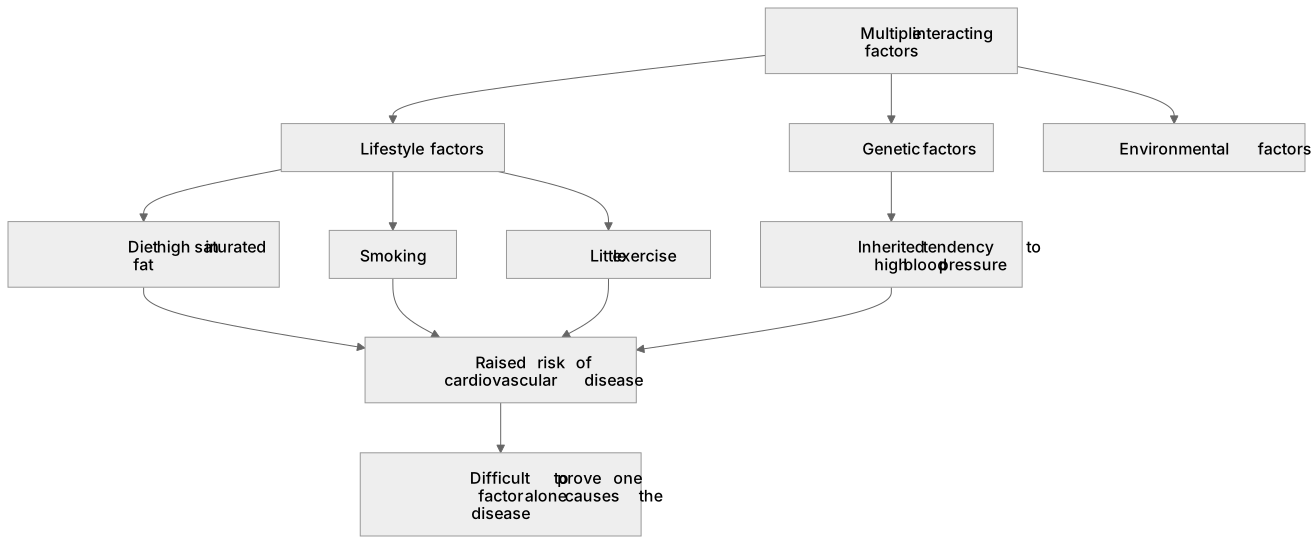
Non-communicable diseases often arise from several interacting factors rather than a single cause. These factors can include genetics, lifestyle choices and environmental exposures. For example, a person may inherit a tendency towards high blood pressure, eat a diet high in saturated fat, smoke and take little exercise; together these raise the risk of cardiovascular disease more than any one factor alone. Similarly, Type 2 diabetes risk can involve obesity, diet, physical activity and family history. Because factors interact, it is difficult to prove that one factor alone causes a disease.
What earns the marks
- State that many non-communicable diseases have multiple contributing factors rather than one single cause.
- Identify categories of interacting factors, such as genetic, lifestyle and environmental influences.
- Give a named example, such as cardiovascular disease, where diet, smoking, exercise and genetics interact.
- Explain that interacting factors can increase risk more than any single factor alone.
- Explain why multiple factors make it difficult to prove a single causal mechanism.
Common mistakes and how to put them right
Attributing a disease to one factor only.
Put it right by describing at least two interacting factors.
Assuming that factors simply add up.
Put it right by explaining that they can interact and multiply risk.
Ignoring genetic factors; correct this by including inherited tendencies alongside lifestyle and environment.
Exam tips
- Use the word 'interaction' and give a specific disease with at least two factors.
- Structure your answer by naming the disease, then the factors, then how they combine.
- Explain why proving one cause is difficult when several factors are involved.
Try the lesson
The start of the The effect of lifestyle on some non-communicable diseases: Many diseases are caused by the interaction of a number of factors. lesson, made from checked teaching notes for this specification point.
Have a go first
Which statement best describes why many non-communicable diseases, such as cardiovascular disease, develop?
Listen
Non-communicable diseases often arise from several interacting factors rather than a single cause. These factors can include genetics, lifestyle choices and environmental exposures. For example, a person may inherit a tendency towards high blood pressure, eat a diet high in saturated fat, smoke and take little exercise; together these raise the risk of cardiovascular disease more than any one factor alone. Similarly, Type 2 diabetes risk can involve obesity, diet, physical activity and family history. Because factors interact, it is difficult to prove that one factor alone causes a disease. A strong answer earns marks for these points. State that many non-communicable diseases have multiple contributing factors rather than one single cause. Identify categories of interacting factors, such as genetic, lifestyle and environmental influences. Give a named example, such as cardiovascular disease, where diet, smoking, exercise and genetics interact. Explain that interacting factors can increase risk more than any single factor alone. A common slip: Attributing a disease to one factor only. Instead, describing at least two interacting factors. Exam tip: Use the word 'interaction' and give a specific disease with at least two factors.
See it
Key words
Say what each word means before you turn the card.
Multifactorial disease causation
Try answering aloud or in your head before turning the card.
Interaction of genetics, lifestyle and environment
Try answering aloud or in your head before turning the card.
Risk assessment and prevention
Try answering aloud or in your head before turning the card.
Scientific evidence and causation
Try answering aloud or in your head before turning the card.
See every definition
- Multifactorial disease causation
- Many diseases are caused by the interaction of a number of factors rather than a single cause.
- Interaction of genetics, lifestyle and environment
- Factors that can interact include genetics, lifestyle choices and environmental exposures, and together these can raise risk more than any one factor alone.
- Risk assessment and prevention
- Because factors interact, disease prevention is complex, and interacting factors can increase risk more than any single factor alone.
- Scientific evidence and causation
- Because factors interact, it is difficult to prove that one factor alone causes a disease, which makes causal proof complex.
Label the diagram
Some boxes have lost their names. Pick the right name for each number.
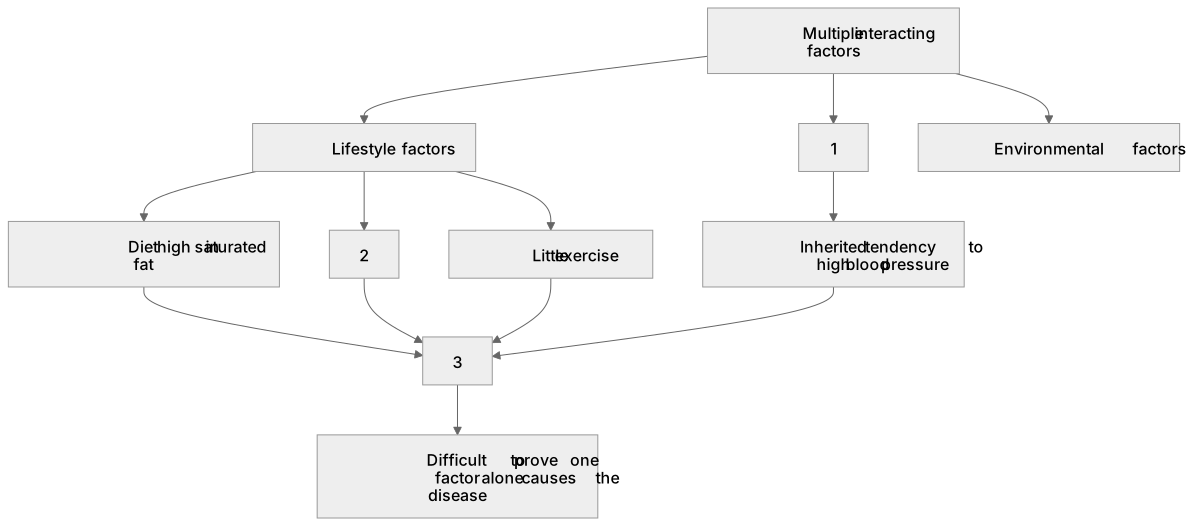
1Box 1
2Box 2
3Box 3
There is more to this lesson
The full lesson goes on to check your understanding and help you earn the marks. Create a free account to carry on, with your progress saved.
A week of Premium from your first lesson · Then the free plan continues · No card, no charge
Test your understanding of The effect of lifestyle on some non-communicable diseases: Many diseases are caused by the interaction of a number of factors.
Active recall beats re-reading. Take an instant quiz now to test what you’ve learned and lock it into long-term memory.
A week of Premium from your first lesson · Then the free plan continues · No card, no charge